Home Blog Page 55

Significant healthcare disparities in Canadian society for Indigenous women

0

After a history of racism, colonization, and oppression that the Indigenous Peoples of Canada have been through, they continue to face the same problems of systemic racism in current society. This systemic racism is especially evident in Canada’s healthcare system. Indigenous people, especially Indigenous women, have a harder time accessing healthcare treatments when it comes to pregnancy. They have also reported being treated differently by healthcare professionals based on their race.

Researchers at the Public Health Agency of Canada recently conducted a survey in August 2023 to measure the differences in accessing healthcare between Indigenous and non-Indigenous women. Using data from the Canadian Community Health Survey, this study found that from 2015 to 2020, 18.6% more non-Indigenous women who were recently or currently pregnant had access to a regular healthcare provider. Compared with non-Indigenous women, 14.2 percent fewer Indigenous women said they had a place to go for immediate, non-urgent care in urban and rural areas. This study, according to many Indigenous leaders and healthcare professionals, was the first to quantify the gaps in healthcare for Indigenous and non-Indigenous women. This study also found that gaps existed across the country, whether in remote or urban locations.

Finding care in Indigenous communities:

Staff shortages hardest hit remote Indigenous communities in healthcare. This leads to many individuals seeking care in urban clinics. This already poses as an obstacle as many communities do not have assigned medical transportation. Once Indigenous women reach the urban clinics, many have reported facing language barriers. A lack of staff who speak languages like Cree or Dene makes many Indigenous women feel unsure of what treatment(s) they are agreeing to. In addition, patients face discrimination regularly. They also receive a lot of judgment based on racist stereotypes associated with Indigenous communities. Due to these reasons, the lack of representation of Indigenous staff, and the lack of Indigenous healing methods and other culturally safe resources being offered as a treatment, many Indigenous women and their families have distrusted the Canadian healthcare system.

Positive experiences in Indigenous-led clinics:

The participants enrolled in the survey also shared positive experiences when seeking care in an Indigenous-led clinic. For example, an urban Indigenous-led clinic in Vancouver called the Kilala Lelum Health Center provides culturally safe and trauma-informed care for patients. This clinic provided support that was not available in other clinics, such as addressing the needs of Indigenous individuals who were facing homelessness by not only providing healthcare but also helping them find stable housing.

Next steps to this study:

According to Cheryl Whiskeyjack, executive director of the Bent Arrow Traditional Healing Society in Edmonton, it is important to start talking to people in medical school and nursing school to have more representation of Indigenous approaches to healthcare and medicine. According to Sebastian Srugo who was one of the lead authors of this survey studying gaps in healthcare between Indigenous and non-Indigenous women, the next step is to write up a plain-language version of the text to make it accessible to more people, and after that comes more research.

It is important to understand and educate ourselves on the obstacles that minority groups in Canadian society face in accessing necessities of life such as healthcare. Here are sources for deeper reading and further understanding of this topic.

Sources:

https://www.cbc.ca/news/health/indigenous-women-health-care-inequities-1.6949274

https://www.cmaj.ca/content/195/33/E1097

Part 2: How to Decide on a Post-Secondary Institution 

Hello, and welcome to Part 2–deciding on a post-secondary institution! This is a 2-part series–Part 1 was on Tips on Picking a Post-secondary Program. To preface, there are many different paths you can take after high school – including apprenticeships, studying abroad, and more – this blog post will only be covering one of those paths. For the content of this blog post, I’m exploring factors to consider when picking a post-secondary institution. Please enjoy!

Factors to Consider:

  1. Cost

    1. Tuition, fees, textbooks, residence, living expenses on food, clothing, entertainment, wifi, etc. 
    2. Tip: Use budget calculators to help you plan
      1. Student Budget Calculator | CIBC
      2. Student Budget Calculator | TD Canada Trust
      3. Personal budget calculators – UNI Financial Cooperation
    3. Is residence guaranteed in your first year?
    4. Are there financial aid options?
    5. What scholarships and bursaries can you apply for? 
  2. Career

    1. What would you like to do after getting a degree– working, Masters degree, programs?
    2. Does this institution offer programs you want to study? What are the quality of these programs?
    3. Does this institution offer research facilities, prestigious sports teams, extensive libraries, etc.? Are you interested in what they offer?
  3. Admission Requirements and Graduation Rates

    1. What grades are needed to apply to this institution? 
    2. What are the graduation rates for this institution? 
    3. What are the demographics?
    4. Helpful websites to answer these questions: 
      1. College Board
      2. Appily.com
  4. Campus Environment:

    1. Although the career path and degree that you get is important, so is the environment you spend your time in. Consider the following: 
    2. What is the city like around campus?
    3. Consider the extracurricular activities that are available – sports, clubs, student council, etc. 
    4. What is the size of the school? Do you have a preference?
    5. Are their resources and support systems for your mental and physical health? Will these resources actually help you?
  5. Miscellaneous: 

    1. How far is the university from home? Does this factor into your decision?
    2. Ask students who have attended the institution about their experiences– what would they recommend and what’s it like.
    3. Talk with friends, family, guidance counselors to get different opinions 

To end off this post, a reminder that choosing a post-secondary institution can be a long process, but an important one. It’s a decision that needs to be considered from all angles – so take the time and effort to research and learn about your options. Regardless of what others think or do, this is a decision that should be made out of your best interest and what you want. As always, thank you for reading and have a great day!

Sources: 

The Dancing Lights

0

Have you ever heard of the Dancing Lights of Nature? They are the ones that illuminate dark night skies, replacing them with an array of vibrant colors, leaving those who witness them either awestruck or inspired. This captivating phenomenon has not only influenced modern-day scientific theories but has also become a part of ancient studies and myths. Altogether, enchanting the locals of the north with its mesmerizing dances. If you haven’t figured it out already, I am describing the Aurora Borealis. Since they are a rarity in the north. They can only be seen during the autumn and winter seasons, prompting more and more people to travel just to witness the breathtaking Northern Lights.

As a Calgarian, I consider myself very lucky to have seen these enchanting light shows numerous times. Being a night owl has made gazing at them even more enjoyable. The ubiquity of the patterns captures all my attention, easing my mind from all stresses. It beautifully demonstrates how nature can transform cold nights with the mere warmth of its magical appearance. The sight reminds me of inner peace and brings me into a state of relaxation. Whether the air around me carries a crisp, cold gust or a soft, chilly breeze, whether the ground is blanketed with thick sheets of snow or scattered patches of ice. The captivating colors diffused by the lights hold no comparison to the scenic beauty of the environment.

How are these mind boggling shows created?

These mystifying lights are created by the formation of massive storms that alter electron and proton particles in the sky, causing them to collide with various gases. This reaction creates tiny bursts of colorful light. Resulting in simultaneous reactions of millions of particles, giving rise to short but spectacular light shows sponsored by nature itself. Expanding over vast surfaces, these lights predominantly display shades of green, with hints of pink, purple, and violet.

It fills my heart with joy to know that I am part of a tiny percentage of people who have actually witnessed the Aurora Borealis. These wonders inspire individuals and ignite the creativity of artists, bringing communities together. As someone deeply connected to this phenomenon, I invite you to join us and experience the magic for yourself!

What we should do to protect the forests

A truly crucial part of Mother Nature

Wild forests are some of the most important ecosystems on planet Earth. Regardless of where they are located, from the coniferous forests here in Canada to the tropical rainforests in the Brazilian Amazon Basin, forests do a great deal in providing our world with very specific needs of stability.

It is widely agreed upon that forests not only support hundreds of other plant and animal species but host almost half of all terrestrial species on our planet. The sheer amount of biodiversity in forests compared to other biomes, and the precious oxygen they give to us humans, are sufficient to support the fact that we should do all we can to protect the trees. 

The larger a tree is, the more “influence” it has, on both its surrounding areas of the ecosystem and far-away regions. Even though all forests are crucial for the overall biosphere of our planet, mature forests with large trees (that is, forests that have been given a long period to grow into their current state), are especially important to keeping the world safe and healthy. Forests not only provide homes to a multitude of different animals, but they also contribute to storing carbon, filtering and purifying water passing through, and placing checks against rising temperatures as a part of global warming. 

The destruction of forests

Apart from these natural benefits, forests also serve as wonderful places for travelers to visit and even contribute to extremely positive effects on the mental health of many people. Families, as well as tourist groups, enjoy visiting forests to seek shade from the summer heat. Or, they would admire its beauty and grandeur in the winter, when the whole scenery is covered with snow. All of these would be disrupted, and even made impossible, by the constant and often indifferent reduction of forests, in developing and developed countries alike. 

Many industries around the world, as well as various world governments, default to allowing agricultural, logging, and mining practices to take over the forests’ lush resources and vast land area. However, these acts of deforestation are mostly unsustainable. When the loggers, for example, exhaust all the timber in the forest vicinity, they don’t plant more trees to replace the lost supply. Instead, they open up more areas to harvest wood, without putting focus on the fact that even vast forests can one day disappear, from the extreme pressures put by humans. If we continue the current trend of deforestation, within a few generations, tropical rainforests will completely be erased from the face of this planet. 

What we can do:

Apart from encouraging government officials to advocate for political policies to protect the environment, other ways all of us can help are planting trees, or committing to other volunteering activities involved in conserving nature. Tasks like removing invasive species or doing small community lectures for the general audience also greatly help the cause of forest protection. 

Supporting Non-Profit Organizations, like the TREE Foundation, really helps to conserve a lot of forests, and serve as a fighter to counter a lot of the misuse of forest lands. 

Lastly, buying environmentally sustainable products in the markets goes a long way in demonstrating support to the brands that care about respecting the environment, developing their products sustainably, and not committing acts of wanton in exchange for profit. 

So, with all of this in mind, let us all do our part in protecting the forests, and our planet in general! Remember, this is for us, and all of the future generations to come. 

Navigating Notion

0

Notion is an online organization tool that’s supposed to make your life easier, by helping you manage your time, your schoolwork, and anything else you possibly need to organize. As we get older and our workload increases, managing and organizing everything sometimes becomes our last priority. So maybe you’ve heard of Notion when you were trying to navigate through the millions of tasks you have. At least, that’s how I heard of it. With thoughts of extracurriculars and schoolwork, tests and family gatherings, and everything else that could possibly stress me out on my mind, I felt myself enter the panic mode.

I like to think of our brains as a libraries, with books for memories, tasks and everything else in there. And sometimes, when you’re stressed, you might feel like the once perfectly arranged library of your brain is suddenly all chaos, the books falling and bookshelves crumbling. And that’s when I learned about Notion. It was the perfect tool to organize everything and keep the library from falling. I could have all my tasks and priorities in there, so I knew when to work on what. Everything would be in one place, and I could get it all done on time. And on top of that, it can be incredibly aesthetic and visually pleasing!

But as soon as I clicked the sign up button, I realized that this was going to be much more complicated that I expected. Notion is helpful, but at first it all seems very complex and intimidating. So today I’ve decided to finally give it a try, and I thought I’d share this information with you too so you could learn how to easily navigate notion without all of the confusion.

So let’s get started!

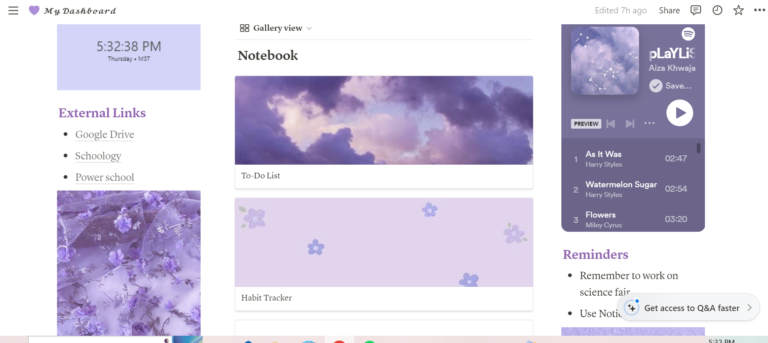
I’m going to show you how to make a Notion dashboard first. This is where everything you need will be, you can have a calendar, to-do lists, and even Spotify connected.

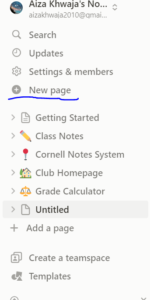
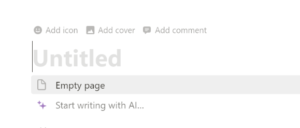
  1. Start by clicking the New Page option on the left side of your Notion

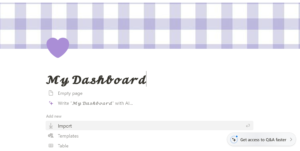
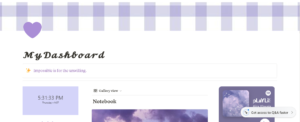
You will probably see options to add and icon and a cover, you can find anything from the web and upload it if you like. If you want to make it aesthetic, pick a color scheme and stick to it. I decided to make mine lavender for the most part.

This is what mine looks like so far.

I used a random aesthetic font copy and paste website online for the font.

2. Then, if you see a lot of options such as import, templates, or table on your page, go ahead and click empty page. I added a quote as the first block on the page, you can add a note too, or if you don’t want one skip to the next step! You just type in a slash and then type in callout. A callout is a grey box with a short note. You can change colors and icons by clicking the six dots to the left of each block.

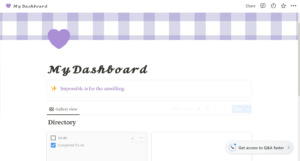
3.  Next, I wanted a place that had all of my other to-do lists, notes, and goal trackers in it. So I typed in slash and typed in gallery view. If you see a pop up that says select data source, click add new database. You can title this whatever you want and edit each of pages too.

3. If you want to add images, you can just copy and paste them from online.

4. If you want to add a to-do list, just type slash and then type to-do list.

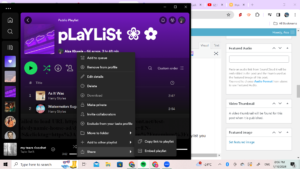
5. To add a Spotify playlist to your notion, just go on to Spotify and select the playlist you want to embed. Then, click on the three dots and click share. Click embed playlist and copy the link.

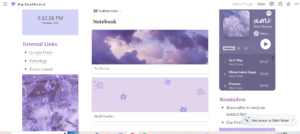
Next, go onto Notion and create a new block (type slash). Type in embed. You will see a pop up where you can paste a link, just paste the Spotify link over there! You can embed almost anything like this onto your Notion page. You can move all of the different blocks around by clicking the six dots on the left of the block, and even put them into columns.

And that is how you make a simple, yet aesthetic Notion spread! This blog post just shows you the basics, but the more you use Notion, the better you will get at it. I hope this helps!

Here’s what my Notion dashboard looks like after I finished:

The future of scorekeeping

For all those parents involved in their child’s sports- we know it can be tough. 

Having the hassle of operating the time clock for your children’s games can sometimes lead to frustration. 

Dallas West is a dad to a 14-year-old daughter who plays ringette and an 11-year-old son who plays hockey. 

West has said that trying to operate the “old console” during the middle of a game, has proved to be ineffective and inefficient. Trying to delete or add a penalty while pushing buttons and while having barely any idea of what you’re doing at the same time can be both frustrating and time-consuming. 

Because operating a complicated time clock during a child’s game has shown to be a stressful task, West decided to come up with a solution. 

“It was really born of people’s frustrations, including my own,” West said. “I thought, hey, I could probably solve this problem.”

Free Hockey Sports photo and picture

“Blitz Sports” is an app that connects a Bluetooth device to the scorekeeping box. Then, through the app, the user can access the scoreboard. This gives the user the option to control the time, shots on the net, and penalties. 

“Nobody likes being in a stressful situation, I just thought I’d make it easy. Now within the app, if you want to delete a penalty, you just push the trashcan. That’s it,” he said.

This hardware can also work on work on scoreboards at schools, for sports such as volleyball and basketball too- which would be very helpful for those scorekeepers out there.

So for all you hockey parents out there, make sure to check out this link:

https://blitzsports.com/

Or to check out our beloved AppStore.

Go Flames!!

Information found from: CTV

Picture Link: 1


Fun Facts About Stars


Wonderful view of a stary night
Photo by Jeremy Thomas on Unsplash

The night sky is always filled with bright stars, especially in rural areas. If you went stargazing, you would’ve realized how incredible the stars in the night sky alone, let alone the moon, comet showers, and planets that are temporarily visible to the naked eye. If not, I strongly recommend stargazing whenever possible because it is an experience you will not forget! Whether you want stargazing or not, it is common to note down that there are many stars in our universe. In more charming words, we can presume that there are a numerous amount of immensely beautiful stars that are observable in the night sky. However, there are also a lot of interesting facts about stars that you may be unaware of. Before you go on your next stargazing, I recommend you remember these fun facts!


1. In the night sky, you can observe things 20 quadrillion miles away!

20 quadrillion miles is an unbelievably big number. In fact, the total distance of circumference of Earth’s equator is approximately 24 901 miles. If you calculate correctly, you would find that 20 quadrillion miles is the same as travelling 24 901 miles 803.2 billion times! This fact may be very interesting, but keep in mind, you can only observe this far on good nights. Meaning: plan your stargazing sessions when it does not seem like it is cloudy or any other obstruction preventing you from seeing that far.

Stars
Image by PayPal.me/FelixMittermeier from Pixabay

2. Every star you see is bigger and brighter than the sun!

This may come as a surprise to some of you, but keep in mind, the sun is the closest star to us than all of the other stars in the entire universe. Because the sun is closest, it would make sense to conclude that it is bigger and brighter than other stars. However, considering the previous fun fact, we can observe stars that are unimaginably far away. Think about it. The earth’s distance from the sun is 1 AU (Astronomical Unit). Now, imagine a star that is 215156003 AU (approximately 20 quadrillion miles) away from our earth. Of course, in order for us to see a star that is that far away from us, that star would have to be incredibly bigger and shining much brighter than our now seemingly pathetic sun (However, never forget that the sun is still the most important star in our solar system).

a close up photo of the bright center of a star cluster
Photo by NASA on Unsplash

3. Red stars are COLDER than blue stars! Blue stars are the HOTTEST!

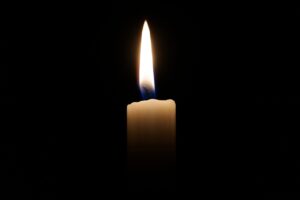
Depending on if you have been taught this in school or not, red is actually the coldest fire. To prove that red (and also orange) are the coldest colors, please observe the the candle picture below.

– Notice how there is a blue color sitting on the base of the candle. That blue color is the hottest part of the flame due to it being more exposed to the oxygen that causes the fire.

A lit candle. The top of the candle's flame is orange and the bottom of the candle's flame (aka the base of the flame) is blue
Image by Andreas Lischka from Pixabay

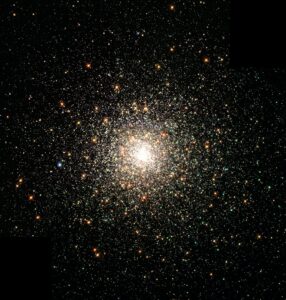
Typically, from our limited everyday experiences, we infer that red flames are hot. However, while they are indeed hot, they are still the coldest color flame to exist. The same logic applies to the temperature of a star: its hottest color is blue and its coldest color is red. All the different color stars you see in the night sky are all in different temperatures. Next time, when you see a barrage of stars painted in a night sky, like in the picture below, remember that blue stars are the hottest!

A barrage of stars painted in the night sky. The barrage comes in a mix of blue, purple, and red stars
Photo by Ryan Hutton on Unsplash


I hope you had fun learning these three interesting facts about stars! I advise that you do not forget any of these the next time you look at the stars in the night sky. Nonetheless, I hope you have a great rest of your day and consider stargazing to end it. Stargazing is always super fun! I strongly recommend it to everyone!

Images: 1 , 2 , 3 , 4 , 5

Sources: 1 , 2

6 Effective Studying Strategies For Students

The Problem

With exam finals coming up, I’m sure that if you’re a student, you have been dreading this period of time for a while. And if you’re like me, you’ve probably heard a lot of reminders from your parents, teachers, and friends that it’s important to study.

However, you probably haven’t heard strategies on how to study. So you just do what you see in movies and on social media – you re-read your notes, read through slideshows and textbooks, and pray for the best.

Long story short: don’t.

My Personal Experience

In middle school I only used passive studying like reading and highlighting. The night before my quiz or unit test, I would try to read over the entire textbook, all of the slideshows, and highlight my notes. And it worked. I might not have retained any of the information after the test, but I got through pretty well. Up until high school, I got perfect grades.

But once high school started, reading and highlighting were no longer enough to help me get through. As a pretty academically focused student, I was devastated when I received a 64% on my first quiz. I knew something had to change, so started using different study strategies. I tried every single one I found on the internet, and there were some that worked, but also a lot that didn’t. But when I eventually discovered the most effective methods of studying, my grades gradually returned to above 95%. So after many late nights of trial and error, here are some strategies that I’ve found which will help you study effectively!

1. Cornell Notes with Review

Cornell notes are a very popular way of taking notes. It is a type of note-organization where you write important concepts in the margins and leave a small space at the bottom to summarize the information in that page. After class or after school, you can go back through your notes and write out the note summaries as a form of review.

I found the Cornell Note Method to be more effective when I turned the important concepts into questions. For example, instead of writing one of the main concepts was “The Greenhouse Effect”, I would turn it into a question like “What is the Greenhouse Effect? Why is it important?” This way, when it was time for review, I could quiz myself on the main concepts using the review questions I came up with while I was taking notes. The answers would be in my notes, and I knew that I was prepared if I could answer all the questions correctly.

2. Feynman Technique

The Feynman technique is also a popular way of reviewing information. It involves learning a concept, closing the textbook, and explaining what you’ve learned to somebody else. This can help you identify gaps in your knowledge and pieces of information that you don’t understand.

This technique is extremely effective if you have family that is willing to listen to you. Understandably, they might have more important things to do. But you can also apply this technique to an inanimate object. Computer scientists call this “the rubber duck technique”, where they try to explain their code line by line to an inanimate object on their desk until they find the error. Similarly, you can use the Feynman technique to teach a stuffed animal the Greenhouse Effect and discover some areas that you might not fully understand while explaining.

Feynman is also particularly for study groups. When studying with a friend, even if you are studying different subjects, you can use the Feynman Technique to review. This benefits both of you – you can identify weaknesses in your knowledge, and your friend will learn something new. So next time a friend asks you for help, think of it as a review strategy and don’t hesitate to lend a hand!

3. Flashcards

Flashcards are one of the most effective ways of basic memorization that I have ever used. While they aren’t very effective for understanding, if you need to learn terminology, historical names, or historical dates, flashcards are the way to go. Although there are many different online flashcard resources such as Quizlet and Cram, I like to use physical flashcards because I don’t want to be distracted by social media or tempted to play games on my phone. I also learn a lot of the ideas while creating the cards.

A few years ago, I had a music theory exam where I needed to know hundreds of musical terms. I made flashcards for each one of them, and reviewed the stack every morning and afternoon on the bus ride to school. Over a few weeks, I memorized an entire glossary of musical terms.

Keep in mind that flashcards are best used when you are memorizing basic ideas. Unless you’re cramming in information last-minute, it’s best to choose a different strategy for important concepts so that you can understand them instead of just remembering.

4. Practice as Much as Possible

The most old-fashioned way of studying… doing massive amounts of practice questions and practice exams. This is where you actually apply your learning. While this technique is only effective when you have time, practicing is one of the most tried and true ways of reviewing key concepts and ideas. You can use your textbook, or extra worksheets from class (never turn those down!). There are so many resources for practice tests online. Here are a few:

  • Khan Academy
    • It has plenty of resources for high school math and science, economics, computer science, American history, and even life skills
  • IXL Learning
    • Great resources for math and English
    • You can’t do all the questions without a paid membership, but you can still look through lots of practice questions
  • Edquest
    • Perfect for middle school science practice questions and Grade 9 PAT preparation

You can also use AI tools like ChatGPTGizmo, and Dende to generate practice exams and answer keys. However, keep in mind that these tools are not always reliable and it’s best to know most of the basic information before using them.

Don’t forget to check your work. Nobody likes doing this, but it is so important to do. Otherwise, all your work is for nothing.

5. Blurting

Give yourself 20-30 minutes to review a lesson or a chapter. Read through your notes and your textbook during this time and try to understand and remember the key concepts. After the time is up, close all the resources and take a brief 2 minute break to move around. When you come back, take a sheet of blank paper and try to write down everything important about the 20-30 minute review time without using your notes or your textbooks. When you finish, compare what you wrote back to your resources and identify any gaps.

Hint: if it feels tedious, that probably means that you know your stuff!

6. Review Your Review

Now that you’ve gone to identify and fix up your weak spots… go back and review the weak spots again. Pull up all the questions you have gotten wrong, and identify why you got them wrong. And the reason is never “I’m just stupid for not remembering” or “meh I just made a mistake in the unit analysis.” Try to find the underlying reason instead of blaming yourself. Did you really understand the information? Is it that you need to practice more questions that involve different concepts so that you can recognize when they’re applied?

Tip: If you have previous quizzes to reference, find all the questions you got wrong or were unsure about. What happened? How can you review your materials so that you get a better score next time?

To Conclude

There are many different study strategies out there that work for many different people with all sorts of learning styles. The techniques I’ve listed today are what helped me go from barely passing my classes, to being among the top scorers.

It can seem super intimidating to try new strategies that aren’t guaranteed to work. However, if you aren’t happy with how you’re doing, it would be a bad decision to continue without any changes because you wouldn’t improve at all. So I encourage you to try some of new strategies and see how it turns out.

I hope this article helped! Best of luck on your next tests.

 

Part 1: Tips on Picking a Post-Secondary Program 

Intro: 

I hope you have had a great winter break! This post hopefully is going to help you with picking a major at a post-secondary institution. Personally, I’ve been thinking a lot about what I would like to pursue, so I thought this would be a good opportunity to research some tips for my own benefit and yours. 

Tips:

  1. Finding your interest and what you like
    1. Questions to ask yourself:
      1. What kind of person do you want to be?
      2. What kind of problems do you want to solve?
      3. What’s your best subject in school? 
      4. What do you absolutely never want to do again?
      5. What are your strengths and weaknesses?
      6. How do you want to learn? Hands-on learning, theoretical, self-directed? 
      7. What kind of degree do you want? Bachelors, Masters, PHD? 
    2. Listing your likes and dislikes (anything works!)
    3. Try out potential careers
      1. This can be in extracurriculars, volunteer work, part-time jobs, going to your parent’s workplace
    4. Talk to close friends, parents, teachers, counselors, etc.
      1. Ask them about their work
      2. Ask them to describe you
    5. Search up people on LinkedIn
      1. Search up someone you admire on LinkedIn and see their education
    6. Take an interest test:
      1. Career test – What career should I have?
      2. Career Quiz – BigFuture
      3. Career Quiz | The Princeton Review
      4. Plan your career with the Career quizzes – Job Bank
  2. Research University Programs
    1. Check out this website for programs in any country: https://www.schoolfinder.com/Programs/ProgramSearchResult.aspx?programCategory=8&ProfileType=University Country=US_CA
    2. Email schools – they may provide resources that can help you find your ideal program
    3. Talk or email senior students that you may know!
    4. Attend university fairs!
    5. How limited is the enrollment in the program? Some universities have limited enrollment as you must meet standards to gain admittance – check for prerequisites and grade requirements.
    6. Consider the earning potential of your field of interest 

Final Remarks:

If you are also a student like myself (I’m assuming you are), it’s a challenging ordeal to find which program to pursue – I’m not entirely sure what I like and what I don’t like, along with the various financial and social factors. However, I was able to find some comforting facts:

  • 20-50% of all students entering university are undecided about their majors
  • 50-70% of students change their majors at least once during their studies
  • most individuals will change their positions and careers 6-7 times over a lifetime

I hope these facts reassure you that you are not alone; many people are unsure about what they would like to pursue even entering post-secondary and even during post-secondary. A reminder that this is a two part series – part one of how to decide on a program and part two on how to decide on a university/college (around Jan.15th, 2024). Thank you for reading and good luck!

Sources: 

https://uwaterloo.ca/future-students/missing-manual/careers/how-to-choose-a-career

https://uwaterloo.ca/future-students/start-here/use-interests-find-program

https://www.utsc.utoronto.ca/aacc/choosing-your-program

https://www.lakeheadgeorgian.ca/blog/things-consider-choosing-post-secondary-education/

Immortalized Through Writing: Nostradamus


As we enter the new year, you may have seen countless headlines regarding Nostradamus’s 2024 predictions pop up in your news feed and social media. I have heard his name on various occasions, and it has always confounded me how an individual could make predictions regarding the future and have many of them come to fruition. Therefore, who is Nostradamus, and what gave him the innate ability to foresee what was to come decades later?

Early Beginnings 

Nostradamus is known worldwide as a 16th-century seer. However, he was also a gifted physician and astrologer. He was born on December 14, 1503, in Saint-Rémy, France, and rose to prominence during the Renaissance period. At 14, Nostradamus pursued a career in medicine by enrolling in the University of Avignon, but his time there was cut short due to the outbreak of the bubonic plague. Despite not having an official degree, he began medical practice in the 1530s. During this time, Nostradamus worked as an apothecary and created herbal remedies. However, it was not until 1544, when he moved to Salon, that he garnered attention for his medical abilities to treat the bubonic plague. His methods of treating this disease were innovative and unconventional compared to other physicians at that time. Nostradamus encouraged his patients to maintain good hygiene, and he invented the “rose pill,” which was rich in vitamin C, to give to individuals with mild cases of the disease. As you can see, Nostradamus initially established himself as a physician with creative healing techniques, but that reputation was soon to change.

Nostradamus and Occultism

Occultism is defined as the set of theories and practices involving the supernatural and has been prevalent in society throughout history. Thus, some regard alchemy and mysticism as occult practices as they allegedly allow individuals to indulge in practices that go against natural law. After some time of traveling, Nostradamus settled in Salon, which promoted his focus to shift from medicine to the occult. Some devout believers of Nostradamus claim that it was throughout this time that he experienced his “spiritual awakening.” Regardless of what is fact and fiction, Nostradamus continued his astrological pursuits and published his predictions in 1550 in an almanac.

His Prophecies 

Nostradamus had a unique writing style for his prophecies. He wrote his predictions in grouped quatrains, and his work often contained cryptic messages and general statements. His prophecies soon garnered popularity, and he was sought after by Catherine de’ Medici and other royal courts for his astrological abilities to create horoscopes. From a modern perspective, you may have heard about his predictions regarding natural disasters and wars. Nostrdamus’s predictions create a paradoxical situation where some believe he possessed a supernatural ability to see glimpses into the future through his visions. On the other hand, others state that his generalized events can be applied to any current-day situation that has similarities. Here are some events that have been thought to be prophesied by Nostradamus:

  • Death of Henry II
  • French Revolution
  • Rise of Napoleon

Legacy 

Nostradamus has been immortalized through his written prophecies regarding world conflicts, natural diseases, and plagues. Moreover, his writing has withstood the test of time due to its vague details, lack of specified timelines, mysterious wording, and generalized events that can be applied to various world events. Therefore, his writing may serve to ease those with restless minds about the future or provide drama and thrill to those who seek it. Regardless of which, he leaves a long-lasting legacy of prophecies and interesting stories that will continue to interest inquisitive minds for generations to come.

Featured image: [1]

Sources: [1]/[2]/[3]/[4]

A Thousand Reasons to Read A Thousand Splendid Suns

0

The clock is always ticking- it never stops or halts due the presence of any circumstances in anyone’s lives. Its hands move second by second, leaving each resolving moment in the past. The inevitability of it causing the situations to pass by without proper greeting or understanding. These circumstances that are endured in the face of time, are the ones that always allows a person to shape their identity.

A Thousand Splendid Suns, is a book by Khaled Hosseini, also well-known as the author of The Kite Runner.  A Thousand Splendid Suns describes the parallel stories of Laila and Mariam, who face adversity in their past, and struggle to cope with these uncertainties in present time. Set in war-torn Afghanistan, the stories of Laila and Mariam are explored with an onset of the adversities or ‘wars’ that have occurred in their lives from their childhood. Mariam is described a harami, an illegitimate child who is born out of wedlock, quite untypical to the surroundings at the time of her birth. Her mother Nana makes it known to her that she would never have access to “legitimate claims such as love, belonging, or acceptance,” and Jalil only offers to make connection with her as a form of penance of what he thinks was a ‘sinful’ act. He never accepts Nana or unconditionally loves Mariam as they would be a stain to his reputation. On the other hand, Laila is born years later, on a revolutionary day, like her revolutionary acts. Her father and Tariq (her best friend) is very supportive of her, and empowers her to fufill her education. However, she lacks the affection of her mother who is grieving the loss of Laila’s brothers who died in the Afghan war. 

Left to suffer to the consequences of time, Laila and Mariam end up meeting and living in a house together.  Laila and Mariam’s struggle to find acceptance and belonging is still evident, but they begin to adjust their surroundings in a war-torn city as well as their internal wars, after finding them with each other. In other words, they find each other to cope through their faces of time. 

Ultimately, their ability to reconcile with the uncertainties of their past, allows them to conquer their circumstances, and overcome with a stronger identity.  As they are able to to reconcile with the differences of their past, they are able to overcome their present situation, and emerge with stronger identities. Mariam is able to find the legitimate claim to all the things that she had since deserved such as love and acceptance, and even claim a legitimate end. Laila is able to find the affection of a mother through Mariam, and utimately overcome her adversities, and accomplish everything revolutionary in Kabul for her parents and Mariam through her eyes.

Overall, A Thousand Splendid Suns is a very powerful and endearing story that I would recommend to read. I have learned so many lessons, from this truly heart-breaking yet beautiful novel. As I found it inspiring, I wanted to share this novel with all of you as motivation to read more books in the upcoming year. Oftentimes with the impending stress of academics, extra-curriculars, and applications, it is hard to prioritize self-care, so I hope this encourages you to read this novel or any other novels into the upcoming year.Remember, the clock will always be ticking…

Sources 1/ 2

What is Boycotting?

0

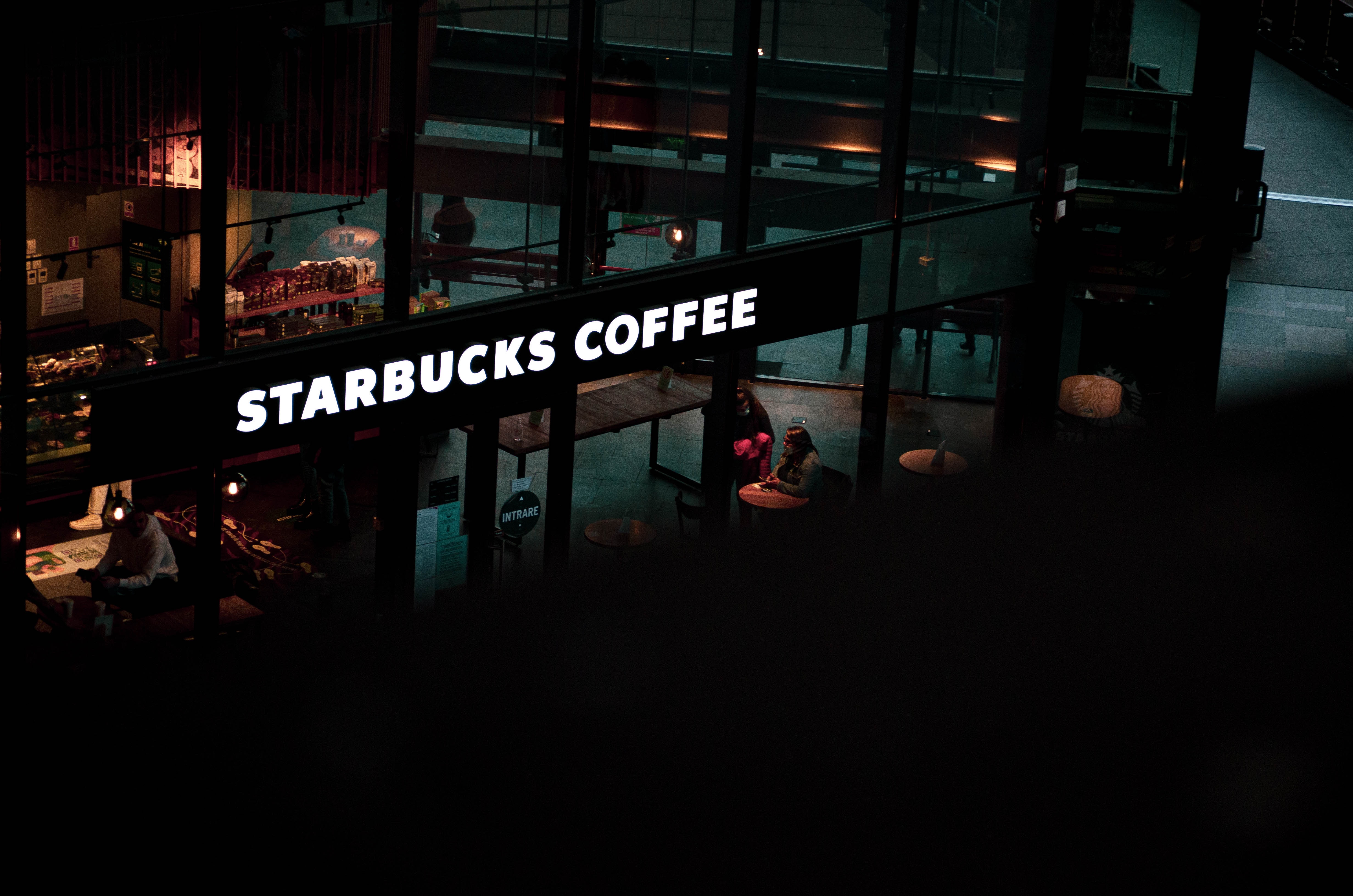
The term “boycotting” has recently emerged as a popular term and has been frequently discussed. It is commonly referenced in conversations related to the Palestinian genocide, especially concerning calls for people to boycott Starbucks. Many individuals may go about their regular lives without contemplating the effects of boycotting and how it can significantly impact a large corporation like Starbucks.

Boycotting is essentially a way for people to express their disapproval by withdrawing their financial and emotional support. Many businesses are currently under fire for their assistance to Israeli soldiers, which has resulted in the violence and ongoing genocide in Palestine. It is evident that major companies utilize their resources and influence to lengthen wars, whether it is through financial support of the Israeli Defence Forces (IDF) or general violence against Palestinians.

Enter boycotting, an effective strategy that allows people to take back control over their financial contributions and change public perception of the Palestinian  genocide.Customers can regulate the flow of funds that could be used to support violence by choosing not to purchase goods from these involved companies. In addition to communicating the viewpoint of the consumer, this collective action pushes companies to reconsider their position in light societal values.

Boycotting has a clear influence and the ability to bring about significant change. Notably, because of customer boycotts, Starbucks, the world’s largest coffee company, has seen a significant decline in market value. This financial consequence demonstrates the power customers have to shape business practices.

All things considered, boycotting is more than just a simple act of consumer protest, it also serves as an outlet for discussion, a way to limit economic power and responsibility, and a tool for bringing about change within corporations. The successes of these movements show the strength in the hands of people who are dedicated to fair trade and moral consumption on a worldwide basis.


Cinematic Reflections: Saltburn

0

Disclaimer: This movie has mature themes (STRONG sexual content, graphic nudity, and disturbing/violent content). I personally would not recommend watching if you’re under the age of 17 and/or are easily disturbed.

NO SPOILERS 🙂

Brief Movie Summary:

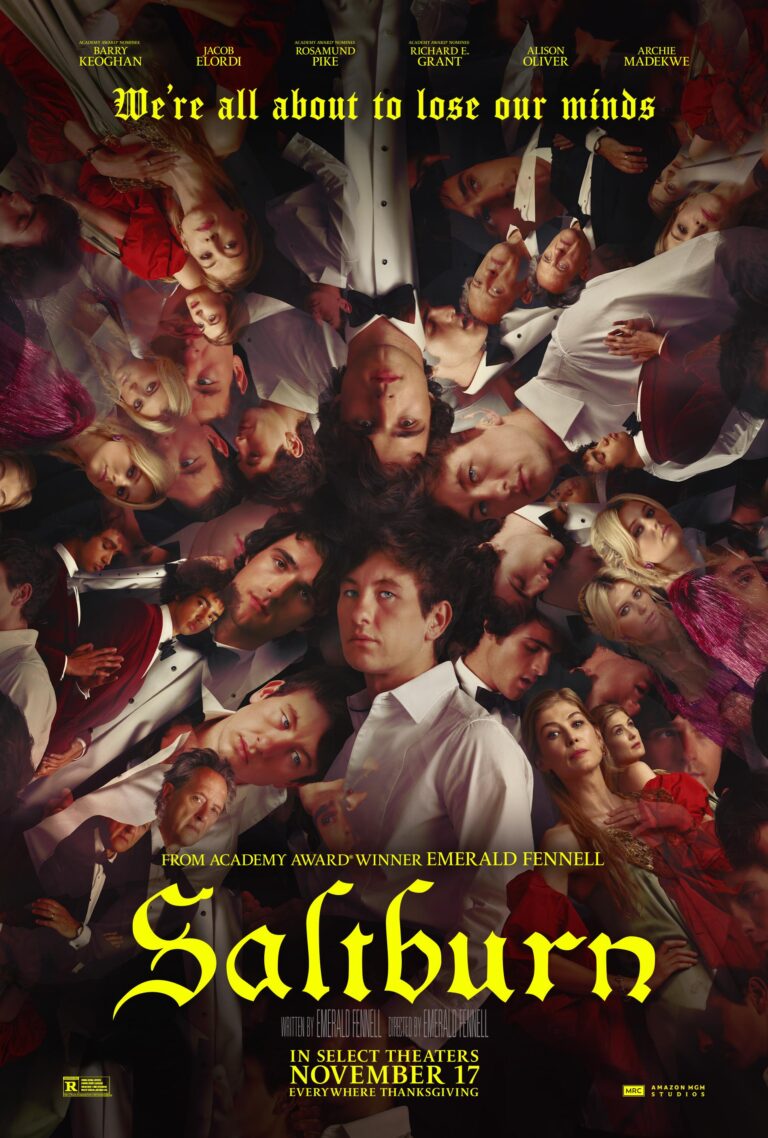
In Emerald Fennell’s ‘Saltburn,’ the story unfolds around Oliver, an Oxford student grappling with a challenging living situation. Touched by empathy, his classmate Felix extends an invitation to his estate. However, the tranquility is disrupted as a series of harrowing events befall Felix’s family.

My Thoughts:

To be quite frank, I thought the movie was pretty bad. The story line is extremely slow regarding its progression, and it miserably failed at capturing my attention as I found myself reaching for my phone quite often. I lost about 40 minutes of the movie and didn’t notice as no major plot developments happened. While the cinematography stands out with its stunning visuals, the overall depth of the film is lacking. The characters remain superficial, making it challenging to truly connect or empathize with any particular individual. A more substantial development of the storyline around the characters would have added much-needed substance to the viewing experience.

Despite being labelled as a thriller/comedy, I struggled to identify this film’s comedic elements. Instead, I was left deeply disturbed as my eyes were continuously bombarded with an onslaught of diabolical, perverted, “sexually” immoral scenes (quotations because  ‘sex’ implies consent.) Upon the movie’s conclusion, I was left more puzzled than before as I questioned how these disturbing scenes were relevant to the plot. It seemed unnecessary to resort to such grotesque and overtly crass depictions, as there could have been alternative ways for Fennell to convey the sociopathic nature of the main character.

So to put it simply, this was probably the most sickening movie I’ve ever seen.  It was definitely something. Watch at your own risk.

✧・゚: *✧・゚:*   *:・゚✧*:・゚✧  ✧・゚: *✧・゚ :*  *:・゚✧  *:・゚✧✧ ・゚: *✧・゚ :*    *:・゚✧*: ・゚✧✧・゚: *✧・゚:*   *:・゚

Want to support us? Check out our other blogs:

How Arianna Huffington Shaped Modern News

Source: 1


Redefine Your Success: Unleash your Potential for the 2024 New Year!


“I already failed anyway! so I’ll just try again Monday…”

-Bill, 2023

Monday evening:

“Tch. Well, I failed yet again. I’ll try again tomorrow. But I’ll probably fail again, argh!” -Bill, 2024

Does ‘Bill’ sound like a certain someone to you? The feeling of being stuck in the cycle of trying again and again, and getting nowhere. Telling yourself you’ll take a break and try again a couple of days later only to fail to reach your goal again. It’s okay, you’re not alone. Like you, many others, including myself, have been or are still in this annoyingly receptive cycle. But do you know why you keep trying to start over and do it again? Because, there is a voice in the back of your head (or heart), that goes ‘Man, I could’ve done that better’, which means you are very much capable of doing it, but maybe you just don’t know how to do it, or simply lack the discipline and consistency to do so. Well, here are 3 tips that I hope can help you become your ‘future self’, but for real now.

Tip #1: Consistency and Setting ONE Goal

The key to reaching any goal is consistency, but we all know that. The real question is how? Well, there are many different ways, but here is one;

Pick only ONE long-term goal to focus on achieving, and one or multiple short-term goals to reach that one goal. This prevents you from getting overwhelmed by all the different goals you need to achieve, so you are less likely to procrastinate and stay motivated to keep going. For example, if my long-term goal is to eventually eat 3 healthy meals a day by the end of 6 months (since that is one of my biggest challenges- may be different for you) then, one of my short-term goals is to drink milk for breakfast, then slowly make more progress each week, until I have the appetite and motivation for making and eating fried eggs with some other nutrients for breakfast. Here is a more detailed guide on how to set up SMART Goals and realistically achieve them.

Tip #2: Reward System and Scoreboard System

It’s not easy to stay consistent, so make sure to reward yourself only if you stay consistent (for a minimum period which you think is best for your specific goal. Eg. After every successful week and or after every short-term goal). This way, you will not only be rewarded when you achieve each short-term goal but you will also be motivated to stay consistent due to that reward. That said, rewards can be anything, from buying a delicious snack to doing/playing your favorite pastime or hobby. However, remember to set strict deadlines for when a short-term goal is to be met, to prevent abusing the reward system and end up getting rewarded for procrastinating (which is the opposite of what you want to do).

One way to do that is through making a graph, where you set your goals and log in your daily progress. By doing so, not only can you get instant gratification by seeing your graph line or bar getting nearer to your goal, but it can also keep you even more motivated to keep achieving your short-term goals to reach your long-term goal. Think of it as a sport, for example, basketball. When you shoot and score a point, you get instant gratification by seeing your team’s score go up on the board, and by seeing how much better or worse your score is compared to the opposing team. Thus getting instant positive and negative feedback, fueling your motivation and determination to try harder. If you’d like, you can go ahead and create a group that also shares the desire to become their dream version of themselves and make it either a healthy competition and or support group, where all of you create your score graphs and compete and or hold each other accountable when you find one of you slacking for no good reason. 

Here is a YouTube video I came across, by YouTuber Tina Huang, which I found as a helpful guide for making your scoreboard. 

Tip #3: Cut-off from a Toxic Environment

Although this may not be completely possible for everyone, (eg. Living in a home, going to school, or working in a toxic environment), it is important to cut off as many toxic people or leave as many toxic environments, as much as you can. Toxic people (Eg. ‘Friends-‘), will not only make your life terrible and make you insecure about yourself, to the point of damaging your mental and emotional health, they will but will also demotivate you from reaching your goal as a result. It is important to surround yourself with a good support system, one that is in-person and or online (eg. Follow Instagram influences that have goals or have achieved a goal that you also have, or an online study group, etc.). This is vital for reaching your goals since encouraging words and unwavering support will not only motivate you to keep going but also go a long way in improving your mental and emotional health. That’s said, who knows? Maybe you just might make some good friends from this support system (if not already), who will genuinely celebrate your success with you and not put you down with discouraging and manipulative words.

Note: A few ideas for Goals

Here are some healthy goal ideas, to help you get started!

  • Journaling: Having trouble figuring out your thoughts and feelings? By letting those out on a piece of paper, it will help you dissect and realize the root of those thoughts and feelings, and allow you to have an outlet for those bottled-up feelings. Thus, allowing you to have a clear mind and heart to approach the problem you are facing, and leave you in an overall less frustrated mood.
  • Fitness: Whether it be a 10-minute walk a day, or 10 push-ups and jumping jacks per day, exercise will increase your dopamine levels which helps your mental, emotional, AND physical health. A lot of us get the feeling that we are just wasting time, and become too impatient when trying to reach our goals, however by working out, even just a little, you may not be able to see the result, but you will feel the result of your hard work immediately. For example, when you start sweating. Thus by feeling like that your mind and body will feel an increase in dopamine, which makes you feel more instantly satisfied with the effort you put in. Here are more details as to how dopamine and exercise go hand in hand
  • Napping instead of Scrolling: I’m sure we’ve all aimlessly scrolled on our social media when we felt like procrastinating, so another way to combat this is to nap instead (of course, napping excessively isn’t good). By resting your body and brain by napping, you will not only be well rested after waving up, but feeling less down on yourself afterward due to doing something useful, instead of the disgustingly repetitive feeling of wasting your time.

I hope these tips were helpful to you! I wish you the best, I believe in you, and you CAN and WILL do it!


Bioinformatics: The Combination of Biology and Information Technology

0

Bioinformatics, the combination of biology and information technology, has emerged as a transformative force in understanding genes and harnessing this knowledge for therapeutic purposes. One of the most promising applications lies in the realm of gene editing, where bioinformatics tools are instrumental in identifying target genes, designing precise edits, and optimizing delivery mechanisms. Through this piece, we will explore the intricate relationship between bioinformatics, gene editing technologies, and disease treatment, focusing on the example of insulin production through gene editing with plasmid vectors.

Understanding the genetic code

Bioinformatics serves as a toolkit for scientists navigating the world of genetics. Its primary function is to interpret the genetic code within our DNA. Through tools, bioinformatics enables researchers to gain valuable insights into the function and instructions governing the formation and operation of living organisms.

Target genes

Within the genome, bioinformatics acts as a sort of compass, assisting scientists in the precise identification of specific genes linked to diseases or critical biological functions. Through advanced methods, bioinformatics aids researchers in pinpointing genetic information crucial for medical research and the development of targeted treatments.

Precision editing with molecular tools

The correction of genetic anomalies requires the use of molecular tools, with restriction enzymes being a prime example. These tools act as molecular scissors, enabling scientists to cut the DNA at specific locations. The role of bioinformatics in this editing process ensures not only accuracy in correcting genetic errors but also minimizes the risk of unintended changes.

Plasmid Vectors

Following the precise editing of genes, the next challenge is reintegrating the corrected genetic material into the body’s cells. Plasmids–a type of vector–acts as a carrier or delivery vehicle for the edited genetic information. Bioinformatic studies plays a pivotal role in the design of these carriers, ensuring their efficacy in delivering the corrected genes to their designated locations within the body.

Gene editing example: improving insulin production

An individual who has diabetes may have inadequate insulin production. Bioinformatics plays a big role in aiding scientists to edit the gene responsible for insulin production. Plasmids, acting as precision carriers, transport the corrected gene back into the cells. This groundbreaking approach holds immense potential to enhance insulin production, thereby revolutionizing the management of diabetes.

Bioinformatics unfolds as a captivating field that empowers scientists to navigate the complex intricacies within the genetic code. Whether through precise gene editing to treat diseases or unraveling the profound mysteries of our genetic composition, bioinformatics stands as an indispensable ally in the ongoing quest for a healthier, more personalized future.

Bibliography:

Bioinformatics. (n.d.). Genome.gov. https://www.genome.gov/genetics-glossary/Bioinformatics#:~:text=Bioinformatics%2C%20as%20related%20to%20genetics,or%20annotations%20about%20those%20sequences.

Restriction enzyme. (n.d.). Genome.gov. https://www.genome.gov/genetics-glossary/Restriction-Enzyme#:~:text=A%20restriction%20enzyme%20is%20a,DNA%20technology%20and%20genetic%20engineering.