Home Blog Page 63

What’s Going On in Turkey and Syria?

0

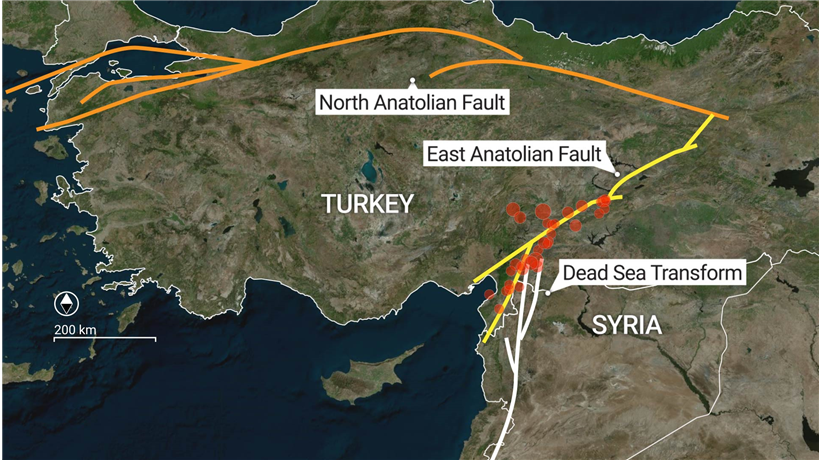
If you’ve been in tune with the news this week, you have probably heard of the massive earthquakes hitting Turkey and Syria the past couple days. These two countries lay on geographical regions known as “fault lines,” which are essentially fractures between tectonic plates. These regions are highly prone to earthquakes as tectonic plates scrape past each other, explaining why these natural disasters are hitting Turkey and Syria.

Deadly Turkey earthquake exposes dangers of major fault lines below - National | Globalnews.ca

Thousands have been killed and many more have been injured as a result. Turkish president Recep Tayyip Erdogan faces heavy criticism from all angles, due to the government’s lack of meaningful response and evidence of previous corruption. Erdogan, in the 2010’s, supported and oversaw a construction boom which intended to bolster Turkey’s economy. A lot of money was put into this economic project; money that may not have truly gone towards the Turkish people. Infrastructure built during this period of time shows evidence of cut corners and shoddy building standards – implying corruption in Erdogan’s administration.

Erdogan is an authoritarian ruler who’s grip over Turkey is in danger due to recent events coupled with a history of economic crisis. Turkish elections are due in only a couple months: May 14th, 2023. As both the Turkish people and the international community put pressure on Erdogan, this may pave way for political changes in Turkey.

Erdogan Pledges Turkey Central Bank Rate Cuts Before Presidential Elections - Bloomberg

Many relief efforts have been launched for the Turkish and Syrian people, and the situation remains to be sorted. For more information on the situation:

Deadly Turkey earthquake exposes dangers of major fault lines below

https://www.bbc.com/news/world-middle-east-64608535

https://www.cnn.com/middleeast/live-news/turkey-syria-earthquake-updates-2-11-23-intl/index.html

https://www.wsj.com/video/series/news-explainers/the-science-behind-the-massive-turkey-syria-earthquakes/4F79BEEF-2D9C-47E3-8F2B-B3A7198C83CE

https://www.redcross.ca/donate/appeal/earthquake-in-turkiye-and-syria-appeal#14bf71f5-0d57-497d-acd2-9b372e8a543a

Featured Image: Mustafa Karali/AP

Image Sources:

Erdogan Image: Adem Altan/AFP/Getty Images

Fault Lines


The Two Faces of the Garment Industry

Fashion has always been an integral part of self-expression. However, we are often unaware of the costs associated with buying fashion from many famous retail brands in terms of their ethical and human rights violations. It often makes me wonder why governments and big corporations continue to operate and support sweatshops when they have the ability to treat their workers fairly in Western countries but exploit workers in under-developed countries by taking advantage of their lack of labour rights and safety regulations. I am well aware of the fact that a lot of us cannot afford to always buy from sustainable brands. But, I believe the overarching idea to take away from this situation is that influential corporations should not normalize hazardous working conditions in the first place. Unfortunately, our society has prioritized monetary gains over human rights many times and that will likely continue to happen as we are susceptible to greed. Countless individuals lose their lives or get injured working daily in garment factories, and it is important to advocate for their rights as we wear the products of their hard work and creation every day.  

Rana Plaza

To understand the gravity of the situation, we can look at the Rana Plaza accident as a testament to the horrible working conditions imposed on individuals, irresponsibility from factory owners and operators, and safety violations. The Rana Plaza incident occurred in Bangladesh and is considered one of the deadliest collapses in the garment industry. More specifically, it led to the death of over 1,100 people and disabled others. It should also be noted that the owners and operators of this garment facility, which produced clothes for brands such as Joe Fresh, knew about the structural issues and the problems with the building material. Furthermore, the building’s owner, Sohel Rana, illegally added floors to the building, ignored structural advice from engineers, and made plans to flee after the incident. To further elaborate, large power generators shook the whole building, especially the top floors. This incident brought international attention to unsafe working conditions and the exploitation of workers for profit motives. Bangladesh continues to be one of the main producers of this industry, and these industries also make up a large portion of the country’s economy. However, I do not think economic reasons should justify the mistreatment of individuals, especially when these conditions do not exist in many Western factors, which further highlights the double standard within this industry. Rana Plaza produced clothes for Walmart, Gap, Adidas, Joe Fresh, and many other brands. After this accident, some companies donated money to relief efforts, but none of these reimbursements would have occurred if this case did not receive global attention. To further add, in light of recent events, the COVID-19 pandemic has made this industry even more vulnerable as employees have been laid off and are made to find work at places that have conditions that worse than the ones at the factories. 

Ethical Dilemma

Unfortunately, there is an immense ethical dilemma associated with this situation, and it is essential to understand all perspectives. From my perspective as a buyer, I often feel guilty for buying from brands that support sweatshops, but it is also difficult to buy from sustainable brands as a student because they are more expensive. On the other hand, many workers in Bangladesh still want to maintain their role in the garment industry due to the economic factor I mentioned previously. My perspective may be that human rights should be prioritized instead of solely economics. On the contrary, it is vital to understand that people in developing countries main goal is to provide for their family, and they are willing to go to any length to achieve that. With that being said, our generation prioritizes sustainability over fast fashion, and that may lead to transformations within the industry. In terms of ethics, should companies place their benefits ahead of those of the workers when the workers are the ones keeping the company in business through their crafts? This question is posed in direct correlation to Rana Plaza because unethical treatment was motivated by conflicts between profit goals and safety. Every company has the ethical obligation to ensure that their employees have appropriate suitable working conditions, but it seems that this line is blurred in this specific industry far too many times. How many deaths will it take before transnational corporations realize the effects their self-interest has on others?

Can Change Happen?

In a highly globalized world, pre-existing societal constructs make it ever more difficult for positive change to occur in the garment industry in developing countries. Changes in labour laws and prioritizing worker safety should be one of the main goals I think we should expect to see in the future as more people globally advocate for these changes to be made. One of the United Nations’ sustainability goals is no poverty, and it is a fact that many people in those countries are forced to work in factories due to their financial state and lack of support from other government infrastructures. Furthermore, sustainability is one of the main problems because the mass creation of clothing we see from fast fashion companies consumes many resources and contributes to rising pollution. Another UN goal is gender equality, and even in 2023, this goal is yet to be achieved in the textile industry. Women are paid less than men in Bangladesh for the work they do. At the same time, these women are subjected to horrible working conditions, have to work overtime, and receive little to no education due to being sent to these factories starting from a young age. To highlight the seriousness of the lack of human rights in this industry, I want to elaborate on the working conditions. In Bangladesh, garment factories are overcrowded, there is a lack of air ventilation, and workers are exposed to toxic gasses that can lead to diseases such as cancer. Additionally, there are no exhaust fans for ventilation, and workers are not provided with face masks to deal with this issue, an effort made by factory owners to save money despite making millions. At the same time, there are no fire exists or fire alarms, and there are an inadequate number of bathroom facilities that can accommodate all of the employees. Rana plaza was a monumental moment for the garment industry and brought to the surface all of the issues hidden away for years to light. It cost the lives of over one thousand workers for some companies to realize that change is needed. Despite the lives lost to Rana Plaza, Walmart has rejected proposals of increasing product prices to improve electrical safety and working conditions for the factories. The reasoning for this was that it would be too costly to implement; keep in mind that the company’s annual gross profit is around $129B. H&M decided to follow a different route, making around 1000 unannounced factory visits to ensure worker safety in terms of their code of ethics. Furthermore, the Accord on Factory and Building Safety in Bangladesh was signed by companies to ensure that retailers would be required to help finance safety and building improvements. The two faces of the fashion industry are truly reflected when on one hand, companies promote and foster acceptance and kindness campaigns in developed countries and on the other, violate countless human rights of their factory employees.

Demand quality, not just in the products you buy, but in the life of the person who made it.

– Orsola de Castro


Sources: [1]/[2]/[3]/[4]

Featured image: [1]

The King of Literature, Edgar Allen Poe

Edgar Allen Poe is one of the most famous gothic and horror writers ever known. He practically invented the gothic literature genre and his most known works, ‘The Tell-Tale Heart’ and ‘The Raven’, have changed how people look at short stories forever. And it doesn’t stop there, he’s influenced multiple genres like science fiction, detective and whodunit stories. Overall, it’s clear that Poe has changed literature forever.

Gothic Literature And Poe

Poe’s macabre tales are a staple of gothic literature. He had a mastery of all aspects of gothic fiction; dark and descriptive scenery, his use of fear as the main catalyst in almost all his stories, a underlining tone of supernatural elements and, albeit dark, with a touch of romance. His stories ‘The Tell-Tale Heart’ and ‘Murder in the Rue Morgue’ highlight his talent extremely well. This paragraph from ThoughtCo. explains the influence of Poe amazingly:

“The supernatural elements in the story, though, launched a whole new genre, which took off in Europe. Then America’s Edgar Allen Poe got ahold of it in the mid-1800s and succeeded like no one else. In Gothic literature, he found a place to explore psychological trauma, the evils of man, and mental illness. Any modern-day zombie story, detective story, or Stephen King novel owes a debt to Poe. There may have been successful Gothic writers before and after him, but no one perfected the genre quite like Poe.”

His Influence On Other Authors

As mentioned in the quote above Poe has affected a lot of our current literature. From H. P. Lovecraft to Stephen King to Ambrose Bierce, many authors have drawn inspiration from Poe and his imaginative storytelling. Being crowned “the originator of both horror and detective fiction” it isn’t a surprise so many writers have looked to his writing for inspiration and guidance. Undoubtedly his work will continue to teach, inspire and terrify people for years to come.

Annabel Lee, One of His Most Famous Poems

In 1849 Poe’s poem Annabel Lee was published in the New York Tribune, two days after his death. It is a tale depicting a beautiful young woman who, unsurprisingly, dies. While this may be one of his shortest poems it is one of my favorites for its simplicity (which makes the story even more chilling) and how his words paint a picture in your mind but, most importantly, for the love that Poe clearly depicts for the woman who he calls Annabel Lee. It is theorized that when he speaks of Annabel Lee he is actually talking about his wife (and cousin…) Virginia who died only a few years prior. Annabel Lee is truly a staple in poetry and everyone should read it at least once in their life.

All in all Edgar Allan Poe is an amazingly talented writer, poet and literary critic. He has rocked the foundations of the world of literature and still continues to do so as he lives on in our awe and stories.

Sources: 1, 2, 3, 4, 5, 6, 7,

Featured Image

The Cult of Andrew Tate: The Dangerous Spread of the Alt-right Online

Over the last few years with the rise of Tik Tok and short-form video content on the internet, a certain man has since risen to an absurd level of fame despite his outdated and controversial views. Andrew Tate, professional MMA fighter and human trafficker began his rise to fame after being featured in a select few TV shows following his winning of several MMA awards. His debut as a TV personality was cut short, however, after a video of him beating his girlfriend at the time with a belt began to circulate. Rather than public outcry, it was this exact abuse of women that led to his rise as an internet celebrity. His career began with abusing women which was readily accessible and consumed by his legions of fanboys. Now with his arrest by the Romanian government, his career is hopefully slated to end, all as a cause of his own hubris.

Who is Andrew Tate?

After his initial debut onto the internet, Tate introduced a ‘university’ to his audience, formerly known as Hustler’s University and currently known as the ‘Real World’. This online course was introduced to not only make money, but also distract from his human trafficking organization, in which he would manipulate and trap women into being webcam sexworkers. It can also be noted that this online business model fits many of the qualifications of a cult, namely the simultaneous exclusivity and belittling of its members as well as the recruiting and behaviour driven aspects of the program. In addition to this, Tate would often encourage his fans to promote him on various social media sites, namely TikTok and Instagram. Most of the work in his rise to fame was therefore perpetuated and maintained by his online audience, where clips of his podcast would be uploaded and garner millions of views. The result of this is clear; millions of men now feel comfortable enough to vocalize their misogynistic views, at least online. 

Another factor in Tate’s success is the reason so many men rationalize and support his ideas- despite Tate’s proven record of sexual and physical assault against women. With Tate’s rise in popularity, we must consider what type of person is capable of falling prey to his manipulation tactics. Millions of men (and some women) have been convinced of Tate’s righteousness. This is because the structures of patriarchy provide an ideal of what it is to be a man, and they have been told that society is structured around them. However, the true masculine ideal can only be fully achieved in combination with extreme wealth. This ‘strongman’ image is only available to the elites of society, therefore to the average man it is completely unattainable. Yet at the same time, society expects them and bases their value as a human by their ability to be attractive, strong, and financially successful. This is essentially what Andrew Tate is selling – an image of ideal masculinity. His Hustler’s University is a prime example of this, as he teaches men how to be financially and personally successful by  telling them how to be more like them – minus the international crime. These vulnerable and often young men want to improve on their life, and Tate’s lifestyle is something they deem desirable. But because they are not and likely will never be able to achieve it, they turn their lack of self-esteem into a hatred of those they perceive as the ones holding them down – such as women and leftists. Ultimately, this sense of entitlement they feel over perceived ‘lesser people’ turns into an undermining of the civil liberties and very humanity of others. 

TikTok and the Alt-right Pipeline

The Alt-right in contemporary politics is often synonymous with the far-right, often encompassing ideologies such as fascism and anarcho-capitalism disguised as ‘libertarianism’. If you spend a lot of time on the internet, you’ve likely heard some of their slang, such as ‘redpilled’ ‘blackpilled’ in reference to the matrix, which is terminology adopted by the Alt-right with the explicit intent to use things like movie references to draw you further into what can be called a ‘decentralized cult’. This is a specifically online phenomenon fuelled by sites like Youtube (and later TikTok) in which people all over the world become manipulated into forming a cult-like community – only online. The leaders of this cultlike following are people like Andrew Tate, Ben Shapiro, or Stephen Crowder, and their followers are slowly fed increasingly reactionary content by algorithms until they finally stumble upon explicitly racist, misogynistic, or homophobic content. To learn more about this process in the early days of the internet, click on this link.

Now however, the Alt-right pipeline has found a new way of radicalizing youth through TikTok. It starts off seemingly innocuous, with niche content like ‘gymtok’ – but soon it turns sinister, with even seemingly harmless content leading to content recommending an increasingly toxic and harmful mentality which prioritises adhering to traditional standards over all else.

In just a few scrolls, seemingly harmless content such as this: 

*Profanity disclaimer in second clip (specifically in the audio)*

https://www.tiktok.com/@dailyjlh/video/7110840981955579142?is_from_webapp=1&sender_device=pc&web_id=7089871630029276678

Can lead to much more damaging ones such as this:

https://www.tiktok.com/@llucxo/video/7052764295834209541?is_from_webapp=1&sender_device=pc&web_id=7089871630029276678 

With Andrew Tate specifically, fans use hashtags such as ‘inspiration’ ‘advice’ ‘life advice’ to market to vulnerable people – who soon get pulled into the TikTok pipeline of reactionary content. This is ultimately a spread of dangerous ideas and the result of it can be seen in an increasing number of domestic terrorism – specifically ones committed by white supremacists radicalized by internet hate groups against minorities. The damaging and hateful ideologies advocated for by people like Andrew Tate directly result in these crimes. These people have blood on their hands, and sites like Youtube, TikTok and Instagram only help the spread of their hate by not being more strict in stopping the spread of misinformation. 

What we can do

It can be hard for individual people to independently recognize implicit bigoted bias in the media we consume, especially when we are consuming a lot of it and are not aware of the sort of content that could be potentially damaging or misleading. Therefore, it is important that we are all contentious consumers of the content we find online. Critically thinking about media is an important part of modern media consumption. When you learn a new concept ask yourself, where did this source get their information? What bias could this media have? And most importantly, what does my reaction to this information say about myself and society at large? Always be sure of the reliability of your sources and if you see something, say something. Report any misinformation or hateful content you see online. For example, when Andrew Tate says women are bad drivers, ask yourself where you have seen this information to be true. Just a simple Google search would reveal that in fact, women are on average better and more cautious drivers than men, and often pay lower insurance rates because they are less accident-prone. Being sure of the reliability of the media you consume is the best way to avoid the manipulation tactics of the extreme right.

Source(s): 1, 2, 3, 4, 5, 6, 7, 8, 9, 10

Image source: 1

Where Do Phobias Come From?

0

We have all encountered scenarios that have struck fear within us. When scared, it is normal to experience slight anxiety, fight or flight responses, and instinctive reactions. However, when our fears of objects or situations become persistent and excessive, they may be diagnosed as phobias [1]. In line with the symptoms of an anxiety or panic disorder, the symptoms an individual experiences when they have a phobia include sweating, trembling, hot flushes and chills, shortness of breath or difficulty breathing, rapid heartbeat, and the feeling of tightness in the chest. Phobias can be categorized into five main types: animal type, natural environment type, blood-injection-injury type, situational type, and other type [2].

Most Common Phobias

Agoraphobia

Agoraphobia is known as the fear of open spaces [3]. At a psychological level, it is a panic disorder that inhibits an intense fear of becoming overwhelmed and not being able to escape situations. Approximately one third of individuals who suffer from panic disorder are subject to experience agoraphobia, as well. People with this phobia avoid situations like mingling with crowds, going to spaces outside of their home, and using public transportation.

Acrophobia

Acrophobia is the fear of heights [4]. Depending on the severity of the condition, individuals fear different height levels. For example, someone may fear being on a high floor of a building as much as they would fear climbing onto a step-stool.

Claustrophobia

Known as the fear of enclosed spaces, claustrophobia encompasses the taking of extreme measures to avoid confined spaces such as lifts, tunnels, tube trains, and public toilets [5]. Research has suggested that many individuals who suffer from claustrophobia experienced a traumatic event revolving around confinement and enclosed spaces during their childhood.

Entomophobia

Entomophobia is the fear of insects [6]. Historically, insects have been thought of as unknown creatures, stirring up a feeling of disgust within individuals. This is referred to as the “rejection response” because people tend to avoid unknown or foreign matter. Additionally, insects and critters have negative connotations attached to them due to the potential diseases they carry. For instance, in many countries, specifically tropical ones, cockroaches are known to cause illness when they dislodge bacteria onto foods. From an evolutionary standpoint, as a species, we may have evolved to be aware of infectious insects. Finally, many individuals feel threatened by colonies of insects because of an inferiority response. By nature, individuals believe that they are strong enough to complete tasks on their own; however, when they observe colonies of insects working together and supporting one another, their beliefs of what they can accomplish on their own are undermined. These are all possible reasons to support the development of entomophobia.

Achluophobia

Achluophobia is the fear of the dark [7]. This phobia may be evolutionary in nature, as many predators hunt at night or within darkness. Some psychoanalytical researchers also believe that achluophobia is related to separation anxiety from a primary attachment figure. Commonly known as “being left in the dark”, when a primary attachment figure suddenly exits an individual’s life without explanation, the individual may never know the reasons for their leaving. Another association with achluophobia is a lack of confidence and security. Individuals who lack confidence may have experienced dark points in their lives that are suppressed. They are fearful of the dark because they are afraid of uncovering personal insecurities and weaknesses. Commonly, individuals with achluophobia become nervous in a darkened environment, are reluctant to going out at night, and prefer to sleep with the lights on.

Causes of Phobias

Although it is difficult to pinpoint the origin of phobias, as everyone has individual experiences and symptoms attached to them, researchers agree that they arise from aspects related to both genetics and the environment. In other words, both nature and nurture have a role to play.

Genetics

Many studies have shown that children will develop the same phobias as their parents, suggesting that the cause of phobias are due to genetic connections [8]. In addition, the biological vulnerability of being startled can predispose individuals to naturally develop fears.

Environment

Phobias most commonly develop as a result of negative or traumatic experiences, occurring when fear produced by an originally threatening situation is transferred to other similar situations.

Changes in Brain Function

Phobias can arise from changes in brain functioning which alter sectors of the brain that control emotion and fear. The primary structure that comes into play here is the amygdala.


Sources: [1], [2], [3], [4], [5], [6], [7], [8]

Images: [Featured Image]

Is Earth’s Heaviest Organism Dying?

0

When thinking about the world’s heaviest organism, many of us might picture the blue whale or perhaps a large elephant. However, interestingly enough, the heaviest organism is a single aspen called Pando. Situated in the high-altitude area of Utah’s Fishlake National Forest, Pando–a colony of quaking aspen trees–is known as one of the oldest and largest organisms to ever exist on Earth. Although there are 47000 individual Pando tree trunks in Utah, these trees are actually one large colony connected by an extensive underground root system. In summary, Pando, also known as the Trembling Giant, takes the metaphor, “the forest is a single organism,” and makes it literal.

With Pando being just one organism, every tree is genetically identical–reproduction occurs asexually through a process called “suckering.” This process occurs when one trunk (which is really just a stem) grows lateral roots that emerge out of the ground to become new “trunks.” Researchers like to describe this process as cloning. Another interesting attribute of this organism is its ability to “quake.” Similar to quaking aspens, Pando’s flat leaves tremble in the wind, creating the soothing sound of rustling leaves. 

What is happening to Pando? 

Research suggests that Pando is one of the oldest organisms on Earth. Its survival can be attributed to Utah’s past environmental conditions. In the last 80,000 years or so, Utah experienced frequent low intensity burns and climate shifts, prohibiting the successful growth of rival aspen trees to compete with Pando. Nonetheless, recent changes in ecosystems around Utah’s National Forests suggest that Pando’s growth is declining due to organisms that graze on premature trunks. Some of these organisms include deer, elk, sheep, and cattle. The deer, one of the most concerning Pando-eaters, used to have several predators in the Utah area. However, hunting activities have disrupted the balance of predators and prey, which ultimately led to a significantly greater number of deers in the Fishlake Forest. 

Not only are animals such as sheep, deer, and elk restricting the growth of a new generation of Pando trunks, but the mature trunks have also been dying at higher rates. As observed by researchers at Utah State University, Pando’s size has been decreasing for decades, suggesting that the organism may be at risk of extinction. However, hope is not lost for these trees as scientists have been working to build fences around them to prevent other animals from eating premature trunks.

Featured Image

Sources: 1,2,3,4,5

Facing the Dilemma with AI

0

Artificial intelligence has undoubtedly become an integral part of our society as we continue to rely on it daily. AI has made significant changes in society through voice-activated technology, facial recognition features, voice assistants, and recently, ChatGPT. These milestones are a testament to the fact that artificial intelligence will continue to play an important role in future scientific pursuits. However, advances such as these also create dilemmas about to what extent humans rely on technology and the consequences associated with that. Furthermore, many people have varying opinions regarding this matter, and these perspectives have been gathering widespread attention on social media platforms. Regardless of your opinions about AI, one thing for certain is that it is important to consider the role these technological features play in society to grasp the issues that come along with it.

The Beginnings of AI:

Artificial intelligence has vastly changed, for the better, since its beginnings in the 20th century, which heavily focused on theoretical work. One of the earliest works related to AI was done by Alan Turing in 1935 when he described an abstract computing machine with memory and a program of instructions stored in the memory by using specific symbols. In 1948, Turing described some of the early central concepts of AI in a report called “ Intelligent Machinery.” Moreover, Alan Turing also created the Turing Machine, which discovers what can be computed. Turing described it as “a machine capable of a finite set of configurations.” AI experienced further advancements when chess computers were created and popularized. The earliest AI program was written by Christopher Strachey, and this program allowed for a game of checkers to be played. It should also be noted that the first AI program to demonstration started in the United States and was also a checkers game. Arthur Samuel studied the fundamentals of Strachey’s checkers and expanded on the ideas, and added features that made the program learn from experience. This idea of a program learning from experience eventually transformed into evolutionary computing. Evolutionary programming involves evaluating a series of programs until the best outcome is achieved. Logical reasoning and problem-solving is another fundamental aspect of AI, and its beginnings started with the theorem-proving program written by Allen Newell and J. Clifford Shaw. Additionally, future AI advancements included inputting programs that enabled dialogue, refining programming languages, microworld programs, and connectionism. More specifically, connectionism involves the development of artificial neural networks modelled after the brain. In this case, networks were trained to recognize patterns and “neurons” were used to create connections. Some neurons are used for input, while others are used for output in a specific sequence. Nouvelle AI and the creation of tablets are other examples of incredible advancements in artificial intelligence. Currently, features such as Siri, use programming influenced by the human brain’s neural networks. 

The Rising Popularity of ChapGPT?

As you may have already seen, the arrival of ChatGPT has been dominating headlines for some time now. ChatGPT is a free AI program created by OpenAI which allows users to ask questions and interact with the program in a variety of ways. According to the OpenAI website, ChatGPT was created using Reinforced Learning from Human Feedback (RLHF). RLHF uses a data collection setup in which human AI trainers created conversions in which their role consisted of acting as the person using the program and the AI assistant. Additionally, comparison data was collected to differentiate responses based on their quality. Furthermore, Proximal Policy Optimization edited the pre-existing models. OpenAI describes the process for this in three main steps, which consists of:

  • STEP 1: Collect data using a sample prompt from the prompt dataset. Responses are then outputted for the specific prompt, which is then fine-tuned. 
  • STEP 2: The next step involves retrieving comparison data to find the response that best matches the prompt. Essentially, the outputs are ranked from best to worst. According to OpenAI, this data is used to assist their “reward model.”
  • STEP 3: The third step involves choosing a new prompt from the prompt data set. This time the Proximal Optimization Policy is used, and a new output is given. The reward model is then used to calculate a reward for the output, which consequently updates the policy.

ChatGPT is a highly sophisticated AI, but it also has its set of limitations. These limitations can include writing answers that do not sound correct, it may not answer questions if the input wording is not recognizable, and it may respond to negative requests. The final point segues into the central focus of this blog, which is to recognize the dilemma that comes associated with AI. The fact that OpenAI recognizes that its program can adhere to user requests that can be harmful shows that it is important to use AI carefully and with an intent that is beneficial to all of those involved. It should also be noted that the creators behind ChatGPT are working to make a model that does not respond to inappropriate requests. However, for the time being, it is essential to recognize the consequences this feature may have on society today.

Societal Dilemmas

Our relationship with AI can be described as complicated. On one hand, AI has been beneficial in increasing human task efficiencies, such as providing voice assistance, grammar assistance, and facial recognition software that improves daily life. In contrast, it needs to be recognized that technological advancements also impact our society in ways that bring about new changes. In this case, a lot of people, especially teachers, have been voicing their concerns over the cheating that can occur in an educational setting due to ChatGPT. These opinions regarding the use of the software are justified because students have the ability to use ChatGPT easily to get written assignments done efficiently. However, the consequence is that it takes away the central purpose of the assignment, which is to develop creativity and writing skills. More specifically, the dilemma associated with this is that in some cases, ChatGPT has also been beneficial to students. Many people use it constructively to create summaries for topics they are studying or to generate practice questions. It can be concluded that an individual’s intent behind using AI dictates the outcome. 

The next dilemma comes with heightened AI usage which creates biases. You may not be aware that AI systems output biased results in accordance with search technology that prioritizes results that gather the most attention or most “clicks.” Therefore, stigmas and prejudices regarding a certain topic can continue through the increased usage of AI. Organizations, such as UNESCO, are working to reduce gender bias in AI. 

Another dilemma that should be addressed is AI involvement in art. Inherently, art can be described as the epitome of human creativity, and it can seem unimaginable that AI can replicate something that is that profound. But, AI does have the ability to be programmed to create art, and that can be detrimental for many individuals that pursue art as a career. It also raises the question of whether AI-created art provokes the same emotions in people that come with traditional art. Currently, AI art is not new art as it is based on data that is previously collected from an artist’s work. For instance, in 2019, Huawei had an AI algorithm that could complete the last two pieces of Symphony No.8 by Franz Schubert. 

Finally, there are also many ethical challenges associated with AI. Some of those challenges include biases, user privacy, and Human Rights risks. Data breaches have occurred in the past, and it is plausible that they may happen again in the future. Overall, artificial intelligence has a lot of duality in terms of societal perspectives. The benefits of AI may outweigh the dilemma that it poses for some individuals. Whereas others may be skeptical of AI’s rising influence in our society. 

Sources: [1]/ [2]/ [3]/ [4]

Featured image: [1]

Prioritize Yourself.

0

Exam season is finally coming to an end, and before the start of the next semester on Monday, I wanted to write a reminder to everyone, about the importance of self-care and prioritizing ourselves.

First and foremost, whether exams went well for us or not, it is important to understand that they are now out of our control, and worrying or being discontent is not useful in any manner. What is useful, however, is to look back on your exams and examine what went well and what you could have done better, to find strategies to improve for the next semester. Always remember that a new semester is a new clean slate, and is an opportunity for you to do better.

Understanding this, it is important to start your new semester with a fresh relaxed mind, which is why it is so essential to take a break, and unwind this weekend. We all know exam break demands a lot of us; our sleep schedules, our eating habits, our extracurriculars are all altered in the process of studying. As much as we try, oftentimes in the process we forget to take care of ourselves, which should be the topmost priority at all times, so use the time before school starts to do so. As cliche as it sounds, even something as simple as watching a movie, spending time with your family, and playing games is ideal. For those who want to find some entertaining reads or watches, here are some recomended ideas:

Movies

  1. Dead Poet’s Society
  2. The Perks of Being a Wallflower
  3. Clueless
  4. The Outsiders
  5. The Giver

Books

  1. When Breathe becomes Air
  2. All the Light that We Cannot See
  3. The Messenger
  4. The Hate U Give
  5. I Know Why the Caged Bird Sings

There are just a few, but many of our other articles in the entertainment section also feature other fantastic books and movies, so you may check those out for more ideas.

Lastly, take this time to be able to reflect, not just on your studying habits, but yourself. How have you grew as a person? Set some goals for the next semester, not just in terms of academics, but also on your health, well-being, and your interests. For example, I set the goal that I want to try to read atleast 15 minutes every day, even though I may be busy with other activities or school. Set goals on your sleep schedule, hobbies, and how you are going to improve them as well. And work on having a plan, and organized schedule for what your want to achieve, and what you want to do for the coming months. Be confident and reassure yourself that you will try your best.

Always Remember to Prioritize Yourself. And take a deep breathe, you got this.

“It’s not selfish to love yourself, take care of yourself, and make your happiness a priority. It’s necessary.”-Mandy Hale

Sources 1/2

Johnny Gaudreau’s Return To Calgary

On Monday, January 23rd, 2023, Johnny Gaudreau made his return to Calgary, playing in the Scotiabank Saddledome for the first time as a member of the opposing team. While no longer on the home side, Gaudreau remained prominent in the memory of all fans in attendance – and I was fortunate enough to be one of those fans. Here are a few key takeaways from my experience at one of the most eventful Calgary Flames games of the season.

I was cheering for Gaudreau all night long, and for those who know me well enough, this comes as no surprise. However, it turned out that I was part of the minority in doing so, as most fans in the building showered Gaudreau with boos every time he touched the puck throughout the entire game. But amidst this unfavourable reaction that provided a clear answer for those who questioned whether or not his return would be well-received, there was a bright spot for Johnny Gaudreau midway through the first period. Despite the bitter end to an unfinished run, the thousands of fans at the Dome rose to honour Johnny Gaudreau’s time as a Flame with a standing ovation as the following tribute played on the energy board: Watch Johnny Gaudreau’s tribute video here.

A picture I took at the game, featuring the energy board’s message moments before the Saddledome rose for a standing ovation.

Beyond the emotional aspect of Gaudreau’s return, the game itself was filled with exciting moments. Milan Lucic, one of the best fighters in the NHL, fought Mathieu Olivier of the Columbus Blue Jackets (and won, of course). Johnny Gaudreau happened to get hooked on a breakaway chance early in the game and was awarded a penalty shot – something that certainly doesn’t happen everyday. Adding to the drama, Gaudreau missed the net and Flames fans erupted into cheers. This kept the game tied at zero. Six goals later, the game was headed to overtime at 3-3. Finally, and most importantly, the Flames finished the job with an overtime winner from Dillon Dube – his first career overtime goal. A fitting end to a battle against the guy who’s tied for most overtime goals in franchise history. Gaudreau finished the night with 2 primary assists, 11 shot attempts, 5 shots on goal, 9 scoring chances, and 3 high danger chances, earning 2nd star of the game. A reminder that he’s still the electric player Calgary once loved. 

In the end, the Calgary Flames had the last laugh. Until next time, Johnny.

Featured Image

Party Ideas

People of all ages will likely be exposed to partying at some point in their life. It’s a great way to have a good time, create new experiences and meet new people. Although each party you attend will be different, they usually fall into similar categories. Honestly, I feel like parties have lowkey gotten a little lame…we’ve lost our creativity. I think that having a theme to your party or some sort of activity can make it 101001x better.

  • Pool Party

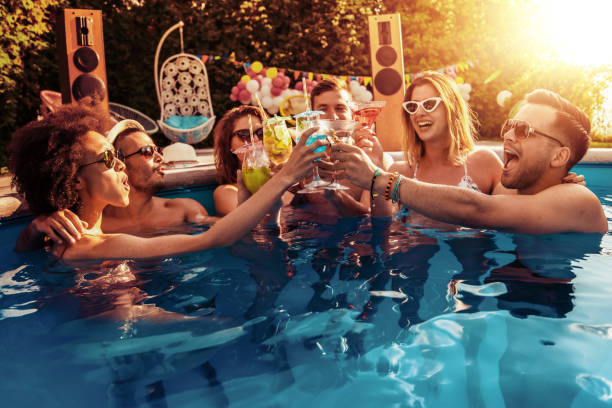
Enjoying Pool Party With Friends Stock Photo - Download Image Now - Pool Party, Swimming Pool, Party - Social Event - iStock

Pool parties are honestly the most hype kind of parties. It will NEVER, EVER be boring. If you don’t have a pool in your backyard or know someone with a pool, then this probably isn’t for you.. but public pools always exist. If you’re open to that.

  • Themed Party

How to Throw a Great Gatsby Themed Party - Haute Off The Rack | Gatsby party outfit, Gatsby party dress, Great gatsby themed party

Themed parties are not limited to kids. There’s so many different themes that are ‘mature’ or not seen as juvenile. Some trendy, cute ideas are: murder mystery party, costume party, 80s, tv shows/movies, masquerade, the great gatsby and glow in the dark.

  • Barbeque

Don't Let Your Barbeque Party End Up In Flames: A Few Safety Tips

Most people can bond over their love for food. One thing I love about a barbeque, is that you can smell it from miles away (even if it’s not yours). It takes so much self-restraint to not jump into my neighbour’s yard and help myself. I think that a barbeque would be great for close friends, or maybe acquaintances. Personally, I wouldn’t invite “strangers” because I see a barbeque as something that’s more intimate and shared with people that are close to you.

  • Slumber Party

Page 18 | Slumber Parties Images - Free Download on Freepik

For me, sleepovers have always been a great way to quickly bond with people. I’ve been to sleepovers where I knew them for at most 2 weeks, and we became great friends. Of course, if you barely know the person there are precautions you need to take in order to remain safe. This is just MY personal experience.

  • Costume Party

15 Tips for Hosting an Adult Halloween Party

Costume parties are exhilarating and are so fun to get ready for. Idk, it’s just a great way to bond with people because there are so many conversation starters and ways to bond.

  • Dinner Party

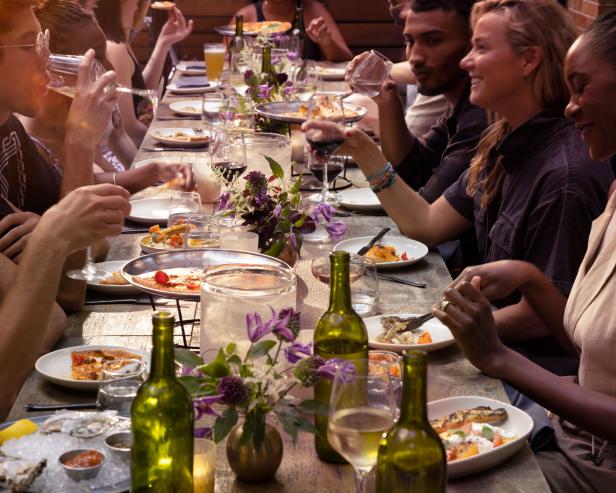
14 Restaurants Designed to Feel Like Dinner Parties | Restaurants : Food Network | Food Network

(P.S): a good party = LOTS of food/snacks.

Calgary’s Best Study Spots

0

Study spaces: you can find them anywhere. Especially with the return of diploma exams and finals, with at least a somewhat higher weighting than last year, any student can attest that finding a good study space was essential in the process of maintaining focus to study this past exam season. With the rush of exams having just passed, I thought it appropriate to share some of the places within the city that I found great in the city. 

Libraries

Libraries have long remained a classic study space for students of any age to drop by, and for good reason. Many of the public libraries in Calgary can be suitable study places, providing a quiet place (with wifi!) to go over school material, however, the Calgary Central library remains to be one of my favorite spots within the city. Unsurprisingly, the building has garnered a large reputation among residents for being a popular study space for students looking for a quiet but spacious place to go to. While it can get slightly louder during the weekends, the top floors of the facility often muffle any volume of events. The option of booking a meeting room for larger group sessions always remains open as well to students, and Luke’s Coffee on the bottom floor can provide a much-needed caffeine boost if needed. 

The Memorial Park Library is another popular place for high school or college students to go to. Not only is it accessible, its location bordering both south and north train terminals downtown, but the staff is widely considered to be incredibly accommodating for anyone who comes in. 

Cafes

Coffee shops have been a study-friendly haven for years. Not only do cafes provide a quiet place with few distractions (depending on the cafe in particular), but they have been proven to increase alertness and creativity in the past. The caffeine and other assorted baked goods available are, of course, an added benefit. Now, there are far too many cafes and coffee shops littered around Calgary with their own individual charm and appeal for me to go through every single one, but here are some of my favorites at least. 

Monogram Coffee has four different locations located in Calgary all with gorgeous natural light, clean and thoughtful space, minimalist decoration, friendly service, and delicious caffeinated beverages. It’s a perfect environment for studying or simply a comfortable place to go with friends for that break between exams. The fact that it is a local, independent business is just a nice boost.

If you don’t mind the potential business of the road nearby, the Oolong Tea House in Kensington is another great location. Their selection of teas is amazing for a cozy study session, and you can stay for hours without being bothered. I would recommend taking transit to get there if possible, just so nobody has to deal with the hassle of finding a parking space, but the cafe is definitely worth the trip if you want to get out of your house. 

A bit of nature

Exam season often means long hours hunched over desks, whether they be inside your house or another of the previously mentioned locations, but studies have shown either getting outside or experiencing some more nature around you can actually help the review process. Research indicates that time spent in nature can be connected to mental and cognitive health benefits, as well as improvements in mood and well-being. While the Devonian Gardens are the only indoor public park in the city, the so-called “urban oasis” is perfect for the cold weather that Calgary can never seem to get rid of. Located on the top floor of the CORE Shopping Centre, the garden is home to waterfalls, trees, and thousands of plants all encased in it. It is easy to find a small corner of the lush and open spaces of the gardens to have some serene time to study. 

However, if you are looking for something outdoors, the other public parks also offer a space for nice breaks. The green spaces green space outside of the Lougheed House, for example, are great for studying in warmer weather with more friends. 

In the end, where you study all depends on where you feel most comfortable, but feel free to take advantage of the numerous spaces Calgary does provide. Maybe you will even find a new favorite in the next exam season yet to come.

Featured Image

Sources: [1] [2] [3] [4]

Who Are You?

Identity. A word that can mean so many distinct things for different people. It can be a compilation of one’s memories, feelings and experiences. It can be your family, your background, or your friends. Identity can be a term to describe anything that makes a person, them. The only issue is, it can be complicated to understand who you are. It is not easy to compile an entire individual’s life experiences, habits and character into a set, and definite category. Yet human nature pushes us to assign names and structure to everything around us. 

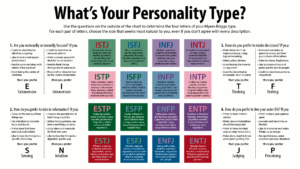
Well, in the field of psychology, a widely known personality classification system has been developed, known as Myers-Briggs Type Indicator System. The Myers-Briggs Assessment is based on a set of 8 functions theorized by a renowned and distinguished Swiss psychiatrist, known as Carl Jung. He developed the 8 functions as follows:

  1. Extraverted Thinking (Te)
  2. Introverted Thinking  (Ti)
  3. Extraverted Feeling (Fe) 
  4. Introverted Feeling (Fi))
  5. Extraverted Sensation (Se)
  6. Introverted Sensation (Si)
  7. Extraverted Intuition (Ne)
  8. Introverted Intuition (Ni)

If you are already familiar with personality types, you may notice that the categories “judging” and “perceiving” are missing. These groups were only later added to the Myers-Briggs system in particular. Depending on which functions are dominant in descending order, your personality type is described using a 4 letter combination. 

Each function is categorized as introverted or extraverted, meaning what happens inside the mind and outside the mind respectively. The four perceiving functions are extraverted sensing, introverted sensing, extraverted intuition and introverted intuition. The “perceiving” functions are characterized as how a person perceives information given to them. The judging functions are extraverted thinking, extraverted feeling, introverted thinking and introverted feeling. The “judging” functions are characterized as how a person makes their decisions. Each function has a specific meaning to it, for example, extraverted thinking is the making of decisions using objective facts whereas introverted thinking is decision-making through logic, data, classifications and personal theories. 

What I think sets aside Jung’s personality classification from others is the ambiguity associated with its core systems. Jung recognized that individuals are far too complicated to be defined through one label and instead settled on the philosophy that everyone has a bit of each function. Still, some are stronger and weaker for different people, characterised by the archetypes of dominant, auxiliary, tertiary and so on functions. He even uses that philosophy among introversion and extraversion- as someone who is an introvert is not completely an introvert, they are just more of an introvert in comparison to an extrovert.


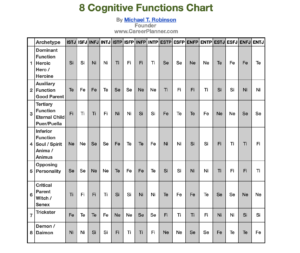
Above are the 16 Myers-Briggs personality types composed of 4 letters with their associated Jungian dominant and weak functions listed. The dominant function is the strongest function of that personality type- what trait that type uses the most and strongly. The Auxiliary function is the second most strongly used function, and so on with the other archetypes following this pattern down the chart, with your 8th and last function (the “demon” function) being your weakest function.

While the Myers-Briggs system uses the Jungian function system as its base, its types are characterised by 8 letters, each having its own meaning.

First Letter:

  1. I – introversion
  2. E – extraversion

Second Letter:

  1. S – sensing
  2. N – intuition

Third Letter:

  1. T – thinking
  2. F – feeling

Fourth Letter:

  1. P – perceiving
  2. J – judging


So for example, an INTJ is introverted, and uses intuition, thinking and judging. Each of these personality types has personality descriptions and associated traits. with them

In the Myers-Briggs community, it is suggested to find your personality type using your own research into the functions and what best fits your personality, for which I recommend careerplanner.com which has detailed insights on each of the functions and explains the Jungian system in an understandable manner. After all, who knows you best rather than yourself? Nevertheless, if you are looking for a quick outlook on where you fit into this system, you can use the popular 16 personality test. On a side note, I did find that the mistype investigator personality test can give you a more accurate personality assessment in comparison to 16 personalities, as it is considered by experts to be an oversimplified version of the actual 16 personality types. However, it is still a great resource as it sums up each personality in an easily digestible manner for those who have just discovered these concepts!

Whether it be for self-discovery or career planning, finding your personality type can give you a feeling of self-fulfilment and help you understand yourself and the people around you in a clearer light. Even so, you can find fictional characters with the same personalities as you using a personality database! Once you know which personality type you are there is a lot of room for exploration and research, and I hope that you also can find the same enjoyment in learning about yourself in the same way that I do.


Featured Images: 1

Image Sources: 1/2

What is Toxic Positivity?

0

We have all heard the sayings, “be positive!” and, “always look on the bright side!” from the people who care about us. But sometimes, even though they are just trying to help us out, these kinds of sentiments only serve to worsen our mood. That is because of something called toxic positivity.

Nowadays, we have all been hearing the word “toxic” thrown around. Toxic relationships, toxic masculinity, toxic environments… toxic, toxic, toxic! However, not many people have heard the term “toxic positivity.” That is why I am here, to explain it to you and provide you with healthier alternatives!

So, What Is Toxic Positivity?

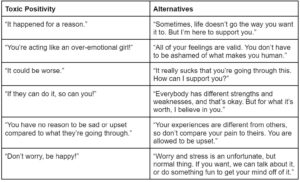
According to Psychology Today, “toxic positivity is the act of avoiding, suppressing, or rejecting negative emotions or experiences.” Essentially, it refers to denying or demeaning others’ emotions, or forcing those around you to always just be happy. Sometimes, it can even escalate to the point that people who have experienced a devastating loss or trauma are told that “it happened for a reason” or “other people have it worse”.  In many cases, toxic positivity is self-inflicted. Because of multiple factors, people pressure themselves to always be happy and never have a bad day. Often, this happens unconsciously or with good intentions. Unfortunately, good intentions do not always equate to good outcomes.

What Are the Consequences?

As we saw in the last paragraph, toxic positivity can deny and demean emotions that are perfectly normal and human. It can also isolate people, sending a message that no one cares about their feelings. To someone who has lost a loved one, it can feel like people never really cared about the deceased person. It also fails to solve the underlying reason for those negative emotions. Instead, it buries them deep beneath the shame and guilt of not being happy all the time. Toxic positivity can also cause stigma and doubt around people in abusive situations or with mental health problems, especially when the whole world is telling them that it’s not that bad. That they just need to have hope.

What Are Some Alternatives?

We all want to help out our loved ones, and learning this may have left you feeling confused and lost on how to proceed. But what we as a collective society needs to learn is that sheer, blinding positivity isn’t the only way to navigate our negative emotions. In fact, toxic positivity isn’t a way to do that at all! Instead, here are some other ways that you can be there for your loved ones.

Validate Their Feelings

We all know the feeling of being told to just “think happy thoughts!” when we are upset, and frankly, it does the exact opposite of cheering us up. Hearing that from someone just pushes you further into the deep, dark pit of despair.

A better way to go about sadness, anger, and all the other daunting emotions that we feel is to validate them. You may not understand these emotions that you or your loved ones are experiencing, and that is completely alright. But you can still acknowledge that they are normal. That they may make you feel horrible, but you are not a bad or abnormal person because you feel that way. In these situations, I find it best to sit with your emotions, and listen. Because there is always a root, and part of feeling better is to understand where these emotions came from.

Decrease the Stigma Around Feeling Bad

One of the reasons that toxic positivity is such a widespread yet unknown thing is because there is a huge stigma around emotions and a huge pressure to just be happy. Obviously, changing an entire society’s deep rooted views on a topic is no easy feat. But you can always start small. The biggest changes are sometimes in the smallest things. Talking to your family about mental health. Sitting with your friends and discussing all the different sides to being human. Establishing an open, non-judgemental space for communication within your relationships. Giving yourself time and space to feel, and to express those feelings. Because we all deserve mental health days when it becomes a little too overwhelming and a little too hard.

Replace the “Be Positive!” With “How Can I Support You?”

The most fleeting statements often stick with us for a very long time. So here are some other ways to verbally show your support.

A Final Quote

Finally, I have an Arab proverb that I feel reflects this message very well. It says, “Sunshine all the time makes a desert.” Often, the most profound things are short and simple, because they resonate with people. This proverb means that everything is not, and cannot be, perfect. Rain, or adversity, brings growth and resilience. Constant sunshine, and the world will be parched and dry. If it is always perfect, perfection ceases to exist.

Sources: 1, 2

Either Way, What Bliss

0

The hole in the ground matched the hole in his chest. Taking up the room where his heart used to be, pushing his lungs to the side in an effort to consume him fully. He guessed that this is what drowning felt like, a building pressure in his lungs, stopping his ability to do anything but grasp around blindly for something to bring him back to the present. 

He wasn’t sure he could be brought back again. How could he exist in this world when his own world, his everything, was right there, pale and beautiful as ever in her coffin? 

There was already a hole in the soil dug out for her, right on the edge of the cemetery, shaded by a rotting tree. It wasn’t fair, how someone who was the stars, the sun and the moon itself was treated so cruelly by fate, left to waste in a place so dull and unloved. 

He snapped out of his thoughts so suddenly he almost fell out of his seat as a hand came to rest on his shoulder. 

“I’m so sorry James. I can’t believe this has happened. It all seems to be out of a dream doesn’t it?” A somber voice spoke. 

“A nightmare, not a dream Mr. Porter.” He snapped. James Whitefield never snapped. It was one of his defining traits that others were always charmed by. But he just couldn’t help it, his world was aflame and there was nothing he could do. Mr. Porter seemed like he expected this though, and wasn’t fazed as he took the seat beside him. 

“I understand.” 

“No. No, you don’t. She’s gone, William. She’s gone and I don’t know what to do with myself.” William Porter looked at him sympathetically, as one usually does with someone on the verge of a great something, even if in the moment William Porter didn’t know how gruesome this great something was. He pulled a handkerchief out of his breast pocket and gently opened James’s clenched fists to put it in his palm. 

“Your heart is hurting, and I can’t say it’ll ever stop. I know you wish you could have done something to prevent her murder-” James flinched. “But you’re not responsible for it. That horrible monster is to blame and he is going to spend the rest of his life in jail for hurting Liliana. Life is going to keep going and it will never be the same but Liliana would have wanted you to keep living it freely and openly, just like she does-did.”

“But how can I not worry, I need to keep her safe!” 

“Keep her safe here.” He placed a caring hand on the grieving man’s chest and looked up at him with watery eyes. “There is no place safer than your heart, where she has been before and where she will stay with you as long as you live.” 

His heart. How could he be so stupid, of course, his heart! The safest place of them all. He needed to keep her with him, he needed to keep her safe. This was the best way to do it. Oh Mr. Porter, what a genius man! He knew what he needed to do. 

He needed his wife’s body back.


Night had fallen on the graveyard, the pale moonlight dancing in the leaves was the only sign of life. He sat hunched beside a fresh patch of soil toying with a rusted shovel on the floor. To an outsider he would look like a ghost, pale and still, and somewhere where he definitely shouldn’t be. A breeze blew through the graveyard. It snapped James out of his trance. It was now or never and he needed to do this. With a manic desperation he started clawing the dirt with his hands, dirt getting trapped into his nails and soil flying everywhere behind him. It wasn’t fast enough, he needed her now. Dig faster, dig faster, dig faster- The shovel! Yes, the shovel! That would help him get to her faster. He twisted around, looking more animal than human as he snatched at the shovel and started digging even more frantically than before. 

It felt like days later when her casket finally came into view. Mahogany etched with a perfect, elegant design. The most perfect part of it though, was her body waiting for him inside. 

He threw the shovel aside and jumped into the hole he’d dug, landing right beside her coffin. He bent down, quickly lifting the head of the coffin. The door of the coffin landed against the wall of the hole with a dull thud. He didn’t even notice it, his joy at being back with her encompassed him. She was lying there. Hair spread around her head like a crown, hands folded gently on her stomach. He fell to his knees. 

“Oh my love. I’ve missed you so much.” He hovered his hands around her face with care, not touching her in fear of ruining her perfection. Something cracked in his chest and the tears he couldn’t cry at her funeral started pouring down his face. He sobbed, a broken, heavy sound, and laying his head on her chest he wept. Wept for how young she was when she got taken from him. Wept at how unfair all this was. Wept for how stupid he was, how he couldn’t protect her in the moment she needed it most. 

He doesn’t know how long he sat there, pouring everything he couldn’t say into his tears, but as he saw the sliver of the sun on the horizon he knew he had to go. With gentle hands he picked her up, pressing her close to his chest. With her close to him again he felt like he could finally breathe again. 

He slowly and carefully climbed his way out of the hole, making sure to keep a grip on her. The sun was rising into the sky now, casting an orange glow over everything. He pressed a lingering kiss to her forehead and started walking out of the graveyard, his wife safe in his arms. 

He sat staring at her. The sun was high in the sky now but he had drawn the curtains, he didn’t want her to get hurt. He sat at his dinner table while she rested on the couch beside it. A set table was laid out in front of him, two different sized forks on one side, a knife and spoon on the other, right in the middle a plate lay. An empty tea cup was on his right. 

Every second he spent staring at her doubt creeped into his mind. It all just felt so wrong. She wouldn’t have wanted this, she would have wanted him to continue on without him and find a way to be happy. She didn’t understand though that she was the reason he was happy. He was nothing before he met her and now that she was gone he was nothing again. Yes, he was sure this was the right thing to do, the only way to keep her safe. Keeping her with him was safe and the right thing to do. 

He got up, imperceptibly slower than he usually would, and went to her. He gathered her in his arms and brought her to the table, gently laying her down on top. He left her there, walking over to the kitchen and grabbing a sharp bladed knife from a cabinet. He went to leave but stopped and reconsidered, turning on his heel he left the knife on the counter and grabbed a butcher’s knife from over him. Better safe than sorry, he didn’t know how hard human flesh was to cut. 

He laid the knife gently on the table, moving to run his hands through her hair. “I will finally be able to keep you safe. Forever.” Bracing one hand against her collar and using the other to pick up the knife, he said a small prayer under his breath, of forgiveness or strength he did not know. He raised the knife above his head and a second later brought it down to her throat. 

Her head rolled and fell off the table. Blood splattered everywhere, staining his face and coating the table. He bent down and kissed her scarlet throat. He walked down to the end of the table and pulled her so her knees were on the edge and her feet dangled off the side. Words of love and guilt, pain and hope, spilled from his lips like blood as he cut off her legs with the push and pull of the knife. Placing gentle kisses on her stomach he sawed off the rest of her legs and placed them on the couch. 

He turned around to walk back to the dining table but his knees buckled underneath him as all he had done finally registered in his mind and he caught sight of her laying there, the light of his life and love of his heart, butchered and sawed up and bloody. Her face on the floor was looking him right in the eyes. God she was gorgeous. She was perfect no matter what but with red tainted fingers and pale skin she was Aphrodite herself. He sat there just admiring her until blood started to drip from the knife onto his pant leg. This shook him from his awe and he got up again to finish the job he had started. Kissing each of her fingers on the knuckle he softly cut her wrists off then moved to her shoulder and tore it off. Her torso was the only intact piece of her body now

He wiped his face on his shirt sleeve and dropped the knife on the table. He moved calmly as he picked up her limbs and arranged them on the couch, from what he assumed was the easiest to eat (the ones that were the easiest to cut) and the toughest to eat (the hardest to cut). A slow grin started crawling its way onto his face. Finally, she was safe. She was with him and she was perfectly safe. Once he had her with him, right next to his heart she’d be the safest. With this thought he grabbed her forearm and brought her to his plate. He wiped away the blood with a flick of his hand and gently placed her down. His mirror reflected him with a mad glint in his eye but when he blinked it was gone. He sat down and said his grace.  

“Lord God, Heavenly Father, bless us and these Thy gifts which we receive from Thy bountiful goodness, through Jesus Christ, our Lord. Amen.” 

He picked up his fork and tucked a napkin into his shirt. He gave her one last kiss before using his knife to cut a chunk of flesh out of her arm. 

His first thought when he tasted her was how perfect she was. Everything about her was perfect so of course she tasted perfect too. After that he couldn’t stop himself, she was perfect and he needed to keep her safe so he kept on eating. Finishing up her whole forearm he shot up and practically ran to pick up another piece of her. He tore into her with the twisted enthusiasm of a man believing he was doing something right. He kept on going with the same routine: finish a piece, stack the bones beside the couch, run to get another one, finish a piece, stack the bones beside the couch, run to get another one. He could feel himself getting full and almost jumped from joy at having her with him at last. Her flesh and his flesh, never apart. 


The morning sun peeked through the closed curtains. He had just eaten her heart. Snapping toward the couch to continue on with his mission he stopped in his tracks. The couch was empty, there was none of her left. All that remained was old blood stains turning from deep red to brown. She was gone. Wasn’t that what he wanted? She was with him, that was the whole point of doing this. Yet his heart squeezed. She was safe, sure, but she wasn’t here anymore. He could never kiss her again or hold her or look in her eyes. He had washed her hair down the drain earlier and it hit him that he would never be able to touch it again. 

She was gone.

It was like all the sunlight had left the apartment and the air was stolen along with it. 


He didn’t remember the last few days of his life. After she was truly gone, both mind and body, he became someone else. He vaguely remembered a red stained mop, his house in ruins, police lights, so many police lights, flashing outside of his window. There was a feeling of cold metal on his wrists, he assumed he had been cuffed for a period of time. Blurred faces outside of a barred up window of disgust, disbelief and pain. 

“You’re a monster!”

“She loved you!”

“What have you become?” 

All their shouting meant nothing to him. He had done the right thing. He was sure of it. He didn’t regret a second of it. 

He was kept overnight at the police station, nobody knew what to do. He didn’t murder his wife so he couldn’t be charged for homicide but he had done something almost just as worse. The policemen talked in hushed whispers outside his cell about him. James Whitefield, the soft-spoken, hard-working husband who turned into a madman from grief. 

It was decided he would stay overnight at the station, so they could keep an eye on him, and the consequences of his actions would be decided the following day in court.

The last of the policemen filed out of the building, eager to be away from James’s stare. He had spent the better of the last hour just staring at the policemen. Spending his time analyzing one, then barely moving his head to find someone new to stare at, this same cycle repeating itself a dozen times over. The sheriff opted to stay back, waiting for the night shift police to make their way over to the station before he left. He didn’t want to leave James alone for even a second. 

Suddenly, after a whole evening of silence, he called out to the sheriff. 

“May I borrow your letter opener?” 

The Sheriff’s head snapped toward him and he was so surprised he couldn’t help but speak.

 “Excuse me?”

“Your letter opener. The one right behind you there, with the silver handle.” 

“Now is not the time for jokes James,” he spat. “Shut up and turn around.”

“I’m so sorry, I know I’m being a bit out of line but I really do need that letter opener. You see, killing myself is the only way to be back with my Lily so I was hoping it wouldn’t be too big of a hassle if you could pass me it and I could quickly get it done.” 

James smiled softly and casually, as if they were just discussing the weather over a cup of tea. The Sheriff’s blood had drained out of his face and he quickly fell into a chair. James simply tilted his head in a curious manner. 

“I-Well-” The Sheriff was quiet for a moment before his eyes became steely and he gave a nod as if reassuring himself about something. He leaned over and gingerly grabbed the knife, quickly sliding it over to the cell as if he’d been burned. James picked up the knife and brought it straight to his throat but before he could do anything the Sheriff spoke and stopped him. 

“I’ll miss you James. I already do, I miss the James you were yesterday.” 

“Liliana was with me yesterday, my friend, that is the difference.” The Sheriff sighed, as if he expected that answer. 

“I hope you find some peace.”

“I guarantee you I will, but I thank you for your prayers. I am on the verge of something great my boy, I can feel it.” 

“Then why haven’t you done it yet?” James hesitated, as if he hadn’t expected someone to actually ask him that. His voice was soft and almost sounded like he was going to cry when he spoke again. 

“Lily is in heaven no doubt, I fear I am going to hell. But still, let me fill you in on a little secret. She wasn’t just everything to me, she still is everything to me. And I will do anything, no matter how much it taints my soul, to keep her safe and happy. There is one quote in particular that I love that I think describes it all very well. It goes something like this: “I would die for her. I would kill for her. Either way – what bliss.” 

With that he gave the Sheriff a final grin and slit his throat. 

Mental Health: What’s Changing For Children and Adolescents in Alberta

0

With Bell Let’s Talk day approaching on January 25, I wanted to share some exciting updates about increasing mental health resources for children and adolescents. After COVID-19, the lasting effects of the pandemic have led to a surge in mental health struggles. In light of this, a centre for child and adolescent mental health has been constructed and will open sometime soon this year.

As a member of the Alberta Children’s Hospital Foundation Youth Council, I am excited to share all the details regarding this new centre that will have such a positive effect on the lives of so many people in the near future. The centre has been built in partnership with the Alberta Children’s Hospital Foundation and Alberta Health Services, and was just recently named, The Summit: Marian & Jim Sinneave Centre for Youth Resilience.

Currently, children and young adults who face mental health crises have limited options such as having to wait hours at emergency departments, which are often extremely busy. The Summit will provide direct access to on-site assessment and therapy, depending on the child or young adults’ needs. With the University of Calgary as its research partner, the new centre will also involve cutting-edge research and training for new specialists.

Depending on the nature and severity of the mental health issue, children and adolescents are provided with three options in this new centre:

  1. Walk-in Clinic: an opportunity for youth and their family to receive help from specially trained doctors through one-hour therapy sessions, access to psychiatrists, referrals to other services, and development of personalized plans. Self-referrals are welcome alongside referrals from other mental health programs or professionals in education, health, etc.
  2. Day Hospital: a place where young people can receive therapy, medication management, outreach to provide support when transitioning back to their communities, and support for education. The Day Hospital aims to reduce young peoples’ stay in the hospital through a smooth transition back to their regular lives.
  3. Intensive Treatment: for those struggling with acute and escalating mental health symptoms, the Intensive Treatment service offers thorough assessments, therapy, and a multitude of other resources to help those in need.

How can you support mental health initiatives in your community?

  1. Break the stigma surrounding mental health by speaking up, educating yourself, and raising awareness.
  2. Fundraise and donate to the Alberta Children Hospital Foundation–any contributions make a great impact.
  3. Show your support through advocating for increased mental health awareness, or by being there for your friends, family, and yourself when going through hard times.


Image, Cover Image/Thumbnail, Sources: 1,2,3,