Home Blog

Shakespeare’s Systems

Centuries later, William Shakespeare and his works remain prominent influences of English literature in classrooms worldwide, beginning in grade 10 in Canada. Almost anywhere you go, students study Romeo & Juliet, Hamlet, and McBeth, analyzing and interpreting the plays, making this ritual ever evolving and allowing new ideas to emerge with every turn of a page and turn of a decade. 

Across Shakespeare’s works, human beings are repeatedly shown as creators of systems- political, social, and moral- that attempt to impose order on an unstable world. In Romeo & Juliet (the one I’ve had on the mind these past few months), these systems seem to collapse under the weight of human contradiction, suggesting that what is understood as “fate” may instead be the result of structures humans themselves construct and then misinterpret.

Being human means struggling in the middle of imposed order and inherent chaos, where hierarchy is used to satisfy humanity’s need for structure. We are constantly being disproved and confused by the disorder within these complex networks, and the fallout is interpreted as divine fate. 

In Romeo & Juliet, Shakespeare presents humans as inherently unstable, driven by conflicting desires for freedom and order. Hierarchy is shown as a structure we create to control the unpredictability of their own nature, often disguising these systems as divine or natural law. The Great Chain of Being reinforces this idea by presenting social order as something decreed by God, where power and status descend through carefully maintained levels of authority and importance. However, Shakespeare repeatedly suggests that these systems are fragile because they depend on flawed human behavior to sustain them, questioning their legitimacy when they are so easily manipulated and abandoned.

To further that idea, I believe the masquerade scene and the attire accordingly worn symbolize the socially constructed identities enforced through hierarchy. At a certain point, the masks will no longer fit correctly, reflecting the instability of imposed roles when human individuality begins to resist them. Romeo and Juliet’s decision to love each other anyways is an act of personal choice rather than submission to predetermined fate, suggesting that human action, not divine order, shapes the course of events.

Once this moment of disruption occurs, the social order collapses into conflict. Shakespeare does not fully endorse either chaos or control; instead, he questions whether fate truly governs human life at all. Authority itself is performative, maintained through the suppression of humanity’s inherently uncertain and contradictory nature. Beneath systems of hierarchy and order, Shakespeare suggests that all people remain unstable, questioning individuals attempting to impose meaning upon disorder.

Sources: 1, 23

Celebrating Asian Voices Through Literature

Asian Heritage Month is a time to recognize and celebrate the cultures, traditions, and contributions of Asian communities around the world. Literature is one of the most powerful ways to explore these voices because books allow readers to connect with experiences, histories, and perspectives that may be different from their own. By reading these stories, we not only appreciate diverse forms of storytelling, but also gain a deeper understanding of the people and traditions that shape our communities.

1.Jenny Han

Jenny Han is a bestselling Asian American author who is best known for her two young adult novels that focus on family, identity, friendship and romance. She gained huge recognition on the trilogy series To All the Boys I’ve Loved Before. To All the Boys I’ve Loved Before is now adapted as a movie trilogy. Through both the movies and the books, Jenny Han introduces us to Lara Jean, a Korean American teenager navigating love and growing up. Through her writing, Jenny Han celebrates culture in a natural and meaningful way while also showing that Asian characters can be at the center of universal coming-of-age stories enjoyed by readers everywhere.

2. Ann Liang

Ann Liang is a Chinese Australian author known for writing contemporary young adult novels that explore identity, friendship, family expectations, and self-discovery. She is one of my favorite author and her books, This Time It’s Real and If You Could See the Sun, are one of my five star books because she includes relatable characters, emotional storytelling, and blends comedy and romance perfectly. She often includes Asian protagonists and cultural experiences in her stories, helping readers see more diverse voices represented in modern literature. Through her writing, she highlights the pressures many teenagers face while also celebrating individuality, ambition, and cultural identity.

3. Sophia Lee

Sophia Lee is an underrated Asian author who wrote a story on identity and personal growth. Sophia wrote Eliza, from Scratch, I recently just finished the book, and found it a relatable coming of age story. Eliza, the protagonist is trying to find her true self while also trying to balance expectations and relationships. Sophia shares diverse perspectives through the story, sharing some of her culture and traditions with her readers through this story.  Personally, I found the protagonist realistic because the author shows how many young teenagers don’t know much about their cultural background and traditions. Sophia Lee has helped celebrate Asian voices and shows the importance of Asian Heritage.

Conclusion

In conclusion, Asian authors have played an important role in Asian Heritage by sharing diverse stories, cultures, and perspectives that help readers learn and connect with others. Writers such as Jenny Han, Ann Liang, and Sophia Lee create meaningful stories that explore identity, family, friendship, and belonging in young adult literature. Celebrating Asian voices through literature during Asian Heritage Month reminds us of the importance of diversity in storytelling and how books can bring people together through shared experiences and understanding.

The Science Behind Why Music Changes Your Mood

0

Have you ever noticed how one song can completely change the way you feel?

A slow piano piece can make you emotional. A loud upbeat song can suddenly give you energy at the gym. Sometimes a random song comes on and instantly brings back a memory you forgot you even had. Music has a strange way of affecting us without us even realizing it.

Most people think music is just entertainment, but there is actually a lot of science behind why it changes our mood so strongly.

One reason music affects us is because of the brain chemicals it releases. When we listen to music we enjoy, our brain releases dopamine, which is known as the “feel good” chemical. Dopamine is also released when people eat their favorite food, laugh with friends, or accomplish something exciting. This is why listening to your favorite song can make you feel happier almost immediately.

Music also affects heart rate and breathing. Faster songs with strong beats can increase energy levels and make people feel more awake or motivated. Slower music tends to calm the nervous system and lower stress levels. That is why people often listen to calm music while studying, sleeping, or relaxing after a stressful day.

Another interesting reason music changes mood is because it connects strongly to memory. Scientists have found that the brain stores memories alongside emotions and sounds. This is why hearing one song from years ago can instantly remind you of a specific moment, person, or feeling. A song can bring back happiness, sadness, nostalgia, or even confidence depending on the experience attached to it.

Lyrics also play a major role. Sometimes people connect deeply to songs because the words describe emotions they cannot explain themselves. Music can make people feel understood, especially during difficult times. Even without lyrics, instruments alone can communicate emotion through rhythm, tempo, and melody.

What is fascinating is that music affects almost everyone differently. One person might hear a song and feel relaxed, while another person feels emotional because of personal memories connected to it. Our experiences shape how we react to certain sounds and genres.

Today, music is part of everyday life. People listen to it while driving, studying, working out, cleaning, or walking home. It has become more than background noise. For many people, music is a way to escape stress, improve focus, or express emotions they cannot put into words.

In a way, music acts almost like therapy. It can motivate people when they feel tired, comfort them when they feel sad, and help them feel connected during lonely moments. Even though music is made of simple vibrations and sound waves, its effect on the human brain is incredibly powerful.

The next time a song changes your mood in seconds, there is a good chance your brain chemistry, memories, emotions, and body are all reacting together. Music is not just something we hear. It is something we feel.

https://www.bing.com/ck/a?!&&p=3928416bfca425ced540e65ba12fa781c9b8b11cafe1ddc29ac29ce3cfa1adc2JmltdHM9MTc3ODM3MTIwMA&ptn=3&ver=2&hsh=4&fclid=0538e8eb-7730-6d42-09e4-fbf776846c71&u=a1aHR0cHM6Ly93d3cuYXBhLm9yZy9tb25pdG9yLzIwMjYvMDMvc2NpZW5jZS1vZi1tdXNpYw&ntb=1

Understanding Depression

What Is Depression?

Depression is more than just feeling sad for a short time. It is a mental health condition that can affect a person’s thoughts, feelings, energy, and daily life. People with depression may feel hopeless, tired, unmotivated, or lose interest in activities they once enjoyed.

Signs of Depression

Some common symptoms include:

  • Feeling sad or empty most of the time
  • Losing interest in hobbies or activities
  • Changes in sleep or appetite
  • Feeling tired or having low energy
  • Trouble focusing or making decisions
  • Feeling guilty or worthless
  • Anxiety or irritability

Everyone experiences depression differently, and symptoms can vary from person to person.

What Causes Depression?

Depression does not happen because someone is “weak.” Many factors can contribute to depression, including:

  • Stressful life events
  • Genetics and family history
  • Changes in brain function
  • Physical health problems
  • Long-term stress or trauma

Scientists also believe that different parts of the brain involved with emotions, memory, and stress can play a role in depression.

Treatment and Support

Depression is treatable, and many people recover with the right support. Treatment may include:

  • Talking to a therapist or counsellor
  • Medication prescribed by a doctor
  • Healthy habits such as sleep, exercise, and social support
  • Support from family, friends, or community groups

It may take time to find the treatment that works best, and that is completely normal.

Why Mental Health Awareness Matters

Many people with depression feel alone or afraid to ask for help. By learning more about mental health, we can reduce stigma and create a more supportive community for everyone.

If you or someone you know is struggling, reaching out for help is a strong and important step.

Source: [1], [2], [3]

Behind AI: Data Centers Uncovered – Part 1


AI has become a huge part of our lives, whether we use it daily or only occasionally; the world around us is becoming increasingly dependent on it. Despite being surrounded by them, it is easy to overlook the behind-the-scenes of how different AI platforms run. Data centers are the heart of AI, where they not only manage data but also provide a system with all the required tools to run servers, process information, maintain optimal temperatures, and protect information without massive disruptions.

What Are Data Centers:

Unsplash. By Taylor Vick. Published on May 21, 2019

Think of data centers as a huge kitchen pantry that stores all the ingredients required to run software in racks. These storage units contain servers that process information, network equipment that enhances connectivity and cooling systems to avoid overheating. Each data center has a unique design in which they use various cooling systems and structural designs depending on their location. For example, a data center in California will have a greater demand for energy and chillers than a data center in Alberta, considering the naturally cool climate.


How They Work:

Within a single data center, there are several systems working together to support the applications we see on our laptops. Google, Microsoft, Amazon, and many other big companies have data centers that help operate the digital services they provide to customers. In order to understand the function of a data center, we need to understand how it uses energy.

Unsplash. By American Public Power Association. Published on October 30, 2017. Energy

Why Do Data Centers Use So Much Energy?

One major concern surrounding the increase in data centers is the energy usage. One data center, as of 2026, uses between 48 and 72 megawatts (MW) of energy. At the same time, the number represents the daily energy used by roughly 60,000 households!

Despite the large-scale energy usage, most of us forget to understand the complexity of data centers, which leads to such high energy consumption. Each data center has hundreds of servers, which consist of GPUs and CPUs that are responsible for processing and generating responses to our AI prompts.

Beyond computer work, energy is used to power the cooling technologies that prevent overheating in a data center. You may have noticed that after long hours of working on your computer, heat starts to build up beneath the computer. Picture this example on a large scale, where every server generates heaps of heat throughout the day. Since servers are stacked in close-set racks, heat can easily build up and potentially cause fires within the data center.

How Do Data Centers Cool Themselves?

Unsplash. By Đào Hiếu. Published on March 25, 2025

Depending on the resources and constraints of the data center, various cooling methods can be used. For example, a traditional air cooling system uses fans to transfer cold air into the surroundings; this system removes the warm air that rises and allows cold air to enter through the floors. Although this method is effective, it consumes 30-40% of the total electricity within a data center. On the flip side, liquid cooling methods are more efficient at absorbing heat and allowing servers to be densely packed. Unlike air cooling methods, liquid cooling uses less power, which means less energy is used.

Why is this Relevant to Us?

Unsplash. By Immo Wegmann. Published on April 14, 2025

While you may feel like this is a system that doesn’t impact our lives, data centers are a huge part of the tech world. North America alone is home to 48% of the global data centers. As the next generation of leaders, we need to understand how we can improve modern technology and develop sustainable systems in order to maximize the use of AI. So the next time you put a prompt into ChatGPT or Gemini, think about your role in the future of STEM.

If you enjoyed the tech insights, stay tuned for part two!

1,2,3,4,5,6


Introverted, Extroverted…Ambiverted? Deeper Than the Shallow Pool We Understand.

If someone were to ask you, “Are you an introvert or an extrovert?” Do you have an immediate answer? Do you tend to ponder, even for a second, where you fall? Most individuals refer to introverts as quieter and more thoughtful, extroverts as louder and more outgoing and Ambiverts as somewhere in between the two extremes. However, there’s more to these names than eleven letters.

Traits

Before understanding more about these titles that reflect our personality, we need to know which category we may end up in.

Introverts

  • Introverts prefer one-on-one conversations rather than a dynamic group discussion
  • They tend to feel drained after a long day of socializing and need some time to recharge.
  • They are more shy or socially awkward
  • They don’t enjoy speaking up, are thoughtful listeners, and they can often be found overthinking things.

Extroverts

  • Extroverts prefer talking through selective conflicts.
  • They enjoy socializing and feel energized from it.
  • They are constantly seeking new thrilling experiences.
  • They prefer a larger social network group with variety, make decisions quickly and are more outgoing, confident and reckless.

Ambiverts

  • Ambiverts do well in social settings and alone
  • They are more decisive than impulsive,
  • Active listening comes naturally for them,
  • They can adapt well to new situations or experiences, be flexible when it comes to problem-solving and draw others out naturally.

Happiness Levels, Which One is Better?

There isn’t a spectrum for which is better because every sign has its strengths and weaknesses. The same applies to happiness rates. While many might think that introverts would be less happy or optimistic because they overthink everything and are always alone.

Extroverts, who are naturally attracted to socializing, feel utterly devastated when they are alone, even for a school project and feel the need to reach out to someone, causing low happiness rates when they are alone, and to live life, there are several times we are confined to solitude.

Ambiverts, on the other hand, might feel growing doubt that they aren’t enough, that they are too weird, or that they don’t fit in with any group, leading to a lack of self-confidence and joy.

Our Brain

Research shows that extroverted individuals may have higher levels of dopamine, which they are born with, experiencing more of a dopamine release when trying new things, socializing, or simply engaging in activities or surroundings, strengthening those extroverted traits.

The Line

Introverts and Extroverts are polar opposites, and being an ambivert means being somewhere in between. In a way, we are all ambiverts because to achieve a perfect introvert with not even an ounce of extroversion is truly rare and nearly impossible. This is because we don’t have a fixed personality and often grow into new molds that are equally unique; we all have differences which make us, well, us.

Nature vs Nurture

While you can grow into yourself, we are born with specific characteristics, one of them determining our introversion, extroversion, and ambiversion. In this context, nurturing our type may decrease the level of whatever type you are; however, it is ultimately our nature that shapes our introversion, extroversion and ambiversion.

Links: 1, 2, 3, 4

Video Translation: The Backbone of Modern-Day Media

Video translation is a rapidly growing and in-demand field, with the development of new and efficient technologies and methods. It is the process of modifying videos for an audience that speaks another language. It is a complex process that involves altering subtitles, recording and implementing voice-overs, dubbing and much more.

This is commonly used in films, television shows, social media videos and marketing purposes. Video translation plays a vital role by breaking language barriers, allowing content to reach global audiences, and making content more accessible. In this blog post, we will be taking a deep dive into video translation, its history, how it is impactful, and some challenges in this field.

History of Video Translation:

  1. 1900-1930s: The first form of video translation involved inserting cards with written text to act as subtitles inserted between scenes of films, which were all silent.
  2. 1940-1960s: As technology improved, dubbing films began to develop.
  3. 1970-1990s: VHS and DVDs introduced multi-language audio tracks and subtitles, revolutionizing the industry.
  4. 2010s: Social media platforms like YouTube began to introduce auto-generated captions to make content reach globally.
  5. Present: The rapid growth of technology and Artificial Intelligence has introduced voice cloning, lip syncing, and AI translation software.

How Video Translation is Impactful

Today, the world is more connected than ever before, and video translation plays a major role in our society. It helps turn a local story into a global movement. Here are some of the impacts of video translation across today’s society:

  • Breaking Language Barriers and Spreading Information: Video translation enables information to spread rapidly around the world by allowing everyone to understand it. For example, a student from Egypt can watch a lecture video recorded in Germany.
  • Economic Growth: Businesses can use video translation to promote their product and idea to a global audience to enter new markets and gain more clients.
  • Cultural Exchange and Increased Awareness: Shows and films can be watched in another language, allowing people from different parts of the world to learn about other cultures and become more aware of the amazing world we are a part of.

With the recent developments in technology and artificial intelligence, the video translation industry is being revolutionized and evolving. By using AI-based video translation software and processes, creators and businesses can easily translate content into multiple languages with little cost.

Some Challenges in the Video Translation Industry

There are several key challenges and hurdles that the voice translation industry and the development of new technologies are aiming to address. First and foremost, maintaining the emotional intent and tone is difficult. For example, simply translating from one language to another can cause confusion among audiences if the statement is intended to be sarcastic or contains a cultural reference intended for one audience.

Also, the emotional tone and nuance of the statement can be lost when using AI processing. Also, the debate between using human translators or AI-driven tools is ongoing, as while AI-generated tools can be efficient and cost-effective, humans are more effective in maintaining the authentic tone of the content.

Sources: 1, 2

The Wonders of Water

Water feels basic. It’s everywhere, it’s free (sometimes), and it’s usually the last thing people get excited about compared to energy drinks, coffee, or anything with a flashy label. But biologically, water is less of a “drink” and more of a system that keeps your entire body running. You are mostly water (roughly half to two-thirds of your body depending on factors like age). That water isn’t just stored; it’s constantly moving through your bloodstream, your cells, and your organs!

One of water’s biggest roles is helping your blood do its job. Blood plasma is mostly water, and it’s what allows oxygen, nutrients, and hormones to travel through your body. Without enough water, your blood volume drops slightly, which makes your heart work harder to circulate everything efficiently. This is why even mild dehydration can make you feel tired or sluggish because your body is basically running a more “strained” version of its normal system.

How it shows up to help in everyday life

Water is also central to thermoregulation, which is your body’s ability to control temperature. When you overheat, your sweat glands release water onto your skin. As that sweat evaporates, it carries heat away with it. However, it only works properly if there’s enough water available to produce sweat in the first place. If you’re dehydrated, your cooling system becomes less effective, which is why overheating risks go up faster than people realize.

Your brain is especially sensitive to hydration changes. It’s made up of about 75% water, and even small shifts in fluid balance can affect how it functions. Mild dehydration has been linked to reduced attention span, slower reaction time, and poorer short-term memory. You might not feel “thirsty,” but your brain can still be operating slightly below optimal efficiency (which shows up as brain fog, irritability, or difficulty focusing). This is also why hydration can affect mood too!

Why thirst isn’t a perfect warning system

One of the biggest misconceptions about hydration is assuming thirst shows up exactly when you need water. In reality, thirst is slightly delayed. By the time you feel it, your body may already be in a mild state of dehydration. That doesn’t mean you need to constantly obsess over water intake, but it does explain why consistent sipping throughout the day tends to work better than waiting until you feel dry or fatigued. Hydration doesn’t usually give dramatic instant feedback. It’s not like caffeine where you feel a spike or sugar where you feel a rush. Instead, it affects baseline functioning such as energy stability, focus, digestion, and even physical performance. That’s what makes it easy to underestimate. You don’t always notice when you’re properly hydrated, but you often notice when you aren’t! 

Overall, water intake is a crucial part of your diet and it needs to be integrated as much as possible. Drink more water, regardless of how busy you are because it will actually improve so many parts of your everyday life!

Sources: 

https://www.cdc.gov/healthy-weight-growth/water-healthy-drinks/index.html

https://www.medicalnewstoday.com/articles/290814


The 2014 Umbrella Revolution Explained


In 2014, throughout Hong Kong, protest crowds erupted demanding democracy. 

Hong Kong students had began to critique the government, and many began to vocalize concerns about the government’s system. Beijing’s increase in political control over Hong Kong and suffrage means the citizens’ needs are unmet by the government. 

There was a deeply rooted fear among Hong Kong residents that they would lose their autonomy under the rule of the Chinese communist party, and that their rights were growing increasingly scarce with restrictions on freedoms of choice and speech. 

The trigger came when, in 2014, the Chinese government announced that candidates for Hong Kong’s Chief Executive would have to be approved by Beijing before running, a clear abolishment of democratic principles. 

Student leaders and activists began to speak up about the issue, organizing protests. Additionally, the Hong Kong government’s unwillingness to speak to the public about the issue created more outrage and protests. 

After many student leaders spoke out, protests began to spread. Many were influenced by their critiques of the government’s control of emotions and anger towards the Hong Kong government. Peer pressure caused momentum towards protests, making them bigger and bigger, using umbrellas as a symbol of the movement itself. 

The crowd did not turn into a mob or riot; however police took their protest as violent and negative. This resulted in violence and brutality from the police. Many medic volunteers at the protest were then pepper-sprayed or hurt in the chaos.


Police using tear gas against peaceful protestors creates more anger and resistance against the government. Social media and documentation of the protests also spread the word, educating others about the matter as well. 

The decline stage of the protest took place after both Chinese and Hong Kong government officials refused to budge in their stance or compromise upon their prior stated announcement on the 2014 elections, following more arrests of peaceful protesters, the usage of tear gas, and the inability for many to resume daily life, which caused protesters to retreat unsatisfied. 

Today, protests still occur in Hong Kong, and full democracy does not exist, as many of the original demands for greater political freedom and autonomy remain unmet.

Power, Fear, and Obedience in Margaret Atwood’s Gilead

In The Handmaid’s Tale by Margaret Atwood, power is not only enforced through laws or violence. It works because people are afraid, and because they learn to obey without needing to be forced all the time. Gilead is not only controlled by those at the top. It is sustained by the people living inside it.

Water Scarcity – The Next Major Global Concern

Water is the most critical resource for all living organisms on our planet. Canada is blessed to have numerous lakes and freshwater resources. However, water scarcity is a growing problem that affects every living being around the world today. In this blog post, we will be taking a deep dive into the water scarcity issue, the causes of the increase in water scarcity and what we can do to combat this and make a sustainable planet for future generations.

What is Water Scarcity and Why is it such a Big Issue?

Water scarcity is when the need and demand for clean freshwater exceed the available supply. Currently, high water scarcity is experienced by over 25 countries around the world, where industries and households consume more than 80% of their available renewable water supply each year. 

According to UNICEF, approximately four billion people experience severe water scarcity for at least one month every year. Additionally, millions of people, including children, around the world are forced to walk many kilometres every day to collect usable freshwater for their household uses, due to the inaccessibility of clean water in their areas.

What are the reasons?

With the rise and development of technologies, such as artificial intelligence, crucial resources, including water, are being depleted at an alarming rate. Data centres around the world consume millions of litres daily for cooling purposes. Climate change is also cited as a major reason for the increasing water scarcity because rising temperatures disrupt the water cycle, leading to frequent droughts and the melting of freshwater resources like glaciers.

Another reason for water scarcity being experienced in many developing countries around the world is due to poor infrastructure and a lack of water management and treatment facilities. Pollution is also a key reason for water scarcity, as contamination from chemicals and untreated waste makes existing water sources unusable for drinking.

What are some possible solutions, and how can we help?

Current methods of water usage are not sustainable and will create more problems for life on Earth. So, the steps to address this issue are very critical for the survival of future generations. There are many ways and methods to help solve the water scarcity problem. By using advanced electronic sensors and AI, we can help conserve water usage in agriculture, which accounts for 70% of global water withdrawal. By developing and implementing modern technology, we can increase efficiency in existing irrigation methods.

As global citizens, we can help fight for this cause by conserving our water footprint and being mindful of our resource usage. This can be as simple as turning off the faucet when you are not using it, while brushing your teeth. We can also donate our time or money to charity and non-profit organizations like UNICEF to help build technology and make clean water more accessible to others experiencing water scarcity. Additionally, we can also spread the word through social media or by talking about this issue to spread awareness and raise our voices.

Sources: 1, 2

Media Profile: A Series of Unfortunate Events

Media Profile: A Series of Unfortunate Events

Recently, I rewatched a favourite childhood series of mine called “A Series of Unfortunate Events.” However, despite it being labeled a children’s show, it has an incredibly complex commentary on social issues, the imperfect nature of justice, and human optimism. 

A series of unfortunate events is originally a book series by Daniel Handler, which has two TV and movie adaptations. The recent Netflix adaptation is believed to be the most faithful to the source material. 

The first aspect of this adaptation that is very interesting involves its use of humans’ inherent desire for hope, or belief in hope. The literal opening song verbatim says “Look Away” and describes how disappointing this tale is, and just how miserable the circumstances of the Baudelaire orphans’ lives are. The story never lies about its outcome. There is no triumph, there is no satisfying resolution. However, even with that warning, viewers continue to watch and observe the lives of the Baudelaire orphans. We even expect these orphans to be rewarded for their hardships or finally get justice. The question then becomes, why? Why do humans continue to believe in a happy ending despite being explicitly told there is no happy ending? This series seems to argue that hope is an inherent human feature, and in many ways paints the viewers as equally delusional as the adults within the story.  

Additionally, the role of justice and adults within this media is also interesting. In most films and media, adults are portrayed as not only logical but also as safeguarders of the law. This is flipped on its head in a series of unfortunate events, with Mr. Poe, the supposed protector of the children, being incompetent and oblivious. The story portrays justice through a very cynical lens, with justice being used more often than not to harm the children. The tale presents the very flawed nature of the legal system and authority in our real world. Arguing that intelligence, or morality, does not guarantee power or success. Count Olaf repeatedly gets away with crimes not because he is brilliant or clever, but because society is careless and oblivious. 

Overall, this series is incredibly fascinating as it diverts from the stereotypical children’s portrayal in novels and adds an extra layer of gothic humor and whimsy to its tale. While simultaneously establishing an intricate and metaphorical worldview, it also weaves real-world themes into its storyline. A Series of Unfortunate Events is a wonderfully executed book and TV series that continues to be relevant to children and adult viewers alike. 


Feature-a-Founder: Skating Toward Inclusion: An Interview with Alexander Sun

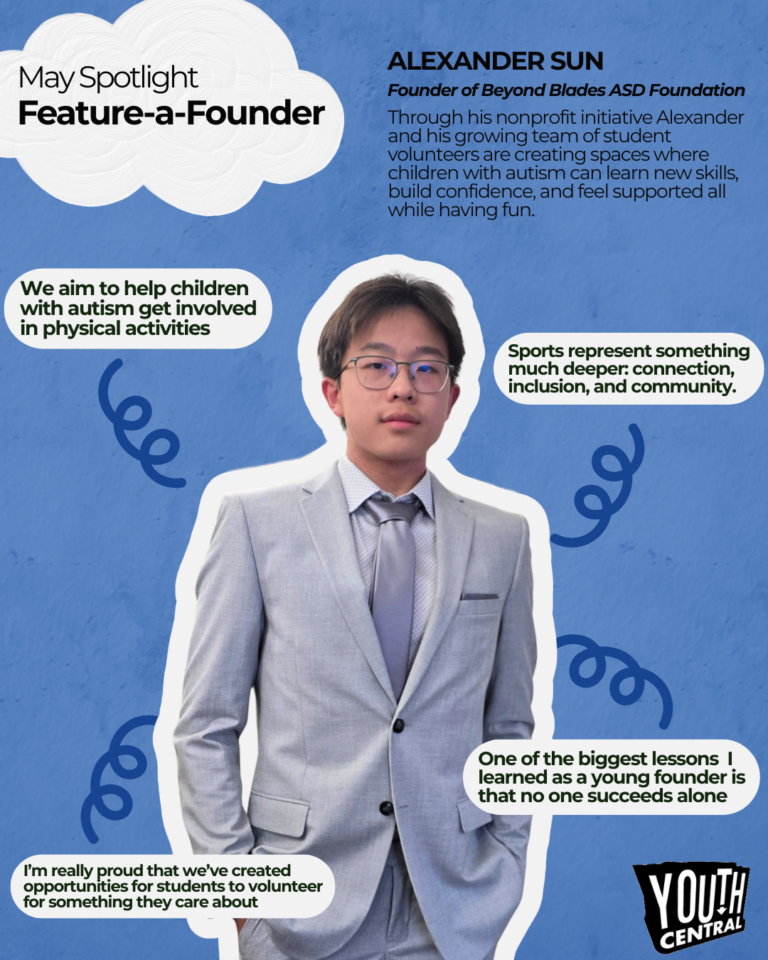
Presented by the Mayor’s Youth Council (MYC), our Feature-a-Founder spotlight is designed to highlight youth-led initiatives in Calgary making a positive impact. This month, we’re featuring Alexander Sun, the founder of Beyond Blades ASD Foundation.

When most people think of sports programs, they picture competition, trophies, and packed arenas. But for Alexander Sun, sports represent something much deeper: connection, inclusion, and community. As a grade 10 student, Alexander has already built an organization that is transforming the way children with autism access recreational programs in Calgary.

Through his nonprofit initiative, Beyond Blades ASD Foundation, Alexander and his growing team of student volunteers are creating spaces where children with autism can learn new skills, build confidence, and feel supported all while having fun.

Where It All Began

The inspiration for Beyond Blades started with something simple: noticing a gap.

Alexander had been involved in a research-based skating program designed for children with autism. While the initiative had good intentions, he realized the children weren’t getting enough actual ice time because the focus leaned heavily toward research outcomes rather than the participants’ experiences.

Instead of accepting the situation, Alexander decided to act.

Together with his father and a friend, he began taking five children to outdoor rinks in the Hamptons area of Calgary for extra skating practice. What started as a small effort quickly evolved into something much bigger.

“As we continued, we realized there was so much more we could do,” Alexander explains.

Soon, he began recruiting other students to help with marketing, fundraising, and social media. The initiative rapidly expanded, eventually partnering with Star Hope Autism Care and broadening beyond skating programs alone. Today, Beyond Blades ASD Foundation offers activities like badminton, is developing pickleball programming, and has even partnered with a robotics team to launch a STEM initiative for children with autism.

The name “Beyond Blades ASD Foundation” became symbolic of that growth: a reminder that the organization was no longer just about skating, but about opening doors to new opportunities and experiences.

Building Something Bigger Than Himself

For Alexander, one of the most rewarding parts of the journey has been witnessing how quickly the organization has grown in such a short amount of time.

Founded in late December 2025, Beyond Blades ASD Foundation has already grown to include more than 40 high school volunteers, a six-person leadership team, and multiple community partnerships. In only a few months, the organization successfully launched two programs while simultaneously developing its third and fourth initiatives.

But what makes Alexander most proud isn’t just the numbers, it’s the people.

“I’m really proud that we’ve created opportunities for students to volunteer for something they genuinely care about,” he says.

By involving youth directly in leadership, event planning, outreach, and programming, Beyond Blades has become more than a volunteer organization. It has become a community of students united by a shared desire to make recreation more accessible and inclusive.

The Power of Community

One of the biggest lessons Alexander has learned as a young founder is that no one succeeds alone.

“You really need friends and like-minded people to succeed,” he explains. “A group of people can accomplish things so much faster than one person alone.”

That belief in teamwork has shaped the way Beyond Blades operates. The team holds weekly Tuesday meetings to stay organized, maintain momentum, and continuously brainstorm new ideas. According to Alexander, that consistent communication has allowed the organization to grow at an incredibly fast pace.

He also credits much of the organization’s early success to personal connections. Many of the first volunteers were friends from middle school or people already within his network.

For Alexander, networking isn’t just a professional skill, it’s the foundation of meaningful community-building.

The Hardest Part: Starting

While Beyond Blades now appears highly organized and fast-growing, Alexander admits the hardest obstacle was simply taking the first step.

“I think a lot of people get scared about future problems before they even start,” he reflects.

Instead of trying to solve every possible issue in advance, Alexander focused on building momentum first and handling challenges as they came. That mindset allowed the organization to grow naturally without becoming overwhelmed by uncertainty.

He believes many young people already have strong ideas they simply need the confidence to pursue.

“Sometimes you just need that push,” he says. “That huge leap into actually doing something.”

His journey serves as a reminder that impactful organizations rarely begin with perfect plans. They begin with action.

Looking Ahead

What makes Alexander’s story so inspiring is not just the scale of what he has built, but the mindset behind it. Beyond Blades was created because one student noticed that children in his community deserved more support and decided to do something about it.

Now, through sports, STEM programs, and youth leadership, Alexander and his team are helping create spaces where children with autism feel included, empowered, and celebrated.

At an age when many students are still figuring out their own paths, Alexander Sun is already creating opportunities for others to thrive.

And if Beyond Blades’ rapid growth is any indication, this is only the beginning.

Next Steps

Started a project? Apply to Feature-a-Founder to be featured and share your impact – submit your story here!

Need help getting your idea off the ground? Explore our grants and funding opportunities: youthcentral.com/grants.

Feature-a-Founder: Shaping the Future of AI Education: An Interview with TypeShift

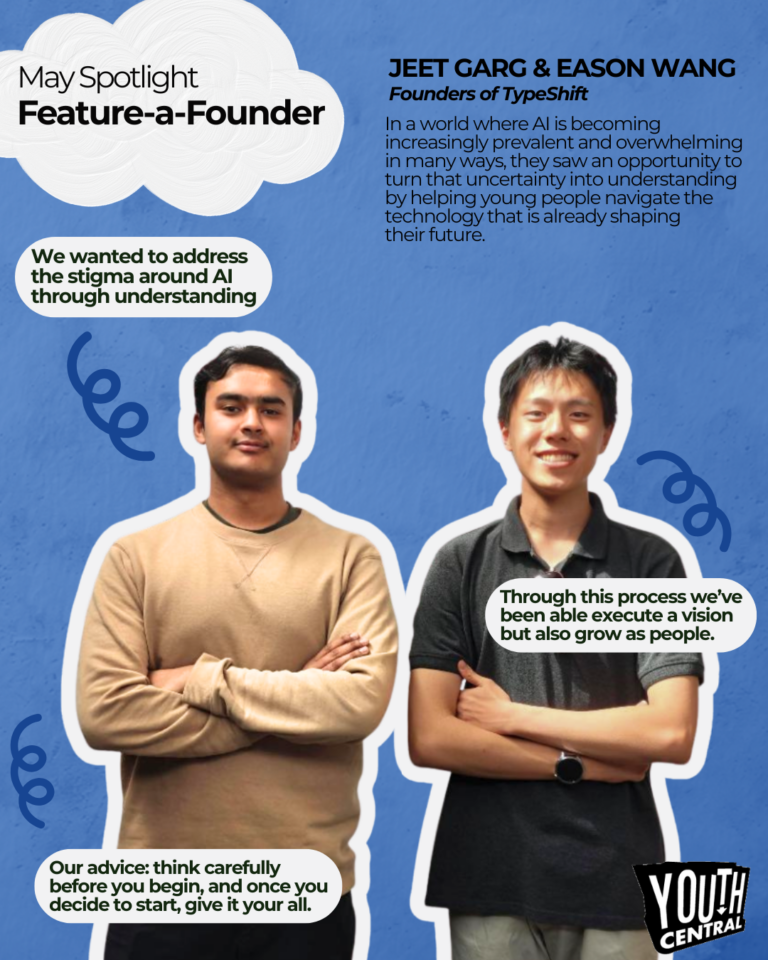
Presented by the Mayor’s Youth Council (MYC), our Feature-a-Founder spotlight is designed to highlight youth-led initiatives in Calgary making a positive impact. This month, we’re featuring Jeet Garg and Eason Wang, co-founders of TypeShift.

Have you ever noticed how quickly AI went from just being a buzzword to something people use every day? For Jeet Garg and Eason Wang, that rapid shift is exactly why TypeShift matters. In a world where AI is becoming increasingly prevalent and overwhelming in many ways, they saw an opportunity to turn that uncertainty into understanding by helping young people navigate the technology that is already shaping their future.

TypeShift began with a simple but foundational question: how can AI be used to actually benefit people? How can it be leveraged as a tool instead of overtaking the narrative. For the team, the answer was not just to talk about AI, it was about making it accessible. By connecting students to industry mentors and real-world speakers, TypeShift helps youth build a sort of AI literacy that builds confidence and context to help them think more critically about AI.

Curiosity into Action

What started as just an idea quickly grew into a hands-on initiative whose mission was clear, they wanted to show students that AI is more than just a generative tool or a handy headline maker. The team wanted to explore practical applications of AI in the “real world” in fields as broad as cancer detection. At the same time, they want to encourage students to think more deeply about the practicality of AI, shifting from just a “theoretical” knowledge into one that is instead rooted in the real world.

TypeShift’s vision has already reached an audience far beyond the founders themselves, they have hosted over five speakers and impacted more than 200 students through workshops and community events. These sessions have introduced concepts like AI being used in reinforcement learning while also creating a space for meaningful conversations, networking and overall mentorship to occur. 

Lessons in Leadership

Both Eason and Jeet said that building this initiative has taught them invaluable lessons about leadership and personal growth as much as its primary objective is community impact. Throughout their journey, they had to combat challenges such as a lack of motivation and developed their abilities to lead responsibility, as Eason put it “through example.” Jeet also spoke to the importance of having a team that you can trust and reinforced just how important it is to consistently show up.

These lessons became especially real when the team faced one of their biggest obstacles to date: uncertainty. While both within other leadership positions previously in areas such as Business Club and Model UN, as first-time founders, it was their first time building something from scratch. Starting from scratch meant that there was no structure to rely upon; they had to figure out their purpose, their format, and ultimately, their direction in the long-term. With support from mentors like Ben and their volunteers, they were able to refine their vision and turn early doubt into something sustainable and impactful.

The Power of Connection and LinkedIn

Although TypeShift uses Microsoft Teams in order to make events more accessible, the team has found that in-person connection is generally preferred in order to maximize on opportunities. Their workshops consist of a theoretical introduction, a live demo, a Q&A session which is then followed by networking with the speaker and other attendees. 

They also discovered that the most successful outreach can happen in unexpected places. LinkedIn, word of mouth, mentor networks, and even Model UN connections all played a pivotal role in growing their community to what it is today. Outreach does not have to be about flashy promotion and TypeShift exemplifies how building genuine relationships with people who care about the same issues can work just as well.

Advice for Future Founders

TypeShift’s message to other youth who might be looking to start their own initiative is to start now and start big, don’t be afraid to fail, and surround yourself with good and trustworthy people because even if you fall, they’ll help you back up. They believe young founders should be able to build a network upon which they can rely on when necessary and stay adaptable through any sorts of challenges. Their own journey proves just how big ideas can grow into real initiatives when they are supported by collaboration, persistence, and a willingness to learn.

TypeShift stands as a reminder that youth leadership isn’t something that has to wait until later in life. Once they identified a gap within their own communities, they took the step forward to close it. By creating a space for education, mentorship, and a more comprehensive understanding of AI, they are helping to shape a smarter and more thoughtful future for AI. 

Next Steps
Started a project? Apply to Feature-a-Founder to be featured and share your impact – submit your story here!

Need help getting your idea off the ground? Explore our grants and funding opportunities: youthcentral.com/grants.


Learn more about TypeShift here.

Uncovering the Thin Layer Under the Expectant Pressure to Achieve Greatness.

0

The truths embodied in success

A few months ago, a special visitor came to my school and talked to us about how she made a huge mistake, which later resulted in her success. Kesinee was in a highly innovative and financially successful degree program, and everyone greatly admired her. However, Kesinee didn’t feel any exuberance in this topic and decided to switch plans to drama. There, she played in many musicals, plays, and everything in between. Kesinee soon became a renowned actor, and this time she loved her career; however, she felt that vibrancy, the fruit of passion, was becoming dull, and once again she decided to switch to a different career, a career which Kesinee faces with brimming optimism.

Mindset

Like Kesinee, we all have felt the notion of longing and not, and like many other individuals, we all have felt a particular pressure to conform to other people’s thoughts and opinions, and what will bring us acceptance and admiration. This reveals that we might require a different mindset to the perception of certain things.

For instance, we have to recognise that not meeting another individual’s standards is okay and regularly occurs. As Theodore Roosevelt once stated, “Believe you can, and you’re halfway there.” Success is not accomplished by an endless, almost cumbersome amount of desire; it is accomplished by a hopeful and sanguine mindset.

Direction

We as a society ultimately fear straying from the original path; we hate the idea of “failing” and “not finishing.” We hate the fact that starting anew, we would be clueless and have to be taught and improved, and have to be the lower ones and not the ones everyone admires. We don’t realise that starting a new path, switching directions, is like planting a new tree before the other ones grow.

However, if something is planted, it will grow, and eventually all of the trees will grow into a forest, even if some are missing branches. Otherwise, you would only have one big tree and nothing else to rely on. We have to be able to perceive that changing your direction is not foreboding or fearful, it’s brave and right.

Love

To do something without passion is a chore; to follow in a course of direction just because it brings great outcomes is a waste. To spend your lifetime not doing the thing you love and rather the thing that is labelled higher in the economic ranking of society, is a loss. Without love and exuberance, we burn out. We stop seeing the benefits, the point, the outcome. When dawn sets, all we notice is the struggle to keep up, because it’s not about skill; it’s about our passion and dedication to this topic.

As Henry Drummond once declared, “to love abundantly is to live abundantly and to love forever is to live forever.” furthermore, love wins over everything and if you don’t believe or have any hope for your subject and is only willing to do take a subject that wins over the favour of others rather than your own, you stop midway in life and is stuck in a hole deep enough you struggle.

Therefore, always remember to be willing to take risks and always lend an ear to the small voice inside of you that whispers ever so tiny and ever so loud.

Featuring: Kesinee