Home Blog Page 96

A Tiny Trio in a Vast Forest

A tiny fox and little lark

Strode through the forest on an untrodden path

Guided by the song of a sleepy hermit

Which echoed through the words to every nearby crevice


Through the underbrush and from the canopy

The pair of small creatures fell into a spacious glade

Sunlight poured in and bathed an old suntanned  man

Along with his old sun bleached lyre


Atop a crumbling log, the man invited the two

And so the little lark chirped and the man smiled back

And the now tiny trio sat together for a time of peace


As time passed, the tiny fox and little lark left to hunt

And man got up to as well

From his log, he strode to a hut on the side of the opening

Made of sticks and flat browning leaves, you’d expect such a shelter to be abandoned.

He entered and likely ate a meal of fruit and fish

But for privacy reasons, the narrator did not enter the house to view the hermits actual dinner


The next day, the man played his lyre and the fox and lark returned

Though, the man could not play the lyre, 

Out of tune and out of touch, his song broke the tranquility of the forest

Echoing through the woods to every nearby crevice, on every day


But the animal pair shared the mutual judgement that the man was kind

And through time they formed an unlikely friendship which acts as a plot device for why the fox hasn’t eaten the lark yet and why the two constantly go near the hermit’s terrible songs.


The trio walked to river, bellowing songs as they marched a new trail

Together, the hermit and fox caught fish after fish

Enjoying the crisp and crystal water

For a time of laughter and non-lyre filled commotion


As the setting sun cast it’s gaze, the trio would depart

Then the next day the little lark and tiny fox would return to meet the kind man

The lark would chirp, the man would smile

And the rest of the forest would avoid the echoing clamor of the trio’s voices


Featured Image

Insight from the Elderly

“Back in my day” is probably one of the most used lines among grandparents and older relatives. I don’t know about you guys but, whenever I heard this line from my elders I would feel slightly frustrated. I mean, the elderly are living in the 22nd century. That stuff doesn’t matter anymore. Right? Well, maybe we’re wrong.  


It’s well known that Gen Z is extremely opinionated towards older generations. First, we had a problem with Baby Boomers, and then it was Millennials. And to be completely honest, plenty of my opinions are polar opposite from these older generations. It can be frustrating to hear their outdated views that are, sometimes, blatantly rude and offensive, so by no means am I saying this kind of behaviour should be excused. There are clear flaws in some views praised by older generations that need to be called out and addressed but we also need to look in the mirror and reflect on the flaws of our generation’s views. 


From my experience,  the most effective way to develop a new understanding of the problems we are enduring is to attain insight on the issue from a new perspective. I find understanding the perspective of a younger child is extremely helpful as they can often make a complex idea simple. As said by Albert Einstein, “A little simplification would be the first step toward rational living, I think.” Another extremely helpful perspective we can learn from is that of the elderly.


Despite what some may think, we can extract components within the elderly’s views to help reveal problems we were oblivious to. The same can go for assisting Gen-Z to find solutions to problems we may encounter, no matter how big or small the problems are. This is why I encourage you all to do your best to interact with the elderly.


Especially during COVID-19, it has become essential for us to direct our attention towards the elderly. When it comes to mental health, we tend to only recognize teenagers, while in the process forgetting its severe impact on older generations. This is especially true for those who live alone or don’t have close contact with much family. 


Below, you’ll find a list of ways you can positively impact the elderly. Like I said before, doing this is benefiting not only them but you too!

  1. Volunteer at a Senior Citizen home!
  2. Volunteer to deliver groceries!
  3. Just talk to them! You can ask them questions about their experiences.
  4. Become a pen pal!
  5. Send videos or encouraging messages!

This post was a jumble of a few different ideas so I hope it was still insightful! Stay safe and get vaccinated!

Sources:

1

Image

Learning new habits

0

It’s been a while since I’ve tried to pick up a new habit and I totally forgot how hard it is. Keeping yourself motivated to complete the task and being consistent seems like an easy thing to do in theory but…. ugh it actually really sucks! So I started reading different articles on how to make habits quicker by following this method.

The method is composed of 4 parts: the habit, the trigger, the behavior, and the reward.

The Habit

It’s kind of ironic that this is the first step in learning a new habit but your gonna want to to choose which habit that you want to cultivate. Whether it be going on morning runs or practicing an art skill you just have to choose something to do.

The Trigger

The trigger is what in acts the habit, what sets it off. For example, Every morning after I eat breakfast or every night after I brush my teeth. The Trigger is set in place as a reminder that helps keeps you, the individual consistent.

The Behavior

The behavior is the essential part of this whole method, actually doing it. After completing the first two steps this step is the climax to top it off.

The Reward

This is my favorite part of the method the reward. It allows you to look at the positive aspect of the task and keeps motivation up high.

For example, 6-year-old boy Bradley learns how to say please and thank you.  What he gains from this experience is manners making him become a nicer person.

All in all this method is simply just a guideline that can help to learn a habit quicker. I’ve tried this myself and it works just fine. So I hope you’d give it a try.

Olivia Rodrigo: The Disney Channel Star That Took The Music World By Storm

For starters, it’s an arduous task to define fame. Nowadays, you can open up a free TikTok account and be seen and heard by thousands. Someone with a certain amount of followers may be considered “famous” today, but might not even be known back in a time when social media wasn’t as developed.

Whether Olivia Rodrigo is famous or not isn’t a question – the 18-year-old’s debut single “Drivers License” alone broke the Spotify record for most streams in a week with around 66 million. But why did she get so famous in such little time? It could be that social media enables faster growth and greater publicity for pretty much anything; it seems as though @livbedumb’s songs are perpetually “trending” on TikTok. Or maybe it’s because our generation is more inclined to listen to someone already familiar to us through the Disney Channel shows “Bizaardvark” and “High School Musical: The Musical: The Series”. But singers such as Selena Gomez, Demi Lovato, and Miley Cyrus were all also Disney Channel icons before their successful music careers took off, and none experienced such results so soon. This begs the question, it is simply easier to become famous than it was before? This doesn’t undermine Rodrigo’s success – all 11 of the songs from her new album “Sour” will still be stuck in my head for at least the next week. It just showcases modern society’s behaviour, and how much power today’s media holds due to how heavily it is relied upon.

How it all started, & where she is now

Olivia Rodrigo’s acting career started with the lead role of Grace Thomas in an American Girl movie. As mentioned above, she then made her Disney Channel debut in “Bizaardvark”, playing Paige Olvera for all three seasons of the show. She currently plays Nini in “High School Musical: The Musical: The Series”, which is now streaming its second season on Disney+. Many believe that Joshua Bassett, her co-star on the show (playing the role of Ricky Bowen), is the subject of many of Olivia Rodrigo’s songs. 

In her first song, “Drivers License”, Rodrigo says something about someone not meaning what they wrote in a song about her. It seems very likely that this was a reference to Joshua Bassett’s song “Anyone Else”. Soon after the release of “Drivers License”, Bassett released a song called “Lie Lie Lie”. Coincidence? I think not. As if this wasn’t enough, a theory emerged that the ‘blonde girl’ Olivia Rodrigo referred to in her song was fellow Disney Channel star Sabrina Carpenter, who played Maya in “Girl Meets World”. Joshua Bassett and Sabrina Carpenter had been repeatedly spotted together, including their viral “Sharkboy and Lavagirl” TikTok. Inevitably, Carpenter then released her own song, “Skin”, with a line that says “maybe blonde was the only rhyme”. This is merely a simplified version of the drama that may or may not be true, but if it is, then we have three Disney Channel stars to thank for over ten great songs in total. When did our favourite TV shows get so complicated?

All three of these up-and-coming celebrities now have a foot in both worlds, as they have all ventured into the music industry while still acting. Olivia Rodrigo has made the biggest mark by far, releasing her first album on May 21st, 2021. This album, with the name “Sour”, features the 11 songs listed below.

  • “brutal”
  • “traitor”
  • “drivers license”
  • “1 step forward, 3 steps back”
  • “deja vu”
  • “good 4 u”
  • “enough for you”
  • “happier”
  • “jealousy, jealousy”
  • “favorite crime”
  • “hope ur ok”

All in all, it doesn’t matter who left the ‘sour’ taste in her mouth or how she rose to the top of Billboard’s charts. At only 18, Olivia Rodrigo has made great contributions to pop culture and likely won’t slow down anytime soon.

Image Source 1

Featured Image

5 Book Recommendations that are a ‘Must’ Read

With extra time on our hands because of quarantine, we are all in need of some form of entertainment to spice up our lives. Yet, despite all the options available, I, like many others, still struggle to find a good book to read. So, here I present to you 5 fascinating & unique books, that are a “must-read”:

1) So Good They Can’t Ignore you

So Good They Can't Ignore You: Why Skills Trump Passion in the Quest for Work You Love

“So Good They Can’t Ignore You” is an eye-opening book debunking how “follow your passion” may not be the best advice at all. Cal Newport sets out to discover why people like their job, by spending time with those, in a variety of professions, who have great satisfaction from their work. The book shares strategies those people used and reveals how passion comes after you put hard work into something that you are even mildly interested in. I would highly recommend everyone to read this as it is a very insightful book. 

2) All the Light We Cannot See

All the Light We Cannot See=

All the light we cannot see is a fictional book by Anthony Doerr that won the Pulitzer Prize for fiction.  As Goodreads puts it, “it is about a blind French girl and a German boy whose paths collide in occupied France as they both try to survive the devastation of World War 2.” Even though I usually do not read this genre, I have read this book this year, it is a ‘stunningly beautiful and mesmirizing’ novel that I would highly recommend reading. 

3) A Brief History Of Time

A Brief History of Time

A Brief History of Time is a nonfiction novel by the one and only Stephen Hawking. It is a stunning book, talking about the origins and the nature of the universe, as we know it today. It is fairly easy to understand and extremely fascinating; even though you may not necessarily like astronomy, physics, or nonfiction, it is definitely a book that will give you goosebumps and is worth checking out. 

4) The Outsiders

The Outsiders

Outsiders is a book by S.E Hinton talking about the divide in classes of society. It follows the story of Ponyboy Curtis, a boy who struggles to tell between what’s right and wrong in the society in which he believes he is an ‘outsider.’ You may have heard of this book before, and if you haven’t read it yet, I would also recommend you to take a look & read it. 

5) The Book Thief

The Book Thief

The Book Thief is a book by Markus Zusak in historical fiction. Set in 1939 Nazi Germany, it follows a family that hides a Jew in their basement, along with various other side-stories. In a unique perspective of death, it is a novel that is filled with emotions and intensity. As with all the other books in this blog post, it’s a great book that I would highly recommend to read 🙂

Sources:

https://www.goodreads.com/book/show/13525945-so-good-they-can-t-ignore-you

https://www.goodreads.com/book/show/18143977-all-the-light-we-cannot-see

https://www.goodreads.com/book/show/3869.A_Brief_History_of_Time

https://www.goodreads.com/book/show/231804.The_Outsiders

https://www.goodreads.com/book/show/19063.The_Book_Thief

Featured Image 

How To Write Poetry: For Noobs

Introduction (because I’m a civilized human):

Hey, y’all! Hope you’re doing well! As the title suggests, if you’re a noob at poetry, you’ve come to the right place. For this blog post, I wanted to take a shot at poetry. I might also admit that I wrote this poem for school a while back, but I followed a template that I’ll share with you as well!

Credits (they’re due!!):

The poem is called “Where I’m From” and essentially allows one to create a piece that is significant to one’s experiences. If you’re not familiar with the original poet, George Ella Lyon, she is an American author who is known for her published picture books, poetry, and other literary works. She was born in April 1949. She received her Bachelors in Arts in Kentucky in 1971, and later got her Masters in Arts in 1972 from the University of Arkansas, and later her Ph.D. at Indiana University in 1978. Aside from her published works, she has also taught at various post-secondary institutions and has been a part of various writing workshops, conferences, and author visits. 

I was first introduced to the poem by my English teacher, in grade 9 (so around March 2020). We were given a template, and we had to fill it out, and then continue to refine it. So here’s mine: 

My final “Where I’m From” poem (no judgy pls):

I am from a piercing crimson thread,
from Scotch and Pink Pearl.
I am from the gravel in the stormwater pond.
(Coarse, lifeless,
they were like velcro that never connected)
I am from the moss that camouflaged the tree’s disease
the Crab apple tree
its seeds I remember spitting out
so the poison wouldn’t get inside of me.

I’m from markers and disappearing purple glue
That never fully faded
from Dhaliwal and Farooq.
I’m from the wise
and the superstitious
and the stop-wasting-time,
from the bottle and the bird.
I’m from not sitting idle and the
verse I would always forget.

I’m from Windsor and Taradale,
the tomato juice and the tea
From aunt’s dish that was too watery, the tears
and the discoloration on her face

In the locked drawer there was a FujiFilm camera
that had captured hundreds of memories.
A blur of faces of people who once knew me as their daughter.
The quadruplicates were never erased from the memory card.

From Post Street and Conrich Road
I am from getting lost at Fisherman’s Wharf,
from Pineridge and the swings.

I am from those places before fifteen
The people I met before sixteen
The vocals I cherished before seventeen
I am from that time before I was thrown into the ocean,
below the red bridge and
before I learned to swim.

Here is the template if you’d also like to take a stab at writing poetry:

I am from ________(specific ordinary item), from ________(product name) and
____________.
I am from the _______ (home description… adjective, adjective, sensory detail).
I am from the _______ (plant, flower, natural item), the _______ (plant, flower, natural
detail)
I am from _______ (family tradition) and _______ (family trait), from _______ (name of
family member) and _______ (another family name) and _______ (family name).
I am from the _______ (description of family tendency) and _______ (another one).
From _______ (something you were told as a child) and _______ (another).
I am from (representation of religion, or lack of it). Further description.
I’m from _______ (place of birth and family ancestry), _______ (two food items representing
your family).
From the _______ (specific family story about a specific person and detail), the _______
(another detail, and the _______ (another detail about another family member).
I am from _______ (location of family pictures, mementos, archives and several more lines
indicating their worth).

Lyon’s original piece if you’re interested (why wouldn’t you be):

I am from clothespins,
from Clorox and carbon-tetrachloride.
I am from the dirt under the back porch.
(Black, glistening
it tasted like beets.)
I am from the forsythia bush,
the Dutch elm
whose long gone limbs I remember
as if they were my own.
I am from fudge and eyeglasses,
from Imogene and Alafair.
I’m from the know-it-alls
and the pass-it-ons,
from perk up and pipe down.
I’m from He restoreth my soul
with cottonball lamb
and ten verses I can say myself.
I’m from Artemus and Billie’s Branch,
fried corn and strong coffee.
From the finger my grandfather lost
to the auger
the eye my father shut to keep his sight.
Under my bed was a dress box
spilling old pictures.
a sift of lost faces
to drift beneath my dreams.
I am from those moments —
snapped before I budded —
leaf-fall from the family tree

– George Ella Lyon

Conclusion (because I can):

I hope you enjoyed being a poet! I’ll admit I’m not much of a writer, but this poem has allowed me to get some creative juices flowing – and hopefully yours too! As always, feel free to reach out to me at ranyabajaj1@gmail.com with any questions or comments. Godspeed.

Sources: [1][2][3]

Pâtisserie – Partie 1

From macaroons to meringues, to madeleines, France is well-known for its desserts! Just imagine yourself sitting on an ornate, iron wrought chair, sipping coffee in the warm morning sun, surrounded by the bustle of a street in Paris. Here are some fun details about a couple of mouth-watering pastries I found!

1. Mille-Feuille


First off is the mille-feuille! This word translates to “a thousand leaves” in English. The dessert is both crispy and creamy, crumbling in your mouth. It balances being flaky and sophisticated at the same time as being light and not too sweet. The mille-feuille is made of three layers of puff pastry, in between which are two layers of piped pastry cream. On top, there is a layer of icing sugar or fondant. Stripes of melted dark chocolate are often used to decorate the tops of mille-feuilles. It is unknown who invented the mille-feuille. However, in the 1700s, Marie-Antoine Carême (AKA Antonin Carême) perfected the pastry. He was one of the first internationally renowned chefs and the most famous chef of his time. Referred to as “the king of chefs and the chefs of kings,” he frequently served royalty and the rich of Paris.

2. Croquembouche

The croquembouche is a type of “pièce montée,” an edible centrepiece It is often served at weddings or other grand occasions. As you can tell, it is literally a pyramid of cream puffs stacked on top of one another, held together using caramel as a sort of glue. The tower is then freely decorated with a thin net of caramel strands, flowers, ribbons, chocolate, fruits, nuts, etc. The name “croquembouche” translates to “crunch in the mouth,” due to the resounding crunch of the caramel crust when eaten. The inventor of this masterpiece remains anonymous. However, once again, it was Marie-Antoine Carême who perfected this pastry. In fact, he had once studied architecture and used this knowledge to help build his croquembouches. 

3. Opera Cake

Opera cake is a classic French pastry. It is made of a layer of joconde biscuit (a light almond-flavoured sponge cake named after the Mona Lisa – in French the Mosa Lisa = La Joconde), a layer of coffee cream, a layer of chocolate ganache, and chocolate icing. It is actually known who invented this pastry: in 1955, Cyriaque Gavillon wanted to create a cake that did not use any flour and whose layers of ingredients were distinguishable. He also wanted anyone to be able to taste all the flavours of the cake in one single bite of any part of it.

4. Paris-Brest

This take on a cream puff is called a Paris-Brest, invented in 1912 by Louis Durand but refined by Philippe Conticini in 2009. He modified the structure of the pastry and added certain ingredients to enrich flavours. The Paris-Brest is made of choux pastry, praline cream (a confection containing nuts and sugar), and pure, raw praline with almonds and hazelnuts.

5. Éclair

Finally, the éclair! “Éclair” means lightning in French. It is so-called due to the fact that it can be eaten rapidly. It is made of choux pastry filled with pastry cream and covered in icing. Chocolate and coffee are some of the more popular flavours. Numerous chefs have made éclairs to break records. For example, a couple of Swiss pastry chefs once made a 503-metre long éclair, breaking the record for the longest éclair in the world.

PS. I actually first learned about a lot of these confections from watching The Great Canadian Baking Show. They really create amazing food, both savoury and sweet, that always looks show-stopping good. If you’re interested in this kind of thing, take a look here.


References: 1/2

Image references: Featured Image/1/2/3/4/5

The Closing of Another School Year

As June is quickly approaching, another school year is coming to a close. This means that some of us will be saying our final goodbye to high school, while others will be preparing to enter a new school or grade. Therefore, today I wanted to mention some ways that you can show appreciation to the people around you in the last few weeks leading up to summer break.

  1. Capture the moment! 

Make sure you document and capture each moment to add to the memories you make with other people. You can do this by simply taking photos with your closest friends, classmates, or even taking photographs of your school. Although we take things for granted right now, when you look back in a couple of years you may be surprised at how much you miss things you never imagined you would.


2. Write a card for your friends & teachers

It is so important to let those around you know how much they mean to you. Writing a handwritten letter is a good way to express your gratitude and to say things that you may not have had the time to say. Take some time to prepare a couple of cards for your friends and teachers as a nice way to end off the school year. Even a short “thank you” card can mean a lot to those receiving it.


3. Reach out to new people

As you transition into a new grade, you may want to talk to a couple new people before the school year comes to an end. Make sure to make new connections; you may be surprised at how willing people are when you first reach out to them. Especially for those of you graduating: make sure to reach out to others you’ve wanted to become friends with but never had the chance to. This includes those in other grades!


4. Spend time with your friends

Although it sounds obvious, it is important that you spend extra time with your friends. Because of COVID-19, it’s been a hard year to see or hang out with friends. Therefore, take the time in the coming month to catch up with them and to do fun things together.


5. Check-in on others

When was the last time you texted or called someone just to check-in and see how they are doing? The best way to show appreciation to those around you is to let them know that you care about them. By sending a simple text or making a short call, you can let them know that you are there for them if they need someone to talk to.

It can be easy to take everything around you for granted and sadly, this is only realized after we lose it. Therefore, this is a friendly reminder to show your appreciation and gratitude towards your friends and teachers as we approach the last month of the 2020- 2021 school year. This will give you a chance to reflect on what was most valuable to you and to help you cherish each moment.


Images: 1, 2, 3, 4, 5


Appreciating Life

When I think of my key motivators, not all of them are abstract, ambitious dreams. Many of them are small but tangible details of life, such as feeling the summer breeze or walking in the rain. Appreciating the little things can go a long way. I’ve gathered them into a list, and I hope they boost your mood.

– School holidays

– Friday nights

– Work periods

– Sleeping after a tiring day

– Closing all the tabs after finishing an assignment

– Acing a test or project you poured your heart into

– The class bond formed from a challenging course

– Group projects with friends

– Finishing a unit

– A new laptop

– Stationery

– Clubs

– Volunteering

– Short instruction days

– IKEA, Costco, and Asian supermarket hangouts

– Spontaneous acts of kindness

– Laughing with someone

– Deep conversations

– Inside jokes

– Reviving group texts

– Long late night drives

– Facebook memes

– Clouds

– Sunrises and sunsets

– The summer breeze

– Stargazing

– Biking downhill

– The view of the Bow River and Downtown Calgary

– Mountains

– Wildlife

– Petting dogs

– Watching it rain, snow, or sleet from a sheltered place

– Sledding

– Snow forts

– Hot chocolate

– Ice skating

– Hoodies

– Experimenting with recipes

– Anticipating new releases

– Bingeing movies and TV shows

– Iced coffee

– Boba

– Fried chicken

– Ice cream

– Warm baked goods

– A hearty bowl of noodles

– Bookstores

– Cafes

– Music

– Personalizing your profiles

– Sharing recommendations

– Airports

– Hotel amenities

– Photography

– Video games

– Revisiting childhood memories

Image Sources: Featured

My COVID Vaccine Experience

I’m finally a part of that lucky statistic-I got the first shot of my COVID vaccine two days ago! However, before getting the shot, the experience was a complete mystery to me, and all kinds of confused questions clouded my mind: When I wait in line, do I have to stand outside for hours or can I just zoom in and out? Does the needle feel like a poisonous wasp sting or a mosquito bite? And will I be completely fine, or will I faint as soon as the needle enters my arm? If your own vaccine is coming up, you are probably worrying about many of these questions as well. So, I decided to document the whole process of getting my first shot from start to finish, in the hope of offering some certainty about the vaccination experience.

Heading to the Vaccine Clinic

As soon as my brother and I woke up, we headed downtown to get vaccinated. It was a wet, snowy day, and I dreaded the possibility of standing and shivering in line.

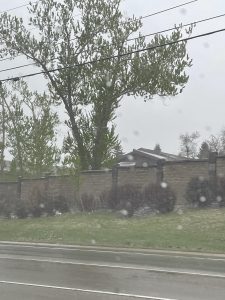
Snowflakes splattered on our car window as we drove to the vaccine clinic.

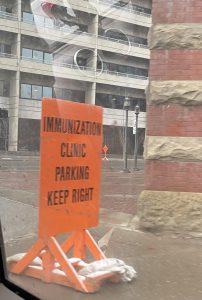
Despite my dread of the wet snow and the cold weather, we didn’t have to queue up outside. In order to minimize physical contact, the clinic made us queue up in cars, using signs directing us to a single lane on the road. We inched forward warmly and safely along this lane for a few minutes until we reached the convention centre with the clinic.

The right lane on the road leading to the clinic was our “queue”.

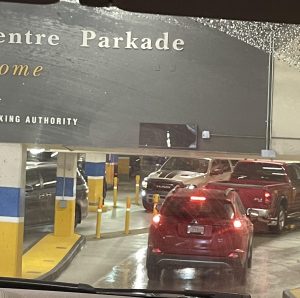
When we reached the convention centre, we didn’t have to wait outside either. The lane led straight into an underground parking lot! The parking lot was heated, so when we got off the car, it actually felt really warm.


Inside The Vaccine Clinic

After paying our parking fees inside, we headed up a few flights of stairs and escalators, and there it was… the doorway to the vaccine clinic I saw on so many newspapers, Twitter feeds, and Instagram posts! Now I was going to be a part of the great big “return to normal” I was hoping for. I went into the clinic through the open door in the picture below.

There it is!

After this point, I wasn’t allowed to take any more photos, so I’ve attempted to re-create my experience as best as I could in drawings. Behind the doorway, there were a lot of airport line dividers for us to queue up in. Since I got my vaccine on a Thursday, the queue moved surprisingly fast, and I was ready to get vaccinated in a few minutes. I highly recommend you book your vaccines for weekdays! It’s efficient and not crowded, so you feel more safe.

Before we entered the room where everyone was getting vaccinated, we had to take a survey. We answered a few questions about our likelihood to be COVID positive, including:

  1. Do you have any COVID symptoms?
  2. Are you a close contact of a COVID-positive person?
  3. Have you visited an outbreak site recently?

After we answered no to all of these questions, we moved on.

Getting the Vaccine!

When we entered the big vaccination room, we confirmed our appointments with an AHS staff member. About a minute later, my brother and I sat down to get vaccinated. All the vaccines were administered by AHS registered nurses, and these nurses wore their certification on their name tags.

Before giving me the shot, the nurse showed me what type of vaccine I was getting (I got Pfizer). She also let me take a look at the vial that the vaccine came in. The vial was tiny! Although pictures from the news made it look big, it was actually the size of my thumb.

Comparison between the vaccine vial and my thumb, to the best of my drawing ability.

My classmate, who got the vaccine before me, told me that “it hurt quite a bit at the injection site, and [he] didn’t expect it to hurt so much” (those are his exact words). However, that was definitely not the case for me! The needle entering my arm felt like a small pinch or an angry mosquito bite. Immediately after this pinching feeling, the muscles around the injection site became a bit sore, like I had been flexing them for too long. Overall, it felt similar to, if not less painful than the flu shot. That was also how most other people felt, given that the COVID vaccine needle was also used to vaccinate newborns, according to the nurse.

After my brother and I got our shots, we waited for 15 minutes in a seating area. This was pretty chill, since we didn’t feel a lot of soreness and we were just sitting around.

Conclusion

I thought my first shot would be terrifying. I dreaded the possibility of waiting in line, getting stabbed by the needle, and feeling terrible side effects. However, my experience with my first shot actually went great! It was a lot less painful and arduous than I had anticipated. When I got the shot, the nurse told me that second shots should happen in around five weeks, and I can’t wait to be fully immunized!

Featured image

All other sources are my own.

Preparing for the DELF Exam: Tips and Resources!

So you’re taking the DELF B2 exam? Me too! Issued by the French Ministry of National Education, the DELF diploma is recognized internationally for life. 

As the exam splits into 4 parts – oral production, written production, listening comprehension, and reading comprehension – there is a lot to prepare for. As such, I wanted to share a couple of general tips and resources specific to each evaluated competence. They are by no means a guarantee to success, but simply things I have found useful and hope you will too. 

Note: most of the mentioned resources are Canadian and may only be available in Canada

General Tips

  1. Spread your study sessions over a period of time: Especially when learning a language, it is so, so important to learn over an extended length of time. Unlike a math or chemistry assignment, you can’t procrastinate everything to one night. In my opinion, learning a language comes with familiarity and everyday use; it integrates itself into your speech, it becomes spontaneous and second nature.
  2. Make a plan: This one ties in with the last tip. Make a day-to-day schedule and/or checklist of French preparatory things to practice. It can be as simple as listening to 1 podcast, learning 1 vocabulary word, and/or reading 1 news article per day. It can be just 30 minutes of writing a French journal entry, or 2 hours watching a movie. There are lots of interesting options available!
  3. Practice exams: Be sure to check out the DELF website for practice exams, both to do exercises on each competence, and also to familiarize yourself with the format. There is a new format for 2021: https://www.france-education-international.fr/hub/diplomes-tests; http://www.delfdalf.fr/delf-b2-junior-version.html

Resources:

Oral production – Resources

  1. Talk to people: Your French teachers, your family, your friends… nothing substitutes that real life (or Zoom) conversation, practicing spontaneous speech. The Alliance Française (AF) is a good resource for this; they generally host cultural events each month to practice French in a real-life context. Check here to find a local AF: https://www.af.ca/af-in-canada/ 
  2. The DELF website practice prompts are definitely the best resource for this, I honestly can’t think of anything else!

Written production

  1. Game-style questions to practice anglicismes, grammar/syntax, spelling, rules of writing, vocabulary, and general culture: https://www.noslangues-ourlanguages.gc.ca/fr/jeu-quiz/index-fra
  2. Writing a letter: https://www.youtube.com/watch?v=sCybzfLG-Gs&t=22s 
  3. More on writing a letter: https://communfrancais.com/2019/02/08/ecrire-une-lettre-au-delf-b2-junior/ 

Listening comprehension

  1. Radio emissions and podcasts (I personally love the podcasts): https://ici.radio-canada.ca/ohdio  
  2. Documentaries: https://ici.tou.tv/categorie/documentaire 
  3. TV: https://ici.radio-canada.ca/tele 
  4. Audiobooks: Check with your local library or just buy your own.

Reading comprehension

  1. Books, books, books! Check with your local library or just buy your own. 
  2. News articles: https://ici.radio-canada.ca 
  3. Create vocabulary study sets with Quizlet


References: Featured image

Learning Something New: Music Edition

After my cousin called me for some help on a school project, they brought with them something I had never seen before- a kalimba. A wooden instrument with long metal rods, which when flicked, create a resounding, high-pitched sound, the kalimba was something that fascinated me. Intrigued, as always, by the prospect of learning a new musical instrument, I spent the next 3 weeks learning how to play it- this article describes the trials I underwent and how that’s applicable to learning anything. 

First of all, when starting anything, it’s important to familiarize yourself with how to actually play it (I put little stickers to show me what the notes are). Using one’s thumbnail to flick the metal rods, it was quite easy to make simple melodies. After familiarizing myself with that aspect of actually playing it, I got down to the nitty-gritty of actually tuning the instrument. Using a tuner, I hit the central rod (or tine) until it registered on the tuner- knowing then that it was flat allowed me to tap the tine in with a little metal hammer provided. After tuning all the tines with the exact same procedure, I now felt I was ready to experiment a bit.

Using my prior knowledge and applying it, I noticed that the tines on the same side were all separated by a third allowed me to understand that hitting two tines on the same side would create a chord. This newfound knowledge was rightfully used for several minutes of experimentation to create random-seeming sounds. 

However, learning songs (my end goal) was a bit more complex- I had to learn how to read kalimba tablature, and from there, play a song with that. It took me a while to figure out how to read it (with the help of Youtube in the end)- and when it did, I began to finally start one of the kalimba songs. Half an hour later- I had my completed project, and I was really happy with it. 


How is this relevant, however, to learning something new? Apart from me learning something new, there are things in here that can easily be applied to anything out there, and this learning strategy is something that’s definitely worked for a lot of people out there. Firstly, by familiarizing yourself with the practical applications of any given task by immersing yourself in the theory, you gain valuable insights when you begin to experiment with that newfound knowledge. Secondly, making sure the instrument works or isolating the problem itself allows you to fine-tune everything to ensure the best learning environment for you. Thirdly, by using prior knowledge and applying it through the theoretical side of things, beginning to experiment once again will eventually lead to you learning those skills. Fourthly, by pushing through and learning the full theory behind any given task, it’s easier to accomplish it in the practical- and finally, have fun while you’re doing it. Whether it’s a trial and error process or one that instantly clicks, remember to have fun all the way- no matter what you’re learning. 

Featured Image

https://www.aliexpress.com/item/32919207707.html


Volunteering During the Pandemic

0

During the course of this pandemic, there have been few volunteering opportunities for those who normally volunteer in person. It’s been hard to find opportunities, job openings, spaces available- and it’s easy to get stressed over the lack of chances available. In this article, I hope to relieve some of that stress by showing some of the volunteering opportunities available online during the pandemic- and even some that are still in person. 


1. Youth Central – https://youthcentral.com/

Youth Central has largely been one of Calgary’s major hubs for volunteering in the past and continues to be one today. From opportunities such as writing for Youth Are Awesome to writing Pen Pal Letters to older people, it’s incredibly easy to get a volunteering position with Youth Central. Simply sign up for an account through the website and begin browsing for something that interests you- for me, it was writing, for you, it might be something else. It’s very simple to get a job, and it’ll continue to be a simple one into the future- simply click the link, follow the instructions, choose something to do, and you’re well on your way to volunteering with Youth Central. 


2. Youth Helping Youth – https://linktr.ee/yhyalberta

Youth Helping Youth is an organization run by youth for youth. At YHY, they create a safe volunteering experience for youth by increasing awareness of social issues and acting as an opportunity hub for youth to learn in. By bringing attention to opportunities for youth provincially and globally, YHY brings more opportunities to youth all around the world and to pressing organizations that need help. To find opportunities or sign up for something, go to their Instagram page at @yhyalberta and check out their posts for something new. 


I’ll only provide two for the moment, but I hope that this article allowed someone to volunteer for something else! I’ll do another one of these articles if there’s enough interest- say something in the comments if this article helped you. 


Featured image

Sign Language: A Crash Course

In my ongoing epic quest for misc. knowledge about linguistics, I not too long ago fell into the rabbit hole that is sign language. Not only are sign languages a crucial tool for Deaf communities around the world and an increasingly important part of many a modern polyglot’s repertoire; sign language is also unique in that it revolves around a facet of communication that is only just becoming widely studied.

Maybe you’re here because you know absolutely zilch about sign language. Maybe you know a lot about sign language already and you’re here out of curiosity/just for kicks.

Whatever brought you here (fate, destiny, a horse), sit down and buckle up. The train is leaving the station, and like it or not you’re about to learn a thing or two about sign language.

Early Sign Language?

Little is actually known about how sign languages actually emerged in the first place. The study of sign languages is a still-maturing field, and it’s difficult to draw conclusions based on the information we have. One theory is that sign language naturally evolved from or is somehow related to gesturing in spoken conversation.

In terms of when sign language became a thing, signed languages have likely been around for as long as there has been society, although it’s hard to say to what degree. What we do know for sure is that for a long time, people who were deaf, mute, or both were often persecuted, deemed “dumb” or incapable of learning.

This meant that although sign languages certainly already existed across the globe, the first free public sign language school in the world was not founded until 1760 by Abbe Charles Michel de l’Eppe. He had added on to the existing Old French Sign Language system with a series of hand movements mapped to different phonetic sounds (to my understanding, basically a form of fingerspelling). For seemingly the first time, deaf and mute people could formally train to communicate using sign language. The rest? History.

Sign Language vs. Spoken Language

This part seems rather obvious, but there’s some interesting story behind it.

At a basic level, the main distinction between signed and spoken languages is the medium. Spoken languages use phonologies, sounds, syllables. Things you can hear. Signed languages use parameters—things you can see—like facial expressions and specific hand positions.Besides that, signed languages are every bit as complex and expressive as spoken languages. They’re simply aligned with a different audience.

Signed languages are not direct counterparts to their regional spoken equivalents. American Sign Language or ASL has entirely different grammar from spoken English, for example. And like with spoken language, there’s no such thing as a single sign language. In fact, rough estimations put the total number of sign languages around the world at between 138 and 300. Some are mutually intelligible. Others not so much. Furthermore, sign language appears to have evolved similarly to spoken language. Some languages are descendants of others, and languages exist in families with common traits and gesturing strategies.

Your Friendly Neighbourhood Sign Language

In Canada, there are two official sign languages. ASL is probably the most common—and it’s the one used in the US as well. The other is Quebec Sign Language or la langue des signes quebecoise (LSQ). There is also a regional dialect used in the Maritimes called, you guessed it, Maritimes Sign Language (MSL).

Resources:

If you’re in the market to learn some sign language, there are a number of fantastic free resources out there for your use. For ASL learners, check out Bill Vicars’ Youtube channel, Sign Language 101. As with any language, immersion is the best tactic. But these provide a great jumping off point.

If you’re looking for more information on the Deaf and Hard of Hearing (HoH) community in Canada or beyond, Deaf and Hear Alberta, the Canadian Association of the Deaf, and Canadian Hearing Services are all Canadian organizations with lots of resources to help you learn! The r/deaf and r/asl subreddits are also a good source of perspective, although as with any social media platform, peruse at your own risk. And if you’re looking for more linguistics shenanigans, check out my article “I Never Said She Stole My Wallet” And What Makes us Human for an intro to human vs. animal communication. Happy learning!

Featured Image

It took 334 days, and I still can’t forget you.

There was a knock at the door.

Alia’s hair was ratty and unwashed and was quick to throw into a messy bun as she put her morning coffee down. She wasn’t expecting anything except an online package and some coupons but mail came later in the day. It was 3:56 in the morning. Alia couldn’t sleep last night or any night for nearly a  year.

She sighs as she opens an orange prescription bottle that she was too familiar with, this month to be a miracle. It hadn’t been working but the psychiatrist that prescribed it said it gave it time but month after month different pills and treatments don’t seem to help.

She walks over to the door and clicks the security button on the speaker

“Who are you and why are you at my house so goddamn early”

She gives an internal chuckle, if it’s the mailman then this is gonna be quite an impression. 

“Uh…” A murmur echoed behind the concrete of the door.

“Speak up” Alia didn’t mean to be rude, but if someone had the courage to knock at someone’s door, they should have the courage to speak. 

“Uhm… uh…” More stuttered mumbles like thunder rattled behind the door. 

After a few more minutes of whoever was at the other side of the door mumbling and fiddling with the English language like a Rubik’s cube, Alia decided to look through her peephole.

The second her eyes landed on the object dysfunctioning behind her door, she tore her eyes away from the door looking down at the colourful cyan doormat she bought on sale at a flower shop. She took a deep breath and shook her head.  Her head rose up as she peered through the peephole again and saw him again.

Tall and lean with shaggy brown hair and chocolate-covered eyes. He was looking around while his mouth floundered grasping for the words. For an English major, he sure didn’t know how to use his words. No, it’s not him. It can’t be.

To assure herself that this was nothing more than a sick daydream she pressed the speaker button again while keeping her eye on the peephole. 

“…Jeremy” She whispered, not trusting her voice or her current state of mind. 

The floundering stopped as he stared at the speaker.

“Jeremy Sloan” A bit louder than a murmur Alia’s voice carried through the speaker.

He gulped looking as though he had run a mile while just standing there.

She felt her lungs collapsing and numbness filling her senses. This was a sick dream.

“Is this Alia?” He regained his will to speak. 

His voice shook, strangled and caught. Her stomach felt like it dropped through her feet.


She threw open the door.

“Jeremy” her voice was still a whisper.

If this was a dream then let it be a dream. At least the pills were working.

He stood there frozen in place like a scared animal afraid to move, to breathe. They locked eyes for an eternity before he cleared his voice.

“I missed you” gravelly and weak, his frame stood taught and frail.

Alia took a step out of her doorway and stood in front of Jeremy. She hesitantly lifted her hand to his face, expecting the dream to end and her to wake up in tears like she had dozens of times before. 

When her shaking hand made contact with his skin, an electric shock went through her spine.  Like reality snapped into the moment, she felt the world spin. Her eyes widened and her mouth fell slack. All of the stardust from moments ago seems so far away.

“Your real” now it was her, whose voice shook like a newborn animal. 

She was delusional. She took a step away from him and then another until she almost fell through her doorway. Her eyes welling up.

“How….you..” She seemed to choke on the reality of the situation “You’re here… alive… wow… how…. have….. where… “

He cautiously touched her arm afraid she would break into a million pieces. 

“I’m here now,” He cradled her, his arms as familiar as her favourite sweater. 

“But how,” Her voice was thick, the tears welling over her eyes marrying her skin. 

“There’ll be time for that,” He was a lake at dawn, calm. 


~~~~~~~~


They end up on the couch, intertwined like no time has passed.


“What happened?” Alia’s voice became steadier than it had been minutes ago, face mostly dry. 

“What do you mean?” He sounded genuinely lost. 


“One day, you were just gone”  Her voice cracked, eyes wide, hands shaking. 

“Right,” With a grimacing expression Jeremy gazed down at Alia with sad eyes.

She looked at him for a moment while he looked imploringly at a wall decoration, the second he locked eyes with Alia her face crumbled a little bit.

He sighed “it’s a long story” He started biting his thumbnail. Alia wondered why he was so nervous. 

“You conned me into thinking you were dead for 11 months. I have time” Her raspy voice filled with determination and annoyance. 

“Oh what, you kept track?” Amusement bloomed at the corners of his mouth, his voice laced with sarcasm. 

“Yes. Every day, every month.” Finality laid in her voice. 

As he opened his mouth she got up from his arms and went to her room, coming back with a calendar full of red X’s. She flipped through the whole thing until she landed on the current month which was only half full of Xs.

Full of wonderment Jermy thought of the first words he could say. His heart bloomed with sadness picturing Alia sitting there making X’s, waiting for him.  “No x today?” 

“I would have put one but someone knocked on my door” she smiled a watery smile, her cheeks still blotchy and red. “Why were you gone so long”

The way she said it, it didn’t sound like a question but more like a statement. 

Featured Image