Home Blog Page 60

5 Tips for Students to Stop Procrastination

0

After binging a whole season of your favourite TV show, you check the time and notice that it’s 11:30pm. Your essay is due at midnight, and it currently has a singular line that consists of your name. You know you should have begun writing it a while ago. You know that you should probably start writing it while you still have thirty minutes. But suddenly, you find your finger hitting the “Next Episode” button, and you’re sucked into the riveting world of zombie apocalypses and alien takeovers, dramatically romantic trips to Paris, and coloured unicorns defeating other magical creatures with the power of friendship.

It’s okay though. The episode is short – only 25 minutes. The remaining 5 minutes should be enough to write a 5000-word essay on the true meaning of life.

…right?

We’ve all been through the awful realization that we haven’t left ourselves enough time to complete whatever tasks we’ve put off. But despite swearing to never procrastinate again, many of us remain in the cycle of leaving things to the very last minute anyway.

So why do we do this? Procrastination is detrimental to the quality of our work, our mental health, and can even cause anxiety.

Here we will break down five reasons for procrastination, as well as how to finally stop the cycle.

1. You’re overwhelmed


Photo by Chris Greenhow on Unsplash

Staring at a task (or many) can seem very daunting, especially if it’s new to you or not your forte.  However, having to do these kinds of tasks is inevitable. It is important to break out of your deer-in-the-headlights pose and just… start.

A way we can overcome being overwhelmed by tasks is to use the 5-Minute Rule. This rule is simply to set a five minute timer and try to focus on your task until the timer rings. If it’s truly that terrifying, move on to something else and try it again in a bit. But most of the time, five minutes is the perfect excuse for us dive in the task headfirst.

It’s only five minutes, right?

2. Boredom

Girl sitting on school campus, leaning against bench with a book lying open, facedown on her face
Photo by Tony Tran on Unsplash

Nobody likes doing things they find bland and mundane. It’s easy to do something more interesting (watching magical rainbow ponies) over something a little less fun (writing a multi-paged essay about the meaning of life). However, sometimes the mundane task is more important, and therefore putting it off has pretty negative effects.

The solution? Make it enjoyable.

It might sound stupid, difficult, or even impossible to make something as dull as essay writing fun and engaging. But it’s not actually that hard. Try to find something positive about the task that you might enjoy.

If you like games, challenge yourself to finish it within a certain time frame. Game-ify everything. Split the task up into levels and turn on some fast paced music. How many chores can you finish within fifteen minutes? Can you beat your high score from last time?

If you’re a daydreamer, attempt to romanticize what you’re doing. Watch yourself from a third person perspective and make what you’re doing seem rosy and interesting. Sometimes just imagining having fun is enough to push yourself into doing the task.

Try to tailor the task into something fun and interesting, whatever that may look like for you. We tend to be more welcoming to tasks that we find more engaging.

3. Perfectionism-Procrastination

It doesn’t seem like a very likely cause of procrastination – in fact, wouldn’t a perfectionist want as much time as they can get in order to do a task to the best of their ability?

In reality, perfectionism is one of the most common underlying reasons for procrastination. Perfectionists tend to spend an obnoxious time in the planning phase for the “grand scheme”. Extreme organization is one of the most common examples of spending too long planning. This often looks like spending a lot of time rewriting and colour coding notes, creating schedules, and making complex lists of everything that needs to be accomplished. While organization is important, over-organization is a form of subtler procrastination that is difficult to overcome.

Photo by Alvaro Reyes on Unsplash

To combat perfectionism-procrastination, we can try to set more achievable goals. It’s critical that we recognize that it’s not realistic to do everything perfectly. Trying to show ourselves compassion and understanding is important. Instead of trying to do everything to the utmost of our abilities, perhaps picking just a parts to do as well as you can is more realistic. It doesn’t have to be the best, or the shiniest, or the most put together.

It just needs to be done.

4. Distraction

Man scrolling through phone, turned away from computer and monitor.
Photo by Nubelson Fernandes on Unsplash

Why would anybody ever choose to study the differences between potential and kinetic energy when their favourite automotive forum is causing their phone to have a seizure? Especially with the rapid evolution of social media and technology generally, there are more distractions than ever. But despite the interesting debate between manual transmission and automatic transmission, you still need to study.

The solution to distractions is simply just to remove them. Change your notification settings to DND (do not disturb), switch the ringer off, chuck your phone down the stairs (don’t actually do that). Draw the curtains closed around the window. Close the door. Play some lofi beats and try to focus on your task.

5. Burnout Fatigue

Disassembled LEGO figure on lime green background
Photo by Jackson Simmer on Unsplash

Burnout is so easy to fall into, especially as youth. Ambition fills us, and all of a sudden we want to do everything with seemingly endless determination and stamina. Eight hours of sleep? Ha! Who needs to spend a whole third of their lives sleeping when coffee exists?

Spoiler alert: the determination and stamina are not endless, and eight cups of coffee are a poor substitute for hours of sleep that you missed. The fatigue catches up so fast, and afterward it can seem that focusing on anything just seems somehow even more exhausting. Therefore, we’ll just do it “later”, when we have enough energy. “Later” tends to be a few moments before the deadline, and then we’re burnt out again in the time crunch to finish. Tada! We’re stuck in a vicious cycle.

The easiest way to avoid burnout fatigue is just to avoid burnout. Set realistic goals for yourself, pace your work, and try to maintain your health both physically and mentally. Check in with yourself periodically for signs of burnout.

However, sometimes burnout is inevitable, especially as a student. So how can we deal with it if we’re already burnt out?

While there isn’t a perfect solution to continuing work during burnout, some things that can help are to split up your work and to add mindfulness periodically  throughout your day. Try to give yourself small breaks in order to recuperate and give yourself enough energy to continue. Do your best to prioritize your health; burning out more will only make everything more difficult.

TLDR;

Procrastinating can stop us from doing important tasks. Some reasons for procrastination might include overwhelment, boredom, perfectionism, distractions, and burnout. We can help ourselves focus and avoid procrastination with a multitude of strategies, including removing distractions and the 5 Minute Rule.

If you’re here, you’re probably procrastinating by reading this entire article about procrastination. So use this as a reminder to go do whatever it is that you’re putting off! Try to use the strategies we’ve discussed. You might be surprised at how fast you can finish!
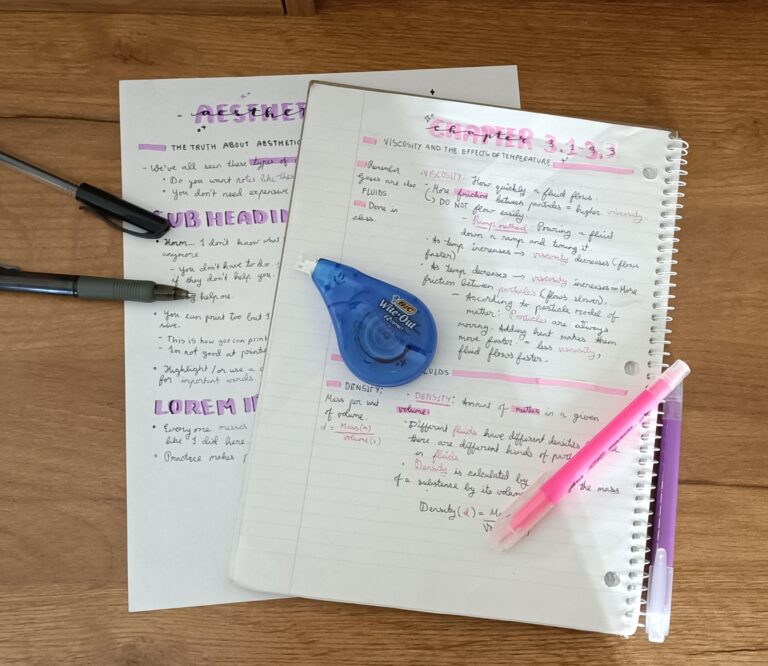
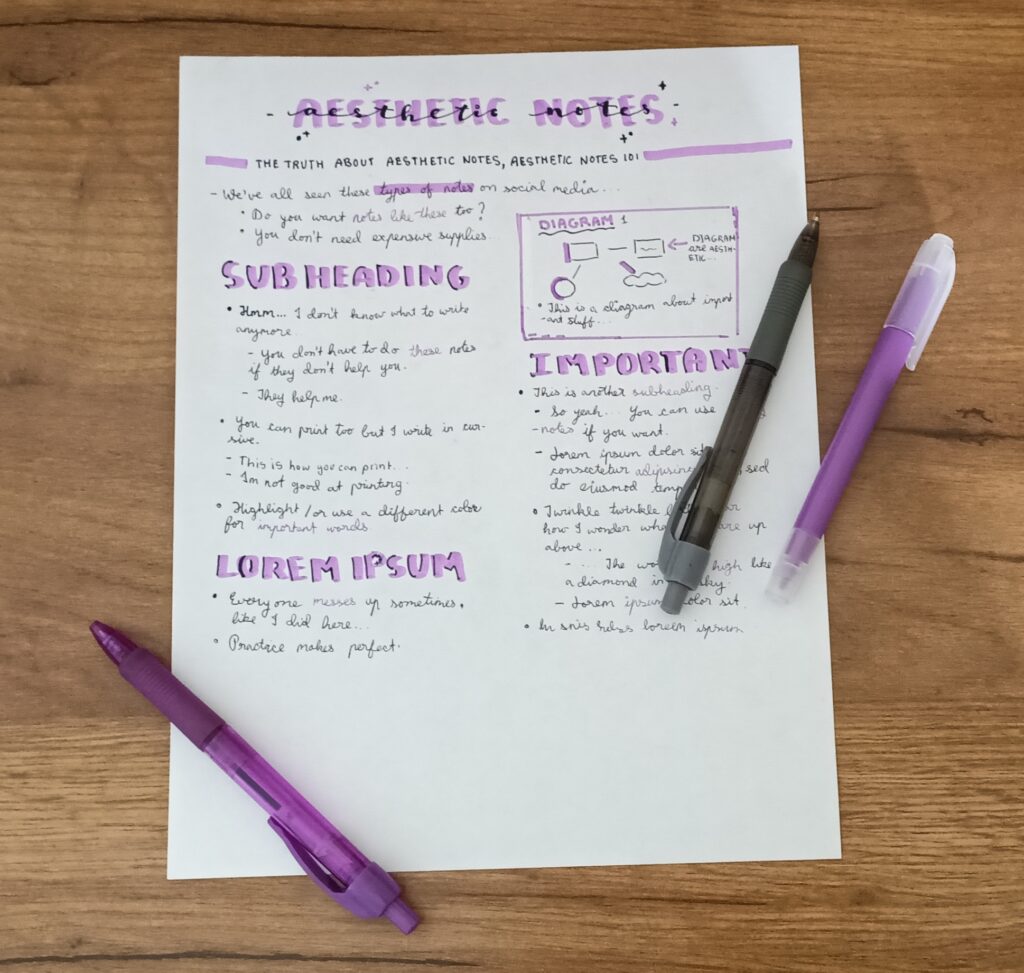
Aesthetic Notes 101


We’ve all seen aesthetic note taking trends on social media, crisp white pieces of paper with perfect handwriting, decorated with pastel highlighters and headings that look like they were designed by professional hand lettering artists rather than the school or university students who actually did them. These short videos and pictures have been trending for a long time, often showcasing an array of fancy highlighters, brush pens and other stationary. In this blog post, I’ll tell you about some note-taking methods and an easy way to make your notes aesthetic.


But first, will pretty notes improve your grades?

Though it depends from person to person, neat, color coded notes often encourage people to study them whereas messy notes make it difficult to focus. My notes are far from perfect, though I try to make them pretty as this encourages me to study them but also makes the note taking process fun instead of long and dull. It helps me remember the concepts when I draw diagrams and use different colors. You don’t have to have aesthetic notes to get good grades. All you need to get good grades is a pencil, a computer if needed, and your brain. If you don’t mind messy notes or you are a perfectionist and it will bother you if your notes do not turn out perfect, you don’t need to have aesthetic notes. Everyone is different and some methods don’t work very well for some people when they may work really well for others.

A simple way to make your notes more aesthetic.

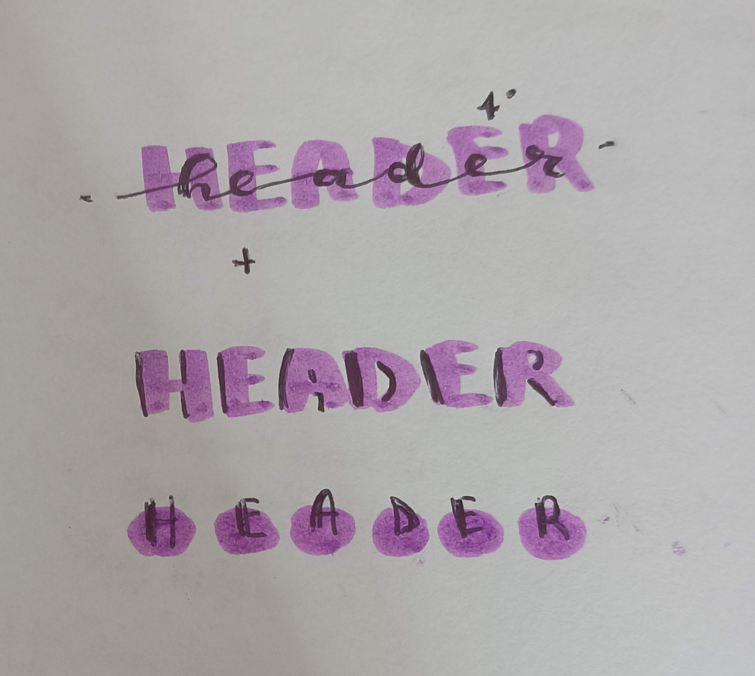
Now I’ll show you what I do to make my notes more organized and visually appealing. First, I pick one color to use for that section of notes. All you need is a black pen, a highlighter in the color you have chosen and a pen in that same color. The titles may seem a bit complicated but as they say, “practice makes perfect”. For the title I have a couple different methods that you can see in the picture below. It’s a good idea to do your titles after you take your notes especially if your taking them while the teacher is talking.


I take my notes in bullet points, just a simple dot and then a dash for a sub bullet. All you have to do is write down your text in black pen, write any important words or phrases that you come across using the colored pen. You can add definitions to these terms in the end if you like. I sometimes highlight a part of the text and add a note or question about it in the margin. Simply doing this makes your notes a lot more visually appealing. You can also add diagrams.


Other methods:

One popular note-taking method is the Cornell method. The page is divided into four sections, the header section which you probably already have in your notebook, two columns and one section at the end of your notes. One of the two columns is a smaller column to the left of the page, kind of like the margin. The larger column takes up most of the page. You take all of your notes in this column. Then you use the section at the end to write a summary about the notes. The smaller column is used to write down any questions that you may have or any details that seem important.

Remember, at the end of the day your notes are going to benefit you. So take them in a way that’s going to work for you. If aesthetic notes don’t work for you, you don’t have to have them even though they’re trending. I hope this post helps!

Spreading Holiday Cheer: 3 Reasons To Share Small Acts of Kindness

0

With holiday cheer slowly dispersing in the month of November, we are given the opportunity to create a chain of positivity through our communities. Using this season as a reminder of our fortunateness and our impact on those around us, the holiday season is an opportunity to rekindle our excitement and to remind us how far kindness can go. Through regular life, we often forget how meaningful a small act of kindness can be and instead get caught up in our own or surrounding negativity. To commemorate the season, here are three reasons to share some holiday cheer with small acts of kindness!

  1. Creating and Connecting Community

One of the most breathtaking things about the holiday season is the sudden change in atmosphere and outlooks. For many, this time can be a turning point in the year. The warmth of home and the ability to spend time at home with friends and family can bring out the best in us all. Extending this sense of gratitude and thankfulness beyond our homes, we as a community could be amazed at what we could do. Creating community means creating accommodation and doing random acts of kindness for those around us. This helps us foster a sense of belonging within the community and allows us all to make a collective impact on each other.

2. Compassion and Inclusion

While the holidays evoke feelings of joy and family for some, others, unknowingly to us, may be reminded or associate this season with loss and exclusion. This may stem from a different set of beliefs or the absence of a valuable family member. We should practice inclusive practices to encourage inclusion in our community. This can include acknowledging or sending messages to celebrate the diversity of holidays during the Christmas season. As someone who celebrates less popular holidays, it has a profound impact for someone to take spare time from their day to celebrate your holiday with them. Additionally, this could mean creating welcoming spaces within our communities, making it easy for people to access and enjoy the festivities without barriers.

3. Inspiring Others

Many times we find ourselves fascinated and inspired with other choices, in this case with others’ acts of kindness. Constantly learning and appreciating others’ actions, we can implement these own principles in our lives. With this in mind, encourage yourself to be this person, the person who is able to inspire others to help others. To be this person means doing what’s right (I know, cliché) and putting others before yourself for the time being. If we all started putting others in front of our immediate needs, our communities would flourish. Though it may feel these actions have nuanced impacts initially, your action will create a web of interconnected positivity that can be traced through small acts of kindness. In our world that is often characterized by negativity, these acts of kindness serve as proof of how far ‘small’ acts can go.

After understanding how acts of kindness cannot be underestimated, we can realize the lasting impact of our actions. Each smile shared, door held, hand held, we can set off a positive chain of events. By recognizing this power, we are given the ability to create an everlasting ripple effect that can transform our communities. By embracing this simplicity and power of acts, we can help to start creating a large and profound impact on our communities!

Spread some holiday cheer!

A Beginners Guide to Alzheimer’s

Alzheimer’s is one of the most common types of dementia. It is a progressive disease that begins by affecting the parts of the brain that control memory, language, and thought. In medical terms, it can start out by affecting the entorhinal cortex and hippocampus but can later start affecting the cerebral cortex as well. Did you know that around 55 million people worldwide live with this disease? Alzheimer’s is commonly aimed at people of an older age but some rare cases prove that younger people can get it too. It is predicted by Alzheimer’s Disease International that by 2050, around 139 million people will be affected.  Basically, Alzheimer’s is a type of dementia that affects the brain’s ability to properly function in society. 

The most popular symptoms of early Alzheimer’s are: 

  • memory loss
  • poor judgment 
  • taking longer than usual to complete daily tasks
  • mood/personality changes
  • increased anxiety or depression

Some more moderate signs of Alzheimer’s could include:

  • Difficulty with language and articulation
  • Increased memory loss and confusion (such as forgetting personal history)
  • Difficulty organizing thoughts and thinking logically
  • Hallucinations and impulsive behavior

The most severe symptoms could include:

  • The inability to communicate,
  • Seizures
  • Loss of bladder control
  • Zero awareness of one’s surroundings

At the moment there is no proper cure for Alzheimer’s. But doctors still can prescribe medicine that can temporarily reduce the symptoms. The main medicines are Acetylcholinesterase (AChE) inhibitors and Memantine. AChE is used to increase levels of acetylcholine, which is a substance in the brain that helps nerve cells communicate with one another. Memantine is different from AChE. It operates by blocking the effects of an excessive amount of a chemical in the brain called glutamate. Glutamate is a chemical inside your brain that sends messages between nerve cells in the brain. But if those cells are damaged by Alzheimer’s, a whole lot more damage could be done. 

Researchers have made significant progress in developing, testing and validating biomarkers that indicate signs of the disease’s process. Scientists have also made advances in blood-based tests that can be used to screen volunteers for further research. In the future, it is hoped that these methods can and will be used to screen patients for both Alzheimer’s and dementia before the symptoms even appear. Other research includes population studies and precision medicine. By looking at large groups of diverse populations, researchers can discover which behaviour, genes, and lifestyle choices can lead to Alzheimer’s and dementia in the future. Some other possibilities they are looking into include “Lifestyle Interventions”, “Disease Pathways”, “Drug Discovery” and “Infrastructure Development”. Hopefully, researchers and scientists can figure out a cure for this disease before more and more have to suffer from it. 

Mayo Clinic – https://www.mayoclinic.org/diseases-conditions/alzheimers-disease/symptoms-causes/syc-20350447

Centers for Disease Control and Prevention https://www.cdc.gov/aging/aginginfo/alzheimers.htm#:~:text=Alzheimer’s%20disease%20is%20the%20most,thought%2C%20 memory%2C%20and%20language.

Alzheimer’s Disease International https://www.alzint.org/about/dementia-facts-figures/dementia-statistics/#:~:text=There%20are%20 over%2055%20 million,and%20139%20 million%20in%202050.

National Institute of Aging (USA)

https://www.nia.nih.gov/health/what-are-signs-alzheimers-disease

Alzheimer’s Association

https://www.alz.org/help-support/i-have-alz/treatments-research#:~:text=Research%20into%20future%20treatments,-Researchers%20are%20conducting&text=These%20changes%20offer%20potential%20%22targets,response%2C%20metabolic%20changes%20and%20more.

Alzheimer.gov (USA)

https://www.alzheimers.gov/taking-action/research-activities

Got some free time? Learn how to echo-locate!

0

Have you ever dreamed of manifesting a super power like invisibility, super strength, or maybe…”seeing” in the pitch dark? Well, maybe magic won’t enhance your vision, but the science of echolocation sure will!

What is echolocation?

We all have some idea of what echolocation, maybe through learning about bats from school field trips to the zoo, or perhaps from reading “did you know” fun facts about nocturnal animals. Echolocation is a mechanism that some animals, most commonly bats and dolphins use to communicate and pick up information about their surrounding environment. Instead of using their eyesight to do this, these animals use their hearing. Bats, for example, contract their larynx to make high-pitched sounds emitting high frequency waves. These emitted waves rebound off of objects, producing echoes which tell the animal the distance and location of an object.

A huge part of echolocation is tuning into the surroundings and listening to the small and subtle changes in sounds and other sensory details around us.

Echolocation in humans:

Experts have found that the human brain has areas that are dedicated to receiving and processing echoes, and it is also estimated that 20-30% of blind people learn how to echo locate at some point in their lives. Echolocation is a skill that anyone can learn, and it comes with several benefits such as being more focused, and aware of the changes that are happening all around us.

Like every skill, echolocation takes practice and everyone has a different way of going about tackling this, but the following are a few tips that are recommended by scientists and experts:

  • Learn how to lose yourself in your surroundings: As I mentioned before, learning how to tune into the environment around you is key to echolocation. It is important to develop the ability to pick up on the change in sounds. For example, when you are going out on a walk to Nose Hill park on a snowy day in Calgary, you can listen to the sound of the snow crunching beneath your feet, or if you are sitting near the Bow River on a beautiful and picturesque autumn evening, you can look out for the churning of the water or the sound of the water rushing downstream. According to Daniel Kish, who has been blind since he was 13 months old, and uses echolocation to communicate, “everything we pass reflects sound differently.”
  • Picking an echolocation sound that you are comfortable with: Every individual has a different sound that they use to help them locate their position and the position of objects around them. These sounds can include tongue clicking, finger snapping, or cane tapping. Experts say that it is important to choose a sound that you can reliably reproduce, but for beginners it is usually a clicking sound that sounds like tsk-tsk.
  • Take it easy first, and later, level up the difficulty: Since echolocation is a hard skill to master, it is important to start training yourself with easy exercises. These exercises can include blindfolding yourself, walking up to a wall, and trying to stop at the appropriate time with only using your sounds and your senses of hearing. As you feel comfortable with this, start moving onto harder exercises such as moving into a room with different acoustics or adding more objects in the room for the sounds to bounce off of.
  • Learn when to take breaks: For beginners, it can be disorienting to be without their visual senses and to only rely on their hearing for direction. Experts suggest that beginners cannot practice echolocation without taking breaks after every 30-45 minute time interval.

Echolocation is a difficult skill to master as we are not accustomed to being without our visual senses for long periods of time. However, even if we cannot become perfect at this, it is worthwhile to try this out as it can make us feel more confident and empowered as we strengthen one of our senses. This skill, also teaches us that every small detail in our lives can make a difference in how we perceive the sounds and positions of objects surrounding us.

I, for one, am excited to try out this new skill, and I hope that you will join me in this journey of learning something new!

Sequences + Series

What are sequences and series?

A sequence is a list of numbers, such as: 1, 2, 3, 4, 5, 6. Each number in the sequence is a term.

Later, we can name these terms such as  

for the first, second, third, fourth, fifth term.

By adding the terms in a sequence, this results in a series:

1 + 2 + 3 + 4 + 5 + 6

Arithmetic Sequences:

There is a common difference between each of the terms:

  • 1, 2, 3, 4, 5, 6: the common difference between each term is 1.
  • 2, 5, 8, 11, 14: the common difference between each term is 3.

General Term:

The general term is a formula for finding any term in a sequence. This continually addition is a pattern -we can turn that into an equation to find the nth term in a sequence, whatever n may be.

General Term of an Arithmetic Sequence:

  • d = common difference between terms
  • n = index of term you want to find – if you want to find 3rd term, then n is 3

We can start by writing out an arithmetic sequence and then converting it to an sequence with only variables:

1, 3, 5, 7, 9

We note that the first term is 1, the common difference d = 2, and let’s say that we want to find the 6th term, so n = 6.

If we were to convert the above sequence to only have variables:

If we look at how to get from 1 to 11, we note that we need to add 2 five times, where 11 is the 6th term of the sequence. We can notice to get the nth term (6th) of a sequence, we need to times the common difference by n – 1 (2 times 5) and add the first term (1):

forming the general term of an arithmetic sequence.

Calculating the sum of an arithmetic series:

As we mentioned before, a series is the addition of a sequence:

1 + 2 + 4 + 8 + 16

Therefore, an arithmetic series is the addition of an arithmetic sequence:

1 + 3 + 5 + 7 + 9

To find the sum of an arithmetic sequence, once again, we can create a formula to compute these sums regardless of which numbers are the first and last terms. A famous problem for calculating the sum of an arithmetic series is finding the first 100 integers:

1 + 2 + 3 + 4 + 5 + … + 99 + 100 = ?

You could simply brute force through this problem; add each number individually, but there is a much simpler and efficient method. By adding the first and last term, then the 2nd term and the 2nd last term, and so on, you get:

1 + 100 = 101

2 + 99 = 101

3 + 98 = 101

Clearly, each pair added together equals 101 –so to find the sum– how many pairs are there in total?

There are 100 numbers, and therefore 100/2 = 50 pairs. So 50 * 101 = 5050 – the sum of the first 100 integers.

I hope you enjoyed this week’s post, thank you for reading, and I hope you have a great day!

Sources:

  • Introduction to Algebra: Art of Problem Solving

What Makes the Companionship of Our Pets So Irresistible?


Konrad Lorenz, an Austrian zoologist and ethologist, is considered to be one of the founders of the study of animal behavior, known formally as ethology. He became widely known for his development of the ‘imprinting’ theory, a captivating concept that brings attention to instinctive bonds between animals. An animal goes through a crucial stage called imprinting shortly after hatching or birth. Lorenz theorized that the first moving object the infants perceive, generally their mother, elicits an instinctual, maternal attachment in them. Scientists claim that imprinting can happen in as little as 30 minutes in some species.

So.. why do I love my dog so much?

Soon after Lorenz’s work, researchers found that oxytocin, the “feel-good” hormone, plays a major role in imprinting. It’s called the “feel-good” hormone because it’s released in response to social or romantic bonding, which triggers happiness. For instance, oxytocin levels spike while nursing which contributes to the creation of a mother-child bond in both parties. Most people regard their pets as members of their family, and according to the brain, we bond with our pets in the same way. Recent studies show that mutual gazes with one’s dog induce an increase in oxytocin levels in both parties. Consequently, our affection for our family and pets is interpreted by our brains via the same neural route. According to studies, people’s brains light up in the same areas when they view pictures of their dogs vs. their children.

Science tells us that the human-dog bond is mutual 🙂

Sources: 1 / 2 / 3 / 4 /

Understanding the Current Israel-Palestine Crisis: A Closer Look

0


In the complex tapestry of the Middle East, the ongoing conflict between Israel and Palestine has once again taken a distressing turn, capturing the world’s attention. As the region grapples with a ground invasion, humanitarian crisis, and geopolitical tensions, the latest chapter in the Israeli-Palestinian saga demands our focus. In this article, we delve into the historical roots, current dynamics, and international implications of the conflict, aiming to provide a comprehensive understanding of the multifaceted challenges unfolding in the heart of the Middle East.

Israel’s Ground Invasion and Humanitarian Crisis in Gaza City

Israel’s ground invasion against Hamas has given rise to a severe humanitarian crisis in Gaza City, where approximately 400,000 people find themselves trapped. The complex situation has been exacerbated by Hamas positioning itself within and below civilian infrastructure, leading to significant collateral damage from Israeli strikes on civilian locations.

Regional Dynamics: Israel, Hezbollah, and Syria

Simmering regional tensions have prompted the United States to engage in shuttle diplomacy. Meanwhile, Israel is engaged in a dual conflict scenario, exchanging rocket fire with Hezbollah in Lebanon and conducting strikes on alleged Iran-linked targets in Syria.

Historical Context: The Israeli-Palestinian Conflict

The roots of the Israeli-Palestinian conflict trace back to the late nineteenth century, culminating in key events such as the first Arab-Israeli War in 1948 and the Six-Day War in 1967. Although the Camp David Accords in 1979 improved relations between Israel and neighboring countries, the question of Palestinian self-determination persisted.

Factionalism and Political Shifts

Factionalism among Palestinians heightened when Hamas won the parliamentary elections in 2006, which displaced the long-standing majority party, Fatah. Furthermore, this has resulted in Hamas gaining control of the Gaza Strip, a region under the semi-autonomous Palestinian Authority since 1993. Also, western governments, including the United States and the European Union, did not acknowledge Hamas’ electoral victory due to its designation as a terrorist organization.

Previous Escalations and Global Influences

Previous escalations in 2014 and 2018 witnessed military confrontations between the Israeli military and Hamas, with a cease-fire brokered by Egypt in 2014. The Trump administration’s policy shifts, including canceling funding for the UN Relief and Works Agency and brokering the Abraham Accords, marked significant changes in the dynamics of the conflict.

Escalation in 2023: Biden’s Support and International Concerns

The Israeli-Palestinian conflict escalated in October 2023, with President Joe Biden expressing support for Israel and the United States sending renewed arms shipments. The UN Security Council failed to reach a consensus on the renewed violence, causing international concerns for civilian safety and a hostage situation.

Humanitarian Impact and Displacement

The conflict has resulted in a significant increase in casualties, with approximately 1,300 Israelis and 10,000 Palestinians killed in the first month alone. Iran’s patronage relationship with Hamas and other extremist groups raises concerns about the potential expansion of the war to the north. In addition, this has displaced millions of Palestinians, posing a dilemma for Egypt and Jordan, which have absorbed large numbers of Palestinians in the past but are resisting accepting them during the current war. Negotiations have led to only 1,100 people exiting Gaza through the Rafah border crossing to Egypt, leaving 1.5 million displaced Gazans facing dire living conditions and security risks.

International Responses: Who Supports Israel, and Who Doesn’t?

In the current conflict, the U.S., EU, and other Western countries have condemned the Hamas attack on Israel, providing over $260 billion in military and economic aid. Russia and China have maintained contact with both sides, with Russia blaming U.S. policy for the lack of peace in the Middle East. Also, Israel’s arch-enemy, Iran supports Hamas and Hezbollah but, denies direct involvement in the attack.

Article sources:

Israel Gaza war: History of the conflict explained. (2023, November 15). BBC News. https://www.bbc.com/news/newsbeat-44124396

Israeli-Palestinian Conflict | Global Conflict Tracker. (n.d.). Global Conflict Tracker. https://www.cfr.org/global-conflict-tracker/conflict/israeli-palestinian-conflict

Image sources:

Pixabay. (2023). Pixabay. Pixabay.com. https://pixabay.com/

Unsplash. (2022). Beautiful Free Images & Pictures. Unsplash; Unsplash. https://unsplash.com/

Not Blood as in Family, But Love as in Choice

0

_______________

I am borne

of love and of sacrifice;

forged from pain and resilience

·

I say, it is not in jest

but in epiphanic confession

that I tell you: I am beholden

Not to the blood of my ancestors

but to the actions of those around me

·

It is the way that

I am my father’s daughter

who taught me resilience above resentment

and change above passivity

They told me 

fall seven times, and stand up eight. 

He showed me 

fall seven times, and stand up eight

·

It is in my mother

whose sacrifices I recall

with more clarity than her face

by night I weep for her embrace 

but by day I rejoice the life she forged for me

From her I learned strength,

the power of a smile and 

the treasure in our words

·

I see it in he

who was obligated only to do his job

yet noticed a sad girl

who had built towering walls

She needed to be noticed

and he was the first to listen.

From him, I learned compassion

and to harness power in gentleness

·

I point you to the boy,

who has known loneliness like no other

who bore a lifetime of hurt

before knowing warmth

He chooses to smile day after day,

embraces laughter and tears,

for the expression that they are.

·

I declare to the world, and you

I denounce the way 

they weaponize my blood,

and demand worship,

for my respect shall be equal

but my reverence must be earned

·

Cruelty is not unique

when kindness is so hard

Immorality is not different

when they sway you to be cynical

·

yet I stand by my words

for there are those who held me close

whispering, “It is okay to let go,

You are worthy of your own love.”

Not Blood as in family,

but love as in Choice

_______________


Feautured Image 

Phineas Gage: Neuroplasticity in Action

0

In the field of Neuroscience, few case studies have left as permanent a mark as that of Phineas Gage. Phineas Gage–a 19th-century railroad construction man–survived a horrific accident that dramatically altered his behavior, and has continued to fascinate researchers and the general public for over a century. This case had a profound impact on our understanding of the intricate relationship between the brain and human behavior.

What Happened to Phineas Gage?

On September 13, 1848, 25-year-old Phineas Gage was working as a railroad construction foreman in Cavendish, Vermont. During a routine procedure, a seemingly catastrophic accident occurred. An iron rod, weighing over 13 pounds and 3.5 feet in length, was propelled through his left cheek and out the top of his head, damaging significant portions of his brain in the process. Remarkably, Gage survived this seemingly unsurvivable accident, and shortly after regained consciousness and was able to speak and walk, although he exhibited severe changes in his personality and behavior. Friends and family reported that the once responsible, polite, and soft-spoken Gage had transformed into an impulsive, rude, and unpredictable individual, causing his colleagues to even state that he was “no longer Gage”.

How Did the Accident Affect the Brain?

Gage’s dramatic behavioral change piqued the interest of his physician Dr. John Harlow. Harlow documented Gage’s case and noted that the iron rod had damaged a significant portion of Gage’s frontal lobe–this realization became a pivotal moment in the history of neuroscience. The frontal lobe, a region at the forefront of the brain, is associated with complex cognitive functions, such as decision-making, social behavior, and personality. Gage’s case offered profound insights into the role of the frontal lobes in regulating behavior, as damage to this region had a profound impact on his personality. 

Results of His Accident

His case sparked decades of research and inquiry into the relationship between brain injuries and changes in behavior and has prompted significant advances in our understanding of neuroplasticity–the brain’s ability to adapt to injury and recover some functions. Gage’s story demonstrated that while some damage is irreversible, the brain has the capacity to compensate for loss and develop new neural pathways. His accident and its consequences continue to inspire research and exploration, reminding us of the resilience of the human brain in the face of adversity. Phineas Gage, a man forever changed by a tragic accident, has forever changed the way we think about the brain and its role in shaping our lives.

Bibliography:

Magazine, S. (2010, January 1). Phineas Gage: Neuroscience’s most famous patient. Smithsonian.com. https://www.smithsonianmag.com/history/phineas-gage-neurosciences-most-famous-patient-11390067/

Teles, R. V. (2020, December). Phineas Gage’s great legacy. Dementia & neuropsychologia. https://www.ncbi.nlm.nih.gov/pmc/articles/PMC6933139/

Encyclopedia Britannica, inc. (2023, October 10). Phineas Gage. Encyclopedia Britannica. https://www.britannica.com/biography/Phineas-Gage 


The Five Main Sources of Stress Amongst Youth


Employee sitting on a chair in front of a table with a laptop and a coffee mug on it. The employee's head is faced down with his forehead on the keyboard. This picture is intended to act as an example as a stressful moment, hence why the caption is made up of the word "Stress"
Stress

In our lives, the feeling of stress is not a strange feeling; it is a familiar feeling that we face in the countless amount of situations that we have to go through. Stress can come to us unexpectedly, and sometimes it may even get us startled. After all, Segal et al. (2023) highlighted that:

“Stress is your body’s way of responding to any kind of demand or threat.”

Our everyday lives are filled with surprises, and thus, it is filled with a myriad of situations that gives us this “demand or threat.” While adults are more experienced, youth face more stress because of more surprises coming at them when they have less experience. Although there are countless amount of situations that gives us stress, they all come back to five main sources of stress. In this article, these five main sources are listed below. Along with these five sources, there certainly are ways to minimize stress, which are also shown below!


Source 1: School

First, school is the most common and dominant source of stress for most youth. From balancing between school work and life, to dealing with material that takes time to learn, there are many scenarios that can make the school experience stressful. There are two powerful factors that cause school to become stressful for students, especially with youth. These two factors are: procrastination and assessments.

  1. Procrastination is a huge factor that leads to a stressful school experience. For most students, their exhaustion and anxiety may outweigh their encouragement to do their tasks, and cause them to decide to do it another time. However, there will always come a time where they would have to do their tasks, and usually by then, they will find themselves in a time crunch. By pushing off their tasks to a later time, students will have much more stress when they find that time is running out to do their tasks.
  2. Assessments can be very daunting as students are looking forward to achieve a grade they wish to achieve. While this factor is not very evident in earlier grades, students usually become stressed when the learning material seems difficult. When a topic seems to not be clear to students, there is often that stress for what would happen if it appeared on an assessment. From this, students are rightfully stressed to study, but then, if the material seems to be too much, students can become too stressed. These assessments can vary from quizzes to tests to exams. When something seems to threat “more,” students are more stressed because of it.
Ways to minimize stress from school:
  • Create a healthy schedule and try to stick to it (Make sure it is flexible for school and other things)
  • Decide when and where you study best
  • Ask for help when needed
  • Break your harder tasks into easier steps instead
  • Allow room for error in your learning


Source 2: Pressure from friends and family

Second, peer pressure from friends and family is another common source of stress amongst youths. Especially when it comes to trying to fit in with the group, peer pressure can bring demand or threat to you. The influence of other people plays a role with, or maybe against, someone’s identity. As youths start to adapt to new environments, like in school, neighbourhoods, or hobbies, being accepted is a common goal in these new environments. Achieving these goals are sometimes easy, but when they are not easy, feeling pressured to achieve them causes you to feel stressed instead. Peer pressure usually comes from two things: friends and family. There are differences in the peer pressure that these two different things provide:

  1. In the pursuit of trying to be accepted, youths are often pressured by friends to do things that are beyond what they would want to do. Friends can positively pressure you to do good and comfortable things. However, they could also pressure you to do things you would not wish to do and reduce your self-esteem. Stress usually occurs from these “demands,” and pressure youths to live up to these expectations from friends. While positive peer pressure is good and not very stressful, negative peer pressure often leads to stress.
  2. The pressure we experience from our family is almost always from the idea of living up to someone’s expectations. Especially when it comes to school work, family expectations can bring a lot of stress for it. When youths fall into procrastination or misunderstanding, the pressure from family contributes to more stress for youth. Other pressures from family can be from taking care of any siblings, aiming for a major they want, but the youth doesn’t, etc.. . Living up to family expectations can become a very stressful goal to achieve.
Ways to minimize stress from friends and family:
  • Learn to say NO when you do not want to do something
  • Choose friends wisely
  • Isolate yourself when you are too stressed from friends and family
  • Enjoy what you’re doing
  • Take care of yourself


Source 3: Negative perspective on themselves

Third, a negative perspective on themselves is another common source of stress amongst youth. Similar to feeling pressured from others, a negative perspective on yourself leads to the fear to change who you are. Being hard on yourself always leads to the “demand” to change the person that you are. While the only thing that can cause this source of stress to occur is yourself, this source is often underestimated. The stress of changing yourself always comes from the self-talk of excessive negativity. When this stress becomes too much, devastating things could happen to a person, especially to youth with a young age.

Ways to minimize stress from a negative perspective of yourself:
  • Allow room for error and imperfection (humans are not perfect!)
  • Think of good things that you have done instead
  • Let your inner-critic also be a friend, not just an enemy (“you are your own worst enemy”)


Source 4: Adapting through big changes

Fourth, having to adapt through a big changes can cause stress amongst youth. Obtaining stress from this source will vary between adults and youths because of their differences in experiences. When a youth has to adapt through a new experience, it is likely that is not easy for them at first. Especially when a big change happens suddenly, like the death of a family member, stress challenges our ability to adapt. There are countless amount of different scenarios of changes that all youths go through. However, with youths, there are two dominant areas of change that they face in their childhood. These two areas are: social and family.

Note: When youths grow up, they are guaranteed to experiences more areas of changes, but these two are the main areas in childhood.

  1. Socially, a big change for youth can be a situation like moving homes, schools, or even cities. The uncertainty of the new setting forces youths to be “on edge,” and become stressed instead of welcomed. In a social change, stress comes from having to adapt to a new place. On a social and emotional view, adapting to a new place can cause loneliness at first and/or people to miss old friends.
  2. With family, a big change for youth can happen when a relationship “breaks off.” With divorce rates increasing since the 1970s, there are also more youth facing the big change from these divorces. Along with parents, siblings can also cause stress in the family. While having siblings alone could cause stress, having to separate into your own lives can cause stress to occur too. Adapting through these family changes can cause an immeasurable amount of stress as family is often a huge part of the lives of individuals.
Ways to minimize stress from having to adapt through big changes:
  • Build resilience for yourself
  • Understand that it is acceptable if you cannot handle it yet
  • Focus on yourself (For example: a deceased family member would want you to keep being yourself)


Source 5: Unrealistic expectations

Fifth, setting unrealistic expectations can cause stress amongst youth. Setting expectations is a necessary asset for someone to improve themselves. However, when someone does not seem to achieve their expectations, it is easy for them to blame themselves. Youth can be impatient and wish to achieve their goals in a quick manner, blaming themselves when they can’t. When youth set an unrealistic expectation for themselves and keeps trying to achieve it, more stress comes due to being impatient, especially when they expected themselves to master it very quickly. Youth setting unrealistic expectations for themselves can cause stress from trying to live up to their own expectations when they realistically cannot.

Ways to minimize stress from setting unrealistic expectations:
  • Be aware of the time and energy you would have to make (If it is too much, then beware)
  • Break your expectation down into goals instead (For example: If you want to climb a mountain, reach the bottom of it first)
  • Allow room for error with your abilities


For youth, stress is a big part of their lives. In fact, according to survey from the American Psychology Association teenagers reported higher stress levels than adults. When an individual experiences something new for the first time, stress is common to occur. The five sources mentioned were: school, pressure from friends and family, negative perspective on themselves, adapting through big changes, and unrealistic expectations. These five sources are almost guaranteed to have happened in an individual’s childhood. While stress is a necessity to move forward and adapt in life, youth experience a lot of stress. The only actual problem with stress is only when it is too much for a person. When there is too much stress for a person, it is very easy for them to suffocate because of it. As humans, stress is natural, but it is our duty to watch over it and ensure it is still a healthy amount, especially amongst youth.

Featured Image: 1

Sources: 1, 2, 3, 4, 5, 6, 7, 8, 9

Celiac Disease and Dieting

0

Diets have a major impact on all of our lives.

From eating disorders to allergies and diseases, someone’s advice or ‘tips’ can have a major impact on how our physical and mental health looks on a day-to-day basis. However, not every tip you see on social media works for your body, and some ‘tips’ (eg. fasting for a certain period), could be detrimental to your health and how you look at yourself in the mirror. For this reason, I deeply respect and appreciate my dietitian and my family, as I found out I have celiac disease.

What is Celiac Disease?

It is a serious autoimmune condition, triggered by gluten, that prevents one from absorbing the nutrients they need from their food. This disease is often misdiagnosed; according to the Celiac Disease Foundation, “only about 30% are properly diagnosed” and it “affects about 1 in 100 people worldwide”¹. That’s because celiac disease can be associated with many other conditions or diseases since nutrition deficiency is not only present in celiac disease. To have celiac disease, the individual usually possesses a hereditary predisposition called human leukocyte antigen (HLA) DQ2 and or DQ8, passed down from your parents². Then, the individual will be tested by blood work and or an endoscopy, to confirm if their small intestine is inflamed and if it’s due to their gluten intake. If it is, then the reason is mostly likely due to the individual’s immune system attacking and flattening the small villi in their small intestine (finger-like projections in small intestine; which are responsible for absorbing nutrients when digesting food), when they eat gluten. 

What are its symptoms?

If it is not being treated, symptoms can range from almost none to many and or severe. Here are some of the many³;

  • Iron deficiency anemia 
  • Vitamin deficiency 
  • Fatigue 
  • Low bone density
  • Skin rashes
  • Bloating
  • Constipation
  • Diarrhea
  • Weight loss
  • Lack of growth
  • Cancer (Only in the most severe cases, if not treated for a long time.)

Treatments and Cures

Unfortunately, there is no cure for celiac disease yet, but constant research is being done. However, there is an effective and simple treatment; a strict, life-long, gluten-free diet. If an individual adheres to a gluten-free diet for the rest of their lives, then gluten cannot get into their body in the first place, so the whole autoimmune reaction will not happen, preventing the small (finger-like) villi in their intestine from being attacked. Thus, their small villi will be able to absorb nutrients from their food better as time goes on and their small intestine starts to heal. However, due to the gluten-free diet lacking fibre, it is recommended that celiacs eat more leafy green vegetables and other high-fibre food, to combat this. Therefore, so long as they follow through with this diet, they should see a significant decrease in their symptoms in their first year or so (may take longer, depending on their severity), hence leading a happier and healthier life.

What to be Careful of as a Celiac

Since gluten is present in wheat, barley, and rye, which are widespread ingredients that we see everywhere, it is important to be aware of cross-contamination. Since many products and fast-food restaurants make their food in the same areas that food with gluten is made, it is important to check the labels on the products and ask many questions to the chefs at the restaurants, to make sure no gluten is being contaminated in their ‘gluten-free’ products and dishes. An important label to look for is the following;

My Dietitian’s and Family’s Importance

So, if all I have to do is follow a gluten-free diet, why is my dietitian that important to me? Well, because many foods you used to like contain and eat daily, have gluten in them, and if you are a picky eater like me, it can be a very hard transition to make, which can result in a bad relationship with food. That’s why my dietitian and my family help me find options that I will enjoy as well so that I do not get turned off by the idea of food. Thus, resulting in a healthy, life-long, and enthusiastic relationship with my food instead of trying to avoid the idea of food completely and damaging my health in the long term.

Thank you for your time reading this!

I hope it made you feel that you are not alone when it comes to dieting hardships and that it was informative! But for more information, check out Celiac Canada


Sources:

¹ https://celiac.org/about-celiac-disease/what-is-celiac-disease/

² https://www.massgeneral.org/children/celiac-disease/genetic-testing-for-celiac-disease

³ https://www.celiac.ca/gluten-related-disorders/signs-symptoms/

⁴ https://www.celiac.ca/living-gluten-free/gf-product-finder/

⁵ https://www.celiac.ca/

Gardening for Beginners

A fun and productive pastime and hobby!

The opportunities for gardening aren’t only available for people who live in the countryside; many people residing in large urban areas can also benefit hugely from the important asset of having the skill to garden. In general, gardening is available in the methods of planting in the backyard or the house, truly opening up possibilities to everybody.

Image by eko pramono from Pixabay

A personal connection

When I was extremely young (still in my early elementary school years), I was always fascinated by my grandpa’s gardening activities. Growing up in China, I often visited my grandparents, delighted when I would find crops, such as tomatoes, peppers, and beans grown in the “sun-room” area of their apartment. Even though there wasn’t too much space in my grandparents’ living quarters, they had no difficulty fitting the various pots containing different types of crops in them and greatly enjoyed watering and fertilizing their plants as a way to reduce stress and pay dedication. My grandparents gardening greatly boosted my interest in this hobby and is the reason why I am thinking about starting it myself now.

The purpose of gardening

The are so many benefits to gardening. For example, you can enjoy naturally-grown food that is fresher to eat. They also tend to be better-tasting than most products that were stored long-term in stores. Tomatoes are juicier, carrots sweeter, and peppers more brightly colored. Most importantly, you would know if the crop had been polluted or not, making it extremely safe to consume. Most importantly, it is awesome to enjoy all the delicious products you grew after months of dedication and hard work from your family! This would certainly be something nice to share with friends as well.

Image by Jill Wellington from Pixabay

The steps

Starting to garden can be a difficult task for many people. Many tend to think that the process is overly difficult and quit before taking action toward it. In reality, this is not entirely true. As I am sharing the steps that I gathered from various instructional sources to gardening, please keep in mind that I am learning all of these at the same time as you are! Just like many of you, I am also a “rookie” at gardening, and I am personally planning to start next season.

  • Set out an undisturbed space to plant your crops. Whether it will be indoors or outdoors, you have to make sure that doing gardening will not overly disturb your day-to-day life of moving through your living spaces. The plants also need much space to themselves so that they can grow healthily.
  • In Calgary, the city where I’m currently residing, many live in houses with backyards. If you choose to grow produce in the backyard, make sure to find a place with abundant sunlight and soil, that is protected from torrential rainfall or strong winds.
  • If you choose to grow produce indoors, make sure to set up an indoor planting bed that you can store dirt in. You can find some inspiration by clicking on this link (DIY-made indoor gardening beds), but basically choose an area with enough sunlight (preferably near windows. The soil bed can be constructed by purchasing wood blocks and assembling equipment, generally found in warehouse stores.
  • For growing plants outdoors, one does not necessarily need a raised bed; just clearing the grass in the area is enough. However, make sure that the plot of cleared land isn’t too large (try to keep it under nine square meters, optimally). Upon learning from a friend of mine, I have decided to personally make the shape of the plot to be very long, but thin. This would allow easy access to all of the crops I will be planting.
  • Crops like lettuce, zucchini, peas, kale, and tomatoes are all extremely easy to grow and tend to be relatively hardy. However, to plant each type, make sure that the purchased seeds are quality. Also, each type of plant thrives in different conditions regarding temperature and watering. For example, peas prefer colder weather, while tomatoes prefer warmer weather. Especially in Calgary, with snowfall usually lasting from October to April, it is highly important to check with the gardening schedule to plan for potentially moving some crops indoors.

Protecting the environment

Protecting nature is always important; when growing crops outside, remember to follow these guidelines (Environmental protection measures). If you reside outside of Canada, be sure to check with your local government’s regulations. Fertilizer runoff, the spread of pollen from certain crops, and other issues are very common in the community, destroying the natural ecosystem and habitat. As we are using the land to grow crops, we should also respect it and appreciate the wonders of Mother Nature!

Thank you for reading my blog post, and I hope that each and every one of you will succeed in your gardening journey!

A Introduction into Infinity

0

What is Infinity?

Infinity is a concept or idea that is boundless and endless. 

Consider the Infinite Hotel or Hilbert’s Hotel:

The infinite hotel is a hotel with infinite rooms and infinite guests, meaning that every room is occupied. One day, a new guest arrives at the hotel and wants to get a room. The manager decides to accommodate this new guest by telling everyone in the hotel to move one room down. The guest in room 1 moves to room 2, the guest in room 2 moves to room 3, and so on. This leaves exactly one new room for the guest, that being room 1. 

Why would we make everyone go through the hassle of moving to the room next to them, instead of just moving the person at the end?

With infinite rooms, it would be impossible to find a room for that person as there is no end to the number of guests and the number of rooms. 

The next night, infinite new guests want to stay at this hotel. How would you accommodate these infinite guests? 

Here’s how the manager did it: The manager tells everyone to move to the room that is double their room number. So the room 2 guest moves to room 4, the room 3 guest moves to room 6, and so on. If you write this down, you’ll quickly see a pattern. The rooms that are vacant are the ones that are odd. There are infinite odd numbers and therefore these new infinite vacant spots accommodate for the infinite new guests. 

Consider a Circle:

Why are wheels shaped as a circle? 

If your bicycle had a square shaped wheel, your ride would be pretty bumpy. If you increased the number of sides, such as a pentagon, your ride would become less bumpy. As you add more sides, the ride becomes smoother. What if we had infinite sides? With infinite sides, that would form a circle. Notably, a circle has no sides or corners, adding an interesting twist to the concept of infinity. 

Sizes of infinities: 

This section will investigate the size of infinities, but first, here are a few concepts to know before understanding sizes of infinities: 

  • A set is a collection of objects. For example, {1, 2, 3, 4, 5, 6} is a set, and {apple, pear, banana, broccoli} is also a set.
    • In terms of infinite sets, can you think of any?
    • Natural numbers, real numbers, integers, even and odd numbers are all infinite sets. 
  • One-to-one correspondence: How can you tell if the sizes of sets are the same?
  • Matching each element in Set 1 to each element in Set 2 without having extra elements means that the size of the sets are the same.
  • For example, if one set contains objects that are pineapples, and another set contains objects that are dragon fruit, by one-to-one correspondence, you can match a pineapple to a dragon fruit to create as many pineapple-dragon fruit pairs as possible. If there is no leftover pineapple or leftover dragon fruit, then these sets are equal in size. 

How can we apply one-to-one correspondence to infinite sets? In other words, how can we compare the sizes of infinite sets to one another? 

Natural Number Infinite Set Compared to Integer Infinite Set:

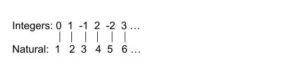
Natural numbers and integers are both infinite sets. Let’s try to compare the sizes of the natural number infinite set and integer infinite sets. As mentioned earlier, we can use one-to-one correspondence. So if each object in the natural number set matches each number in the integer set, then these sets are equal in size. Here’s how we could do this:

Showing the one-to-one correspondence between natural numbers and integers.

The list would go on for infinity. This conclusion of the natural and integer number sets isn’t intuitive. How could their set size be the same? Integers encompass negative numbers, positive numbers and zero while natural numbers only contain positive numbers and zero. However, when thinking about these infinite sets, we must remember that infinity is not an amount and it is endless. Therefore, even though it seems that there are many more integers, because they are both infinite and because of one-to-one correspondence, their infinite sets are the same size. 

Natural Number Infinite Set Compared to Real Number Infinite Set: 

Is the real number infinite set the same size as the natural number infinite set?

When looking at real numbers, we can narrow down our

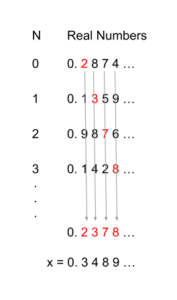
Two columns including the natural numbers and the real numbers.

scope to all the real numbers between 0 and 1. As mentioned previously, we need to use one-to-one correspondence to show whether the infinite sets are of the same size. In other words, we need to see if we can match our natural numbers to real numbers. First, we can just simply choose a couple real numbers that are in between 0 and 1 (the numbers chosen do not matter and you can try this at home):


As marked in this photo, the second digit of the first line is marked, then the third digit of the second line, and so on. 

The arrows point down where x = 0.3489. x is formed by simply adding 1 to each digit. So in the first line with the second digit of 2, we add one to get three which we place as the first digit after the decimal. We continue adding one, so the 13 turns into a 4, the 7 into a 8, and so on. This resulting number, x, is a new real number. This is because it is not the same as any of the lines. Because it takes one digit from each line and changes that digit, it will not be the same as any of the lines and therefore, it will be a real number that has not been listed. 

So when we list these real numbers and try to match them to a natural number, {0, 1, 2, 3, 4, …}, we will find that not every real number will be ever listed, because there can always be a new real number that is formed. Therefore, there is no one-to-one correspondence. Finally, this shows that the real numbers infinite set and natural number set are different size infinities. 

If you found this topic interesting or you would like to explore it some more, I really recommend the sources I looked at to write this post. Many of the sources explain what I talked about in greater depth and clarity, with much more credible sources. Thank you for reading and have a great week! 


Sources: 


Elephants: Soon to be History?

The elephant: You’ve probably read about them in books or seen them in movies. They are the world’s largest land animals, and it is said that they never forget. Unfortunately, there are only 400,000 African Elephants remaining. If action is not taken, the African Elephant will be extinct by 2040! Asian elephants on the other hand, are even more scarce, with less than 40,000 remaining worldwide.

The Role of Elephants

Elephants play a big role in their environment. They are seed dispersers. When they eat plants and fruits, the seeds often emerge undigested. This helps plants spread. Because of their huge size, they make clearings in areas of the forest, letting new plants grow. Without them the environment they live in will suffer.

Elephants also have the largest brain of any land animal. Have you ever heard the saying “an elephant never forgets”? This refers to their amazing memory, empathy and delicate feelings. They even recognize and respond to the sadness of other elephants. They are one of the most intelligent animals on the planet! The loss of the elephant will be a loss to the environment, but it will also mean the loss of a remarkable species from which we have a lot to learn.

mother and baby elephant on a grassy plain.
Photo by Hu Chen on Unsplash

So what is happening to the elephants?

Even though there is an international ban on ivory trade, elephant poaching persists. The international ban was enforced when elephant poaching for ivory skyrocketed. In  the 1980s, approximately 100,000 elephants were killed every year. The ban helped restore some of the population. Recently, there has been an upsurge in the demand for ivory, especially in Asian countries. Thousands of elephants are being killed for their ivory tusks, which are often used to make ornaments and jewelry.

A close up of an elephants tusks
Photo by Bisakha Datta on Unsplash

Elephants are also losing their habitat. As the human population continues to grow, more and more of their land is taken away and used for agriculture. This is causing more contact and conflict between humans and elephants. Elephants may damage crops, and may even injure or kill people. They are often killed as a result. The Asian elephant suffers from habitat loss, living in one of the most densely populated locations in the world. According to worldelephantday.org, their habitats have been destroyed in order to build highways, and plantations of crops such as palm oil and rubber tree.

As well, a lot of baby Asian elephants are taken from their homes and sold in the tourism industry. These elephants are trained and used for entertainment in places such as circuses, where they receive poor veterinary care and inadequate living conditions.

Imagine having to tell future generations about an animal called an elephant that once existed. That’s what I first thought of when I learned about this issue.

If elephant poaching for ivory, habitat loss, and the use of elephants for entertainment continues, we might lose this amazing species forever.

Sources

1, 2, 3, 4, 5, 6, 7, 8