
Home Blog Page 52

Exploring My Top 5 Favourite Landmarks In My Recent Vacation: Summer 2023

0

Context:

Due to my sister getting a job in Geneva, we as a family decided to take a trip to Europe to see her in Geneva, while stopping along a bunch of different places. In order, we went to London, Paris, Versailles, Geneva, and Rome. This took place in Summer 2023.

5. The Eiffel Tower, located in Paris. Measuring 330 metres to the very tip of the tower, the Eiffel Tower is truly an amazing landmark of the Paris city. It was built in 1889 to be an important attraction at the Paris World Fair during that time. The building since then has been recognized from an attraction, to a symbolization of French expertise, daringness, and modernization. You can not truly understand the remarkableness of the Eiffel Tower unless you see it yourself firsthand. The first sight of the tower blew me away, seeing all the pictures of the tower online and not seeing it in real life really made the blow more impactful. Overall, seeing the Eiffel Tower was a fabulous experience, but it is not one of the best that I have had during this vacation.

4. The Louvre Museum, located in Paris. The Louvre is recognized worldwide as one of the most diverse and full art collections in the world. The works of art displayed there ranged from heiroglyphs on small vases and pots, to immaculate paintings such as the Mona Lisa and the Liberty Leading the People. Navigating yourself throughout the building was much easier than any other museums we went to. They had Nintendo 3Ds’s that acted as audio guides while allowing you to read background info on all the displays at the museum. They also allowed you to see where you were in the museum. Seeing some works of art like the Mona Lisa were some of the reasons why I would put this in 2nd place. Although, the depressing size of the glass pyramids threw me off.

3. The Colosseum, located in Rome. The Colosseum is universally known as the largest amphitheatre (oval stadium with gap in the middle) in the world. The project for the construction of this building ranged from 72 AD to 80 AD. This place hosted multiple events such as gladiator fights, animal hunts, executions, etc. One thing interesting I learned about the Colosseum was that the basement was where they would hold all the animals and people before fights. The basement is visible in the picture above as they removed the actual battleground. Overall, this building was probably the best landmark I have been to so far in Rome. This would have made 1st place if it weren’t for the amazing landmarks succeding it.

2. The British Museum, located in London. The British Museum is acclaimed for it’s in depth representation of human culture. Each part of the building is sectioned off for lots of different cultures such as Asia, Africa, and of course English. In fact, it is the first and only museum to display all fields of knowledge. During my time there, we took an afternoon tea that they offered and along with tea, they offered us lots of small British treats and sandwiches. My favourite attractions there were definitly the Rosetta Stone and all of the Parthenon sculptures shown there. The gift shop offered there was definitly the largest one out of all the places I visited. This landmark is absolutely stunning in both its presentations and style, however, there is one landmark I believe that cannot be beat.

1. The Versailles Palace, located in the city of Versailles. This palace was home to Louis XIVs and his family. Along with providing his family a home, the building was also built as a symbolization of power and authority. A notable part of the Versailles Palace that I enjoyed includes the Hall of Mirrors,  which was the place where the Versailles treaty was signed. I also enjoyed the Royal Chapel, the Chapel looked so majestic, as if it was straight out of a movie. The courtyard though was where it got extremely cool. There were so many sculptures surrounding the unearthly huge shrubs. In the middle, there even was a giant body of water where people could kayak on. The place did not only offer kayaking, they also offered bikes to people who would like to really take in the beauty of the palace. They even had cafes which although were expensive, tasted delicious. All of these reasons are why I believe that the Versailles Palace is one of the best landmarks out of France, Rome, and Geneva. Dare I say the best in Europe?


Sources:

https://en.wikipedia.org/wiki/Louvre

https://en.wikipedia.org/wiki/British_Museum

https://en.wikipedia.org/wiki/Palace_of_Versailles

https://en.wikipedia.org/wiki/Colosseum

https://en.wikipedia.org/wiki/Eiffel_Tower
Roots of My Orchid – a Poem

0

Today I cut out the rotten roots of my orchid plant,

And thought of the life you gave me.

My hand brushed its green, healthy leaves,

A symbol of new possibilities.


Where in the soil can you find love like this?

Love that’s new. Love that we seek. Love that speaks to us. 

I wish you could have it,

like the way I have it

When you gave my life new possibilities.


Today I cut out the rotten roots of my orchid plant,

and wondered if you regret your last love?

My eyes wandered down to the dried up petals,

that I held in the crevices of my hand.


Where in the soil can you find love like this?

The kind that makes your flowers bloom?

Do you search for it or run from it?

The love I wished for you?


Today I cut out the rotten roots of my orchid plant

and tried to see the beauty.

The dark crevices along the sagging root,

Is that really something pretty?


I want to speak to the tears you’ve cried,

And meet your inner soul.

Tell me you have hope for love

Like the kind you wished for me. 


I want you to have love like mine:

Love that’s new and love that’s old

Love that surrounds me and brings me joy

Like you always wanted to. 


Where in the soil can I find you love like this?

Because I know you need more than mine.

Could I find you an orchid plant?

Cut out its rotten roots?

Or gently hold your hand? 


Today I cut out the rotten roots of my orchid plant

And prayed that love would find you.


Featured image

The Dream of Cleaner Energy

0

Climate change has been one of the most pressing issues of the past decade. As a society, we have become increasingly more aware of the inefficiency associated with burning fuel to generate electricity, an aspect of thermal generation. This raises a paradoxical dilemma as our quest for energy, such as the continuation of global coal-fired power plants, harms our climate change goals. Yet electricity and other power sources dominate all aspects of our lives. Thus, the latest advancements in nuclear fusion paint a new reality for society, one where clean energy is possible.

What is Nuclear Fusion?

Nuclear fusion is a process that occurs in stars, such as the Sun. It involves two light atomic nuclei combining to create a heavier one, which releases enormous amounts of energy without the production of greenhouse gasses and toxic nuclear waste. For this process to occur, the nuclei must combine at very high temperatures to ensure that they overcome the electrical repulsion among them. Fusion occurs when the nuclei come in close enough proximity that the electrical repulsion is outweighed by an attractive nuclear force. This reaction takes place in plasma, an ionized gas that is the result of superheated matter. Many fusion reactors try to harness the energy using a mixture of deuterium and tritium, which are isotopes of hydrogen atoms. Additionally, one kilogram of nuclear fusion fuel can provide the same amount of energy as ten million kilograms of fossil fuel. This astonishing difference is the reason many scientists and engineers are trying to further nuclear fusion research and possible industrial designs.

The Tokamak

tokamak. It is a doughnut-shaped machine that uses a magnetic field to trap plasma. The structure involved in the plasma confinement is called the “torus.” The plasma particles are contained inside the torus using a magnetic field composed of magnetic coils that create a field in the “toroidal” and “poloidal” directions. The poloidal field is generated by the central solenoid that carries electric currents. On the outside, another set of coils establishes a poloidal field that maintains the shape of the plasma. Through magnetically confined plasma, temperatures higher than the core of the sun have been achieved.

Recent Breakthrough

The Joint European Torus (JET), a tokamak machine, was involved in the new energy production record set by nuclear fusion. Scientists were able to create 69 megajoules of nuclear fusion energy for five seconds, which is an astounding breakthrough in experimental designs for fusion power. To achieve this, the scientists used 0.2 milligrams of fuel. If researchers and engineers are able to progress with their current breakthroughs with nuclear fusion, our society will have increased energy efficiency and a significantly lower threat of climate change. The JET used deuterium and tritium to make helium; during this process, the machine reached temperatures around 150 million degrees Celsius. With that in mind, the progress made with the JET will inspire the ITER (International Nuclear Fusion Research) engineering project.

Upcoming Challenges

The progress made with nuclear fusion acts as a beacon of hope for a society plagued with troubles. However, commercial nuclear fusion will stay a dream for now due to the complexities and obstacles needed to overcome with the current tokamak machines. For example, the recent project used more energy during the experiment than was produced. Furthermore, there are challenges associated with the availability of materials for fusion plants. As previously mentioned, the tokamak relies on the confinement of plasma particles that constantly spin in the machine. However, the plasma could escape if any issues arise with the magnetic fields keeping the particles close together. As a result, the reaction would cease, and the reactor could also experience damage if the plasma releases significant thermal energy.

Overall, the future for nuclear fusion remains bright as Princeton researchers claim to have used artificial intelligence to tackle these problems. Humans have the ability to work through adversity and break the conformities of past engineering design. Therefore, the dream of clean energy remains at the forefront of scientific discovery.

Sources: [1], [2], [3], [4], [5], [6]

Featured image: [1]


How Chemistry is used in day-to-day life

0

A fundamental branch of Science

Even though all of us, our pets, and all the objects we use in our daily lives are technically made of matter, which would fall under the branch of Physics, one cannot deny that we are also chemicals. Yes, it may seem dehumanizing to say it this way, but it’s the truth. Together, all the countless atoms make up the chemical and biological molecules in each of us, ensuring our survival of our lives and our existence. The food we eat, the water we drink, and even the house we live in are essentially supported by the chemical bonds that exist between and within the molecules, giving us the privilege to enjoy our material, physical world. 

Fun facts about Chemistry as a natural part of life

Did you know that Chemistry is extremely important for the safety of everyone’s lives? I thought we should begin here, as safety is paramount in the well-being of our lives. For example, it is extremely unwise to mix multiple sources of chemicals if you do not know their composition; if you intend on purposefully creating a new chemical solution, you also have to use math to figure out the proportions of each substance you can add to the final liquid. 

Whenever you use insect repellents, for example, they become less effective with sunscreens. Keeping the repellents to the natural choices is extremely important for one’s health, as synthetically made materials are often toxic and damaging to health. These are just some of the many things we as responsible folks for our health should consider. 

The type of crops (and livestock) we consume, and their cultivation methods are hugely dependent on the theory and practical usages of chemistry. Figuring out the natural environment where each crop grows the best, and how to fertilize them are all crucial in producing food of higher quality for society. This is to meet both the challenges of a growing population, and also, to a large extent, inflation. 

Have you wondered whether you can mix different types of oils for the vehicle you drive (or the vehicle owned by your family)? Oftentimes, we visit different gas stations to refuel our vehicles, even if there is still a lot of oil left in the tank. Do all of the gas stations import refined oil so they are compatible in usage with each other? Well, as it turns out, the experts largely agree that they do. Even if you mix a form of synthetic oil with a more naturally derived form, it is still unlikely that bad things will happen. For more great information on this area of Chemistry, be sure to visit this article (Oil Mixing)

Wonder what protects us from bacteria? Well, the soap we use every day to kill the germs is purposefully manufactured to be basic and destructive to the protein substances within bacteria and viruses. Every living organism needs some sort of protein to be able to survive, and if we tear the germs apart by destroying their protein, it is highly unlikely that they will continue to cause us illnesses! 

To conclude, Chemistry is truly an amazing branch of Science, and it is certainly used in every part of our day-to-day life. Creative people all around the world have figured out how to demonstrate the brilliance of the purpose of Chemistry to aid themselves in living more conveniently and comfortably. If you would like to discover anything more about Chemistry, feel free to look up some other online articles as well! And remember, prepare to be amazed at its application usages. 

Black History Month: The Inspiring Story of Willie O’Ree

People who overcome discrimination, racism, and obstacles to achieve their dreams inspire  and encourage many of us not to give up and try our best to reach our own goals. To honour Black History Month of 2024, let’s dive into William O’Ree’s story of perseverance and bravery.

Who is Willie O’Ree?

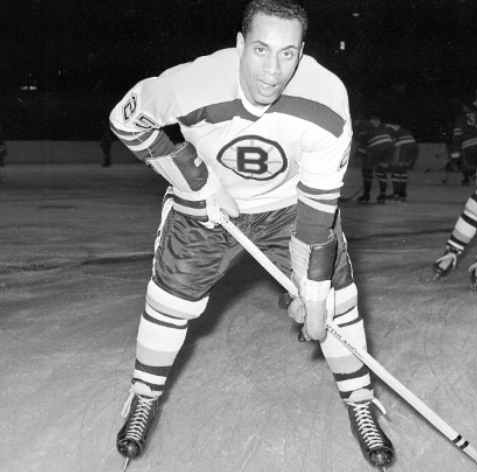
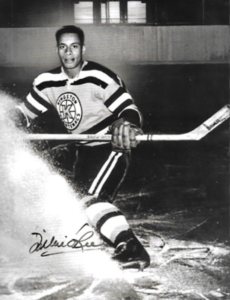
William O’Ree was born on October 15, 1935, in Fredericton, New Brunswick. He became the first black hockey player in the National Hockey League (NHL) on January 18, 1958, and played professional hockey for over 20 years.

Childhood in New Brunswick

O’Ree grew up in a large family in Fredericton, New Brunswick, and was the youngest of 13 children. O’Ree’s grandparents left the United States to escape slavery throught the Underground Railroad to Canada. O’Ree’s family was an ethnic minority in Fredericton as his family was the only one of two Black families in Fredericton while he was growing up.

O’Ree’s passion for hockey has been noticeable since he was young, as he started playing hockey when he was three. He played regularly on the backyard rink and even skated to school when the weather allowed.

O’Ree recalled that his experience of growing up in New Brunswick was a positive memory for him in his autobiography called The Willie O’Ree Story: Hockey’s Black Pioneer. In his early life, he recalled that colour was never an issue on ice rinks. However, he wrote that when he became older, he faced discrimination from the colour barrier.

Early Hockey Career and Eye Injury

O’Ree started playing organized hockey with Richard, his brother when he was 14 years old. He continued his hockey career by playing for Fredericton Falcons in the New Brunswick Amateur Hockey Association when he was 15, and he played for Quebec Frontenacs of the Quebec Junior Hockey League when he was 19 years old.

When O’Ree was playing for the Kitchener Canucks of the Ontario Hockey Association during the 1955-56 season, he had a serious injury. 95 percent of the vision in his right eye was lost after a puck hit him and also broke his cheekbone and nose. Healthcare professionals recommended him to stop playing hockey, but he couldn’t lose his dream and was back on ice within two months. However, as NHL law states that the league forbade players who are blind in one eye from competing, O’Ree could not tell anyone about the injury as he would lost his chance to play for NHL. In order to compensate for his blindness, O’Ree had to turn his head far over his right shoulder while playing left wing. 

His Career in the NHL

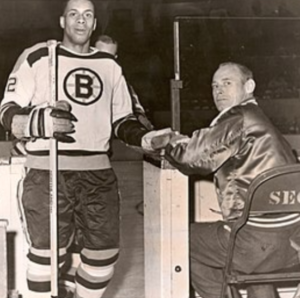
O’Ree became the first Black hockey player to play in the National Hockey League on January 18, 1958, as a part of the Boston Bruins. He only played two games in the 1957-58 season in Bruins but returned in the 1960-61 season. O’Ree made history as he became the first Black player to score a goal in the NHL in a 3-2 win over the Canadiens. He scored 4 goals and 10 assists for 14 points in 43 regular-season games in the 1960-61 season.

At the time, there was not much of O’Ree’s status as the first Black player to compete in the NHL.Neither The Boston Globe nor The New York Times mentioned his first appearance in the NHL. Additionally, at the time, a Canadian sports writer noted that O’Ree received no emotion, no applause, and above all, no animosity.

O’Ree played 14 years in hockey, including with the Hull-Ottawa Canadiens, Los Angeles Blades, San Diego Gulls, New Haven Nighthawks, and San Diego Mariners. He extended his career by moving from left wing to right wing in 1964-65, resulting in 38 goals, a personal best. 

Colour Barrier

O’Ree faced hardships in his hockey career because of his skin colour. From opposing players and fans, he had to experience racial taunts. Cotton balls and a black cat were thrown onto the nice while O’Ree played in Virginia in the 1972-73 AHL season. When he was playing with the Bruins in the 1960-61 season, O’Ree was the victim of racial slurs from a Chicago Black Hawks player. In addition, the player knocked out O’Ree’s teeth and butt-ended O’Ree with the stick. 

In 2022, O’Ree interviewed with Trevor Noah and described the obstacles that he had to face as a Black hockey player of NHL. He says, “I was called the N-word every time I stepped on the ice by players on the opposition, by fans in the stands—if I had a penalty and I went in the penalty box I could hear them saying the N-word—but I just blocked it out. Thanks to my older brother…he told me, “Willie, if they can’t accept you for the individual that you are, because you have the skills and the ability to play in the league at this particular time,…forget about everything else. Just go out, stay focused on your goal, and work hard.” And, basically, that’s what I did. But…it was really rough at the beginning.”

Honour 

He won the Lester Patrick Trophy in 2003 for his superb service to hockey in the United States. He also received the Order of Canada in 2010 for his outstanding work promoting hockey and youth development within North America. In addition, O’Ree also received the Order of the New Brunswick in 2005 and received the title of honoured member of the New Brunswick Sports Hall of Fame in 1984. In 2022, the Boston Bruins retired his number, 22, to honour him.

Legacy

Throughout his career, O’Ree’s legacy contributed to motivating generations of Canadians through his dedication to promoting a diverse and inclusive environment in hockey. Even though O’Ree retired in 1979, his path still inspires many youths all around the world and gives them a message to follow their dreams despite prejudice and obstacles. O’Ree continues his legacy with a position as a head of the Hockey is for Everyone program, where he promotes perseverance, teamwork, and commitment as important values to host an annual all-star weekend to bring youth of diverse and unique backgrounds of economics and ethnicity together for a tournament.

His legacy inspired the world, but his remarkable story didn’t finish with a period yet. Most recently, William O’Ree earned the title of the NHL’s Director of Youth Development and an ambassador of the NHL Diversity program. He travelled across North America to promote grassroots hockey programs focusing on helping economically disadvantaged children. According to a 2008 Sports Illustrated piece, He said this was the most rewarding job he’d ever done.

“Breaking into the NHL was great, but the work that I’m doing now has to be the most rewarding job I’ve ever had,” says O’Ree, 72. “People say to me, ‘Willie, do you think you’ll ever get into the Hall of Fame?’ If I get in, it won’t be because I broke the colour barrier. It will be because of the work I’m doing now.”

O’Ree’s work on and off the ice rink was recognized, and he was inducted into the Hockey Hall of Fame in 2018. The NHL also created the Willie O’Ree Community Hero Award to honour him.

Sources 1 / 2 / 3 / 4 / 5 / 6 / 7 / 8 /


Movie Recommendation: Nimona

0

Nimona is a 2023 Netflix film based on the graphic novel of the same name by ND Stevenson. It features the genre of science fantasy: an amalgam of science fiction and fantasy elements represented through a flawless and captivating mixture of futurism, with advanced technology such as flying cars and holographic screeens, and medieval influences, such as the concept of knights and walled cities. Perhaps most notable is the anachronistic presence of fairytale tropes and themes within the postmodern world, grounding the audience in the nostalgia of childhood bedtime stories while basking in the familiar novelty of sci-fi technologies. All this portrayed through stunning animation, on-point character design and brilliant voice acting.

The story is told around two main characters: Ballister Boldheart, a knight framed for a devastating crime, and Nimona, a shapeshifter insistent on becoming Ballister’s villianous sidekick. Through these characters, Nimona explores the experiences of being marginalized or othered by society which resonates despite being toned down from the original graphic novel due to its younger target audience. Throughought the movie, they embark on a journey that begins with trying to prove Ballister’s innocence and ends with a complete upheaval of the City’s corrupt institutions and reworking of the peoples’ worldviews (kid-friendly edition). There are also heavy themes of queerness throughout the story, largely testament to ND Stevenson’s own experiences of being nonbinary and transmasculine, with Ballister’s relationship with his fellow knight Ambrosius Goldenloin portrayed as organically and realistically as you can in a comedic, action-packed science fantasy and Nimona’s gender non-conformity. This coupled with the allegorical plot of the protagonists being othered by society’s prejudices, and stellar quotes that serve to directly call out prejudices and validate queer experiences, and we have a film centering around two queer main characters, whose queerness is not the main point but still an important part of their identities and character development. It is a brilliant example of casual, validating and humanizing representation.

There are pieces of media out there that are difficult to recommend to people whilst skirting around huge spoilers. However, the fact that it is entirely uncomplicated to find good things to say about Nimona while managing not to spoil it is simply a testament to its brilliance. And now, there is nothing more for me to say but to watch this movie. Whether for the fun of it or in a critical lense, whether to turn it into a family movie night or to watch it alone in your room, this is a movie for absolutely everyone.

Featuered Image

The 8 Ingredients To Write An Effective Timed Essay


Are you someone, like me, who is always stressed out the night before a major timed essay in English or Social Studies class? I, personally, love reading and writing, especially creative writing. For someone who is really interested in literature and writing about literature, you would expect that timed essays in English and Social Studies are a piece of cake for me, but that is unfortunately not true! It would not be an exaggeration to say that timed essays are the bane of my existence. The part that makes them especially challenging is that the writing prompt is not provided beforehand. Therefore, it often feels like writing on the spot. To tackle this problem, I have been researching ways to write an effective timed essay. In this blog, I want to share what I learned.

Before Writing:

  • Study relevant class material: It may seem like there is no way to “study” for an essay. This is because the writing prompt is given on the day of the essay. It can be intimidating to realize the fact that you would have to write a 5 paragraph essay on a random topic. That, however, is not entirely true. You do have some idea of the topic. It will likely be on something you have discussed in class. To be prepared, you can study your notes and ensure that you have understood all the topics discussed in class. This way, on the big day, even if you see a prompt for the first time, ideas from class will start popping up in your head, and you can ace that essay!
  • Time your writing when practicing: Practice does not necessarily mean writing a timed essay every day. You can still practice by timing any piece of writing you do. This way you will get accustomed to writing under the pressure of time.

During the essay:

  • Read the prompt carefully: Even before you write the first word of your essay, it is important to read over the prompt/question carefully. It can be useful to highlight important parts of the question, and then decide on which pieces of evidence would be most appropriate to use. It is crucial that your essay directly answers the question that is being asked. To achieve this, it is necessary to pay careful attention to the prompt.
  • Set a time limit for each paragraph: Many people, including myself, struggle with time management during an essay. I tend to focus too much on my introduction, and my body paragraphs of the essay end up becoming weaker. To solve this problem, it is important to allot a set time for each paragraph. This way, you will distribute your time evenly, and will not end up spending all your time on one paragraph.
  • Be neat, organized, and double-space your essay: When there is a time constraint, it is not easy to keep your essay neat or organized. However, it is important to do so. Messy writing, awkward wording, or uneven spacing not only confuses the person marking your essay but can also confuse you when you go back to edit. A very helpful strategy to keep your work organized is to double-space your writing. This way, if you are hand-writing your essay, it is easier to make corrections. If you are typing your essay, it is much easier to read your essay if it is double-spaced.
  • Do not waste your time on editing during the essay: Yes, editing is extremely useful to catch any errors or to strengthen your arguments. Editing once you are finished writing each paragraph is a good tool when you are writing a paper. However, it can be detrimental during a timed essay, as it can cause you to lose track of time. It is important therefore to give first priority to finishing your essay, and then going back to editing.

After writing:

  • Edit if you have the time: If you finish your entire essay well within the time limit, you can then go back and edit. When editing, check for spelling or grammar errors, and make tweaks to your writing to make your paragraphs stronger. I would suggest not to rewrite entire sections of a paragraph. This can make you lose sense of time. When editing, I try to look for small things to change, such as my word choices, or my sentence lengths. Sometimes, even small changes can make a difference in the effectiveness of your writing.
  • You’re all done, relax: After you’ve done all that, go home and ponder about all the things that would cause you to lose marks in the essay. Haha, just kidding! Go home, and relax. It can be easy to get worked up about a major essay, but it is important to take your mind off of it when you are done. Do something you enjoy, or just sleep.

The next time I have to write an essay for an English or Social Studies class, I will be sure to try out these tips and see if they work for me. I hope you will join me in completing a timed essay! Good luck!

The Rise of Animal Crossing: Why It Became a Pandemic Escape for People in 2020

0

        THE RISE OF ANIMAL CROSSING


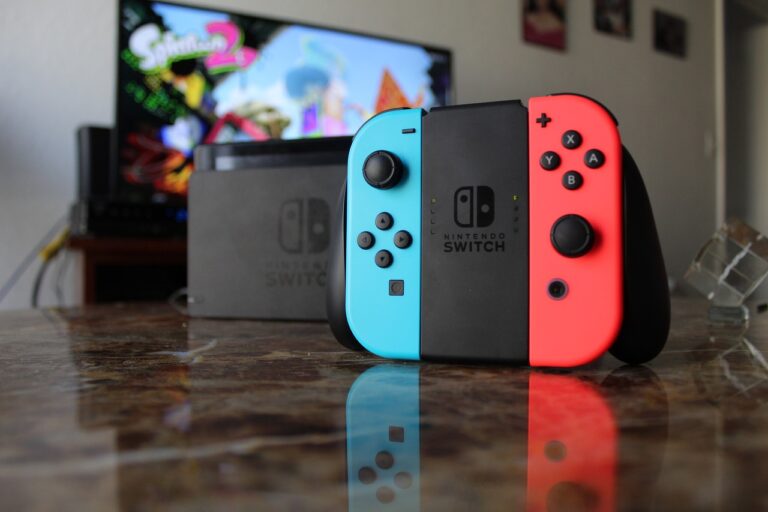
Animal Crossing is a Nintendo game series about exploring, creating, and living in your own self made paradise. While there are 5 versions of this game released worldwide, we’re going to be focusing on the one released in March, 20, 2020; Animal Crossing: New Horizons. I’m going to specifically talk about how Animal Crossings New Horizons, became so popular, especially during the times of COVID-19.

Throwback to when COVID-19 started, everybody was in lockdown and the streets were barren, everyone was stuck in their homes with barely anything to do. This resulted in most people going on social media a lot. They did this to try and escape the reality of the pandemic and because they were craving socialization. As a result of this, the release of New Horizons during this period caused people to go nuts for the game.

Animal Crossing provided people with the socialization that they yearned for so much. The game allowed players to invite other players to their island and basically do fun everyday tasks without the stress of COVID. Some people have even claimed that its the universe we’ve always wanted, but cannot have. Animal Crossing is a unique game because the theme and play style of the game can be enjoyed by gamers and non-gamers, and children to millennials, even though the design of the game may seem childish.

Nintendo Switches flew off the shelves and Nintendo’s sales went up by 541%!

To conclude my article, Animal Crossing New Horizons was a cultural phenomenon in 2020 due to its ability to provide people comfort, social interaction, and escapism during such a difficult time. The popularity of the game really shows how it can hit home to people and provide them with entertainment.


Sources:

The Worst of Canadian Human Rights- Japanese Canadian Internment

0

Canada’s history is marked by the struggles endured by many minority groups. One of the darkest and forgotten chapters is that of the Japanese Canadian Internment Camps, which began in 1942. At that time, around 90% of Japanese Canadians were forcibly removed from their homes and placed in camps under the guise of national security. Despite many being born in Canada and holding Canadian passports, they faced mistreatment simply because of their heritage. This injustice followed the outbreak of the Pacific War, Pearl Harbour, and World War II, during which all Japanese individuals were labeled as “enemy aliens” in both Canada and the United States.

The sequence of events started with the seizure of Japanese property in 1941, followed by restrictions on essential items, a fishing ban, and limits on accessing certain areas. Eventually, the Canadian government issued removal notices for all Japanese Canadians. Approximately 27,000 people were imprisoned without any legal recourse, while others were forcibly sent back to Japan. This gross violation of human rights undermined legal principles such as non-discrimination, equality, and individual identity, stripping away the civil liberties of Japanese Canadians. Conditions in the internment camps were harsh and inhumane, though fortunately, no deaths were recorded. When restrictions were finally lifted in 1948, many Japanese Canadians returned to find their lives shattered, facing the daunting task of rebuilding from scratch.

The legacy of this injustice lives on in intergenerational trauma, perpetuated by the government’s horrendous actions and lack of justification. It wasn’t until 1988 that the Canadian government formally apologized and offered compensation to survivors and their families. This apology, however, can never erase the trauma and loss inflicted upon thousands of Japanese Canadians, serving as a stark reminder of one of Canada’s gravest human rights violations.

Sources:

https://www.thecanadianencyclopedia.ca/en/article/japanese-internment-banished-and-beyond-tears-feature

https://humanrights.ca/story/japanese-canadian-internment-and-struggle-redress

Image:

Photo by Антон Дмитриев on Unsplash


Pretty Cool Prosthetics

A Basic Defenition: A prosthetic implant is an artificial device that is designed to replace a missing body part. A body part may be lost through accidents, amputations, disease, or a condition present at birth. And so, prosthetics allow people to have a more comfortable life and appearance.

The Basic History: Ambroise Paré was an official royal surgeon who practiced medicine on the battlefield by attempting to save, or at least treat wounded soldiers. He was disturbed by the soldiers’ reactions to his care because he saw that they would rather take their own lives than live without limbs. So, he began crafting artificial limbs, a practice that dates back to ancient Egyptians. He believed that this would give them a psychological and spiritual sense of wholeness. They were used in the Dark Ages, in ancient Greece, Rome, and Egypt. But one of the most earliest and accurately drawn references to prostheses was found in a book published by Ambroise in 1579. The very first uses of basic prosthetics were in Ancient Greece, Rome, and Egypt. Such as functional wooden toes etc. However, some more accurate documented references were found in France and other parts of Europe. The concept has remained the same over time. Its job was and is to provide a second chance to live better. Back then, people lost limbs due to infection and battle. But now, we may lose body parts due to accidents and surgical amputation. Over time, the materials have dramatically changed too. From using wood and naturally occurring adhesives, we have evolved to using electronics and metal.

Some technical information: Prosthetic devices are divided into 2 categories: Upper-extremity and lower-extremity. The Upper-extremity ones are used for different levels of amputations at specific places in the upper body, such as for shoulders, wrists, arms, and fingers. Lower-extremity prosthetics are used for – as you may have guessed – lower parts of the body, such as for hips, knees, feet, and toes. Depending on the specific needs of the patient, varying prostheses may be administered. For example, some prosthetic devices may focus on the concept of cosmesis. Cosmesis is the preservation and restoration of bodily beauty. This means that this specific device will focus on making the device look as real as possible. This could be through adding minor details such as freckles, hairs, scars, and etc. This may help restore some peace to the mind. But the more common reason for prostheses is for function. Like being able to grip objects or increased freedom of movement.

How they may be powered: 

Body Powered: This method speaks for itself. Basically, your body can control the prosthetic. For example, a cable may be attached from one shoulder to the prosthetic hand. So when you move your shoulder- your hand will move too!

Motor Powered: Think of this method as using a remote control panel. For example, a prosthetic hand may have a few buttons on it – and pressing one of them could lead to gripping an object.

Myoelectric Powered: This method is one of the most recent ways to operate your prosthetic device. In simple terms, prosthetic limbs are powered by muscles in your real limb to generate electric signals and pulses. When electrodes (an electrical conductor used to make contact with a nonmetallic part of a circuit) are put on the skin, they read the muscle contractions (like a code) and sends signals to the limb to move.

The Main Parts:

The Pylon: Think of this part of the device as the skeleton. Made of light carbon-fiber composite rods, its function is to provide structural support to the rest of the device.

The Socket: This is one of the most important aspects when talking about prosthetics. It’s the part that is fitted to the real limb. It needs to be extremely precise so no irritation or damage is caused to the skin tissue. Did you know that a patient might even wear a layer of “prosthetic socks” to achieve a snuggly fit?

The Suspension System: This part works to ensure that the prosthetic limb is securely attached to the body. Although you can attach the device to the body through straps and other mechanical devices, a more common practice is through suspension and suction. This airtight seal will ensure stability.

Their effect on the world around them: Prosthetics benefited the world immensely. It allowed people to recover from the trauma of not having/losing a limb. They give people the opportunity to live comfortably and to take care of themselves. For example, arms are extremely important parts of your body. Without them, you wouldn’t be able to do anything by yourself and would always have to rely on others for the most basic tasks, like eating, writing, and even balance. Basically, have benefited our world because they gave people a second chance to live a normal life.

Its Future: The future of this invention will be having the ability to control your prosthetics with your mind. Scientists want to find a way to hook up the device with our nerves so that they connect to our brains. This will allow us to control our limbs just like we would normally. Of course, we are nowhere close to achieving this- but Elon Musk is. He has spent over 100 million dollars to pursue the development of Neurolink. Basically, the future of this invention will enable us to make prosthetic limbs as closely related as possible to real human limbs. 

Links:

https://www.freedomprosthetics.com/how-do-prosthetic-limbs-work/#:~:text=One%20of%20the%20most%20recent,to%20the%20limb%20to%20move

https://www.ncbi.nlm.nih.gov/pmc/articles/PMC3664166/#:~:text=One%20of%20the%20earliest%20written,he%20fitted%20on%20his%20amputees.

https://qz.com/2141720/modern-prosthetics-go-beyond-bionic-limbs-and-into-the-brain


Black History Month: Willie O’Ree

To celebrate Black History Month, let’s take a closer look into a Black Canadian: Willie O’Ree!

Willie O’Ree was the first Black hockey player in the National Hockey League. He has a very interesting story that inspired diversity in the National Hockey League.

Willie O’Ree’s Childhood 

Willie O’Ree’s grandparents came to Canada to escape slavery in the United States. As a result, Willie O’Ree was born in Fredericton and grew up as the youngest child of 13 children in New Brunswick. Unfortunately, in Fredericton, there were only two black families while he was growing up. As he was growing up, he began playing hockey when he was just three years old. Willie O’Ree instantly had a passion for hockey, and got into organized hockey by five years old. However, as he grew older, he began noticing the “color barrier,” which in simpler words, can be referred to as “racism.” This “color barrier” becomes more evident as he grows up, especially during his time in the NHL. By the time he was 15, he was playing for the Fredericton Flacons in the amateur hockey association for New Brunswick.

Young child playing hockey outside
Image by Jill Wellington from Pixabay


The Rise of WIllie O’Ree

Over the next few years, he progressed through the hockey system, leaving a very good record with one season in the junior ranks. Followed by the next full season in the senior ranks, and played in the Allan Cup tournament, where he scored seven points in seven games. When he was 19, he moved to Quebec for the 1954-55 season and played in the Quebec Junior Hockey League. From this season, he had 27 goals and 17 assists, accumulating to 44 points in 43 games. After that good season, Willie O’Ree unfortunately had an accident in the 1955-56 season. During a game, he was hit by a hockey puck, which broke his nose and cheekbone. The result of this accident was that he lost around 95% vision in his right eye.

Hockey players
Image by 12019 from Pixabay

However, despite being advised to stop playing hockey, he was back in ice two months after the incident. Willie O’Ree could tell anyone about his injury as NHL forbade players who are blind on one eye from playing. He continued to play hockey, and in the 1956-57 season, he became eighth in team scoring with the Quebec Aces. Despite being blind in one eye, he went on for two more season with the Aces. The Quebec Aces had a history of racial integration, in spite of “color barriers.” During the 1957-58 season, the Aces formed a relationship with a NHL team called the “Boston Bruins.” This relationship allows the NHL team to call up players from the Quebec Aces anytime. In fact, Willie O’Ree was called up to the team and made history by becoming the first Black hockey player to play in the NHL.

Hockey Arena
Image by Tom Glod from Pixabay

His Main Challenge In The NHL

Despite his title as the first Black player in the NHL, and later, the first Black hockey player to a score a goal in the NHL, he was given little attention for it. He wasn’t mentioned in any major newspaper articles and “was greeted with no emotion, no applause…”. Because Montreal was already familiar with Willie O’Ree as a player, he wasn’t given much attention for his historical debut. William O’Ree went on to play for 14 more years. However, despite having good records, he experienced racial taunts from opposing fans and players. To this day, Willie O’Ree was adamant that these discriminations mostly occurred in the US, and not in Canada. Although it was really rough for his career, same as one of his brothers, he was able to go out on the ice, stay focused, and try his best.

Hockey players in a game
Photo by Klim Musalimov on Unsplash

Willie O’Ree’s Honorable Actions and Awards

Willie O’Ree retired hockey in 1979. Eventually, he became the NHL’s director of Youth Development and also became the first Diversity Ambassador in 1998. As the ambassador, he was able to champion diversity and inclusion among hockey programs. Along with that, he was able to teach 120 000 children how to play hockey. Following his retirement of hockey and his work towards fostering hockey for young people, he was recognized for his dedication and outstanding services with incredible awards.

Ambassador
Image by Mohamed Hassan from Pixabay

In 2003, Willie O’Ree received the Lester Patrick Trophy for his incredible services to hockey in the United States. After that, in 2010, he received the Order Of Canada for his services towards youth development and promotions of hockey across North America. Similarly, he received the Order of New Brunswick, after being placed in their hall of fame in 1984. Along with being placed in their hall of fame, Willie O’Ree was inducted to the Hockey Hall of Fame in 2018. Last, but not least, in 2021, the Bruins honoured him by retiring his jersey number.

22
Image by Clker-Free-Vector-Images from Pixabay
-Willie O’Ree’s jersey number: 22

Conclusion and Final message

Willie O’Ree has had a lot of challenges during his hockey career. From starting with amateur associations in New Brunswick to playing in the NHL to teacher children how to play hockey, his career has certainly went far. As shown from the awards, he has officially been recognized as a historical skilled hockey player. He is an inspiration towards all hockey players. Willie O’Ree has been honoured for his incredible dedication and outstanding services to the game of hockey. By remaining strong against discrimination during his time in the NHL, he was able to go far, leaving a strong legacy in the NHL. As you celebrate Black History Month, please honour Willie O’Ree, the first Black hockey player to play in the NHL.


Martin Luther King quote "They will not be judged by the color of their skin but by the content of their character"
Photo by LeeAnn Cline on Unsplash – A Martin Luther King quote: “They will not be judged by the color of their skin but by the content of their character”

Sources: 1 , 2 , 3

Images: 1 (Featured Image), 2 , 3 , 4 , 5 , 6 , 7 , 8

Image of Willie O’Ree: click here

“I did nothing wrong”: Advice for bullying victims

0

I did nothing wrong.

As talked about in previous posts, bullying is a serious yet prevailing issue in schools and communities in the entire world. According to a report from the National Center for Educational Statistics in 2019, one out of every five (20.2%) students reported being bullied.

man in black jacket holding white and blue banner

Yet despite continuous efforts from educators, advocates, teachers, and student leaders to reduce cases of bullying in different schools, this issue still persists. In this case, it is immensely important, then, to be equipped with knowledge of how to cope with bullying – if one ever becomes involved as the victim.

person wearing blue denim jeans and red socks

From the official site of the government of Alberta, there are several ways of getting help. There are numerous organizations – such as the support for bullying victims from the Alberta government – that provide help and support for victims. Namely, one can call 310-1818 or text 310-1818, or log on to the bullying support site for an online chat with a professional counselor. 

a woman standing in front of a red wallIn addition to online support, there is some advice one should keep in mind.

 

  1. Do not blame yourself for what you are treated with. It is never your fault that you have become a victim of bullying. Bullying itself is an unacceptable behavior, and the ones committing these behaviors should be the ones to be ashamed. 

black laptop computer turned off

2. Seek help. Like what was mentioned before, there are numerous ways that one can seek help from external sources. A few organizations that can be helpful are: Bullying Canada, Pink Shirt Day, STOMP Out Bullying, and Let’s Defeat Bullying/Let’s Defeat Bullying Alberta. Along with these organizations by educational leaders and advocates, there are always sources of help from official governments, such as the one from Alberta government. Above all of that, seek help and support from loved ones that you can trust, such as parents, teachers, and trusted peers.

a couple of men standing next to each other

3. Keep track of what happened. When it comes to seeking help, it is important for one to keep evidence of bullying incidents to make sure related authorities such as school authorities – or even authorities from police – would have evidence to punish the bullies. Have a document somewhere, record all important information about every bullying incident – date, time, location, what the bullies did. Sometimes it is even more helpful to have more certain evidence such as voice recordings and/or videos of the bullies in their bullying actions.

group of man gathering inside room

Lastly, stay confident and proud – it may be a long time until bullying is completely eliminated, therefore staying strong and confident and arming oneself from the inside will serve to be the most effective way to keep the impacts of bullying to a minimum. 

person shadow boxing grayscale

Stay safe.


Sources: 

https://www.alberta.ca/bullying-find-supports

https://actagainstbullying.org/bullying-advice/

https://www.pacer.org/bullying/info/stats.asp

A Tribute to Kids Help Phone

Hi! In this post, I’ll be expressing my gratitude to Kids Help Phone (KHP) and delving into the variety of services they offer. 

What is KHP?

KHP provides free 24/7 mental health services to young people. Their vision is to have “a future where every young person in Canada will access the support they need, in the way they need it most”. They believe that young people are experiencing more and more struggles, and they need support. In response, they offer various mental health services.  Not only do they include a variety of mental health services, they are also passionate about inclusivity. They have included initiatives to include Indigenous youth (First Nations, Inuit, and Metis), black youth, 2SLGBTQ+, and more. 

What services do they offer?

  1. Crisis support – texting or calling a trained volunteer responder
  2. Professional counselor – texting or calling a counselor 
  3. Quizzes, games, activities
    1. Quizzes to reflect on what you are feeling
    2. Activities to explore different tools to express your feelings
    3. Games to reduce stress or practicing mindfulness
  4. Mental health tips and information – providing information of thoughts you may be feeling, how to cope, from topics to body image to friends to self-care
  5. Search for mental health support near you
  6. Moderated Forums – connecting with other peers and sharing your own experiences 

For myself, I was introduced to KHP when I was in middle school, and I’ve been regularly using the services they provide to support my mental health. I honestly think that there is never a day where I do not somehow struggle with my mental health, big or small. KHP has truly been an invaluable asset to myself, which is why I wanted to write this post and show appreciation for this organization. If you are struggling even a little, I hope you’ll consider checking out the website (Kids Help Phone). Your mental health matters and no problem is too small. Thank you for reading and take care of yourself. 

Sources: 

https://kidshelpphone.ca/


On Black History and Identity – The Work of Simone Saunders

In light of Black History Month, I would love to share how Calgary artist, Simone Saunders, has empowered Black women through her beautiful and deeply-meaningful textile portraits.

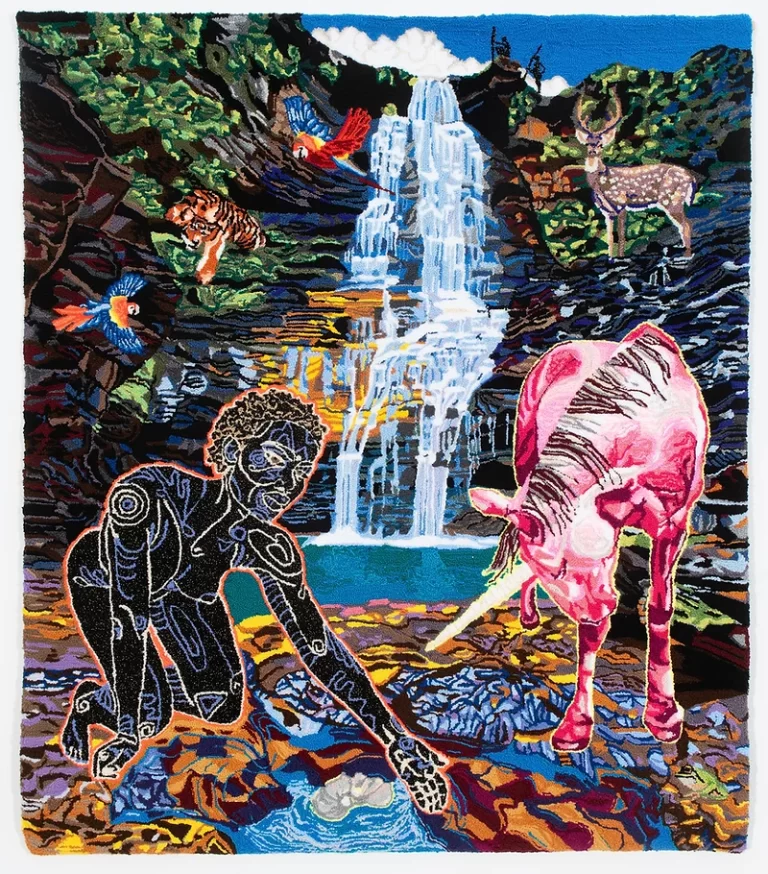
Simone Elizabeth Saunders is a talented artist and performer who focuses on Black identity and belonging. She grew up with a strong passion for theatre, engaging in one of the earliest afrocentric theatre companies in western Canada called Ellipsis Tree Collective. From theatre, Saunders found a deep love for visual arts that blossomed into her creation of textile art that celebrates Black identity. Theatre also inspired Saunders to create art in the form of story telling – a central idea that pushes her to create portraits that spark deep emotions for viewers. 

Simone Saunders’ focus on empowering Black identity started from her observation that colour-blind casting was not very prevalent in the theatre scene. She felt a desire to strengthen the Black community, starting by first exploring her own identity. Today, Saunders uses powerful motifs, symbols, and story images from her Jamaican heritage to create large scale textile portraits of mostly Black women. 

Simone Elizabeth Saunders, Lady Justice, 2021. Courtesy of the artist.

Simone Elizabeth Saunders, Lady Justice, 2021. (Source: Contemporary Calgary

Internal Reflections 2022.jpg

Simone Elizabeth Saunders, Internal Reflections, 2022. (Source: Simone’s Hand-Punched Textiles) 

Another element that can be seen in Simone’s work is the mix of the past, present, and future. Simone feels that Black history has long lasting effects that create this intertwining of the past, present, and future for Black individuals and society in general. She represents this idea through her literal action of intertwining the threads when she’s tufting to create the textile portraits. 

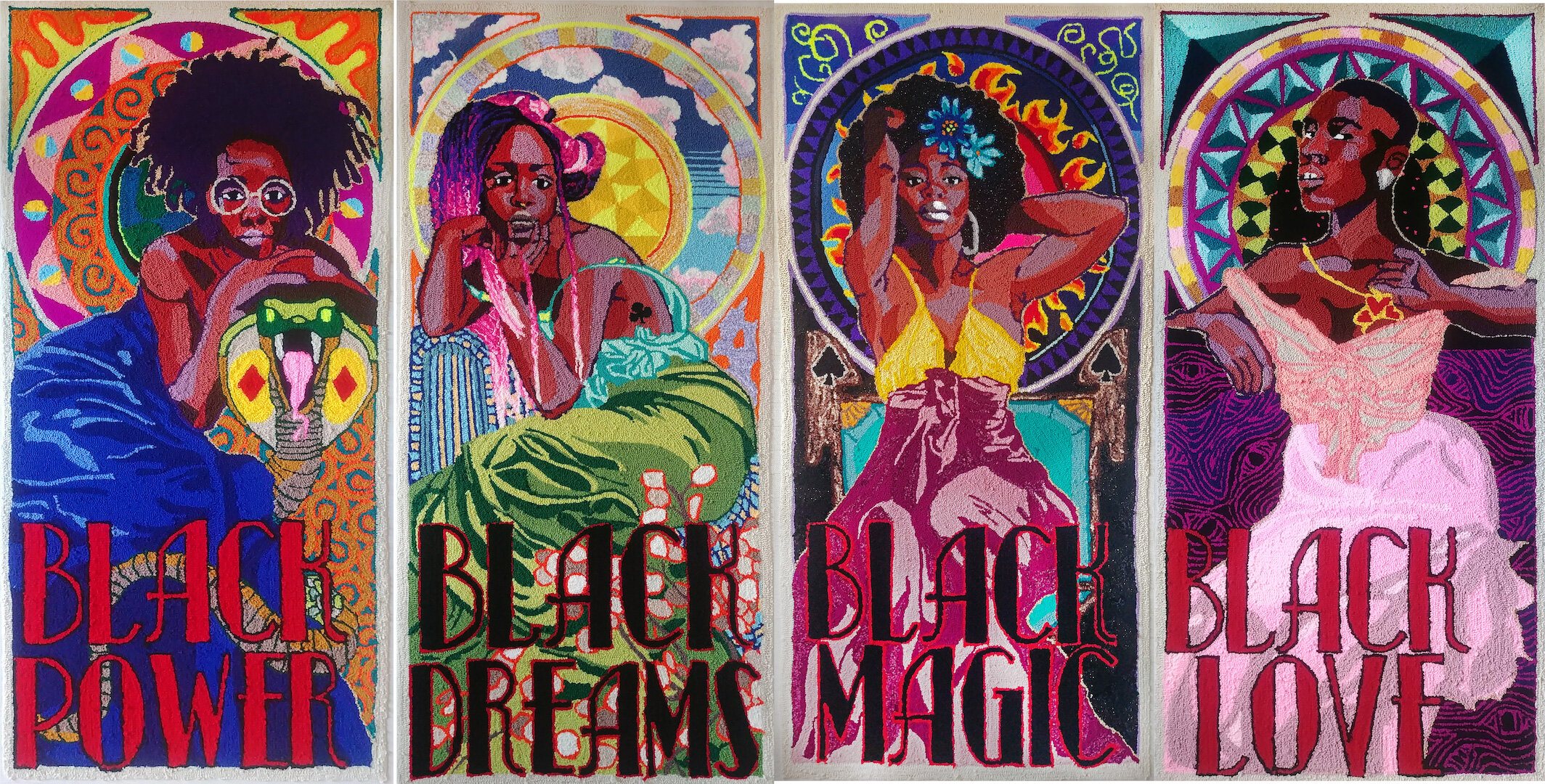
A central theme of Saunders’ work is Black womanhood – many of her portraits focus on the beauty of the Black female body and the strength that these women embody. Saunders starts most textile portraits with the eyes, often making the figure’s eyes focus directly on the viewer. The direct eye contact is used to symbolize that Black woman are strong and not “diminutive or demure.” Many admirers of Saunders work note that the strong eye contact of her female figures seems to invite the viewer in while also commanding the space in a powerful manner. 

Simone Elizabeth Saunders, Four Queens, 2020. Courtesy of the artist.

Simone Elizabeth Saunders, Four Queens, 2020 (Source: Contemporary Calgary

Simone’s work has truly made a deep impact on not only the Black community but society as a whole. Her textile portraits highlight the strength of Black individuals and their connection to history. Simone is making a lasting impact in celebrating Black history and identity!

Featured Image (Simone Elizabeth Saunders, Affirmations of Day, 2022), Source1/Source2

The More You Know – Nervous System Edition

Have you ever wondered how the brain works? How we, as such an amazingly complex species are able to function?

Well – the answer to this is through the running of our nervous system. In this blog, we will be exploring the seemingly simple phenomenon that allows us to run our highly complex structures today.

Underlying Concepts

Behind the running of our nervous system (as well as our other body structures), there is two underlying principles – homeostasis and negative feedback. Homeostasis is the constant internal environment that our body works to maintain through “negative feedback” loops – where a sensor detects an imbalance, signals a control center, and activates an effector that reverses or stabilizes, making the body regain its balance.

The Neuron

The cells of the nervous system are called neurons and they work to conduct nerve impulses. Their structure is based on having dendrites that collect nerve impulses from the sensors in the body and send an action potential or electrical impulse along the axon to the central nervous system when in any imbalance. The central nervous system, composed of the brain and the spinal cord, decides how to react or how our body’s response would be.

The most fascinating part of the nervous system cells or neurons is how they are able to transfer this electrical impulse to the central parts. Well – this is through a relatively simple yet beautiful way by sodium potassium pumps.

  • The plasma membrane of almost all cells has an electrical potential of -70mV (resting potential). When a nerve cells recieves any stimulus, it becomes permeable to more sodium ions which enter and cause a reversal of charge called depolarization (the cell membrane has a potential of 40mV). The flow of postively charged ions toward the adjacent resting areas causes an electrical distrubance, that triggers a wave of depolarization along the membrane.
  • Neurotransmitters at the end of the nerve cells and receptors at the start of the next nerve cell allow the transfer of this action potential or impulse along multiple neurons until it reaches the central nervous system.

One very cool fact about the central nervous system is our reflexes – our involuntary actions that protect us from stimulus in the environment. Within reflexes, the neurons convey the message to the spinal cord before the brain – so we often react before we even interpret what is happening. This is why we move back our hands when we touch the stove, even before we scream or realize the pain!

The Central Nervous System

Now, we come to the brain and the spinal cord- the two fundamental operating sectors of the body, which compose the central nervous system.

The spinal cord is responsible for co-ordinating the body in its response. In the case of reflexes, it contains interneurons that connect sensory neurons to motor neurons in order to generate a fast response. It also carries this information to the brain for intrepretation. Emerging from the skull, the spinal cord extends through the backbone, with nerve tissues called white matter and grey matter. It is protected by the vertebral column (bones that encases it and protects it from any damage).

The brain comprises of three regions: the forebrain, the midbrain, and the hindbrain. Each hemisphere is composed of different lobes, with futher components of each lobe into distinct parts. There is incredible detail into the anatomy of the brain and the several complex structures that you can find in this website. The cerebrum controls movement and regulates internal temperature, in addition to several other functions such handling the senses, or emotions. The brain stem connects the cerebrum with the spinal cord in order to encompass the central nervous system. On the whole, the brain in composed of 60% fat containing blood vessels, nerves, and neurons, encased by the cranum built to protect it. One fun fact is that there is an estimated number of approx. 100 billion neurons in a fully mature human brain.

TL;DR

On the whole, the brain and the spinal cord are incredibly important structures that allow us to be human – give us the ability to think, feel, and experience emotions as we do as homo sapiens. Learning and understanding information about the brain can help us understand and appreciate the incredible complexity of the body that we have. Always remember, “ignorance is bliss, but knowledge is power.” The more you know.

Sources: 12