Home Blog Page 2

Feature-a-Founder: Shaping the Future of AI Education: An Interview with TypeShift

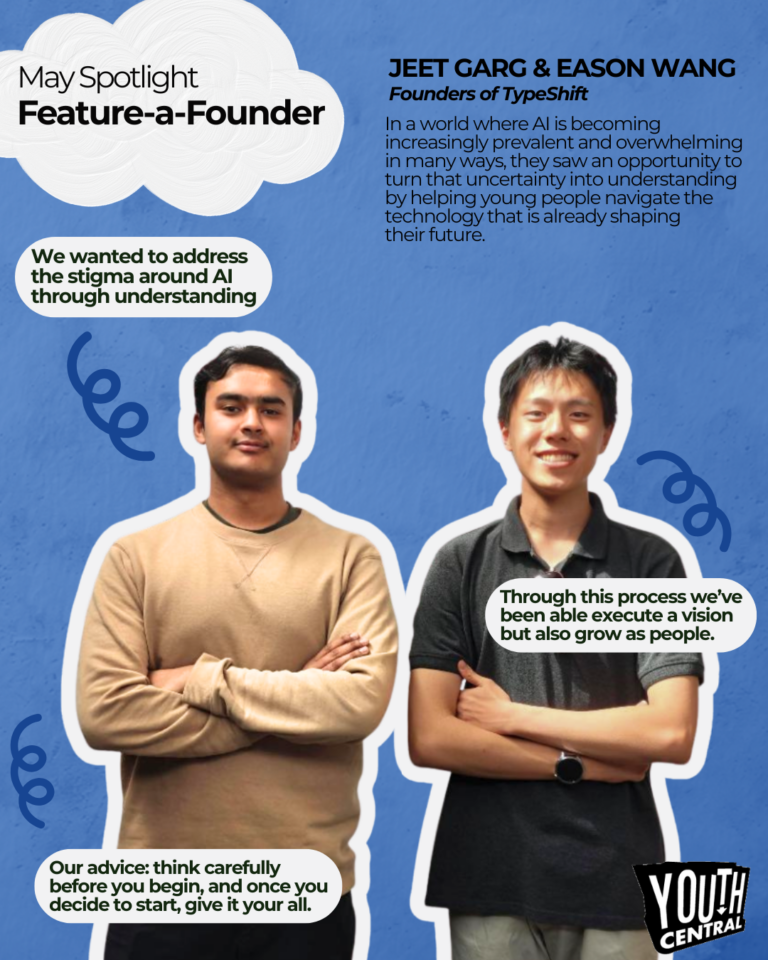
Presented by the Mayor’s Youth Council (MYC), our Feature-a-Founder spotlight is designed to highlight youth-led initiatives in Calgary making a positive impact. This month, we’re featuring Jeet Garg and Eason Wang, co-founders of TypeShift.

Have you ever noticed how quickly AI went from just being a buzzword to something people use every day? For Jeet Garg and Eason Wang, that rapid shift is exactly why TypeShift matters. In a world where AI is becoming increasingly prevalent and overwhelming in many ways, they saw an opportunity to turn that uncertainty into understanding by helping young people navigate the technology that is already shaping their future.

TypeShift began with a simple but foundational question: how can AI be used to actually benefit people? How can it be leveraged as a tool instead of overtaking the narrative. For the team, the answer was not just to talk about AI, it was about making it accessible. By connecting students to industry mentors and real-world speakers, TypeShift helps youth build a sort of AI literacy that builds confidence and context to help them think more critically about AI.

Curiosity into Action

What started as just an idea quickly grew into a hands-on initiative whose mission was clear, they wanted to show students that AI is more than just a generative tool or a handy headline maker. The team wanted to explore practical applications of AI in the “real world” in fields as broad as cancer detection. At the same time, they want to encourage students to think more deeply about the practicality of AI, shifting from just a “theoretical” knowledge into one that is instead rooted in the real world.

TypeShift’s vision has already reached an audience far beyond the founders themselves, they have hosted over five speakers and impacted more than 200 students through workshops and community events. These sessions have introduced concepts like AI being used in reinforcement learning while also creating a space for meaningful conversations, networking and overall mentorship to occur. 

Lessons in Leadership

Both Eason and Jeet said that building this initiative has taught them invaluable lessons about leadership and personal growth as much as its primary objective is community impact. Throughout their journey, they had to combat challenges such as a lack of motivation and developed their abilities to lead responsibility, as Eason put it “through example.” Jeet also spoke to the importance of having a team that you can trust and reinforced just how important it is to consistently show up.

These lessons became especially real when the team faced one of their biggest obstacles to date: uncertainty. While both within other leadership positions previously in areas such as Business Club and Model UN, as first-time founders, it was their first time building something from scratch. Starting from scratch meant that there was no structure to rely upon; they had to figure out their purpose, their format, and ultimately, their direction in the long-term. With support from mentors like Ben and their volunteers, they were able to refine their vision and turn early doubt into something sustainable and impactful.

The Power of Connection and LinkedIn

Although TypeShift uses Microsoft Teams in order to make events more accessible, the team has found that in-person connection is generally preferred in order to maximize on opportunities. Their workshops consist of a theoretical introduction, a live demo, a Q&A session which is then followed by networking with the speaker and other attendees. 

They also discovered that the most successful outreach can happen in unexpected places. LinkedIn, word of mouth, mentor networks, and even Model UN connections all played a pivotal role in growing their community to what it is today. Outreach does not have to be about flashy promotion and TypeShift exemplifies how building genuine relationships with people who care about the same issues can work just as well.

Advice for Future Founders

TypeShift’s message to other youth who might be looking to start their own initiative is to start now and start big, don’t be afraid to fail, and surround yourself with good and trustworthy people because even if you fall, they’ll help you back up. They believe young founders should be able to build a network upon which they can rely on when necessary and stay adaptable through any sorts of challenges. Their own journey proves just how big ideas can grow into real initiatives when they are supported by collaboration, persistence, and a willingness to learn.

TypeShift stands as a reminder that youth leadership isn’t something that has to wait until later in life. Once they identified a gap within their own communities, they took the step forward to close it. By creating a space for education, mentorship, and a more comprehensive understanding of AI, they are helping to shape a smarter and more thoughtful future for AI. 

Next Steps
Started a project? Apply to Feature-a-Founder to be featured and share your impact – submit your story here!

Need help getting your idea off the ground? Explore our grants and funding opportunities: youthcentral.com/grants.

Learn more about TypeShift here.
Uncovering the Thin Layer Under the Expectant Pressure to Achieve Greatness.

0

The truths embodied in success

A few months ago, a special visitor came to my school and talked to us about how she made a huge mistake, which later resulted in her success. Kesinee was in a highly innovative and financially successful degree program, and everyone greatly admired her. However, Kesinee didn’t feel any exuberance in this topic and decided to switch plans to drama. There, she played in many musicals, plays, and everything in between. Kesinee soon became a renowned actor, and this time she loved her career; however, she felt that vibrancy, the fruit of passion, was becoming dull, and once again she decided to switch to a different career, a career which Kesinee faces with brimming optimism.

Mindset

Like Kesinee, we all have felt the notion of longing and not, and like many other individuals, we all have felt a particular pressure to conform to other people’s thoughts and opinions, and what will bring us acceptance and admiration. This reveals that we might require a different mindset to the perception of certain things.

For instance, we have to recognise that not meeting another individual’s standards is okay and regularly occurs. As Theodore Roosevelt once stated, “Believe you can, and you’re halfway there.” Success is not accomplished by an endless, almost cumbersome amount of desire; it is accomplished by a hopeful and sanguine mindset.

Direction

We as a society ultimately fear straying from the original path; we hate the idea of “failing” and “not finishing.” We hate the fact that starting anew, we would be clueless and have to be taught and improved, and have to be the lower ones and not the ones everyone admires. We don’t realise that starting a new path, switching directions, is like planting a new tree before the other ones grow.

However, if something is planted, it will grow, and eventually all of the trees will grow into a forest, even if some are missing branches. Otherwise, you would only have one big tree and nothing else to rely on. We have to be able to perceive that changing your direction is not foreboding or fearful, it’s brave and right.

Love

To do something without passion is a chore; to follow in a course of direction just because it brings great outcomes is a waste. To spend your lifetime not doing the thing you love and rather the thing that is labelled higher in the economic ranking of society, is a loss. Without love and exuberance, we burn out. We stop seeing the benefits, the point, the outcome. When dawn sets, all we notice is the struggle to keep up, because it’s not about skill; it’s about our passion and dedication to this topic.

As Henry Drummond once declared, “to love abundantly is to live abundantly and to love forever is to live forever.” furthermore, love wins over everything and if you don’t believe or have any hope for your subject and is only willing to do take a subject that wins over the favour of others rather than your own, you stop midway in life and is stuck in a hole deep enough you struggle.

Therefore, always remember to be willing to take risks and always lend an ear to the small voice inside of you that whispers ever so tiny and ever so loud.

Featuring: Kesinee 

Happy Mother’s Day!

0

Why is mothers day special? Why does it get celebrated? The answers to these questions are that mothers are very special for everyone because they provide unconditional love to a child. Mothers are the angels sent by God to take care of us. Kudos to all the mothers on planet Earth for doing such a good job. There are many ways to celebrate the special day such as:

  • Breakfast in bed
  • Spending time with her
  • Buying gifts for your mom

Breakfast in bed

Breakfast in bed is when you make breakfast for someone before they wake up and give it to them in bed. You could give your mother breakfast in bed because it is a kind action that will make her very happy. She won’t have to cook food but she will get food to eat. For breakfast in bed you will most likely want to make something that won’t get messy. Examples are: salad with juice, Tea and biscuit, sandwich and fries with ketchup. All of these things are quick and easy to make and they are yummy and filling.

Spending time with her

People are very busy in their lives and usually take their mothers for granted. Mothers do a lot of things including: cleaning the house, working, cooking, and many more. These are things that kids would have to do every day if it weren’t for their mom. Spending time with your mom would make her happy and that would make her day. You could do many things with her such as: going for a walk, something as simple as making a meal together, and asking each other quality questions that wouldn’t be asked.

Buying gifts for your mom

Often times gifts can show more care and consideration than words alone. From a handmade card with meaningful messages to colorful flower baskets, really anything can do the job. What matters the most is the type of intension you have. Whether you just want to get it over with or have a well thought out surprise; it can really show. A gift can prove a lot more than the words, “I love you mom,” can, it can show when you choose to stop and pay attention or when you choose to listen actively. Most of all it can show how much there presence can mean to you.

CONCLUSION

It is unobjectionable that a mother is a guide, a teacher, a friend, and provides orientation in different phases of life to a person. This helps a person become strong emotionally, physically, socially, and intellectually. Mother’s Day is a way to provide tribute to the mothers for being so helpful, resilient, supportive, and irreplaceable.

The Survival Instinct Behind Gossip

Long before the age of group chat notifications and whispered hallway updates on who’s dating who, human ancestors gathered not just to share stories of hunts and danger, but of each other as well. We have always shared information on who was forming bonds, who could be trusted, and who was drifting away through subtle social exchanges.

Gossip has a bad reputation. It’s often dismissed as trivial or cruel, and while it remains a complicated subject in terms of morality, there is no doubt that the desire to map the social world around us is rooted in one of our oldest survival instincts: the need to understand and belong to a group.

Connection remains a crucial part of the human experience, but why can the need for it manifest in negative ways? Gossip, at its core, exists because humans are defensive and deeply socially attuned creatures. We care about being accepted, understood, and safe. In many ways, gossip increases social cohesion and connection in the same way grooming does in primates; it provides mutual soothing and strengthens relationships. Sharing information about others can also teach group norms, communicating the unspoken rules of acceptable behavior within a society while helping people identify others with similar beliefs and attitudes.

Though the survival value of gossip has diminished greatly, it still remains prevalent. Humans are naturally more likely to believe negative information about someone’s reputation than positive information. In early hunting societies, failing to heed a warning about someone dangerous could have far worse consequences than believing a false compliment. That instinct still lingers today, even when the stakes are much lower.

However, not all gossip is equal. Sometimes it comes from admiration or curiosity, which is far less harmful than spreading rumours to deflect attention from one’s own insecurities. That kind of gossip often becomes a form of bullying. There is both good and bad gossip, and the difference is usually felt afterward. Good gossip leaves a pleasant aftertaste. You feel closer to the person you were speaking with, more connected to the people you spoke about, and more aware of the social world around you. It feels like catching up with old friends or checking in on people you care about. Bad gossip leaves the opposite feeling: drained, uneasy, guilty, almost bitter- like a grapefruit. That unpleasant aftertaste often indicates that your words have crossed a line and done some damage to your own sense of morality.

The healthiest way to approach gossip is to talk with a purpose. Ranting because you are genuinely upset can help you process emotions and strengthen trust with another person. Ranting out of boredom, or simply to poke fun at someone, rarely does. Taking a second to think about your intentions can help you recognize whether your words are meaningful or simply snarky comments made without reason.

It also matters who you confide in. Choosing someone who can offer a balanced perspective and keep your conversations private creates a healthier environment for emotional expression. Complaining should not become a habit simply because it is easy; it should come from a genuine need to express emotion. Ironically, honest vulnerability is what actually brings people closer together.

There are also ways to make gossip less harmful. Focus on behaviors you know happened rather than attacking someone’s entire character or making assumptions about their motives. Avoid gossiping online or sharing screenshots, where conversations can quickly spread beyond their original context. And when someone tells you something negative about another person, resist the urge to rush to judgement. Check the source, question the validity, and remember that widespread belief does not automatically make something true.

Ultimately, gossip reveals something deeply human: our constant attempt to understand one another and secure our place within a social world. The instinct itself is not inherently bad. What matters is whether our words are used to connect, comfort, and understand, or to isolate, embarrass, and tear others apart. Sometimes the healthiest response is simply refusing invitations to pick others apart altogether. After all, the conversations we choose to participate in shape not only how we see others, but also the kind of people we become.

Meal Ideas for the Clueless College Student

0

For those of us graduating and moving onto post-secondary this year, we are about to experience such a massive shift in our lives. One aspect includes learning self-sufficiency, which often consists of learning how to cook. If you’re like me and have had the priveledge of eating food your parents cook every day, chances are food might be a little foreign. Fear not! Here in this post, you’ll find a couple budget friendly options for any cook to get started with.

Breakfast

…is arguably the easiest meal to cook. It’s also my personal favorite. Here are some ideas that would be quick, easy, and cheap:

  • oatmeal (from rolled oats, not instant)
    • sweet or savory, super easy if you’ve got a spare 10 minutes in the morning
    • can add fruits or vegetables from frozen, which is often more budget friendly and nutritious
    • check out r/Oatmeal on Reddit! They have some lovely ideas
  • cereal
    • You’ll want to buy bulk options to lower costs here
    • Can add in yogurt and fruit if your budget allows to make it more nutritious
    • Catch: you need milk, which means access to a fridge
  • toast
    • Staple breakfast item, and so easy to make
    • Catch: you need a toaster.

Lunch

My least favorite meal to make, lunch often poses a challenge between tasting good and being portable because you’re not likely to have a sit-down situation in the middle of the day.

  • Gimbap
    • Sort of like a roll of rice and veggies wrapped in seaweed
    • Easy to meal prep!
  • Bean salad
    • Very nutritious, and beans are cheap
    • Wrap in a tortilla for a bean burrito!
  • Microwave hotpot
    • Place your hotpot materials in a mason jar at the beginning of the week to meal prep, and pour hot water into them when it’s time to eat!
    • A little on the pricier side, but very very tasty.
  • Leftovers
    • This is literally what lunch is for – cleaning up the food from last night.

Dinner

Hopefully you’ll have some time to devote to a hearty, nutritious dinner!

  • Edamame salad
    • Frozen edamame is cheap, but so nutritious and very tasty when seasoned the right way
  • Congee
    • I grew up with this East Asian staple. If you’ve got a crockpot, pressure cooker, or rice cooker, congee is great because you put it all in the pot, forget about it until the timer rings, and dinner is served.
  • Stir Fry/Fried Rice
    • Kimchi fried rice is the easiest thing to make ever – you just need kimchi and rice
    • You can add any kind of vegetable or leftover you like to fried rice and it always tastes amazing
    • easy to pack leftovers for the next day 🙂

That’s all for me today! Best of luck and have fun learning!

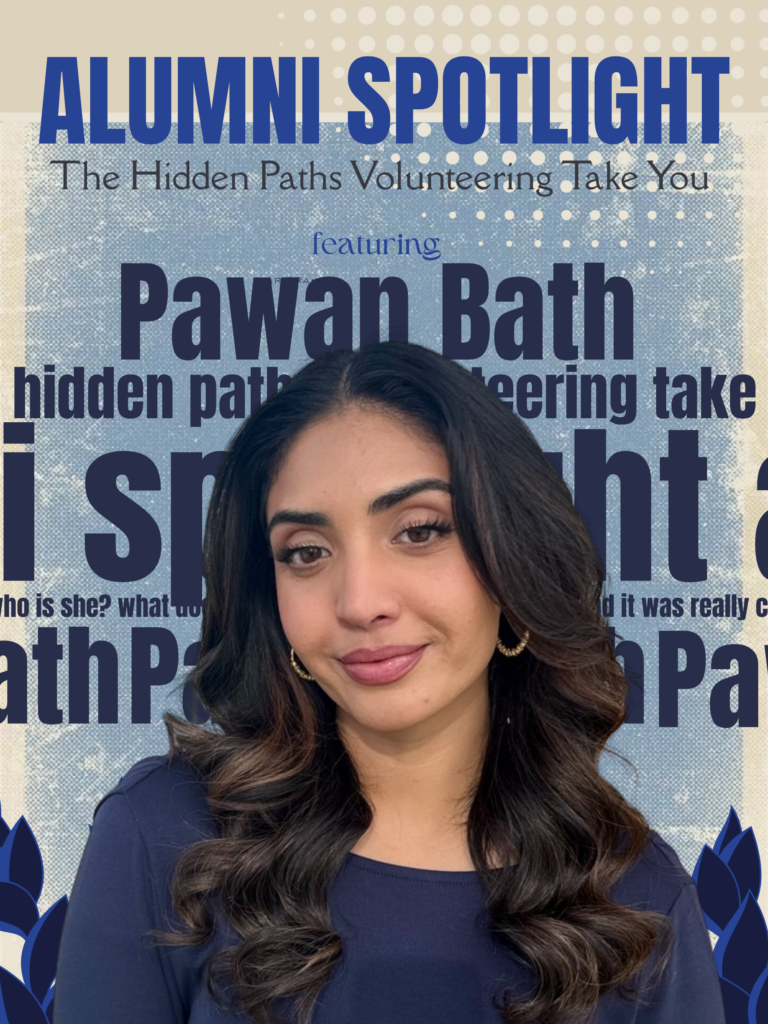
The Hidden Paths Volunteering Takes You: Featuring Pawan Bath

Alumni Spotlights celebrate the journeys, experiences, and impact of Youth Central’s former volunteers beyond their time with the organization. Through interviews conducted and written by youth bloggers from Youth Are Awesome, these stories aim to inspire current youth while reconnecting alumni through shared experiences, lessons learned, and the different paths they’ve taken since their involvement with Youth Central.

Hero’s Journey

Pawan was a “painfully reserved” kid ever since elementary, an academic rat who would rather study than socialize. Outside of school, her time was vacant. As she wanted to give back to her community, Pawan joined the Youth Central community. With time, she accumulated 800+ hours worth of experience and stories. From waking up early for breakfast Salvation Army shifts to helping seniors pick out their grad gowns, the once quiet student grew out of her shell.

But this volunteer journey does not end at “shy girl becomes confident leader, wow!” The seed that Youth Central planted had grown into a grandiose tree, sprouting branches that each produced its own fruit. 


A Sense of Belonging 

Pawan’s love for volunteering naturally drew her to others of the same mindset. By volunteering at the same events, she would keep meeting the same people over and over. They would get ice cream or dinner after events, harboring connections that are still kept alive to this day. The group was diverse, different age groups, different schools, and different parts of the city.

“These are people you wouldn’t have crossed paths with otherwise.”

During her time at the Youth steering committee, Pawan met Ros, the program director. Ros acted as a mentor for her – guiding her through times of doubt, giving life or career advice when she needed it. 

Mentorship is an insane multiplier for personal growth. Pawan characterized a mentor not necessarily as someone who’s older than you, but someone with more life experience. They lead you down life’s path, warning you against the common stumbling blocks that they and many others have tripped over.


Finding a career

How is it possible to be interested in something you’re not aware of? Answer: it’s not. Volunteering introduces you to people of all different walks of life, significantly broadening your horizons. The best way to gain perspective isn’t through personal pondering and reflection, but rather throwing yourself out there and tuning your ears to absorb it. 

For Pawan, she never knew about hackathons before Youth Central, a discovery that opened a whole new world of possibilities. Hackathons are events where participants collaborate to solve a problem by inventing a product, usually using code (explaining the name “HACKathon”) in order to gain a cash prize. Now, she works in a job that requires coding in her everyday life!


The baseline.

While you’re young, it may seem like the only thing that really matters is studying to get into a good university, and work hard to get a good job. However, Pawan emphasizes how none of this is possible without a baseline; your health.

Throughout her high school years and early university, Pawan was able to get by pulling all-nighters and drinking copious amounts of caffeine. After the loss of a loved one due to health complications, Pawan was faced with the harsh truth. Health is not something to be taken for granted, and everyone is responsible for their own. 

From there, Pawan completely turned her life around. She now goes to the gym six times a week, and genuinely enjoys it. Challenging your body inevitably builds discipline, as you’re pushing through discomfort it would’ve otherwise avoided. It also releases happy hormones!  

“It was daunting at first, but it’s been one of the best decisions I’ve ever made for my personal development.” 


Final Thoughts

While I was listening to Pawan’s story, I was thoroughly impressed by how much she’s evolved. It seemed to me that each and every aspect of her life improved significantly. Once shy and antisocial, now able to strike up conversation from nothing with anyone. Once in the doomful pit of poor health, now basically a health genie. So I asked her one more question, what is your biggest piece of life advice? 

“Work hard. Have integrity. Believe in who you are and stand up for what you think is right.

Hard work will take you further than your degree, your family’s background, where you’re from, or how much money you have. Those things can’t replicate genuine effort. And if you say you’re going to do something — follow through. That builds self-belief. If you put your mind to something and do it, you learn that you’re capable of hard things.”

The Final Stretch: Last-Minute Resources For Your AP Exam

It’s that season again– exam season! With AP’s looming around the corner, students taking these Advanced Placement classes may feel panic starting to set in. These exams feel like they’re in another universe when you compare them to your quizzes at school. The stakes feel higher, the questions get harder, and the tests get longer, with students required to follow a strict time limit for each question in order to finish the exam. Preparation for AP exams eats up hours of your time, with some students beginning their studying months in advance.

If test day is starting to feel a little too soon, too close for comfort, here’s a list of resources you can refer to for extra practice or clarification. Most of these resources are general, while others are specific to a certain course.

The Obvious Choice: AP Classroom & Bluebook 

Link: AP Classroom

I know if seems obvious, and most of you may be rolling your eyes right now, but it’ll surprise you to find out about how many new AP students overlook AP Classroom and Bluebook for practice. Bluebook’s comprehensive full-length practice tests are perfect for last-minute cramming before your exam, and may be the most helpful/accurate resource for your studying. Additionally, College Board also posts past papers and free-response questions for you to try. What better place to get AP study materials from than College Board, the organization that creates the exams?

The Godsend: Khan Academy

Link: https://blog.khanacademy.org/khan-academy-is-the-official-practice-partner-for/

Khan Academy is truly a life-saver for every student, no matter how old. With lessons on everything from finances to grammar, it’s no surprising that they offer AP courses too. If you’re feeling swamped with your practice, try some of Khan Academy’s short quizzes, which are usually around 4 questions and perfect for a quick, low-stakes refresher. Unit tests for each unit, as well as videos with detailed explanations on each concept are available for you to access for free as well. As a bonus, you can collect points based on how much practice you do, and level up your cool avatars as well 😉

An Underrated Platform: Knowt

Link: https://knowt.com/exams/AP

A personal favourite of mine, Knowt is a platform that offers the services of multiple study apps and flashcard tools in one place. With lengthy AP reviews and flashcards available for you to browse, Knowt is the Duolingo of studying. They offer resources in most AP courses, from flashcards to cheat sheets, and “must-memorize” lists. If you’re feeling stuck, you can use one of the “Knowt Ultimate Guides” for your AP course for help.

Our Collective Savior: The Organic Chemistry Tutor

Link (YouTube): https://www.youtube.com/@TheOrganicChemistryTutor 

For the average highschool student, the Organic Chemistry Tutor is our go-to YouTuber for anything and everything. With exhaustive videos on mathematics, chemistry, physics, and more, his teaching style and worked-out problems make complex concepts seem manageable. His lessons are detailed and address every potential question you may have, making his videos great for a quick review of concepts.

Everything Science: Bozeman Science

Link: https://www.bozemanscience.com/

Paul Andersen at Bozeman Science may seem familiar to you, as his videos are usually the ones teachers play in class to further explain a concept. He offers thorough videos on AP Biology, Chemistry, Physics, Environmental Science, and content on Statistics as well. I highly recommend his videos for detailed explanations with clarity. His website offers resources on several other non-AP courses as well, which I highly recommend.

Improve Your Writing: Quill

Link: https://www.quill.org/ap

Quill is a great website for those of you writing essays for your AP exam. This tool provides constructive feedback and lots of resources to give you the opportunity to improve your writing. You can stimulate the test environment and practice writing with a time limit using this platform, allowing you to get better at essay writing faster.

For Insider-Advice & Hacks: Reddit

Whether you’re on r/APChem like me, or r/APStats, there’s a Reddit forum for everything. Although it’s not a reliable source of information, lots of gracious students who survived AP exams make posts with advice and resources that helped them with their studying. These Reddit threads can be helpful as they contain personal experiences, allowing you to see what worked for other students like you. Some students post questions they have about the concepts, which are answered by the AP veterans, which can be helpful to read through. As long as you make sure you’re careful with what you post and read, you’ll find Reddit very helpful!

For History, Literature, Psychology, and Geography: Marco Learning

Link: https://marcolearning.com/students/ap-study-guides/

Marco Learning provides free study guides for all the English, Literature, History, and Psychology AP courses. Although an initial step of making an account must be completed

Aesthetic Study Guides: Naeha’s Active Recall Guides

Link: https://www.apactiverecall.com/

I LOVE this website and its aesthetics, everything is super easy to navigate. and the study guides are both clear and comprehensive. This website offers active recall guides for AP courses like AP Gov, APUSH, AP Psych, and AP Human Geography. I highly recommend using the study guides for last minute cramming before your exam!

The Lifesaver: MahadTheMentor AP Guide

Link: https://docs.google.com/document/d/1nciTvBjgy6046nihfJ_URzAzqgJngIuAbJx-jcFx3Ks/edit?tab=t.0

You’ll thank me (and MahadTheMentor) later. No matter what AP course you’re doing, you’ll find something useful from this document!

Conclusion

For extra study resources, refer to the videos and study guides above, but make sure you continue to utilize the AP Classroom resources as well, as they are ultimately the best tools for exam preparation. You’re getting a 5 on this exam, I know it!

Good luck!

Wexit: The Scoop on Alberta Separatism

The first time I heard about Alberta separatism was in 2019, during a “Current Events” presentation in school. I never explored it further, but the movement has picked up recently. Here’s a condensed version of what’s going on.

What’s Happening Right Now

An Alberta separatist group collected over 300,000 signatures on a petition to include the topic of Alberta separatism in the referendum on October 19th. They still need to be certified, but there’s a key stakeholder concerned. Many groups of Indigenous peoples are worried that a separatist movement would damage their constitutional treaty rights, which has become a court case that could derail the petition. The ruling is undetermined at this time.

What Separatism Would Mean for Youth

While different separatist groups have different ideas of where Alberta would go if it did indeed separate, options are primarily:

  • becoming a sovereign country – which is what’s being considered now
  • joining the United States

Primary Reasons for Separatism

  • uneven wealth distribution – some Albertans think that being a part of Canada’s economy has significantly stunted Alberta’s economic prosperity, referencing the effects of the oil crises and the NEP (National Energy Program)
    • In 2015, Alberta paid 27 billion more to the federal government than it received back in services
  • feeling underrepresented and neglected by political powers in Ottawa
  • feeling as though their culture is tied to their province over their country
  • potential trade opportunities with the United States

Primary Opposition for Separatism

  • fear of economic instability
  • loss of treaty rights for Indigenous groups
  • fear of international relation instability, particularly with the United States

My Two Pennies as an Albertan Youth

The last time a vote was held to see Albertan interest in separatism, 48% were in favour and 52% opposed. That’s a really close margin!

This potential for separation could have an upheaving effect on Alberta’s economy, and has the potential to create a whole different culture and national identity. This is an important issue, and I encourage you to research it further. Stay informed, and if you’re old enough to vote should the referendum occur, do so! Participate and have your voice heard because the outcome of this potential referendum question could have a drastic impact.

Sources: 1, 2

Could You Upload Your Brain to a Computer?

0

It sounds like science fiction. Take everything that makes you you, your memories, your personality, your thoughts, and move it into a machine. No aging, no disease, maybe not even death. But the real question is not whether this idea is fascinating. It is whether it is even possible. To understand this, you first have to look at how the brain actually works. The human brain is made up of about 86 billion neurons, all connected through trillions of synapses. These connections are not random. They form patterns that store memories, control movement, and shape how you think. In simple terms, your identity is not stored in one place. It exists in the structure and activity of this entire network.

The idea behind “uploading” a brain is based on a concept called mind uploading. Scientists would need to scan the brain at an extremely detailed level, map every neuron and every connection, and then recreate that system in a computer simulation. If the simulation behaves exactly like your brain, some argue that it would effectively be you. There is already some progress in this area, though it is still very limited. Researchers have mapped the full nervous system of tiny organisms like the roundworm. More recently, parts of animal brains have been digitally reconstructed to study how neural circuits function. But scaling this up to a human brain is an entirely different challenge. The level of detail required is enormous, and even small errors could completely change how the brain functions.

Another problem is that the brain is not just a static structure. It is constantly changing. Synapses strengthen or weaken over time, new connections form, and chemical signals influence how neurons communicate. This means that even if you could scan a brain perfectly at one moment, you would only be capturing a snapshot, not the ongoing process that makes it alive. There is also a deeper issue that science alone cannot fully answer. If you create a perfect digital copy of your brain, is that actually you, or just something that thinks it is you? The original biological brain would still exist, at least at the start. From your own perspective, you might not feel like you have moved anywhere at all. Instead, there would simply be a second version of you, living in a different form.

Some scientists believe that if consciousness is purely the result of physical processes, then it should be possible to recreate it. Others argue that consciousness might depend on factors we do not fully understand yet, including the physical properties of the brain itself, not just its structure. Right now, uploading a human brain is far beyond current technology. We do not have the tools to scan a living brain at the necessary resolution, and we do not fully understand how consciousness emerges from neural activity. Still, the idea is not completely impossible. Advances in neuroscience, artificial intelligence, and computing continue to push the boundaries of what we can model and simulate.

In the end, the question might not just be “Can we do it?” but “Should we?” Uploading a brain would challenge everything we think we know about identity, life, and what it means to be human. Even if the technology becomes possible, deciding whether to use it could be the hardest problem of all.

https://news.gatech.edu/news/2025/05/23/can-you-upload-human-mind-computer-neuroscientist-ponders-whats-possible?utm_source

The Science Behind Artificial Intelligence: How Machines Learn to “Think”

0

Artificial Intelligence (AI) sounds like something you see in movies. Like robots taking over cities, computers writing essays, or chatbots answering every question instantly. It’s actually funny because we actually see some of those today, yet the majority of us don’t really understand the concept behind it . 

At its core, AI doesn’t really “think” the way humans do. Instead, it uses mathematics and statistics to make predictions. The most common type of AI today is machine learning, where systems improve by analyzing huge amounts of examples rather than following strict step-by-step instructions. For example, if you show a machine learning model thousands of photos labeled “cat” and “dog,” it doesn’t memorize every image. Instead, it learns patterns (like shapes, textures, and features) that help it distinguish between the two. Over time, it becomes better at guessing what a new image shows even if it has never seen it before!

A more advanced form of this is deep learning, which uses structures called neural networks. These are loosely inspired by the human brain, with layers of “nodes” that pass information between each other. Each layer picks up different levels of detail. Early layers might detect edges and colors, while deeper layers recognize faces, objects, or even language patterns. This is how tools like voice assistants, recommendation systems, and chatbots work. When a streaming platform suggests your next show, or a map app predicts traffic, that’s AI analyzing patterns in your behavior and comparing them to millions of others.

But AI is not perfect just like the majority of machines. It can only learn from the data it’s given. This means that bias in data can lead to biased results. If a system is trained on incomplete or unfair data, it can repeat or even amplify those issues. That’s why researchers talk a lot about “responsible AI” because they  want to make sure that these systems are transparent, fair, and safe.

Another big misconception is that AI “understands” information the way humans do. Plot twist: It doesn’t. It doesn’t have consciousness, emotions, or intentions. It’s extremely good at pattern recognition, but it doesn’t necessarily know what it’s saying. All it does is that it calculates what is most likely to come next based on training data. Even so, AI is already changing the world. It’s being used in medicine to detect diseases earlier, in science to model climate change, in business to optimize logistics, and in education to personalize learning!

Overall, AI is an insane tool that is changing our world each and every day!

Sources: 1, 2


Rewiring Minds: The Neuroscience of a Better World : Issue 5

The Illusion We Keep Calling a Skill


“To do two things at once is to do neither” – Publilus Syrus

We tend to treat multitasking as a modern cognitive advantage, almost as if it represents an evolved form of intelligence suited for an increasingly fast world. It is often described as efficiency in action: responding to messages while thinking through problems, switching between conversations while completing work, or holding multiple streams of input at once. But this framing depends on a misunderstanding of how the brain actually processes information. What we call multitasking is not parallel thinking. It is rapid switching between discrete cognitive states, so fast that the transitions are not consciously registered.

Each perceived “simultaneous” activity is actually the brain repeatedly disengaging from one task set and reconstructing another. The illusion of continuity is created by speed, not true parallel processing. And while this can feel efficient on the surface, it introduces a structural limitation: every switch carries a cognitive cost.

What Actually Happens When Attention Switches

When the brain shifts from one task to another, it does not simply redirect focus. It must actively suppress the previous neural configuration and activate a new one. This includes recalibrating working memory, updating contextual rules, and reloading relevant goals and constraints. Even when the transition feels automatic, the underlying system is performing a full reset sequence.

This process is not neutral. It consumes time, energy, and cognitive resources. More importantly, it introduces a subtle inefficiency that compounds over repeated switches. The more frequently attention is redirected, the less time the brain spends in a stable configuration where deeper processing can occur.

Over time, cognition becomes less about sustained engagement and more about constant reorientation.

The Role of Novelty and Why It Feels Productive

One reason multitasking feels effective is because of how the brain responds to novelty. Every new input or task shift triggers a brief increase in dopaminergic activity, which the brain interprets as salience or potential reward. This creates a subjective sense of momentum, as though something meaningful is happening with each transition.

But novelty is not equivalent to progress. It signals change, not depth. The brain can therefore misinterpret frequent switching as productivity, even when each switch interrupts ongoing cognitive construction. This is why long periods of multitasking often feel busy but not necessarily fulfilling or clarifying.

The mind becomes responsive, but not necessarily integrative.

Task Residue: What You Don’t Leave Behind

A less visible effect of multitasking is what cognitive science refers to as task residue. When attention leaves a task, it does not fully disengage from it. Elements of the previous task, like unfinished thoughts, active constraints, or partially processed information, remain temporarily active in working memory.

This means that when a new task begins, it is not entering a clean cognitive space. It is entering a space already occupied by remnants of the previous one. Over time, this creates overlap between tasks that should be distinct, increasing mental noise and reducing clarity.

The result is not just distraction, but interference. Thought processes begin to compete rather than sequence.

Why Deep Thinking Breaks Under Fragmentation

Sustained thinking depends on continuity. When attention remains stable over time, neural systems gradually optimize around a single representational space. Irrelevant signals are filtered out more efficiently, associations become stronger, and internal models become more refined. This is the foundation of deep understanding: not speed, but stability.

Multitasking disrupts this stability by repeatedly resetting the conditions required for consolidation. Instead of building a layered understanding, the brain repeatedly returns to early-stage processing. Ideas are initiated but not fully developed. Patterns are noticed but not fully integrated. The system remains in a state of perpetual beginning.

This is why fragmented attention often produces the sensation of thinking a lot without arriving at anything conclusive.

Working Memory as the Bottleneck of Conscious Thought

At the center of this issue is working memory, the limited system responsible for holding and manipulating information in real time. It is not designed for continuous interruption. It requires temporal stability to integrate inputs into coherent structures.

When attention is constantly redirected, working memory is repeatedly cleared or overwritten before it can complete integration. This disrupts the natural flow from perception to understanding to synthesis. Instead of building upon itself, cognition restarts repeatedly from partial states.

The subjective experience of this is subtle but recognizable: mental effort without progression, activity without accumulation.

How Modern Environments Reinforce Fragmentation

The structure of modern digital environments intensifies these patterns. Notifications, rapid messaging systems, open-ended content streams, and constant availability create an environment where interruption is not occasional but expected. Attention is rarely allowed to remain in one place long enough to fully stabilize.

Over time, this does not just change behaviour. It changes baseline cognition. The mind adapts to fragmentation by becoming better at switching and worse at sustaining. This is not a failure of discipline, but an environmental conditioning process.

In such contexts, continuous attention begins to feel unnatural, even though it is closer to how the brain originally operates.

The Trade-Off We Rarely Name

Multitasking is not without function. It increases responsiveness, allows for rapid environmental engagement, and can be useful in situations that require surface-level coordination across multiple inputs. But it comes with a structural trade-off that is rarely acknowledged: it reduces depth in exchange for breadth.

The brain becomes capable of handling more simultaneous demands, but less capable of fully resolving any single one of them within a continuous cognitive arc. Over time, this shifts the nature of thinking itself, from integration to management, from synthesis to switching.

The cost is not immediate. It accumulates in the background as reduced clarity, weaker retention, and diminished capacity for extended reasoning.

Closing Reflection

The brain was never designed to think in parallel streams of complex thought. It was designed to select, sustain, and deepen. Multitasking works against this architecture by fragmenting the very conditions that allow understanding to form.

In environments that reward constant switching, depth becomes harder to access, not because it is gone, but because it is continually interrupted before it can fully emerge.

And so the real limitation is not attention itself, but the conditions under which it is allowed to remain intact long enough to become meaningful.

When “I’m fine” needs an asterisk: highly specific emotional vocabulary

We’ve all experienced an emotion so complex, mixed or specific to a particular situation that we’re incapable of putting it into words. Maybe it’s the calmness of being inside and having your life on pause during periods of bleak weather, or longing for a place you can return to, but that will never be the same. Remarkably, many of these nuanced sensations have words to describe them. Many of these words were developed by psychologists around the world to describe ideas found during their research, and portray deeply complicated but relatable emotions. Below are some of the most interesting:

Monachopsis

If you’ve ever been at a social gathering where you knew a few people but couldn’t help but feel a bit out of place, you’ll understand monachopsis: the quiet, internal dissonance of feeling just slightly in the wrong environment, often compared to a seal just out of the water.

Kenopsia

Kenopsia is described as the eerie feeling one might get in a space normally teeming with people that has been vacated for unknown reasons. Seeing an airport or a movie theatre or some other place where crowds are expected to be completely empty feels unsettling, wrong or unauthorized, simply because you know the context in which you usually experience the place.

Limerence

Crushes can feel impossible to explain, especially when there’s so much your brain and nervous system go through during one- luckily psychologist Dorothy Tennov coined the term “limerence” for the compulsive thoughts and infatuation with a person before knowing much about them, often relying on an idea or ideal one creates.

Chrysalism

As mentioned before, the tranquility and serenity of being safe indoors during heavy rain or a thunderstorm feels comfortable and safe- like all the world’s responsibilities are on pause and that’s ok.

Sonder

Sonder is the profound, often sudden realization that every passerby and stranger that you walk by at a subway station or at a busy concert is living a life just as vivid and complex as your own. Everyone has a childhood, goals, a destination- you are their background noise. This emotion comes on without warning and shows up as a striking realization.

Types of nostalgia (yes- there isn’t just one!)

Vellichor

The wistful nostalgia felt when wandering a used shop (often a bookstore) is called vellichor, and consists of the melancholic knowledge that each paperback contains a story, both within its pages and the places it has been, and that you will never get to know everything each could tell you.

Anemoia

Old photographs and clips of the past with their low resolution graphics and comforting expressions often evoke a sentiment called anemia, where one feels nostalgia for a time or place they never personally experienced. These bits of the past are snapshots of what we consider a simpler time (which we wouldn’t if we had the full story), and only show the pleasant parts of life, like a snapchat story.

Hiraeth

A Welsh word representing a deep, bittersweet longing or yearning for a home, place or time that one can no longer access, hiraeth is one of the most relevant to many living today with the era’s increase of nostalgia due to turbulent times and unique stress factors. Hiraeth often denotes nostalgia for a place you can physically return to but would never “be the same”- perhaps the childhood home your mind has sanctified.

Types of existentialism

Onism

The realization that you are limited to a single set of choices and a single path in life and that this confines your existence and experiences.

Occhiolism

The belief / sensation that you will never experience the full grandness of the universe as the scale is too massive and this prevents you from making meaningful conclusions about the world. Occhiolism can feel unsettling and stressful or comforting- your mistakes on the test don’t actually influence the fate of Earth.

Hopefully something in the list felt familiar, and it encourages you to start noticing and naming your emotions with new depth. These words are only the beginning- there are so many feelings out there you may not have the words for yet.

Sources: 12

The Branches in the Sky, Our Hearts in the Moons

0

The Thirteen Celtic Tree Signs
(Astrology originated from the Ogham calendar)

Birch (Dec 24-Jan 20)

The Achiever,

Birch individuals are the unstoppable signs. You are motivated, resilient and ambitious. You are natural-born leaders and can adapt to tough environments. As the first tree to grow after a fire, the Birch tree’s signs are always highly driven yet also contain a soft side that offers beauty and purity. Remember to chill for a moment, too, Birch!

Rowan (Jan 21-Feb 17)

The Thinker

Rowans are the philosophical minds of the group; your ideas are creative, and your presence shifts the room. If you happen to find yourself born under a rowan, you probably have a lot going on. You’re curious, insightful, and can seem detached or cold at times, but you are burning within from your passionate ideals. You are always thinking about life’s bigger questions and probably overthink a lot, too. Maybe don’t isolate yourself that much.

Ash (Feb 18-March 17)

The Enchanter

Ash signs are the free thinkers, the dreamers, the creatives and the intuitive ones that are naturally talented in the intersection of the arts. Your imaginative and enchanting personality draws people in towards you, and you are deeply intertwined with nature, spiritual connections and your inner circle. Ash sign can sometimes be so far off that they need to be reminded to stay grounded.

Alder (March 18-April 14)

The Trailblazer

Alder signs are natural pathfinders; they’re the first ones to try something new or charge into the unknown. You are confident, action-oriented, charming, and get along with almost everyone. Correction, you get along with everyone. You have strong self-faith and focus, don’t like wasting time and have boundless energy, but beware, Alder signs can burn out fast without some kind of relaxation.

Willow (April 15-May 12)

The Observer

Willow signs are the empaths. You are creative, intuitive and intelligent; you have a more realistic perspective of the situation, resulting in you being more patient, often standing as a natural healer offering support to those around you. Willows are full of potential, but they tend to hold themselves back due to fear. Like the tree, you bend, not break and adapt to life’s changes. Just remember not to overwhelm yourselves with other people’s emotional baggage.

Hawthorn (May 13-June 9)

The Illusionist

Hawthorn signs basically represent the quote, “never judge a book by its cover”; their external personalities and internal personalities can be quite different from each other. You are creative, dynamic, curious and can easily adapt to most life situations. They have fiery passions, but just don’t forget to embrace yourself instead of hiding behind a mask.

Oak (June 10-July 7)

The Stabilizer

Oak folks are born with a unique strength; they are the rock of tree astrology. You are nurturing, protective and generous. They are deeply connected to history, family and tradition, often stepping up as a mentor, crusader and a spokesperson for the underdog. You are optimistic and exude an easy confidence, but remember that your sturdy shoulder could shudder too.

Holly (July 8-August 4)

The Ruler

If you find yourself born under a Holly, you possess a regal status. You are noble, confident, ambitious, competitive, high-minded, and natural leaders who aren’t afraid to tackle bigger challenges. People look up to you and admire you as you skate through obstacles. A Holly could also be kind, affectionate and quite generous. However, make sure you don’t steamroll everyone else in your quest for success.

Hazel (August 5-September 1)

The Knower

Hazel signs are highly intelligent, organized and efficient. They have memories like steel traps and have a gift for subjects that call for analytical skills. You are natural scholars and teachers, always seeking out new knowledge or understanding. Although you are always aware of your facts, remember that it’s okay to make mistakes sometimes; perfectionism shouldn’t weigh you down.

Vine (September 2-September 29)

The Equalizer

Vine signs are unpredictable. You are full of contradictions and are often indecisive. You can see both stories’ opinions and empathize with them equally. Your ability lies within your gift to navigate life’s struggles with grace. Vine signs appreciate the finer things in life, such as food, wine, music and art. You have a great aesthetic sense, only don’t get too caught up in luxury.

Ivy (September 30-October 27)

The Survivor

Ivy individuals are tenacious; they can thrive in situations that most people are knocked down by. You are determined, compassionate, deeply intuitive, and loyal. You fight through the difficult challenges life handed you and have a giving nature, always ready to lend a helping hand. However, learning to trust their intuition to guide them through is something they are unsure of.

Reed (October 28-November 24)

The Inquisitor

Reed signs are the detectives; you dig deep inside to the real meaning and uncover the truth behind layers of distraction. They can easily be attracted to gossip and are easily curious, and interpretive. Reed signs often become journalists, historians, and archaeologists. Just keep in mind that not all secrets need to be uncovered.

Elder (November 24-December 23)

The Seeker

Elder tends to be freedom-loving and can be interpreted as a little wild. You love adventures and are outspoken, independent and a little bit rebellious. You are extroverted and think considerately about other people and genuinely try to help, which can sometimes be thwarted by your brutal honesty. You thrive on change, excitement and the thrill of new experiences, but remember you need balance to ground yourself.

Sources: 1, 2, 3

Red Moon – A Thrilling Science Fiction Novel

A novel is supposed to immerse the reader in the world of the story and have rich characters and plot. In this blog post, I will be sharing my experience reading one of my favourite novels, Red Moon, by Kim Stanley Robinson. It is a science fiction novel set in 2047, a future where China dominates the global landscape, and has rich characters and revolves around an interesting plot. I will also be sharing why I liked it and why you should read it too.

Basic Summary

Many nations have established colonies and laboratories on the Moon, with an overwhelming majority of Chinese presence. The main character, Fred Fredericks, is an American who works for a Swiss tech company and has been tasked to install a quantum communication system for the Chinese Lunar Authority.

However, after arriving, he is involved in an incident where Chang Yazu, a Chinese official, is poisoned and dies, leading to Fred being blamed and forced into hiding with Chan Qi, the daughter of the Chinese Finance Minister, who is a major figure in the growing rebellion movement in China. The story takes place during a period of political turmoil in China, where a power transition is underway amid a conflict between conservative authority and a rising rebellion movement, with many factions opposing each other, leading to intense internal fighting and conspiracy.

Millions of Chinese migrant workers and labourers, being exploited and feeling unrepresented by their government, want reform and change. While this is going on, the novel explores how Fred and Qi are sent back to Earth and back to the moon, facing various assassination attempts by many of these factions who oppose what Qi stands for along the way, forcing them to rely on allies and complex quantum technology to survive the conspiracy involving members of the highest level in the Chinese government. 

Why I Liked It

I liked this novel as it was amazing to read, and I really enjoyed learning about lots of new ideas and the significance of historical events, which this book was filled with. The author did an amazing job of immersing the reader into the experience, and by showing the story from different points of view, it was nice to see a broader picture rather than just seeing the main characters struggle to survive.

Robinson utilizes vivid imagery and incorporates poetry through the character Ta Shu, a former poet, to convey powerful messages. The story being set in 2047, the year Hong Kong is set to join mainland China, gave the novel many conflicts to explore, especially the struggles of Chinese migrant workers who are being significantly exploited with the Hukou system (where each citizen is tied to their birthplace and migrating to other places is illegal and if they do they will lose access to key services such as healthcare and labour safety laws), which is relevant today. 

Also, there were many rich and complex themes explored throughout this novel. Firstly, the idea of political reforms and social change is a core concept of this novel. Through Chan Qi and the rebellion caused by a billion people, the idea of how reform is slow, complicated and requires collective effort and motivation is shown.

This novel also expands on the idea of inequality and exploitation faced by millions of people and how it impacts their livelihood. Something I learned from this book about the world is that even when advanced technology and a new way of living emerge, core emotions such as defiance and rebellion will remain unchanged, as depicted in the text where Robinson compares the similarities of this rebellion with the revolution of the past. Also, this book taught me to appreciate different viewpoints, as seeing the story from multiple characters helped me understand the complex nature of conflicting motivations and enhanced my empathy.

NASA’s Comeback: Artemis 2 Brings Humans Back To Deep Space

After more than 50 years, humans have once again ventured toward the Moon—and made it back safely. The crew of Artemis II, including astronauts Reid Wiseman, Victor Glover, Christina Koch, and Canadian astronaut Jeremy Hansen, completed a historic 10-day mission that pushed human space exploration farther than ever before.

Throughout the mission, astronauts tested critical systems needed for future deep-space travel, including life support, manual spacecraft control, and emergency procedures. They also conducted scientific research on how the human body responds to space conditions like microgravity and radiation—key knowledge for longer missions in the future.

The crew captured over 7,000 images, including stunning views of the Moon, Earth, and even a solar eclipse from space. These observations will help scientists better understand the lunar surface, especially areas near the Moon’s south pole, where astronauts are expected to land in upcoming missions.

After splashing down safely in the Pacific Ocean and returning home, Artemis II marks a major milestone in NASA’s long-term goals. The mission proves that the technology, teamwork, and international partnerships are ready for the next step: landing humans on the Moon again.

With Artemis II complete, all eyes now turn to Artemis III—the mission that aims to return astronauts to the lunar surface and begin building a long-term human presence on the Moon, paving the way for future exploration of Mars.

1