Youth Are Awesome, commonly referred to as YAA, is a blog written by youth for youth.
YAA provides the youth of Calgary a place to amplify their voices and perspectives on what is happening around them.
Youth Are Awesome is a program of Youth Central.
Any views or opinions expressed on this blog belong solely to the author and do not represent those of people or organizations that the blog may be associated with, unless explicitly stated. All content is for informational purposes only.
Vaccines are one of the most essential medical supplies in the world. They help humans prevent certain diseases, even the fatal ones. In fact, they have decreased roughly 40% of the child and infant mortality rates for over 50 years! [1]
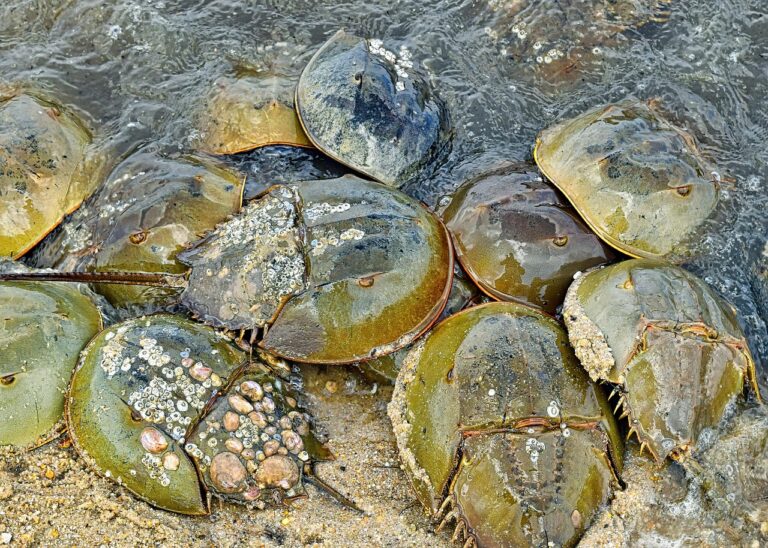
But, have we ever wondered what we use to test vaccines in the labs? The creatures in the picture is the answer: horseshoe crabs!
What are horseshoe crabs?
Horseshoe crabs are arthropods of family Limulidae, and they are the only surviving members of Xiphosura. Horseshoe crabs aren’t crabs or crustaceans; they are chelicerates, related to arachnids (spiders, ticks, scorpions). Their body has three main parts: cephalothorax (house eyes, limbs, and organs); abdomen; and telson (tail spine) to balance, not to sting . The largest part is the cephalothorax, which looks like a horseshoe, giving them their name. [2]
Experts call them “living fossils” because they’ve been around and remained unchanged since the Triassic period (at least 445 million years), making them older than the dinosaurs! [2]
They live in brackish water, and are often found along the coasts of the western Atlantic Ocean in North America, and the Central Indo-Pacific in South and Southeast Asia. [2]
From “living fossils” to mankind’s heroes:
Horseshoe crabs has a special copper-based blood, called “blue blood“. It’s true to its name because their blood is indeed blue in colour. It is intriguing as we immediately think of red, which is not the case for horseshoe crabs. The “blue blood” contains a substance called LAL (Limulus Amebocyte Lysate). This specific substance is used to test vaccines, any other injectable drugs, and medical devices to make sure these medical supplies don’t have any dangerous bacterial toxins called “endotoxins“, which are hazardous to human body by causing reactions such as high fever, chills, low blood pressure, organ failure, an septic shock, etc [3] . Their blood are used for further biomedical researches beyond LAL like cancer research, diagnosing leukemia, and other medical diagnostics [4]. However, it is estimated that around 15% of horseshoe crabs die after the blood being drawn, even though most of them survive [5].
What’s more, the biomaterials from the shell is useful, too. Their shell is made of chitin, a biopolymer. It can be used to manufacture contact lenses, sutures, and wound dressings, especially for burn patients which improve the healing time by 35% to 50% [5].
Conclusion:
Horseshoe crab’s contribution to our mankind is undoubtedly significant. Remember that in every dose of vaccines and injections we’ve had, there is blood and unseen sacrifices of this sea creature. Therefore, we should take action to protect horseshoe crabs and their habitats to ensure that this spectacular marine animals to continue exist on this beautiful Earth.
If you love crime thrillers with a psychological twist, The Naturals by Jennifer Lynn Barnes is the perfect book to get lost in. Its a gripping young adult mystery that blends elements of the show Criminal minds with a coming of age story, exploring what happens when extraordinary teens are recruited to think like killers and catch them.
The story follows Cassie Hobbes, a 17 year old girl with a natural talent for reading people. She is scouted and recruited by the FBI to join a special program called The Naturals, which trains gifted teens to solve cold cases using their unique abilities, such as profiling, statistics, emotion reading, and more. But when a new case hits close to her past, Cassie’s skills are pushed to the limit.
The one thing that stood out to me is how different The Naturals is from other YA mysteries, showing how smart it is. Barnes doesn’t just write about catching criminals, she dives deep into psychology and emotion. Its like the tv show series Criminal Minds meets the book One of Us is Lying, but darker and more character driven.
The Naturals was kind of book that kept me guessing until the end, and even then I had to grab the sequel immediately. It’s thrilling, clever, and full of heart, making it the perfect read for anyone who adores psychology, mystery, and books that makes you stay up way too late!
If you have read this series, let me know how you liked the books and your thoughts on it in the comments!
Life can feel heavy sometimes—not just mentally, but physically, surrounded by stuff we don’t really need. That’s where minimalism comes in. It’s not about living in an empty room or giving up all your favorite things. It’s about making space—both in your home and in your mind—for the things that actually matter. Here are some practical hacks to bring minimalism into your everyday life.
1. The One-In, One-Out Rule
Every time you bring something new into your home—whether it’s clothes, gadgets, or kitchen tools—try to remove one item you no longer need. It’s a simple way to keep your space from overflowing without feeling like you’re constantly decluttering.
2. Tidy Your Digital Life
Minimalism isn’t just for physical stuff. Take some time to clean up your digital space too. Unsubscribe from emails you never read, delete apps you don’t use, and organize files into folders. A clean digital environment can do wonders for your focus and stress levels.
3. Build a Capsule Wardrobe
Instead of a closet full of clothes you rarely wear, invest in a few versatile pieces that mix and match easily. Not only does this reduce clutter, but it also makes getting dressed in the morning way less stressful.
4. Daily Mini-Declutter
Set aside just 5–10 minutes each day to tidy one area of your home. Small, consistent efforts beat occasional massive cleaning sessions and make your space feel constantly fresh.
5. Choose Multi-Use Items
When shopping or organizing, pick items that serve more than one purpose. Think of a backpack with compartments that can hold both work and gym gear, or a cooking pot that doubles as a storage container. Fewer items with multiple uses save space and money.
6. Practice Mindful Buying
Before making a purchase, ask yourself: “Do I really need this? Will I use it regularly?” Being intentional about what you bring into your life helps prevent clutter from creeping back in.
7. Simplify Beyond Stuff
Minimalism isn’t only about material things. Look at your schedule, commitments, and digital notifications. Cut out what drains you and focus on what energizes you. A less crowded life is often a calmer, more productive one.
Minimalism isn’t about perfection. It’s about creating room for what matters, reducing stress, and feeling more in control of your life. Start small—pick one of these hacks to try this week—and see how much lighter life can feel when you simplify.
When people think of biology, the first thing that comes to mind is heavy memorization, whether that be vocabular or cellular processes. Does aerobic cellular respiration, glycolysis, and oxidative phosphorylation ring a bell? After having taken biology IB courses in high school, and planning to pursue a career in this field, I do agree that it can certainly be daunting sometimes. But what I realized last January when I was studying for my Biology 20 final exam, was that when concepts actually clicked in my head, I found topics that would otherwise have been boring for me to be quite interesting. So here are some quick tips!
Flashcards (but make them yourself):
The biggest mistake I made with biology was using passive study techniques. All of junior high, and even during early high school, I would usually get away with merely reading and re-reading my notes over and over again, sometimes even cramming to read that one sentence at the end of the note that somehow might make its way onto the test. And it worked for me. However, when you advance in your biology course, it becomes really hard to memorize info just by reading the textbook or the notes.
My favourite method of active recall is using flashcards, whether that be online ones (eg. Quizlet or Anki), or physical ones. That way, when you actually write (or type) out the terms/definition to make your flashcards, and you revise them periodically, you get double the amount of studying done! Of course, if you’re cramming, you might not have time to make your own flashcards. Some apps, like Quizlet, have software that has AI to create flashcards if you upload your notes. I still suggesting going over these flashcards and editing them yourself so it’s customized for you!
Focus on understanding, not memorization:
I know that this is easier said than done. The reality is, there is no way around the memorization in biology. But unlike common opinion, biology is not about memorizing random vocab, or cramming in the different stages of a biochemical process which you’re probably going to forget in the next few days. Taking IB biology, I’ve come to realize that much of this course is based on data analysis, and using data analysis to make inferences or predictions. Critical thinking is more important than rote memorization.
When I’ve got the time, I like to flip to the end of each chapter in my biology textbook, and do the unit review questions. Even if they’re not assigned by my teachers. Most of these questions are aimed at helping you make connections between the concepts learnt in classes to the real world. That way, you’re giving everyday life context to seemingly meaningless (although I don’t think so) bodily processes.
Who cares about how oxygen is used in our muscles? I know I would if I’m gasping for breath in the middle of a marathon.
Ask Questions:
This is an obvious one, and probably advice your parents or teachers have been giving you since elementary school. And you might not even struggle with so. If that’s the case, give yourself a pat on the back and move on.
But for people like me, it can be difficult approaching teachers, especially new ones, every time we don’t understand something. However, I don’t think there’s an easy way around with this. But most often than not, teachers love it when students ask questions. The reason they chose teaching as a profession is because of their dedication towards education and student well being.
So just take a deep breath, walk up to your teacher’s desk and ask your question. You will thank yourself later when you’re at home studying.
TL;DR:
Biology’s hard, but it can also be quite interesting if you find the best ways to study for it. The tips above can help!
A municipal government is a local governing body that provides daily life services, therefore affecting key aspects of day-to-day living and contributing to a larger picture.
However, Statistics Canada shows that only 52.5% of Canadians aged 18-30 vote in the last municipal elections as compared to 77.7% for those 47 and older. What this means is that when young voices don’t show up at the ballot boxes, the rising problems of today’s generation go unheard.
Even though for young voters, it is still their city, their sidewalks, transit routes, and parks that get built or neglected.
This creates an assumption which turns into reality that “big impacts” happen elsewhere, in provincial and federal elections, but change starts from within your own home.
If fewer people, especially youth, engage with local government, we risk letting others decide how our neighbourhoods look, how our services run, and who benefits. Creating disparities in already unequal systems of justice and policy.
So let’s break down Municipal Politics as well as elections, so you can be an informed voter or youth building a better city.
Key Facts
The municipal mayor is elected every 4 years by all eligible voters in the city. What this elected position means is that the mayor will act as the city’s chief representative and chair the city council meetings.
As for City councillors, on a local scale;
Calgary is divided into 14 wards, each electing one councillor.
Councillors will represent their ward’s residents and make decisions on city policies, budgets, and local issues.
The hierarchy of municipal politics is as follows, from the least amount of influence held to the most. (On a municipal level)
City staff / administrators → Committees & advisory boards → City Councillors → Committee Chairs / Deputy Mayor → Mayor
Election process:
Anyone 18+ and a Canadian citizenhabituated in Calgary is eligible and encouraged to vote.
Candidates will campaign before the election, and residents will vote in person, by mail, or online (if available).
The municipal government cannot make laws without City Council approval.
Now that we know the basics of municipal elections and who comprises the governance systems, let’s take a look at a few of the responsibilities of a municipal government.
Local services
Handles garbage, recycling, water, snow removal, and road maintenance.
Keeps fundamental daily operations like Calgary Transit and infrastructure running efficiently.
Planning and development
Power over how land will be used, zoned and/or developed across the city.
Approves new construction of neighbourhoods, buildings, and implements long-term city growth plans.
Public safety
Supervises law enforcement, such as Calgary Police and manages Fire and emergency response services.
In charge of running community safety programs and ensuring quick responses in times of crises.
Parks, Recreation, and Community Programs
Maintains free third spaces that are of public access, such as; parks, recreation centres, and green spaces for example, Nose Hill and Prince’s Island Park in Calgary.
Supports sports, youth programs, and local cultural or community events.
Taxes, Budgets, and Policy
Will be funded primarily through property taxes and city service fees.
City Council gets to decide how money is spent as well as put in place local laws and clarify priorities.
Many youth who are under 18 often feel as though their ineligibility to vote means that their voices don’t count and actions go unnoticed; however, there are plenty of ways to get involved and make an impact.
Here is how:
Youth Advisory Committees, such as the Calgary Police Service Youth Advisory Board and the Child and Youth Advisory Council (Southern Alberta), among others.
Attend Council Meetings, these are open to the public and give u a glimpse into how decisions are made, and you may even get a chance to speak during public hearings.
Petitions & Public Campaigns, in the double-edged sword era of digital advocacy, youth can utilize it for good by creating change through organizing petitions or social media campaigns to raise awareness about local issues (e.g., public transit, mental health programs).
Voting When Eligible, take on the responsibility to educate and share the importance of voting during municipal elections to your friends, family and communities, and once you do turn 18, you can participate to influence local leadership!
Conclusion
Municipal government in Calgary aren’t a distant, abstract and inconsequential event. It directly affects day-to-day life, from transit and parks to snow removal.
Youth can influence change even before they can vote, by joining advisory committees, attending council meetings, volunteering, and advocating for their communities.
The genocide in Sudan has reached its breaking point, and it seems like the rest of the globe isn’t paying attention. Millions of Sudanese are caught in the crossfire of one of the most brutal civil wars.
What’s happening in Sudan may feel like another headline to you, but in reality, it is a humanitarian catastrophe that needs our awareness. This post sheds light on what’s going on, the role that youth and the media play in advocating for change, and what you can do to help.
Since April of 2023, the country of Sudan has been facing a horrific humanitarian crisis. The Sudanese Armed Forces (SAF) and the paramilitary group RSF (Rapid Support Forces) have been engaging in large-scale combat. As both sides struggle for power over the nation, a civil war has erupted with catastrophic casualties. As of now, over 150,000 people have been killed, 12 million have been forced from their homes, and over 30 million–more than half of the country’s population–require urgent humanitarian aid.
It is believed that the RSF is carrying out a genocide in the western region of Darfur. They are attempting to make the diverse region entirely Arab-dominated. There are reports of mass civilian killings, ethnic-targeted violence, deliberate starvation, and violence against women and girls increasing at an alarming rate. Armed men have been using sexual violence as a weapon of war, leading to both infants and women alike being subjected to rape. Reading stories from victims of these war crimes scarred me, the extent of the violence is sickening. These abhorrent acts are being used to suppress the population and to drive non-Arabs out of the country.
Additionally, famine and disease have torn through the country, with basic health infrastructure and supplies diminished. Hospitals lack safe water, supplies, and electricity. Healthcare staff and clinics are being targeted and attacked, preventing the population from receiving the aid they need. Civilians face malnutrition and displacement, with millions of lives on the line.
The situation is heart-wrenching, with the conflict becoming increasingly more harrowing as the days go on. Global attention and funding is falling short, and an irreversible collapse of the country is on the horizon. Urgent, collaborative action is needed immediately.
Amidst the crisis, youth are stepping up to use their reach in the media for advocacy. Whether its reposting updates on the war or donation links on their Instagram stories, promoting and attending rallies at City Hall, or urging their peers online to advocate for the innocent civilians in Sudan, youth are fighting for change.
Young people all over the world are using the internet to demand global attention for Sudan. Through their social media accounts, they are providing a bigger platform for the voices of the Sudanese to be heard. By promoting journalism on their platforms and urging their peers to educate themselves on the crisis, teens are amplifying stories that are otherwise overlooked by the mainstream media.
Sudanese youth in particular have been at the forefront of peace efforts online. Documenting experiences and fighting to counter misinformation, young activists are fighting for their futures–as well are their country’s future. They held peaceful protests resisting military takeovers and created spaces online for sharing accounts of the violence. Through these brave acts, Sudanese youth show us the power of collaborative action utilizing the media.
Evidence of youth voices creating change in Sudan can be seen in the social movement hosted by young Sudanese back in 2019, which resulted in the end of the Omar al-Bashir regime and years of corruption. Youth are often the most affected by war and crisis, and by using our voices to demand reform, we can advocate for the children in Sudan who face horrors that no child should ever have to see.
How Can You Support Peace Efforts?
1. Stay informed
Read articles online from reputable sources regarding the situation, and look for stories highlighting the experiences of victims. Follow verified sources online and ensure you don’t promote misinformation.
2. Donate to humanitarian or peace organizations
Consider making a donation to organizations and trusted groups like Doctors Without Borders, theSudanese Red Crescent Society, and the UNHCR. Ensure you read up on what your donation will be used for.
3. Use your platform/social media for advocacy
Whether it’s posting a donation link on your Linktree or your bio, sharing a credible article detailing the situation on your story, or urging your friends and followers to educate themselves on the atrocities, every small act of advocacy builds up as more people take part.
TL;DR
Since 2023, Sudan has been torn apart by a brutal civil war of historic proportions. Millions have been displaced and civilians face genocide, starvation, and horrific violence. Hospitals, food supplies, and other aid systems are on the brink of collapse as global attention to the war fades.
Amidst the violence, youth voices are fighting for change, using social media to spread awareness, share credible information, and call for peace. They are proving to the world that collective action and online advocacy methods can make a tangible difference.
You can help by staying informed on the situation, donating to humanitarian organizations, and using your platform–however big or small–to amplify the voices of those who are suffering in Sudan. Every post, conversation, and share counts. Keep the Sudanese in your hearts and minds.
In the current day and age of hyper-achievement, where only the success stories are shared, youth are becoming more and more stressed and overly self-critical. The need to perform, the need to prove yourself to others, becomes so intertwined with a youth’s sense of identity that when they do not reach these goals, they believe they are inadequate. There is a fundamental difference in the way students are being viewed, compared to previous goals through education. Today, youth are conditioned to believe that all they can bring and all they are worth is some economic value. Studying for the sake of getting a high-paying job is promoted instead of studying for the sake of learning. Often starting around thirteen, we are told our entire life is going to be based on the results we yield today. This breeds insecurity and self-loathing, often later leading to burnout.
The biggest contributor to student burnout has to do with early praise in adolescence. Some students show high aptitude early on in their lives, often due to high reading levels and math comprehension. This aptitude is met by praise; however, this praise is not understood by children at such a young age. Instead of interpreting it as gratification for being exceptional, youth view that as the new “standard” which becomes intertwined with self-worth. Believing they are only worthy of praise, affection, or attention when overachieving. When these students find school more difficult in the future and have to grapple with the reality that they are not as “special” anymore, that’s when we see self-inflicted destruction. Students who used to be extremely high achievers become average students. Procrastination because of the fear of failure is incredibly common. This is fueled by the belief that they are not “smart” anymore, instead of a more realistic interpretation that school is becoming more difficult, and having to work harder to maintain grades is very normal.
Social media and the glamorization of toxic study methods and high achievement have only furthered this issue. The accepted belief is that you have to prove everyone wrong and prove your worth. This enables further self-sabotage as youth begin to believe that hyperachievement is the only way to prove their importance and value. The issue with social media is that it only shows this ideal, not the work that went into the outcome, and not the many failures that occurred along the way. Social media casts an even wider net of people to compare yourself to; additionally, these posts are not truthful, as people don’t post their failings, only their successes. In reality, and as cliché as it sounds, nobody is perfect.
Perfectionism is a trait that is extremely common in teenagers, and while interpreted as an action, perfectionism is more of an attitude toward oneself. An attitude that places the bar for yourself impossibly high, and when an individual fails to meet this expectation, they find themselves in a downward spiral. Ruminating over past mistakes, and fear that it means failure in the future.
The question then becomes, “How do we prevent burnout and perfectionism?” While this issue cannot be immediately fixed, improving one’s attitude is the best way to start. First, you need to emphasize to yourself what you can control and what you cannot. You can control how much you study, but you cannot control others’ perceptions of you. You can control how much effort you put into an assignment, but you cannot control others’ interpretations of your efforts. Focus more on the journey than just the goal. The point of education is learning and growth, not perfection. Shift gratification from outcome to effort. Appreciate the amount of effort you put in, not just the outcome. Finally, know that you are doing your best, and that is enough. You do not need to prove yourself to others; you are the only one who needs to be happy with yourself.
Perfectionism and hyperachievement in youth don’t necessarily correlate to success in post-secondary education or in life as a whole. This is due to how perfectionism breeds extreme self-criticism and burnout. Recognizing these self-destructive traits in yourself can help you develop strategies to deal with these factors. Realizing that these years of high school and jr high are not the end-all be-all. Establish your interests and personality outside of just academics. Finally, give yourself grace; you are only human and are just trying your best.
Beauty pageants are competitions in which contestants are traditionally judged on their physical and social attractiveness. Modern pageants have now gone to judge on inner beauty, poise, and ability to make a difference in the community, despite their vanity. The big four, and widely broadcast beauty pageants are Miss Universe, Miss World, Miss Earth, and Miss Grand International, which are the most prestigious, even though thousands of pageants are held annually around the world. So what are the duties of a title holder? How can we ensure this opportunity goes beyond the cosmetic exterior?
As I had mentioned, most modern pageants have tried to expand beyond just attractiveness and judge on the young women’s leadership, mentorship, and passion to make an impact, especially towards something that they may hold personally. The duties of titleholders are universal. Usually, it includes going to events, charities, organizing fundraisers, and starting up initiatives that contribute to their platforms. It is a celebration of sisterhood, community service, and confidence for the young women to interact with their communities and learn the core tenets of leadership and personalize their reigns through their chosen incentives. Pageants are an opportunity for young girls to open pathways into their identities and personalities and retain skills that they did not even believe they could inherit from the challenging and foreign experience that pageants can bestow upon them. But these skills are critical and fundamental to pursue and advance as these girls grow into amazing young women and seek the endeavours, career goals, and ambitions that are bigger than themselves. Pageants are the bedrock of many skills that are paramount to different career paths and professions, which makes it such an honourable journey. What makes it even more special is that you are going through these challenges amidst a growing sisterhood and supporting your fellow sisters and their journeys to become successful, graceful, and confident young women.
My advice is, if you’re ever considering a pageant? Be your most authentic self. The only way in which you can thrive in pageants is if you exhibit your most unique self. It is an opportunity to be the best version of yourself and allow your personality to shine through. It is always important that you find a pageant that aligns with your morals and values, and one that you think will allow you to thrive professionally as a leader but also as a person.
Jennifer Stewart, entrepreneur and CEO, says the most thrilling moment from her history in pageants was the interview round. Sitting there in front of a panel of judges, talking about you, your community, personal beliefs, and issues surrounding our world today. She states these experiences gave her the ability to think on the spot, articulate her thoughts, and face challenging questions head-on. Skills that are fundamental to her position and in the corporate world. These are the things that young women can inherit through being a part of pageants, and it is what makes being on stage with other sisters who are sharing the same experience so empowering.
It is not just about the crown; it is the journey leading up to the crown. And even if you do not win the big title or have the glossy gemstones glimmering on your head, the experience, the lessons, and the relationships should feel equally as honourable as winning the crown should feel.
Like Palestine, Sudan has made headlines in the media for the ongoing violence its people have experienced since April 15, 2023. 2 A civil war between the Sudanese Armed Forces (SAF) and the Rapid Support Forces (RSF) has cost hundreds of thousands of lives, perhaps over 150,000, although the count is still unclear. 4 Famine and hunger mark the territory, with 14 million people being displaced from their homes. The most sensitive to the irreparable effects are children and women, who have suffered violence (sexual violence regarding females), disease and lack of access to necessities such as clean water, food, and aid, which all have been destroyed by the RSF.
The RSF is responsible for the deaths and mass starvation, and displacement in Sudan and the UAE has been funding its protocol. Severe acute malnutrition has reached terrifying depths, where it has increased in children by 46 per cent across Darfur. 3 It doesn’t help that food insecurity and poverty are prevalent in the country due to political instability and economic collapse.
In an endless fight for democracy, a military-civilian government was overthrown by a coup that included the leader of SAF, Gen Abdel Fattah al-Burhan and RSF Gen Mohamed Hamdan Dagalo in October 2021. 6 These two had conflicting visions for the country, leading to the war between the two forces that targeted non-arab ethnic groups. On October 26, nearly 1,500 were killed by RSF forces in ethnically targeted massacres, according to survivor accounts and satellite images. 1
G7 ministers in the UN have, as of November 12th, 2025, demanded a ceasefire and for a deal to be settled amongst the RSF and SAF. Fragile improvements are not enough to mitigate the harm done to civilians. Overcrowded camps and depleted resources are toppled by an influx of displaced people, who are seeking to find humanitarian relief, struggling to barely survive. 5 The death toll keeps increasing, and the fight is not even close to being over. Helping families and individuals with donations can prevent sleeping on an empty stomach.
But how can you support? – Advocating for the cause
Every day, I scroll on TikTok to find yet another heartbreaking story, which some people still scroll past, apathetic to different situations for instant gratification. But it’s easy to find more and more excuses to ignore the crisis, not realizing that it continues to benefit the oppressors. Action is necessary now.
Donating to humanitarian organizations, such as the International Rescue Committee 7, should be at the top of your list. This can deliver supplies and resources for aid, food and clean water across the country for millions of people
Donate to GoFundMes that support the affected people and spread awareness on social media platforms.
Be mindful of consuming products from the UAE that have been made using natural resources from Sudan, and organize conversations about these issues with others.
Your best friend can talk for hours about photography, a classmate is already running an art business online, and then there’s you. Staring at the ceiling, wondering if you’ll ever find the thing you’re passionate about.
You’re not lost; you’re just exploring. Passion isn’t a lightning bolt, ‘aha’ moment type of discovery (although it also can be); it’s a process built from curiosity, mistakes, and paying attention to what truly interests you.
Stop treating passion like a personality trait.
Somewhere along the way, passion became a kind of status symbol, something you’re supposed to declare by sixteen. But it’s not a label, it’s a relationship you build with your interests over time.
Think about it: you wouldn’t expect to fall in love after one conversation. You spend time with someone, notice how they make you feel, and eventually realize they matter to you. Passion is the same. It grows through experience, not pressure. So instead of asking ‘what’s my passion?’ try ‘what’s interesting to me?’ or ‘what do I want to try doing?’ That mindset turns the question from a stress test into an open invitation.
Follow your curiosity, not a plan.
You don’t have to ‘discover’ passion by thinking about it. Oftentimes, you stumble into it by actually doing things. Start small: join a club, try a new activity with a friend, shadow someone, or volunteer for something interesting. Perhaps you join a sustainability group and discover that you love the activist side more than the science. Or you sign up for coding and discover you enjoy designing interfaces, not algorithms. Everything can teach you something, even if you might think it’s ‘not for me.’
Each experiment gives you data about yourself: what energizes you, what drains you, what you’d do again and again. Those moments of quiet excitement, that’s the trail to follow.
Redefine what ‘counts’ as a passion.
You don’t have to be winning international competitions for something to matter. Some of the most meaningful interests start quietly: journaling, making playlists, collecting stories, editing videos, and organizing notes.
What looks ordinary on the surface can often reveal a deeper theme. A love for journaling might point to psychology or storytelling, and a fascination with room design reflects creativity and visual balance. When you trace patterns behind what you enjoy doing, you start to see your true values, interests, and eventually, passions underneath. Passion isn’t just about what you do; it’s also about why it feels right.
Be willing to be bad at things.
One of the biggest barriers to passion is perfectionism. We’re afraid to try because we don’t want to come across as inexperienced or silly. But passion often hides itself in such messy beginnings, the stage where you’re curious enough to keep going, even when you’re not great at it.
You might paint five terrible canvases before something finally clicks. Or go through a coding project and still keep going through revising each line until it finally works. The important part isn’t natural talent; it’s fascination. If you want to come back to something, even after failing, that’s worth noticing.
So give yourself permission to be bad. Passion doesn’t come from being an expert; becoming an expert comes from being interested enough to keep learning.
Remember that passion evolves.
Even when you find something that interests you, it doesn’t have to define you forever. Passions grow and shift as you do. The things that spark your curiosity now might fade, while new interests may pop up later.
Passion is more like a compass, not a cage. It exists as a guide for meaning, not to lock you onto one path. What matters most is keeping such curiosity and interest alive, allowing it to carry you as you read, talk, walk, try, collect, and live.
You don’t need a single dramatic passion to live a meaningful life. You just need to have enough curiosity and interest to keep exploring.
If you don’t know what you love yet, that doesn’t mean you’re behind; you’re just in the middle of the story. Most people are still figuring it out, even when they look like they’ve already arrived. Passion isn’t discovered in one moment; it’s built through all the late nights, the failed attempts, the sparks of curiosity that keep you moving forward. Keep following those, and one day you’ll look back and realize you’ve been creating your passion all along.
November 11th, a day many of us celebrate to commemorate the sacrifices made by soldiers. People symbolize their respect by wearing a poppy, or taking a moment of silence; but what do we truly know about WHY we celebrate Remembrance day?
The history of Remembrance day starts back in 1918, when the armistice was signed between the Allied Forces and Germany to officially stop the first World War. The peace began after that agreement was signed on November 11th, 11AM, 1918. Millions of soldiers and civilians died during WW1, sacrificing their lives willingly or unwillingly, all for our safety.
This ceasefire prevented many more deaths that could have occurred, and started a tradition in many countries, in which we take a second and just remember how many lives have been taken due to wars. The first Remembrance day was recorded in November 1919, when King George V hosted a “Banquet in Honour of the French Republic”.
Armistice day, later renamed Remembrance day, was originally used to commemorate only World War 1 soldiers and the life they lost in battle. The big push was made in 1928, where many citizens including veterans, grieving families, and many people who just wanted a change, fought for greater recognition and acknowledgement and to separate the sacrifice of wartime deaths away from Thanksgiving holidays.
It was only in 1931, when the federal government proclaimed that freshly renamed Remembrance day would take place on the 11th month, of the 11th day, on the 11th hour. Remembrance day would now honour any fallen soldiers instead of specifically the World War 1 veterans.
You may be asking yourself “What now?”, the truth is there are many possibilities. I know how busy life can get, especially on a Monday this year no-less. You may not be free at 11AM on November 11th, and that’s okay. There’s absolutely no restrictions on recognizing the many deaths and sacrifices made throughout history to make the world a bit safer.
The only thing that I can possibly ask is just to try. You don’t need to throw a huge celebration party, or do anything big, but doing something small like taking a moment of silence, wearing a poppy (which you can find in many stores at this moment), or just thinking about the lives lost can mean a lot.
If everybody took a moment of realization and appreciation, the world could be a bit kinder that day. Just like how it was just for a moment back on November 11th, 1918.
Honestly, the thought of machines in medicine felt like pure movie stuff. Picture robots figuring out illnesses? Machines bossing around physicians? I imagined a high-tech room full of flashing panels and lab folks in clean suits glued to monitors. Yet, after digging deeper, it hit me – this tech isn’t waiting in the future; it’s inside clinics now, working behind the scenes to boost human choices. Not taking over MDs either – it’s closer to a sharp helper that runs 24/7.
AI is like a machine mind acts like a super-aware helper, quietly watching everything. Instead of waiting around, it dives into loads of info, finding hidden links people often skip. Think about your fitness band warning you your pulse is off – now stretch that idea across every lab result, X-ray, or file in a clinic. While some people struggle with piles of stats, this tech sorts through them fast, no drama. No alarms go off, nobody shouts updates, yet it’s always on, spotting red flags way ahead of time. The first moment I looked deep at real cases, spotting cancer through tech totally shocked me. Computers go over images quicker than doctors trained for years, while occasionally flagging hidden signs no one would’ve seen on time.
Catching it sooner might actually keep people alive – yeah, it feels intense, yet weirdly cool too. Think about a machine catching a speck on an X-ray that gives someone more months to battle illness. Mind-blowing stuff. I couldn’t help but wonder: my device messes up basic words, yet artificial brains out there could be stopping deaths. Now that’s a shift. It’s not only about tumors. With diabetes dangers or heart issues – or even what might go wrong post-op – AI spots warning signs early. Certain tools recommend care plans built around your unique needs, shaping therapies just for you. Think of it as a mix between a medic, a sleuth, plus a numbers expert, piecing together hints you never noticed before. The thought of software spotting trends in data from countless people and actually making treatment fit you better? Truth is, it feels pretty reassuring.
For sure, it’s got flaws. AI ain’t some wizardry – things go sideways when its training data’s skewed or missing pieces. What about privacy? Huge concern. Medical centers hold your private details, so folks are constantly asking, “How do we protect this?” But here’s the thing: physicians stay in charge. The tech doesn’t run things – it chips in, kind of like a sharp buddy who knows shortcuts. Picture leaning on Waze rather than guessing turns: the app won’t steer for you, yet it cuts out the confusion. The thing that really stood out? Healthcare’s getting quicker, sharper, less generic – thanks to AI. Patients receive improved care earlier, while physicians gain help with critical calls, so things work out better all around. Then I began picturing how subtly it might weave into my daily routine.
That alert from my wrist gadget? Out of nowhere, it seemed less like a pest – and more like a mini sidekick for well-being, perhaps a glimpse into what’s coming with smarter tech down the road. I started seeing a bit of hope in how AI picks things up. At first it’s all over the place – codes go off track, info’s missing – but slowly, it finds its way. Like tossing ingredients together with no guide, it tries stuff, tweaks each round, and ends up nailing it more often than not. Because of those stumbles and fixes, people end up okay when they might’ve been lost. Clumsy? Sure. Flawed? Definitely. But weirdly cool too.
TL;DR
A medical robot takeover? No. Think of it more as a brainy helper inside clinics – slipping under the radar, catching details people miss, nudging doctors toward smarter choices. This tech lifts up human effort instead of swapping it out. Perhaps – even without noticing – your fitness watch already gave you a small taste of what’s coming.
Do you like caramel? I absolutely love it in practically any dessert I eat. It’s so sweet and gooey, and makes every treat so much better, but do you know the science behind it? Today I’ll be telling you the chemistry behind making caramel, because it’s not as easy as it may seem at first glance. Most people think that it’s a super simple reaction: add granulated sugar in a pot, add water, and heat it up to eventually form caramel. But what’s the science behind it?
Step 1: The sugar splits up into smaller pieces of sugar
Basically, table sugar (the sugar you get at the grocery store) is made up of these two compounds called “fructose” and “glucose”. When heated up, the table sugar (also known as sucrose) breaks up into these two compounds. This is called “hydrolysis”, and you can think of it as breaking 1 big Lego tower into two smaller ones (but submerged in water).
Step 2: The water eventually leaves and the sugar reacts
As we continue to heat up the sugar, the water molecules inside the sugar eventually start to evaporate (which is called “dehydration”). This allows the sugar molecules to stick and react with one another in more ways more effectively, and form other compounds such as “difructose-anahydride”. That’s just a fancy molecule that helps the plain sugar turn more golden and have a more complex flavour.
Step 3: Sugars break down
The sugars react even more with the heat. Basically, with more heat, sugar molecules break apart even more and increase the number of molecules that react with one another. They essentially rearrange and combine into bigger molecules. This is where the caramel color deepens from light golden to amber to dark brown. It’s also when the flavors start to get nutty, toasty, or even slightly bitter if you cook it too long.
Step 4: Fragmentation
At this point, the sugar molecules are under some serious heat pressure, which causes a process called “fragmentation”. So along with splitting into even smaller parts than before, there are 3 compounds that are further emphasized. Diacetyl: which gives it a buttery flavour; Furan: which adds a nutty flavour; and Maltol which gives it a toasty warm vibe (like Christmas).
Step 5: Polymerization
Yes, the name sounds complicated, but this final process is actually pretty simple and pretty important too. So in step 4 we talked about “fragmentation” where the sugar molecules broke up, but now some of those same molecules join up again. But instead of joining up to how they were before, they link in an entirely new way forming these 3 large brown molecules: Caramelan (C12H18O9) , Carmelen (C36H50O25), and Caramelin (C125H188O80). These molecules along with the other compounds mentioned in step 3 all make caramel so gooey, sweet, and delicious!
Now that you know the science behind caramel, stay tuned for more sweet facts just like this in the STEM section of the YAA blog.
Winter can be a tough season for many people. The days get shorter, the nights longer, and it is easy to feel more tired, unmotivated, or down than usual. Seasonal depression, also known as seasonal affective disorder or SAD, affects a lot of people, and it can sneak up quietly. Recognizing it early and taking proactive steps can make a huge difference. The first thing to remember is that it is normal to feel a change in mood during winter, but you do not have to let it control your life. Awareness is the first step toward managing your mental health effectively.
Get Sunlight and Stay Active
One of the most effective ways to fight seasonal depression is to prioritize sunlight and outdoor activity. Even though the days are shorter, try to spend time outside during daylight hours. Natural light has a powerful effect on your mood and energy levels, so even a short walk or sitting by a window can help. Combining sunlight with gentle exercise, such as walking and running, can boost endorphins and reduce stress. Indoor light therapy lamps are another option for days when going outside is difficult. These lamps simulate natural sunlight and have been shown to improve symptoms for many people experiencing SAD.
Keep a Consistent Routine
Maintaining a consistent routine is essential. During winter, it is tempting to stay in bed longer or skip meals, but irregular sleep and eating patterns can worsen mood swings. Try to go to bed and wake up at the same time each day, and plan meals that are nutritious and balanced. Including physical activity in your daily routine, even if it is just a short stretch or home workout, helps your body maintain energy and your mind stay sharp. Keeping yourself engaged with hobbies, schoolwork, or social activities can also prevent feelings of isolation that often worsen seasonal depression.
Stay Connected
Connecting with others is another important aspect. Even when it feels easier to withdraw, talking to friends, family, or mentors about how you are feeling can help you feel supported. Online communities or local groups can also provide connection when in-person interaction is limited. Sharing experiences and seeking advice from others who understand can make the winter months feel less isolating.
Be Kind to Yourself
Finally, it is crucial to be kind to yourself. Winter can be challenging, and it is okay to acknowledge that. Give yourself permission to rest when you need it, but also set small, achievable goals to stay motivated. Journaling or reflecting on what you are grateful for can help shift focus from what feels heavy to what is positive in your life. If symptoms of seasonal depression feel overwhelming, it is always okay to reach out to a counselor, therapist, or healthcare professional. Asking for help is a sign of strength, not weakness.
Finding Joy This Winter
Winter does not have to be a season of struggle. By prioritizing sunlight, exercise, routine, connection, and self-care, you can manage seasonal depression and even find moments of joy in the quieter months. Preparing ahead, knowing your limits, and taking small, consistent steps can make the difference between surviving winter and truly enjoying it.
Back in January, the Calgary Zoo/ Wilder Institute announced that their tapirs, Sempurna (Female, 5 years old) and Tanuck (Male, 23 years old), were pregnant, marking the beginning of a huge milestone in conservation.
The Malayan tapir is one of the most unique mammals, famous for its easily identifiable pattern and prehensile nose and other appendages. Additionally, tapirs are considered prehistoric animals because they haven’t undergone extensive evolutionary changes for the past 20 million years, meaning their ancestors would’ve looked very similar to a modern tapir. Malayan tapirs are native to Southeast Asia, and due to overdeforestation in Malaysia and Thailand, the tapir has been identified as an endangered species since the 1970s.
Photo by Jeffrey Hamilton on Unsplash
Why Watermelons?
Throughout Sempurna’s gestation period (pregnancy), the period was lovingly deemed “Watermelon Watch.” This adorable name stems from the appearance of baby tapirs. Unlike their older counterparts, who are black with a white middle section, younger tapirs are instead black with vertical stripes, similar to a watermelon!
Image by Ercole Sartori from Pixabay
The Exciting Day!
Tapirs have a gestation period of 13 months, meaning the zoo was expecting a summer birth. However, animal care wasn’t able to pinpoint an exact due date, so for the months from June to August, the entire zoo and everyone else in Calgary were waiting with bated breath all summer.
On September 3rd, the Calgary Zoo announced that Sempurna successfully delivered the baby on August 28. Later in the month it was announced that the female baby tapir’s name is Nyawa, meaning “Life” in Malay. The Calgary Zoo is known to choose names for their animals based on the culture and language from the region the animals originate from, honouring their homes.
What now?
If you head over to the zoo and visit the “Gateway to Asia” exhibit, you may be lucky enough to catch a glimpse of this adorable new family. Not only is Nyawa adorable, she is also an amazing example of the benefits of the Species Survival Plan (SSP) Program. The SSP is a breeding program utilized by zoos across the world to introduce individuals from endangered species to procreate to help rebuild their species’ population. Nyawa’s birth is a victory not just for the zoo, but for animal lovers across the world.