

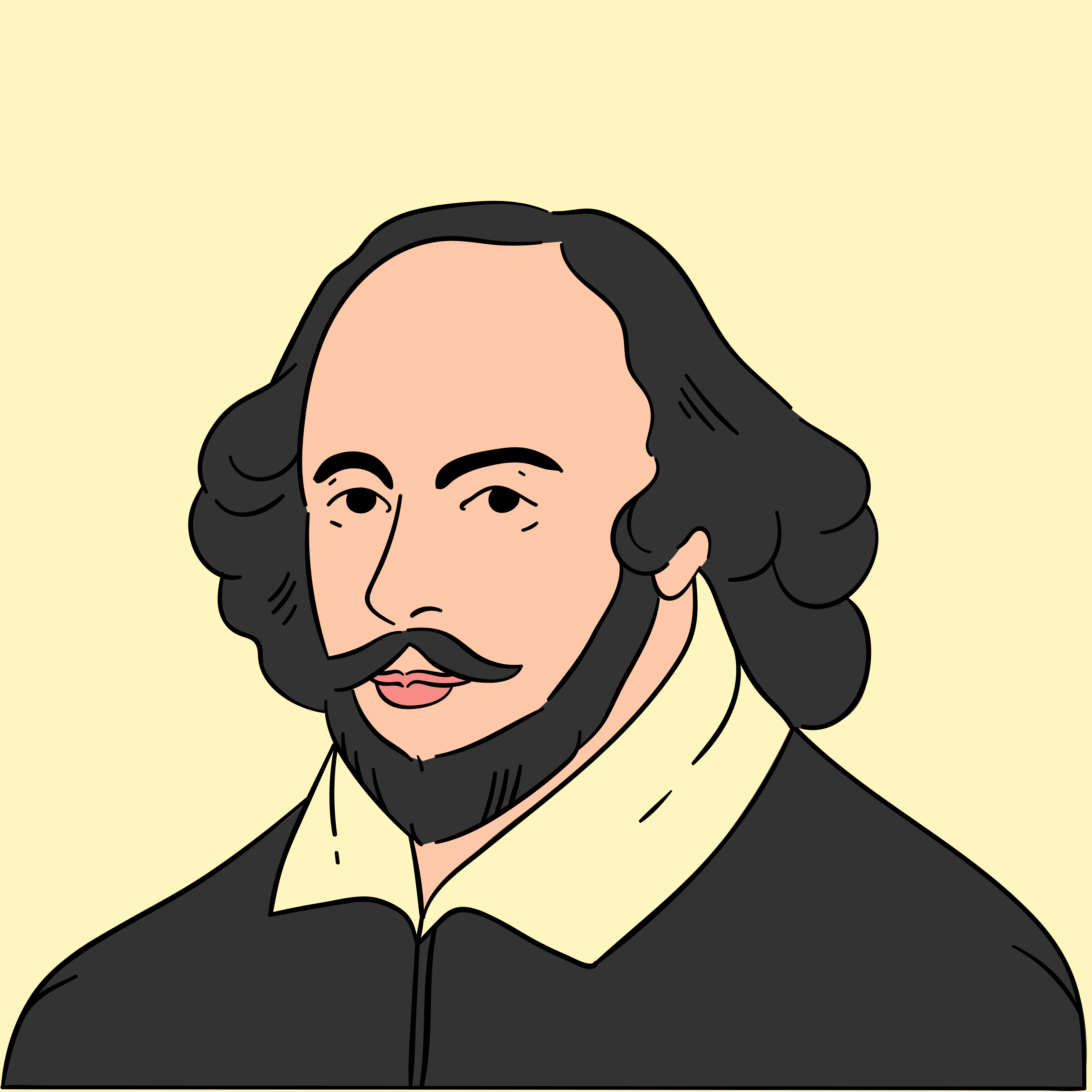
Centuries later, William Shakespeare and his works remain prominent influences of English literature in classrooms worldwide, beginning in grade 10 in Canada. Almost anywhere you go, students study Romeo & Juliet, Hamlet, and McBeth, analyzing and interpreting the plays, making this ritual ever evolving and allowing new ideas to emerge with every turn of a page and turn of a decade.
Across Shakespeare’s works, human beings are repeatedly shown as creators of systems- political, social, and moral- that attempt to impose order on an unstable world. In Romeo & Juliet (the one I’ve had on the mind these past few months), these systems seem to collapse under the weight of human contradiction, suggesting that what is understood as “fate” may instead be the result of structures humans themselves construct and then misinterpret.
Being human means struggling in the middle of imposed order and inherent chaos, where hierarchy is used to satisfy humanity’s need for structure. We are constantly being disproved and confused by the disorder within these complex networks, and the fallout is interpreted as divine fate.
In Romeo & Juliet, Shakespeare presents humans as inherently unstable, driven by conflicting desires for freedom and order. Hierarchy is shown as a structure we create to control the unpredictability of their own nature, often disguising these systems as divine or natural law. The Great Chain of Being reinforces this idea by presenting social order as something decreed by God, where power and status descend through carefully maintained levels of authority and importance. However, Shakespeare repeatedly suggests that these systems are fragile because they depend on flawed human behavior to sustain them, questioning their legitimacy when they are so easily manipulated and abandoned.
To further that idea, I believe the masquerade scene and the attire accordingly worn symbolize the socially constructed identities enforced through hierarchy. At a certain point, the masks will no longer fit correctly, reflecting the instability of imposed roles when human individuality begins to resist them. Romeo and Juliet’s decision to love each other anyways is an act of personal choice rather than submission to predetermined fate, suggesting that human action, not divine order, shapes the course of events.
Once this moment of disruption occurs, the social order collapses into conflict. Shakespeare does not fully endorse either chaos or control; instead, he questions whether fate truly governs human life at all. Authority itself is performative, maintained through the suppression of humanity’s inherently uncertain and contradictory nature. Beneath systems of hierarchy and order, Shakespeare suggests that all people remain unstable, questioning individuals attempting to impose meaning upon disorder.