

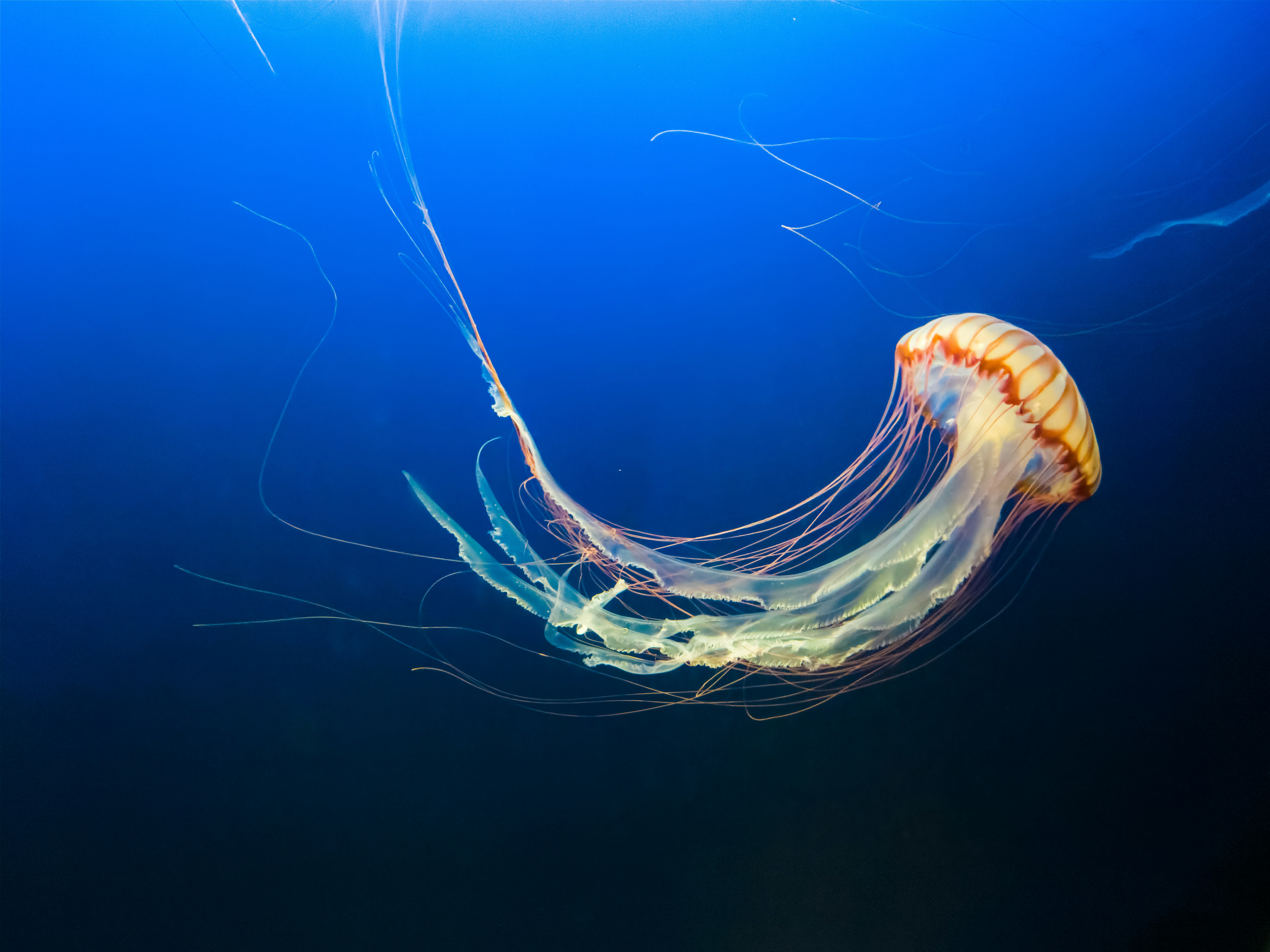
There’s a creature smaller than your pinky nail that can live forever. It’s not a vampire or science fiction. It’s a transparent jellyfish called Turritopsis dohrnii, and scientists are still trying to figure out how it keeps cheating death (1).
Meet Earth’s Only Officially Immortal Animal
Most jellyfish live for a few months. They grow from larva to polyp to adult medusa, then die. Simple, right? Not for Turritopsis dohrnii. When this tiny jellyfish, about 5 millimeters across, gets injured, stressed, or starts starving, it doesn’t accept death (3). Instead, it hits the ultimate reset button (2).
The “immortal jellyfish” was first described in 1883, but its incredible life cycle wasn’t discovered until 1992 (2). Since then, it has been found in oceans worldwide, likely hitching rides in ship ballast tanks (1).
How a Jellyfish Hits the Reset Button
A normal jellyfish moves forward through its life stages. Turritopsis dohrnii can go backwards. When its adult form is damaged, stressed, or just old, it transforms back into a polyp, defined as the juvenile, bottom-dwelling stage, and starts its life over again (2).
The process takes about three days. The jellyfish settles on the ocean floor, its tentacles and mouth disappear, and polyp features emerge. The result is a brand-new polyp colony, genetically identical but biologically young again (2).
This isn’t reproduction, but instead personal time travel. A butterfly turning back into a caterpillar (3). And this species can do it repeatedly, theoretically forever (1, 4).
The Secret Ingredient: Transdifferentiation
How does a jellyfish reverse its own life? The answer lies in transdifferentiation (1). In most animals, cells have fixed roles. A skin cell stays a skin cell. But in Turritopsis dohrnii, cells can change their identity entirely (2).
During reversal, specialized cells from the jellyfish’s body transform into completely different cell types needed for a polyp (2). Researchers have identified several key genes involved, including SIRT3, which is a gene linked to human longevity that spikes during the jellyfish’s transformation (2). The same genes that help this tiny creature cheat death are also found in humans (2).
The Catch (Immortal Doesn’t Mean Invincible)
Before you get too excited, here’s the reality. “Biologically immortal” doesn’t mean “cannot die.” It solely boils down to “does not die of old age.”
In the wild, most Turritopsis dohrnii still get eaten, diseased, or damaged long before they ever revert (1, 5). Thus, the oceans aren’t filling up with immortal jellyfish clones. They’re still tiny, still vulnerable, and still part of the food chain.
What This Means for Human Science
However, scientists aren’t studying the immortal jellyfish just for fun. They want to understand whether the lessons of transdifferentiation could apply to humans (1, 7).
Turritopsis dohrnii has become an important model for aging and regeneration research (4). Its genome has been fully sequenced, revealing over 23,000 genes (4). Researchers have identified genetic networks involved in DNA repair and stress response that are highly active during the jellyfish’s reverse development (2, 6).
Imagine if we could activate similar processes in damaged human tissues. A heart attack destroys heart muscle. What if those cells could be reprogrammed into new, healthy cells? A spinal cord injury severs nerves. What if we could induce transdifferentiation to repair them?
We’re not there yet. The evolutionary distance between jellyfish and humans is vast (7). But the immortal jellyfish offers something invaluable: proof that nature has already solved the puzzle of cellular rejuvenation. Now, we just need to learn its secrets.
What Comes Next
The immortal jellyfish won’t make us immortal. But it might help us live longer, healthier lives by revealing how cells can be reprogrammed and renewed. It’s a reminder that extraordinary discoveries often come in the smallest, most unexpected packages.
Next time you’re near the ocean, take a moment. Somewhere out there, a creature the size of your fingernail is quietly rewriting the rules of life, death, and everything in between.
Sources
[1] “Turritopsis dohrnii (Weismann, 1883)” – GBIF (Global Biodiversity Information Facility)
https://www.gbif.org/species/165761467
[2] “The genetic networks of regeneration, cell plasticity, and longevity of the Immortal Jellyfish Turritopsis dohrnii (Cnidaria, Hydrozoa)” – bioRxiv, 2025
https://www.biorxiv.org/content/10.1101/2025.07.02.660568v1.full
[3] “Science with Dr Karl: Immortal Jellyfish!” – National Geographic Kids, 2016
https://www.natgeokids.com/ie/discover/science/nature/drkarl/
[4] “Genome assembly and transcriptomic analyses of the repeatedly rejuvenating jellyfish Turritopsis dohrnii” – PubMed (NIH), 2023
https://pubmed.ncbi.nlm.nih.gov/36519838/
[5] “Meet the immortal animals that never die” – BBC Wildlife Magazine, 2025
https://www.discoverwildlife.com/animal-facts/insects-invertebrates/is-it-really-true-that-some-animals-live-forever
[6] “Cellular Reprogramming and Immortality: Expression Profiling Reveals Putative Genes Involved in Turritopsis dohrnii’s Life Cycle Reversal” – Genome Biology and Evolution, 2021
https://www.ebi.ac.uk/biostudies/studies/S-EPMC8480191
[7] “Translating lessons from immortal models: Hydra and the immortal jellyfish” – Elsevier, 2025
https://www.elsevier.es/es-revista-revista-espanola-geriatria-gerontologia-124-articulo-translating-lessons-from-immortal-models-S0211139X25000046