Home Blog Page 99

Not Everything is Yellow

I was racing with the wind down the damp, grassy hill with bare feet. 

Friends followed behind me desperately, trying to catch their breath. 

Our hair flew behind us carelessly through the summer breeze.

I felt like a dandelion flying through a white orchid field.

The new ideas of fun entered our brains like lightbulbs.

As long as I saw smiles, everything was fine. 

The only gray cloud I saw was the thought of one of my friends throwing a water balloon at me. 


I could once go on the upside-down roller coaster with not a drop of cold sweat on my back. 

I was happily, reckless.

I always continued on the optimistic train of life and never headed back to the station to see if I took the wrong train.

It was only my thoughts acting as the soloists in my head to guide my decisions. No one else’s voice was there back then. 


My mind was a soaring hummingbird flying across robin egg blue skies. 

It was like cool, turquoise water. 

My parents navigated me through the sea of choices where all I had to do was learn to see the good. 

They were the bulletproof glass shielding me from the dark, melancholy parts of the world.


Time was once longer. 


My ears were deaf to issues of society and only heard the melodious laughter and majors of music. 

Not a sound of a minor key or the cries of people’s pleads for help.

It was only me, my family, and friends in a round, yellow smiling Earth. Only me.


Everyone seemed to be at peace, I thought. 


The bookshelves in my mind were still empty with a lack of knowledge of my surroundings. 

Little did I know I had yet to see the gray side of the world. 

After all, not everything could stay yellow.


Now, the protection glass I had was shattering day by day. 

 I could now see the whole world. Weights were on my shoulders as I had to continue carrying a heavy backpack of thoughts.


Slowly, I gathered information to add to the once empty bookshelves in my head. 

The people’s needs for help seemed loud and clear, like a billboard sign with block letters.

The smiles now seemed as though they were hiding something beneath. 

My world was mixed with colours of red, pitch black, yellow, and white. 

The arms of the clock seemed to be moving faster and faster. 

Were the choices I was making alright now? 

It was not just me anymore in the world. 


Behind the Poem:

I wrote this free verse poem due to a feeling of nostalgia. This poem takes a shift from childhood joy to growing older to see that the world is not perfect, like the way it was once perceived as a kid. With age comes more responsibility as I am sure many have heard of that before. I have also noticed that time goes by faster now than it did ten years ago.  I also noticed that confidence slowly decreases as many grow older whereas a five-year-old’s confidence is bold. Based on my observations about life, I was able to contrast the worlds of growing up and childhood. I still reminisce about playing outside at the age of 6 and having an immense Disney obsession.  Writing this poem also helped me spill out my thoughts. As someone who overthinks, I find writing poetry helps clear the mind. I suggest for you people to write free verse poetry as well whenever you need to get rid of your thoughts and let them run wild!

 For feature image: https://www.pinterest.ca/pin/739645938781288937/ 

My Top 5 YA Book Recommendations

Over this past year, the pandemic has affected all of our lives greatly. While it did bring about some negative consequences, there is also a brighter outlook to this challenging year. For one, we have been given an abundance of time that is valuable in this fast-paced world. In my experience, I found that I often put my interests or happiness on the back-burner when it came to academics. However, this past year has allowed me to explore my existing interests and discover new ones. As a result, I have rekindled my love for reading and hope to share this wonderful pastime with you! Here is a list of my top 5 YA book recommendations!

Heartless by Marissa Meyer

This book is absolutely stunning, whimsical and heartbreaking! I like to think of it as sort of a prologue to the Queen of Hearts that gives this beloved antagonist a heart-wrenching backstory. It takes place in Wonderland and follows a naive, young girl named Catherine as she meets Jest, a handsome court jester. However, her future is uncertain as a monster called the Jabberwock attacks Wonderland. A fearless female protagonist, a beautiful romance, a dangerous threat, all surrounded by the whimsical world of Wonderland. What more could a reader ask for?? I cannot do this book justice, so go read it!

Spoiler-Free Review: Heartless – Odd Librarian Out

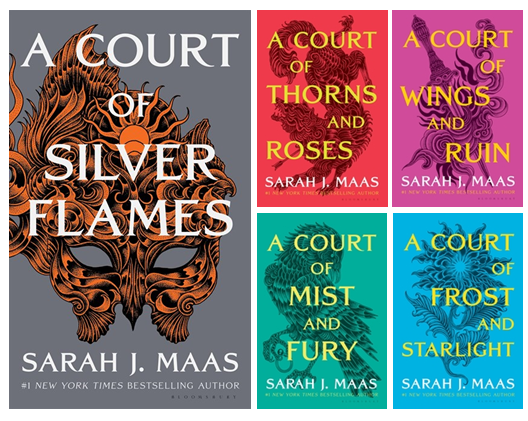
A Court of Thorns and Roses by Sarah J. Maas

Also abbreviated to ACOTAR, this series is full of plot twists, romance and a world divided between humans and fae. The books follow a courageous, yet stubborn human girl as she is taken by the faeries as punishment for killing one. However, the world is dangerous and it is up to her to save it. A heroic character, a fiery romance and a great plot, one of my favorite series! Warning though, it does contain some explicit content.

Author Spotlight: Sarah J. Maas (1/12/21) | Macmillan Library

Six of Crows by Leigh Bardugo

This fantasy, young adult series is set in Ketterdam, a place full of merchants, tourists and of course, gangs. These books are based on Kaz, a cunning thief and his talented crew as they pull of an (almost) impossible heist. To raise the stakes higher, their success will decide the future of their world and more importantly, whether or not they get a large sum of money. Told through several perspectives, this action-packed story is a page-turner and definitely worth a read!

Six of Crows Duology (Paperback) by Leigh Bardugo in 2021 | Crow books, Six of crows, Book series covers

Caraval by Stephanie Garber

This trilogy is amazing! This fantasy, romance series is about two sisters, a magical show that allows the audience to participate and a mystery that threatens everything our characters hold dear. These book feature daring characters, a beautiful world full of magic and a captivating plot. Highly recommend this one!

Caraval Series by Stephanie Garber {Series Review} – A Writer Can Dream

The Sun is Also A Star by Nicola Yoon

This contemporary, romance is a heart-warming story that made me extremely emotional. The Sun is Also a Star takes place over one day in New York City and focuses on the short, yet beautiful love story of two individuals. However, their story is told in conjunction with the lives and experiences of the people they interact with throughout this day. By doing so, the author truly shows the drastic impact that a small, meaningless interaction can have on the course of someone’s life. I cried on several occasions of this novel and it is truly one of the best, SO GO READ IT!!

The Sun Is Also a Star by Nicola Yoon


That’s it! Those are the top 5 YA books that must be on your TBR list! I hope that you read at least one of these books and love them as much as I did. I also love ranting about books so feel free to share your opinions about any of these and let me know what you thought! You can connect with me through my email, which is: shraavni.patankar@gmail.com!

Featured Image: 1

Image Sources: 1/2/3/4/5


Alberta’s Decentralized and Devastating COVID Policies

0

As Canada enters yet another wave of the pandemic, most provincial governments have reacted with a wide range of measures. Unfortunately, Alberta is the exception here. Instead of enacting strict measures, officials told citizens to “just behave, and everything will be fine”. Other than  going back to Step 1 of the transition plan and implementing minimal restrictions, our government has done nothing to “stop the spike”. In using this hands-off approach, the government has shifted responsibility to local authorities, creating disparity and chaos in the province.

The government has shifted responsibility to local authorities, creating disparity and chaos in the province.

Mask On, Mask Off

Right now, Alberta is the only province in Canada without a mask mandate because of this decentralized approach. While other Canadian provinces announced mandatory mask laws in the fall of 2020, Alberta sat on its hands and only “encouraged” citizens to wear masks. Left without direction, local municipalities took responsibility by passing mask bylaws. Calgary announced that masks would be mandatory last November, and Edmonton did this as well, around the same time. Although people are masked up and protected in Alberta’s big cities, the lack of a provincewide mask mandate has put many Albertans at risk.

By refusing to take responsibility for the whole province, Alberta’s government is creating a disparity between citizens in different conditions. In zones with mask mandates, most people are safe. However, significant outbreaks have erupted in zones without mask laws. Fort McMurray is one of the most severe COVID-hit zones in the province, because workers in the surrounding oil fields and work camps are not protected by masks. In these rural work zones, some workers refuse to wear masks, and as a result, these workers contract and spread the virus. The virus affects their close contacts in cities, forming a “hotspot”. Provincewide action could have easily prevented this from happening, but the government decided to do nothing.

In zones with mask mandates, most people are safe. However, significant outbreaks have erupted in zones without mask laws.

A Tale of Two Exam Seasons

A similar problem is happening with schools as the third wave rages on and the provincial government dithers. Officials insist that the province has a “robust plan” to keep students safe, and refuse to close schools. However, in-school transmissions and staffing shortages hit Calgary and Edmonton school boards hard, and these boards moved grades 7-12 online in order to curb the spread of COVID and recover from teacher shortages.

Each school board has decided to deal with the online transition in a different way. While it’s important for each board to address its issues uniquely, this creates disruptions to Alberta’s May 2021 IB exams (held from April 29 to May 20 this year).

Because of the pandemic, the IB organization announced that it will cancel exams in regions where students cannot go to school in person on exam dates. This is where the different approaches from school boards comes in. In Calgary, the CBE stated that students could not attend in-person school on April 29 and 30. As a result, the board cancelled IB exams on those dates. However, in Edmonton and rural Alberta, school boards insist that students can take the exams in person if they are spaced out enough. Students in these regions still need to take exams, even with inadequate online revision and skyrocketing cases.

The provincial government could have shut down all in-person learning and cancelled exams province-wide. But it failed to take action, and as a result, some students can stay safe at home with reduced pressure while other students are forced to take challenging exams in the midst of the third wave.

Lack of Action? Divided Province.

These are only a few examples of how the government has failed to act and devastated the province. Different regions address the pandemic in different ways, giving some regions an unfair advantage over others. Whether it’s wearing masks, or going to school, or going about any other part of life, Alberta’s decentralized action during the pandemic will only result in disaster.

Whether it’s wearing masks, or going to school, or going about any other part of life, Alberta’s decentralized action during the pandemic will only result in disaster.

All information sources are either from my own experience, or embedded as hyperlinks in the article.

Featured Image

Reducing Food Waste and Hunger in your Community


Around ⅓ of all food for human consumption is wasted yearly. This means that about 1.3 billion tones of food are wasted each year. To put these numbers into context, this amount of food could feed about 3 billion people every year and about 2 billion people on the planet struggle to eat safely. Although many of us are aware of the issue that seems ageless, we are still overlooking world hunger. It’s not enough for us to acknowledge these issues because doing so can only take us so far. We need to play our part to support each other because everyone deserves to go to bed with a full stomach. This is why I wanted to share some simple ways you can reduce your food waste and help others struggling with safe food access.

1. Freeze Food

Instead of simply throwing away your produce when it becomes mushy, try freezing it when you feel like it’s about to go bad. Similarly to most of GenZ, I love avocado toast but I often run into the problem where all my avocados become perfectly ripe at the same time. I can’t eat all of them at once so the second my avocados become ripe (or even slightly under ripened) I put the ones I don’t eat into the freezer. I do this for a lot of my produce and it’s great because, all I have to do is pull one out of the freezer and let it thaw, then I’m good to go! If you’d like, you can even blend your produce to make a smoothie. You can freeze virtually any type of produce and although the food may not taste as good as the day you froze them, it’s better than them going to waste. 

2. Stop buying so much!

I think this point is pretty self explanatory, but I still wanted to discuss it. When you are buying groceries, try to buy items in portions that are realistic. Often when we buy in bulk, lots of that food can end up going to waste. Although it seems like you are saving money when buying in bulk, you are actually losing money from the wasted food. It’s ok to buy in bulk sometimes because it can be more practical but be aware of the food you are buying and ask yourself, “Is it really worth it to buy this much of one item?”

3. “Don’t toss that!”

Stop throwing away your fruits and vegetables that turned brown! This doesn’t always mean they are bad. Fruits oxidize and that’s normal. If there are some spots on your produce that seem unusually dark or wrinkly, do your best to cut off only the bad parts and salvage the rest of the fruit. Obviously if a food is dark brown and smells, don’t eat it, but try to keep in mind that oxidation common. If this really bothers you though, you can use lemon juice (or any acidic juice) to coat your fruit which will keep it looking fresh for longer. 

4. Free Rice

I’ve been playing a game called Free Rice for a while and I absolutely love it!  You answer questions from a variety of categories with different difficulty levels. You can answer a variety of questions from Spanish vocabulary to math problems. The apps allows you to generate money that goes to the World Food Program (WFP). Now you may be wondering how this works. Well, each time you get a question right, an ad pops up and generates money. The money is sent to the WFP and works towards helping those who don’t have access to enough safe food or drinkable water. You can easily download the app on your mobile device or play it on your computer. So, instead of scrolling on TikTok in an attempt to relieve your boredom, try playing Free Rice! 


You can play and find more information about how free rice works here: https://freerice.com/about. You can play Free Rice here: https://freerice.com/. If you want to learn a little more about the WFP, you can go here: https://www.wfp.org/support-us/voices/get-know-world-food-programme?utm_source=freerice&utm_medium=eye-catcher-banner&utm_campaign=wfp_nobel. 

5. Volunteering

Lastly, I wanted to give you a method that directly impacts our community, specifically for Calgarians in need. Although Calgary’s homeless population isn’t as high as other cities in Canada, homelessness is still a significant issue that needs to be addressed. Now you may be wondering, how does this relate to food? Well, less fortunate people are often lacking necessary nutrition in their diets too keep them healthy. This can lead to illness later on in life. Luckily, many organizations, that require volunteers, are directed towards helping those who have difficult access to safe foods. 


Here are a few organizations based in Calgary heavily focused on helping less fortunate people obtain safe food :


The Calgary Food bank

Website: https://www.calgaryfoodbank.com/


The Salvation Army

Website: https://salvationarmy.ca/


The Mustard Seed:

Website: https://theseed.ca/


I hope these tips and tricks were helpful! Although this may seem trivial, by utilizing these small methods, you are playing your role in fighting world hunger.


Sites used:

1/ 2345

Alberta’s New Curriculum Doesn’t Want You to Think

0

Draw a path from B.C. to Saskatchewan using a map of Alberta. Learn about BCE and CE before learning how to read a clock. Admire Jason Kenney’s grandpa as the most influential jazz musician in all of Canada-these are some of the most glaring problems that educators found in the Alberta government’s draft K-6 curriculum. But this proposed curriculum change does not just involve logical failures. It doesn’t give any opportunities for students to develop critical thinking skills, use their reasoning, or form their own opinion. To put it plainly, the Alberta government is proposing to teach something that will stop children from thinking.

The Alberta government is proposing to teach something that will stop children from thinking.

Two Ways of Learning

There are two ways you can teach in a curriculum: based on knowledge, or based on skills. Knowledge involves the memorization of facts and information. When you learn that water freezes at zero degrees, or that Christmas is on December 25, you are engaging in knowledge-based learning. While it’s important to remember facts and absorb information, this type of learning falls short on analysis and reasoning. Students are not instructed to ask why a fact is true, or understand how a fact came to be the way it is. Because students don’t think critically when they are memorizing dry facts, they cannot form an opinion and make informed, justified decisions.

The other, more constructive type of learning, is skill-based. This type of learning asks you to dig deeper into information. It instructs you to state and justify your opinion, use the information to solve problems, or draw conclusions from the information. When students develop learning skills,  they interact with the information that they learn. They question and analyze the facts, coming to well-reasoned conclusions.

The New Curriculum’s Objectives

Now let’s look at the command terms from the new curriculum in English, Social Studies, Math and Science.

An overwhelming amount of the learning objectives want students to “identify”, “list”, “define”, or “label”. These command terms are all knowledge-based because they instruct students to point out a single fact, list out multiple facts, or apply facts in context. Only a few aspects of the curriculum ask students to think about what they are learning by “drawing conclusions”, “analyzing”, “arguing”, or “interpreting”. In other words, this curriculum is essentially asking: “Here’s some information, can you regurgitate it back?”  K-6 is an essential time for students to develop critical thinking skills, and the new curriculum offers no opportunities to teach these skills at all.

An overwhelming amount of the learning objectives want students to “identify”, “list”, “define”, or “label”. Only a few aspects ask students to think about what they are learning.

Five Terrifying Words: “I Don’t Want to Think”

John Locke once said: “Reading furnishes the mind only with materials of knowledge; it is thinking that makes what we read ours. When we start teaching this curriculum, students will start saying they don’t want to think. This phrase should not be coming out of any student’s mouth, but it might just be what the new curriculum results in.

Sources:1/2/3

Featured Image

The Little Occurrences of a Small Town Bard – A Poem

A little tavern off the side of the main street might prove inconspicuous 

And that’s true with the low grumblings at the tired hour of mid day


Soft layers of light filter through the half closed blinds

Onto a table held in a stagnant game of cards


You’d think the players were caught in stasis


At the table were two men, they joust their words

Until one places a card, flashing a prideful smile

And with a steep crescendo their voices rise

Then the inconspicuous tavern turns to a lively brawl 


And in the corner of this growing excitement

A smile curves on an even more inconspicuous figure

As she pulls out her lute and places a resonating chord


After all, what fun are clashes without a little accompaniment?


With a spirited melody, the bard dances along

Each footstep echoless but gracefully flowing


Matching the pace of the battling brawl

Until one stands triumphantly over the collapsed other


And so the bard ends her piece as the final punch connects

Among the distraction she pays her bill on the counter

Then quietly steps out of the tavern as to not deal with the mess inside

________________________________________

The next day, you might find that bard at the same tavern

Or maybe not, she lives a carefree, unorganized life


This midday she quietly sat in lull playing her flute

Halfway into an alley to avoid the busy marketplace

She didn’t notice the approaching armed and drunken man


And so the man called to her, unkindly requesting all of her money

But she was a bard, so she didn’t have any money


So she spun up an offer to buy the man a drink

And hopped to her feet with a slight grin


The bard walked down the road with alacrity

Leading the drunken man who stumbled behind inattentively 

Straight into the sheriff’s office, knife still in hand

________________________________________

The main street held a fountain near the middle

The bard sat there only sometimes

And today was one of those sometimes


Seeing the busy street in front, She pulled out her lute

And played the songs of her people


Passerby’s would often stand by the side to watch

Sometimes they tossed coins into her upturned hat in front

Having a crowd riled her motivations

And so she strum and sang at her best until the sun began to set


After the performance she sat slumped against the bench

Eyes resting in an easy torpor


Until 2 children came running up 

Their faces excited, and eyes glowing with the light of the setting sun


“Could you play another?” they gleefully asked.


The inconspicuous bard then let out a soft groan

With her face upturned to the vibrant sky

Then she cast a sweet smile at the children

And played her lute again


Featured Image Link

“I Never Said She Stole My Wallet” and What Makes Us Human

Sometimes I could swear that my cat is a human trapped in an animal’s body. She loves to cause mischief; she drinks water nearly exclusively out of (explicitly human) glasses that we accidentally leave lying around. And when she knows she’s in trouble, she looks at me with those glassy feline eyes and I find myself wondering: What’s the difference between my cat and me, really?

I recently undertook a Coursera entitled Miracles of Human Language: An Introduction to Linguistics, and the very first topic was an effort to address this question. When your cat is outside your bedroom door at three AM, scratching and meowing to be let in, she’s demonstrating intelligence and communicative faculties. She knows exactly what to do to communicate a certain desire and elicit a certain response.

Sometimes, animals demonstrate an uncanny resemblance in their behaviour to humans. But to the best of our current knowledge, there are actually some key differences marking the cognitive disparities between humans and other animals. The most common area where these differences manifest? Language. As it turns out, there are three main “dimensions” of difference separating human language and animal forms of communication.

1. Displacement

This one is pretty straightforward. In order to understand it, all you have to do is ask yourself a few questions:

What’s for dinner tomorrow?

When you picture the future, do you see jetpacks or hoverboards?

Would you rather fight 100 chicken-sized zombies or 10 zombie-sized chickens?

Now, ask yourself whether your cat would be able to a) ask this question of another cat and b) receive a coherent answer in return.

Well, maybe. But all of the evidence we have points to the contrary.

Human language can express displacement, which refers to our ability to communicate about things that aren’t happening right this very moment. That could mean something happening elsewhere in time, elsewhere in space, or not at all. Which is to say, displacement refers to the human imagination—the ability to grasp the abstract and the hypothetical. Without displacement, watching TV or reading books wouldn’t really be much fun. You’d never be able to follow the story.

2. Joint Attention

Joint attention is defined as the ability to collaborate by anticipating the consciousnesses of others.

That group project you’re working on for online school? That requires joint attention. You have to keep up communication with your group members and consider their thoughts when making decisions about what Slidesgo template to use for your powerpoint, which semi-relevant chemistry meme to stick on the “Thank you” slide, and who gets to read out the title slide and byline in an overly dramatic P.T. Barnum voice when it comes time to present.

Language allows humans to collaborate on a massive global scale. Government requires joint attention. International organizations like the UN, the EU, or the WHO? Also require joint attention. And thanks to the internet, humans are pushing the boundaries of what it means to collaborate.

On the other hand, animals lack this ability. Sure, wolf packs work together to take down prey and in fact lots of animals manage to form some semblance of a society out in the wild, but you’ll never see any number of omega wolves from different packs unionizing to demand rights and fair pay.

3. Discrete Infinity

“I never said she stole my wallet.” Maybe you’ve seen this sentence before, floating around the interwebs or tossed about as a conversation starter. You can read the sentence in seven different ways by switching out the word you emphasize. Each way of reading the sentence yields a different implication; this is one aspect of discrete infinity.

Language is a discrete entity; there are a finite number of symbols in any alphabet, for example. There’s no such thing as 3% of the letter ‘a’—or at least, you also can’t intuitively pick up on what 3% of the letter ‘a’ means or sounds like, because the alphabet is discrete and not continuous. But in the case of human language, these symbols can be arranged in an infinite number of ways to convey an infinite number of contexts. That’s discrete infinity, something which animal communication styles lack. Animals have a finite number of symbols and a finite number of goals to express with those symbols. Conversely, humans are limited only by their imaginations.

In conclusion, there’s actually a lot that separates us from our furry/scaly friends. Studying language helps demonstrate this. But that’s not to say that animals don’t communicate! They do, and often loudly (my cat is a testament to this). And even if they can’t comprehend ideas like love or hatred or any piece of fiction ever, they still have the capacity to love you (my cat… well, we’re working on it). Make sure you show them lots of love in return!

Featured Image

Puppy Love- Creative Writing

0

Dear Lover,

Some people say that the universe creates things in perfect synchrony, the same reason many people believe in religion, what is the possibility that I fell for and met the perfect person for me. What are the odds they actually exist? Everything in the world sits like a huge puzzle, just yearning to be put back together. To be found. Everyone has a puzzle piece they fit perfectly with. Someone they see themselves in. They say you only feel this way once in your life, and you zing. If you don’t cherish and take care of that zing, then what’s the use of life? Every person has a puzzle piece, they spend decades upon decades harping on broken relationships, trying to search. Trying to find their other half. I’ve done something many people spend their whole lives in pursuit of. 


The pursuit of a mystery is truly a courageous one, because at the end of the day, you don’t know what you’re looking for. You never fail, but most times, you don’t find the thing that every soul contemplates their entire existence over. The concept of a twin flame has been around for a while, whether that be platonic, or romantic. The concept of a soulmate has been around forever. People dream of one day finding that perfect person, the one who finishes their sentences, but doesn’t leave them to die of an accidental frozen heart at the hands of their sister.


Instead, many people strive for the bare minimum, someone they can tolerate for the rest of their life. This may not be the person perfect for you, which is why divorce rates are so high. People enter lifelong commitments before knowing the person, and it eventually ends in failure. To avoid becoming a statistic, you must imply the notion of a theory that many philosophers have studied before. The theory of a soulmate in the modern world. The theory states that in order to find your twin flame, the person you could comfortably spend the rest of your life with, you must first find a person willing to change. A person who is willing to admit their flaws without using them to manipulate sympathy. A person who can admit their flaws is a more perfect person then the ones who actively choose to portray themselves as perfect. Eventually, that “perfect” persona falls, and when you cannot come to terms with yourself, you are left with a shell of a person who doesn’t understand how to be themselves, and doesn’t understand how to love themselves. You have the “perfect” person turn into nothing more than a pile of shards. Never touch broken glass.


The person who is willing to change is then moldable, but first you must understand the fact that changing and becoming the perfect person for someone is a multiple person activity. You must be willing to change for them. This is where the meat of the theory comes in. That soulmates are created and not found, because intrinsically, trying to find the absolute perfect person for yourself is impossible because everyone lives such a different life. Out of 7 billion people, you will never find your soulmate. Which is why you must create a healthy relationship in which you can foster your own twin flame. A relationship in which you are both willing to become the best versions of yourself for the achievement of a higher outcome. Instead of having stubborn opinions on everything, you must be able to be fluid. 


Of course, you must first find a person you see yourself in. A person whose character is similar to yours in a way that’s complimentary instead of contradictory. And ultimately there is where you will find your own soulmate. They say that the concept of everyone having a perfect fit puzzle piece is completely correct, but I disagree. In order to find your own perfect puzzle piece, you must both be willing to change shapes, instead of just having one person mold to fit the bounds of the other piece, or jamming pieces that don’t fit together into a synchrony, knowing they won’t fit, but still attempting it, for the good of no-one, and instead you operate under the guise of actually making an impact.


Zinging doesn’t happen often, and this may just be my puppy love, but I am completely confident in saying that puzzle pieces must mold to fit each other, which is why I’ve done the seemingly impossible. So many people spend their entire life trying to fit themselves to the perfect person narrative, they spend their entire life in pursuit of love, instead of happiness, and not realizing those two terms are not interchangeable. You must first find love in happiness, not happiness in love, because at the end of the day, you must be willing to accept that love is never a universal answer. Millions of people ache for their soulmate, and I’ve done the impossible. I’ve found my puzzle piece.


With devotion,

Knight.

Free Rice: An Initiative to Combat World Hunger

Hey y’all, first of all, I hope you had a restful and well-deserved spring break. Today I’ll be sharing a wonder I discovered through school quite a few years ago.

Well, what is it?

The website, “Free Rice” is an initiative led by the United Nations’ World Food Programme; they aim to support calls for need and assist in building a prosperable future for underprivileged individuals.

So what do I do?

Great question! Head on to the website. Now you have an option of creating account (which is optional), or you can play without one. Essentially, by correctly answering a multiple-choice vocabulary question, the UN will donate ten grains of rice to help feed the hungry (however due to budget costs from COVID, they had to reduce it to five grains of rice – not to worry, it will pick up back again once they have the funds). As of April 2021 they have a lifetime count of over 202 billion donations of rice. The best part is, that there’s no limit to how many questions you may answer in a day. So why not take this opportunity to brush up on your vocabulary while supporting a great cause?

What’s so special?

  1. The World Food Programme has also won the 2020 Nobel Peace Prize, and is the most prominent organization who fights for hunger.
  2. You may alternatively use this software as an app on your IOS or Android devices.
  3. They also have a feature called “Categories” in which you can choose the subject you want the questions to come from, so yes, it’s not only limited to vocabulary. Currently, you have the options from, Ancient Rome to Famous Paintings, to Chemical Symbols, and everything in between.
  4. There’s a setting for difficulty level as well!
  5. There are challenges that they continually post throughout the year that you may join.
  6. You can make groups (if you sign in)
  7. There are leaderboards (for individual players and groups)

I hope you guys check it out and share this article with others if you believe they’d be interested. As always, feel free to reach out to me with any comments, concerns, or questions at ranyabajaj1@gmail.com. Peace out.

Sources: [1] & [2]

5 of my Favorite Self-Help Books 

Once again, most of the Calgary student population is back to online school. I usually lose a lot of motivation at home, and it is very easy to feel down about yourself. That is why I want to share some of my favorite self-help books that I have, currently am, or want to read in the future, in order to help you feel a little bit better during this time!

Napoleon Hill’s Keys to Positive Thinking    

Published by Michael J. Ritt, Jr. 

Although the author, Napoleon Hill, died quite a while ago, Micheal J. Ritt, Jr. published his 10 steps to achieve health, wealth and success. The main focus of this book is PMA, or positive mental attitude, and what it can do for you. I like to read one of these 10 steps whenever I feel down, to remind myself to look at the brighter side of things. 


The Power of Now

By Eckhart Tolle

This book focuses a lot on how to fully live in the present, and how to get rid of bad feelings such as anxiety and regret. The author published this when he found out how to do these things after being in a very dark place in his life. He says that the answer is in the “I”, and stresses greatly the power of our own thoughts. These lessons are good to read when you have lots of negativity in your life, because it teaches you how to regain control over your thoughts through recognition and observation. 


Extreme Ownership: How U.S. Navy Seals Lead and Win 

By Jocko Willink and Leif Babin

Extreme Ownership teaches readers the lessons that two US Navy SEAL officers obtained during their service in the Iraq war. It talks a lot about leadership and how to apply that not only to business but to everyday life. This is one I’ve heard many good reviews about, although I haven’t personally read it, but I definitely want to. 


The 7 Habits of Highly Effective People 

By Stephen Covey 

This novel obviously talks about the 7 habits someone should adopt to become effective in whatever they are trying to achieve, but it also recognizes that this is not as easy as it might seem. It says that a person must go through a paradigm shift, which is a change in how we see ourselves and the world around us, in order to become highly effective. It is a very good book to read if you believe there is always room to change and grow. 


Who Will Cry When You Die? 

By Robin Sharma 

This book is part of the series Life Lessons From the Monk Who Sold His Ferrari, and it teaches people how to overcome the challenges of everyday life. For most of these self help books I tried to choose ones where religion isn’t the main aspect, but I think this book was very much worth mentioning. It dives more into the spiritual realm of discovering yourself, so it applies to anyone that is willing to be open-minded. It is divided into over 100 short chapters on different kinds of problems, so it is nice to read new a lesson everyday. 


If you click on the title of each book it will direct you to the Amazon page where you can purchase it, but there are also many other places where these novels are available. I do hope you check some of them out since they are definitely good reads. Plus, there are many previews available if you are uncertain about one.

Featured Image

How to be a better ally

Its been a year since the original BLM protests and now with the Stop Asian Hate movement, it seems that this is the time we have to be standing in solidarity with our friends from minority groups. Since last May people have been calling out to people the reeducate themselves on the social issues surrounding these groups and work together to help combat racism. But what might that actually look like? How do we be a part of the movement without overshadowing and taking all the glory from those most affected?

In response to the current events going on around the world, I have created a guide highlighting how to be a better service to the movements, on how to be a better ally.

1- Understand your privilege

First of all, what is a privilege and how do I know I have it?  Privilege refers to social advantages, benefits, or degrees of prestige and respect that a person enjoys as a result of belonging to specific social classes. For example, as an able-bodied person, I am able to enter any building without having the fear of it being inaccessible for me to enter. I don’t even have to question if a building is able to cater to my needs because most buildings are designed in the likeness of able-bodied people. Therefore before an individual can stand and combat for the rights of others they must look at themselves and seek to understand the privilege that they hold and others don’t.

Having privilege does not mean you are rich, have had everything handed to you, or you have never had to struggle for anything in life. What it means is

2- Educate yourself

When you hear that a marginalized group is being marginalized, listen, and listen wholeheartedly. If you feel like your ignorant in some areas, feel free to ask questions and do a deep dive on Google to get really deep into the historical context.

Remember it’s not anyone’s responsibility to be your personal tutor on social issues, especially if you’re not paying them personal tutor money. There are plenty of resources that are already out there, of people who have shared their own stories and perspectives through books, news articles, and Instagram posts.

And be intentional about staying updated on current changes in the movement you are supporting. There are no cookie-cutter Black, Queer, Asian or Disabled experiences so constantly staying informed helps detach yourself from any implicit biases formed of that particular group’s experience.

3- Speak up, not over

As an ally, your goal should never aspire to be the spoke person for the movement but to bring awareness to it. Speaking out against prejudice is not the same as speaking on behalf of an oppressed community. Call people on their problematic actions, particularly when you’re in a position of privilege and have less fear of retaliation.

4- You have to put in the work

The term ally means “to unite or form a connection or relation between” which is a definition that defines an action. A person cannot simply claim to be an ally of a marginalized group they have to put in the effort and become an ally. It’s like saying ‘I’m a pilot’ yet have never flown an aircraft in my life there requires some action to it. This is why I push people to first become an ally in training before becoming a full-blown ally. Being an ally in training allows awareness and acknowledgment of the responsibilities of working in tandem with others.

In today’s society, activism has become the new norm. It is no longer okay to be not racist or not homophobic we must be anti-islamophobic and anti-ableist. In our efforts to do so we must remember to recognize our own privilege and ignorance while striving to do better and continue lifting marginalized voices working for change. 


For Want of an Airplane: A Memory

0

Several years ago, in an airport terminal, I sat in front of a wide, floor-to-ceiling window, waiting to board my flight. Outside, a murky fog had set in by that point in the evening, and for as far as I could see, the view was a dull mixture of greys—the concrete, the unsettlingly thick fog—broken only by eerie lights from planes and other vehicles on the tarmac.

But there was no airplane parked in front of the boarding gate, even though only half an hour remained until the “19:45” printed on my boarding pass. The staff at the gate, for some reason, had yet to announce anything, but by that point, I knew it was inevitable that the weather would delay the flight by at least an hour or so.

It seemed then that I would be stuck there for quite a while, deprived of anything interesting to keep me occupied, forced to keep looking up from my phone every few minutes, hoping—in vain—to see a plane pull up to the boarding gate so that I could finally be freed from my boredom and anxiety.

I recall that at one point, after I had just put away my phone to look into the distance, my mind began to wander into its own world, lulling me into an absent-minded stare.

In the background, the distant whirring of engines and clamour of voices echoed, but I suddenly heard nothing. I saw nothing. I lost touch with my senses as I delved into the world of my mind—a trance of sorts.

Imagination is a curious phenomenon. It is rarely the result of conscious thought. It’s more of a journey that the mind takes us on, which is outside of our control.

And so I imagined stepping on board the airplane, the environment that would surround me, with that strange smell that had greeted me before on previous flights. I would find my seat, 24F, right next to the window and ensconce myself securely into its cushions. Safety instructions. Seat belt and tray table. Taxi to the runway.

In my mind, the plane would take off with gentleness, effortlessly gliding through the sky—no turbulence or discomfort at all, just the sense of freedom from the restraints of gravity. I would look out the window at the now fogless city, with all its vibrant nighttime lights, saying goodbye, carrying with me the recollections of what I had experienced there. I would close my eyes and rest.

And in this vision, I would welcome the sense of anticipation for my arrival in Calgary, where I would once again become closely acquainted with my home and my bed. La fin. An idyllic conclusion to my journey.

Of course, this did not last. Without warning, some blurry object in my periphery jerked my mind awake and a dim reflection of myself appeared on the glass window.

I was still at the airport. Hundreds of other travelers surrounded me with their conversations and movements. The future I had pictured, without the constraints of the delays, discomfort, and troubles of the real world evaporated.

The reflection on the window was but a reminder of the world to which I belong—a world to which I was obliged to return from my mind’s wanderings.

And reality did inevitably return.

But on that gloomy day, while waiting for an airplane to arrive to take me home, I also resolved to never forget the moment of freedom for my mind, lest I lose sight of imagination.

Featured Image

Ways to Give Back During a Pandemic

Throughout the past year, many of us have faced hardships. But, throughout this time, our community has also grown closer together and we’ve found ways to support one another. To bring to light some ways that you can also show appreciation, check out this list of ways that you can support your friends, parents, teachers, and others in your community in this tough time.

Friends

  1. Find time to hang out virtually
  2. Ask them how they feel and actively listen
  3. Check-in with them every week
  4. Send them a cute card or letter
  5. Deliver food
  6. Compliment them!
  7. Send a gift or gift card
  8. Watch a movie or TV Show together
  9. Cook or bake together
  10. Play a virtual game with them

Family

  1. Active listening – Asking a family member about their day or how they feel might mean the world to them
  2. Make them a meal or snack
  3. Help with chores or cleaning
  4. Spend time with them
  5. Bake with them

Community

  1. Make donations
    1. Food
    2. Personal Protective Equipment (PPE)
    3. Pandemic Supplies
    4. Computers/Technology
    5. Clothing
  2. Donate Blood
  3. Be creative
    1. Put Artwork on your window
    2. Hand-sew or embroider masks
    3. Virtual Fitness Classes
    4. Use your skills!
  4. Use services like Health Hero Hotline (877.226.HERO) to show your appreciation to health care workers
  5. Make cards for those in Old age homes
  6. Practice Social Distancing – keep yourself and others safe


Image Source: https://consent.yahoo.com/v2/collectConsent?sessionId=2_cc-session_59263b5d-a6bb-4bef-9d83-c7e2381d1462

Extraterrestrial Pollution

When one thinks of pollution, water, air, and soil are typically the only categories that come to mind. However, one often overlooked type of pollution is the contamination of space. Though we do not feel it, we utterly depend on space in today’s modern-day and age, and the neglected buildup of space garbage may quickly become a serious problem.


Every time a missile is set off as an experiment into space, it creates thousands of pieces of debris. Whenever a rocket is launched, its empty fuel tanks remain in low earth orbit. This waste is an urgent problem because space debris is very numerous and travels at incredibly fast speeds, which can destroy the satellites that provide essential services, seriously affecting our society’s capacities.


Currently, in space, there are 2,600 broken satellites, 10,000 pieces of garbage larger than a television, 20,000 pieces the size of an orange, 500,000 pieces the size of a grape, and 100,000 000 pieces too tiny to be tracked in low Earth orbit regularly. The featured image (from NASA) provides a visualization of the sheer amount of debris in Low Earth Orbit. With more and more satellites, missiles, and rockets launched each year, scientists estimate that these numbers will increase tenfold in ten years. Each piece, no matter how large or small, travels at a speed of approximately 30,000 kilometres per hour. As a result, each piece is capable of inflicting serious damage to our satellites and space stations—even a piece the size of a marble can punch a hole directly through solid metal!


Fortunately, space pollution is gradually gaining the recognition it deserves, as Canadian astronaut Chris Hadfield was interviewed about the issue. He mentioned that, if he remains silent on the International Space Station, he can begin to hear collisions between small pieces of space debris and the station within minutes. But, the advanced technologies of the International Space Station only protect it from tiny pieces of debris. If the ISS encounters larger pieces, it is forced to move. However, the satellites that provide us services crucial to the modern world such as global communications, GPS signals, and weather data don’t even have this protection—and they’re all located in low Earth orbit.


3-4 satellites are destroyed each year, and the parts that cause this damage are typically only about 1cm in diameter. The number of destroyed satellites will only increase in the coming years. Imagine a world where we can’t check the weather, call our friends, or access the internet! With the ever-increasing amount of space debris, our atmosphere will also become a prison that we cannot escape. Just as plastic can remain on earth for hundreds of years, it can take hundreds of years for waste in space to fall back to earth. Dreams of exploring space, establishing a colony on the moon, and visiting Mars will be impossible.


Without satellites, scientific progress will also decrease drastically. We will not have any telescopes to observe the dangers in space, nor satellites that perform tasks such as thermal imaging and laser ranging. The age when we do not have access to space is approaching quickly, so we need to accelerate our current efforts. If possible, you should try your best to play your part to keep our Low Earth Orbit clean. Further, educate yourself with books and the internet, raise awareness on social media, and support the companies who are actively combatting space pollution. The future of space is in our hands!

Sources: 1/2

Image source: 1

How to Stay Productive and Focused during Online School

Many schools will be returning back to an online system… So why not make the best of this time and be as productive as possible?

Here are my top ways to stay productive and focused during online school:

1. Treat your classes as if you were doing them in-person

The biggest mistake an individual can make is not taking classes seriously. By keeping the mindset that you would in normal school, you can keep yourself focused and attentive during classes. This is a key part to do well in an online format. It is incredibly easy to lose sight of your goals and deadlines, so treat school as if you were going in person.

2. Set up an organized and quiet study space

That being said, setting an organized and quiet study space is crucial. Sitting on your bed or on the kitchen table will likely cause you to be distracted. To combat this, try to use a desk that is in a place in your home where you won’t be bothered by parents or siblings. Make sure that it is as organized as can be in order to limit distractions. On your desk, include everything you might need while doing homework or in zoom classes.

3. Manage your time

In order to do well in school, it is very important to manage your time. Using the Pomodoro method or other time-management methods are the best for staying productive. Specifically, setting a goal for what you want to complete during a study session is especially helpful for staying focused.

4. Have dedicated study times

One of the many challenges of online learning is being able to manage studying. I would recommend setting aside certain times during the day to watch lectures, take notes, and complete homework. These times should be dedicated only to school. This should keep you focused when you’re studying, but also give you the chance to have free time.

5. Take good notes

It is challenging to stay focused during zoom classes, but, in order to stay focused, try to draw your attention to taking notes. This should keep your hands and brain busy so that you are completely focused on your schoolwork.

6. Choose the right music

The factor that can make or break a study session is the music you choose. Something with a good beat can make you lose focus, or something with good lyrics might just make you more focused on singing than on getting work done (that’s totally not what I do 😉  ) Try to listen to lofi beats; something that has a nice beat and few lyrics.

7. Put your phone away

It is very easy to get distracted by your phone during boring meetings or while doing homework. My solution: put your phone at least 5 steps away from where you are sitting. This makes it so that it requires an effort for you to reach it, making you less likely to actually use it.

8. Schedule time away from the screen

It can be hard to spend the majority of your day looking at the screen, so make sure to find time away from homework. Try to get fresh air (maybe not right now since it is snowing) and spend time outdoors. Maybe schedule a weekend spa day at your home to find time to unwind and relax.

9. Connect with others

A big part of school is seeing your friends, so it is crucial to keep in contact with others. This can be done through a zoom meeting or maybe playing video games together.

10. Track your deadlines

Keeping track of deadlines is arguably the most important. In addition to this, set goals for yourself and overall, make sure you have the tools you need to be productive. If you want to learn about some good planner systems such as Notion or Google Calendar, check out my article on my Top 5 Planner Systems in 2021. 


Hope you enjoyed this article! If you ever want to chat with someone about online school (I have lots of experience), feel free to email be at: bhargava.aarushi@gmail.com