
Home Blog Page 9

How to Not Get Called a Zombie When You Wake Up

0

Culprit: Dark Circles

Have you ever woken up and your parents called you a zombie? Well that happens to me quite a lot, and no I don’t have the stereotypical green skin or want to eat brains. Sometimes when I wake up, my under eyes are dark. And when I mean dark, I mean extremely dark. In this post, I’m going to tell you about the 4 most common causes behind them and some ways you can get rid of them!

Fatigue and eye strain

Basically, your under eyes are one of the most prominent parts of your body that gets affected because the skin is very thin and sensitive. The blood vessels dilate which makes the skin have a pale look and an increased visibility of “dark circles”. The lack of sleep reduces the blood circulation in your face, which can lead to certain fluids storing up that create the “puffiness” that your eyes usually have in the morning. This puffiness creates a shadow, which also helps emphasize the dark circles. This is why it is super important to get a good night’s sleep. Teenagers need at least 8 hours while adults can go off 7. As you’ve probably heard 100s of times before, the blue light emitted from screens drastically affects not only your eye and psychological health, but even your appearance. When you stare at a screen for prolonged periods of time, your eyes become stressed which affects the blood vessels in your under eye. 

Dehydration:

The human body is made up of 70% water, meaning that water is super important for your body to function properly. When your body is dehydrated your skin doesn’t appear as plump as it usually is. This makes the skin under your eye appear to have “shrunken” , which emphasizes the darkness under your eye. 

Genetics: 

Sometimes, having dark circles under your eye isn’t even your fault. You can reduce your screen time and sleep 10 hours a day, yet if they are still on your face, you may not be able to get rid of them. Take a look at your family members, and if they all have pretty apparent dark circles, chances are it’s genetic and there’s not too much you can do to fix it. However, there are always some ways to reduce these dark circles so you don’t look too much like a “zombie”. 

In terms of natural treatments, you can use:

  • Ice cubes or a cold compress: Apply cold spoons to your eyes to help shrink dilated blood vessels. This can reduce puffy eyelids and the appearance of dark circles.
  • Cucumbers: Just like in movies, you can lay cucumber slices on your eyes. This can help with puffiness because cucumbers are full of water and vitamin C.
  • Teabags: Place cold tea bags under your eyes. This can increase circulation because tea contains caffeine and antioxidants
  • Facials. Facials that include massage around the eye area can help improve circulation

In addition to these natural remedies, you can always use makeup to cover it up for the day! You can buy pretty affordable concealers from your closest drugstore and they can do the trick. 


Sources:

https://canadamedlaser.ca/dark-circles-under-the-eyes-the-causes-and-effective-treatment/#:~:text=Eye%20Strain,dark%20circles%20under%20your%20eyelids.

https://my.clevelandclinic.org/health/symptoms/23128-dark-circles-under-eyes

https://www.sleepfoundation.org/how-sleep-works/how-much-sleep-do-we-really-need

 

What Palestine Reveals About Democracy

0

Gaza Today

Today, the city of Gaza is the ‘world’s largest open-air prison’, subjecting the Palestinian people to nearly a century of systematic dehumanization and oppression. This is not a byproduct of conflict, or a sacrifice of freedoms, but a deliberate series of actions by the state of Israel to erase the Palestinian people.

How It Started: 1948

This campaign of ethnic cleansing is traced back to 1948, when over 750,000 Palestinians were forcibly removed from their rightful land and shattering communities. This event, the ‘Nakba’ set place generations of unjustified displacement, occupation, and ethnic cleansings. Homes destroyed, olive trees uprooted, and identities erased by the genocidal regime of Israel, that in turn has perpetrated propaganda against the Palestinians, fueling and spewing hate within Israel against the victims of their bombs. 

This created the identity of a Palestinian, to be able to stand firm in the rightful land of your ancestors, even as the world attempts to erase you. 

Why People Spoke Up- Especially Students!

In turn, protests erupted across the world in support of Palestine, and in the face of genocide and global silence, students rose. With chants, posters and banners, held by the fundamentals of a ‘democratic’ country, they demanded a ceasefire to stop the support of this genocide, while mourning the children lost by the bombs of the Israeli regime.

Freedom Has ‘Limits’

The right should have been protected by the constitutional freedoms of the West that preach freedom, but it failed to be utilized in this scenario as it comes at the support of a Muslim country. It is through this that the West exposed the limits of their ‘liberal democracy’, as the only crime the students committed was that of having compassion.

Such was imposed on protestor to maintain power and control over the voice of students, not peace. The West, branded with their supposed values of democracy, is challenged by its citizens for exercising democratic freedoms, to demand them to defund and denounce Israel for its actions. Even failing to even call these targeted actions a genocide, protecting political alliance and corporate interest over constitutional rights of its people. 

Detaining of Protesters

During such protests, detaining citizens and arresting them without cause were all undemocratic and illiberal acts perpetrated by the government, as protesters, mostly  students did NOT threaten safety nor disrupt any civil rights, but challenged complicity in this genocide. Governments often justify such acts  with the balancing of freedoms, or need to protect national security, or most importantly prevent hate-speech.

Many say these acts are being done to prevent the spread of antisemitism, to protect the same genocidal regime responsible for literal ethnic cleansing. A singular life, cannot equate to hundreds of thousands of Palestinian lives. These acts are examples of the US government selectively providing rights and freedoms, showing their true ‘dedication’ to maintain freedoms, while suspending them to project their own interests. 

What This Says About Democracy

Reflecting upon the last year of Pro-Palestinian protests, and the current state of foreign affairs and their impact on the application of democratic rights, it has made me realize the role of the citizen is much further than obeying laws within democracy to maintain ‘peace’.

Democracy, each time fails to stand beside injustice when it does not provide gain, leading to the establishment of the role of the citizens to challenge such beliefs when governments are complicit with injustice.

Students standing for Gaza did not call for destruction or hate, nor did they carry out attacks to the level of police they were met with. They simply asked the tough questions. “Why are the Western governments funding this?” “Why are Palestinian lives disposable?”.

Democracy celebrates these actions, it demonstrates the right to freedom of speech, peaceful protest, and is the basis of change. The government met this with hate, highlighting how The West is only a democracy in name, and reverted to control, surveillance, detention, and fear.

These are NOT values of a democracy but of an authoritarian regime. The role of students became a representation of action when the government fails to, to speak to individual beliefs, and to fight for injustice supported by your ‘democratic’ nation. 

Compass – The Instrument that Revolutionised Navigation

0

For centuries, one instrument has been the backbone for navigation and is known for bridging human curiosity and the unknown: the Compass. Though often overlooked, the compass is arguably one of the most important discoveries in human history. By using a single magnetized needle, the compass provides a constant point of reference, requiring no power. In this blog post, we will be taking a deep dive into the function of a compass, how it works, its history and how it has become such an important tool in the world of navigation.

How a Compass Works

A basic compass contains a magnetized needle, with the ability to rotate, which aligns itself with the Earth’s natural magnetic field. Earth behaves like a giant bar magnet due to the movement of molten iron within its core, which generates a magnetic field. Because opposite magnetic poles attract, the north-seeking end of the needle aligns itself with Earth’s magnetic field lines, which generally point toward the Magnetic North Pole.

This enables us to use a compass to know the location of a reference direction regardless of where we are in the world.

The History of Compasses

The first compasses were created from lodestone, a naturally magnetic iron material, in Han Dynasty China, which were used for divination purposes. During the Song Dynasty in the 11th century, this technology evolved into magnetized needles used for navigation. 

This revolutionary technology spread to Europe and the Islamic world by the late 12th century, enabling mariners to sail safely even when stars were hidden by clouds, thus sparking the global Age of Discovery.

In the upcoming centuries, European sailors refined and improved the compass, which improved precision and sparked naval exploration.

Why is it Such an Important Tool?

The compass is one of the most important instruments invented by humanity, as it plays a huge role in navigation. Before its invention, sailors and travelers used the sun and stars as a guide in navigation, which was an unreliable method. A compass is crucial to ensure safe and accurate journeys and voyages undertaken by sailors throughout history. Its invention revolutionized global trade and warfare. 

The invention of the compass is a foundation of the age of discovery, where newer lands were identified and explored, especially the discovery of the Americas by Christopher Columbus.

A major advantage of having a compass is its reliability to function under all weather conditions and at all times of day. The development of compasses also revolutionized the field of cartography. Compasses meant explorers could accurately map newly found coasts and land, contributing to more accurate maps.

Sources: 1, 2

I Finally Used Google Calendar Properly – Here’s How It Actually Saved My School Life

0

I used to think Google Calendar was only for adults with meetings and color-coded lives. Turns out, I was very, very wrong. Because once I stopped ignoring it and actually set it up, it became the only reason I stopped missing deadlines, double-booking plans, and panicking at 11:47 p.m. But don’t worry, this post isn’t going to be a productivity lecture. Instead, I want it to seem like an actual breakdown of how teens can use one free tool to stay organized without losing their minds.

Why Everyone Is Suddenly Obsessed With Digital Planning

Paper planners are aesthetic and cute… for about two weeks. And then they disappear into students’ backpacks forever. Instead, people have been switching over to digital planners. These work better, mainly because they:

  • Send reminders
  • Sync across devices
  • Update instantly when you have to change your plans

Specifically, Google Calendar is designed to help all of its users manage their time and tasks more efficiently. You can read how it works straight with all of the features it provides from the source on the official Google Calendar page.
And yes, that efficiency actually matters when you’re juggling a mixture of school, work, sports, friends, and sleep all in your life. No, even if your memory is amazing, you’ll probably forget something, and that something might turn out to be important to your future.

The Setup That Actually Makes It Work

Here are some things that made the biggest difference for me:

1. Color-coding everything
I gave school assignments, volunteer shifts, extracurricular clubs, classes, and social plans all different colours. You might not have the exact same commitments as my schedule, but this concept can be applied to any categories of events you might see in your life. And just like how seeing my week at a glance instantly lowered my stress, it will for sure help you manage yours!

2. Putting in “fake” deadlines
Yes, I know this sounds iffy, but hear me out. If something is due Friday, I set a reminder for Wednesday to finish it, and that way, Future Me isn’t mad at Past Me for forgetting another important deadline. This was one of the best things I did that helped me get as good at time management as I am today.

3. Using reminders, not just events
What’s the exact difference? Events are for things that happen at a set time, but reminders are for the “start this” moments. Knowing the difference between these two and using that to effectively plan your calendar is the ultimate cheat move you can use to take your time management to the next level.

Making It Feel Less… School-ish (or Work-ish)

Although this can be done in a multitude of ways for different individuals in varying circumstances, here’s what I did to keep my Google Calendar from feeling like too much like a load of tasks and homework:

  • I added emojis to events
  • I blocked off “relax” or “chilling while doing nothing” time
  • I scheduled fun things on purpose, like hanging out with my friends, or playing basketball at my local gym

Seeing plans I’m excited about right next to different responsibilities makes me feel like my week is balanced, not miserable or monotonous.

At the end of the day, Google Calendar didn’t magically fix my life – I still had to work for it. But it definitely gave me a system that helped me there, and that still works even when I’m feeling tired, busy, or unmotivated. So if, like Past Me, your brain feels like it has 37 open tabs, you might find this to be the tool that quietly but surely closes a few (or a lot!) of them.

And hey, a few tabs or a lot of tabs, a win is a win.

Seasonal Soundtrack- Songs to Start the Semester

A new chapter begins as we students stumble into our 8:30 AM lectures, and conjure up impossible to-do lists for the upcoming semester its hard to find time to relax and unwind. I’ve always found that the best way for me to take a break and focus on myself is through music. I’ve compiled some of my favourite songs that help me get through the stressful moments of school, and also the tunes that capture the beauty of our teen years.

1. Perfect Places by Lorde

Lorde has undeniably become synonymous with the angst of teenagedom; however, “Perfect Places” to me perfectly sums up the confusion and excitement of high school. This song is perfect for late-night ponders and nostalgic drives around town with friends.

2. Funny How the Universe Works by The Runarounds

The Runarounds are an incredible real band from an equally incredible fictional TV show. Their 2025 self-titled album encapsulates the high school experience start to finish, from unrequited romance to the impending decisions of life after school. “Funny How The Universe Works” is an upbeat indie rock-pop love song that is bound to get you dancing around your room!

3. 17 by The Greeting Committee

As the title suggests, “17” is about navigating the uncharted waves of transitioning from childhood to adulthood. The Greeting Committe are an Alternative Pop band with indie and rock influences, and “17” is an especially upbeat song with relatable lyrics about defying authority and changes in relationships as we grow up.

4. Get A Job (Live from The Porch) by Porch Light

Don’t feel attacked by the title; this song by Porch Light is the anthem of not knowing what to do with your life. This song single-handedly got me through the life-altering decisions of university applications, and I hope it can also resonate with you.

5. here we go again by Juliet Ivy

I first discovered Juliet Ivy on my Explore Page on Instgram and she has not disappointed since. Specifically, I really enjoy Ivy’s songwriting; it feels like reading a page out of her diary, raw and truthful. Paired with her bedroom pop style of music, “here we go again” is a song that balances whimsy and poignant lyricism. 

6. My Life by LAUNDRY DAY ft. Matilda Marigolds

When I was in Grade 10, this song was on repeat and was my top song on Spotify, with nearly 300 streams. Needless to say, I thoroughly enjoy this song and the themes explored within. LAUNDRY DAY is one of my favourite bands, flawlessly bending between genres like Electronic, Pop Rock and Alternative Indie. However, “My Life” is a more chill song, great for listening to with your headphones at full volume as you stare out the window on the bus ride home.

7. Sick Dogs by hey, nothing

A complete 180 from the previous song, “Sick Dogs,” is a raw, fast-paced, and energetic song. Lyrically, hey, nothing never dissapoints, and this song is no exception. As a proud fan since 2021, this is by far one of my favourites from them. The lyrics in this song remind me of the ramblings of an emotion-fuelled journal entry while still being perfectly coherent and relatable. Despite featuring unexpected references to the beloved Adam Sandler movie “Grown Ups” and M and M’s, the song still manages to evoke the feelings of growing pains.

Fun fact! The duo’s stage name, hey, nothing, is a reference to the film “Perks of Being a Wallflower.”

8. Friday I’m in Love by The Cure

A classic love song, this song embodies the joy of discovering a new crush and the second wind that comes with it, which seems to carry you throughout the week. Undoubtedly, this is THE song to play over and over again when you have a new hallway crush and feel like dancing through fields after class.

9. Don’t Dream It’s Over by Crowded House

At the risk of sounding cliché, even with more tests and harder classes, the second semester always has me feeling nostalgic and sentimental for the good ol’ days. “Don’t Dream It’s Over” is a beautiful ballad that reminds us that the bad times will never outlast the good. While it was written in 1987, the meaning holds true even in 2026. Even though you barely passed that calc test, there’s nothing that playing Crowded House and a sweet treat can’t fix.

10. Telescope by Cage the Elephant

And finally, to end the list, “Telescope” is a melancholic song that beautifully captures the feeling of disembodiment from life. Sometimes, there are times when it seems like life is passing you by at 150 km/h; this song is for that moment. Cage the Elephant uses the metaphor of looking through a telescope at yourself to represent that feeling.

Final Notes (pun intended)

Give these songs a listen, during the good times and the bad, I promise they won’t disappoint. Hopefully the bring some joy and comfort to your lives as we enter a new era of our lives.

Progressive Metal Albums that Blew my Mind


“Progressive metal” describes an approach to music that focuses on technicality, setting it apart from what listeners would hear on average. It blends the intensity of metal with the complexity and experimentation of progressive rock. Below, I’ve picked my top 5 favourite progressive metal albums which have all significantly altered my perspective on metal in general.

  1. Opeth, ‘Blackwater Park’ (2001)

Blackwater Park is considered a masterpeice by many as it perfectly balances heaviness and progressive composition with dark and emotional story telling. Steven Wilson’s production helped give the album clear separation between instruments, warm acoustic tones, and a natural, organic sound despite the heaviness and melancholic tones.

2. Between the Buried and Me, ‘Colors’ (2007)

Colors is definitely one of my favourites, being a big fan of fusion themes, especially involving jazz elements. It is extremely experimental, yet emotional as it blends metalcore, death metal, jazz, fusion, prog rock, bluegrass, and avant-garde music. The production is clean yet agressive, as every instrument is clearly audible despite the overall density.

3. Tool, ‘Lateralus’ (2001)

The insane musicianship shown in this album through its odd time signatures, alien polyrhythms, and riffs all prove it to be one of the best prog metal albums of all time. The title track, “Lateralus” follows the Fibonacci sequence in its structure and lyrics, further reinforcing core ideas of the album; growth and evolution.

4. Devin Townsend, ‘Terria’ (2001)

Terria focuses more on emotional significance, rather than technicality, allowing it to feel more sincere and deliberate to listeners. The reverb, washed-out guitars, and ambient passages contribute to the contribute to the soundscape with themes of isolation, distance, and reflection. Terria has had a major influence in modern post-metal, ambient prog, and emotional djent.

5. Cynic, ‘Focus’ (1993)

Before this album, metal was mostly focused on either brutality or technicality, rarely both. Cynic fused death metal, jazz fusion, and prog rock structures, a combo that hadn’t existed prior to this album. It was also hugely influential as without Focus, a lot of modern things wouldn’t exist such as, progressive death metal, atmospheric tech-death, and bands like Opeth, Between the Buried and Me, and Periphery.

All 5 of these albums completely blew my mind the first time I listened to them, through their technicality, vocals, riffs, structures, and overall extremely impressive musicianship’s. I highly recommend listening to these albums as they completely changed my appreciation for metal in general.

The Science of a Student Centred Classroom

0


Quality education for children and youth—regardless of sex, gender identity, race, religion, ethnicity, or ability—is a basic human right and is central to achieving a sustainable and prosperous quality of life. Education provides children with the knowledge and skills they need to face daily challenges, while also fostering economic growth and social development. However, there are many barriers to providing quality education in less developed countries, including overcrowded, unsafe, or distant schools, limited investment in curriculum, materials, and teachers, and pressure for children to support their families through work. Children living in conflict areas, children with disabilities, girls, and those whose religion, race, or ethnicity differs from the majority or ruling group often face even greater challenges. Above all, the physical and emotional safety of students is a necessity for basic education to take place.

Once these fundamental barriers are addressed, the challenge of education shifts from access to engagement—how students experience learning within the classroom itself. Teaching methods such as student-centred learning, open-ended instruction, and addressing fears surrounding learning have been used for years, while others continue to emerge alongside social and technological change. These approaches can be highly effective in helping students participate, engage, and understand material. Still, the question of how to get students to pay attention, understand concepts, and complete assignments remains prominent within the education sphere. The importance of classroom environment is often overlooked, with blame frequently placed solely on teaching practices. While classroom atmosphere is not the only factor influencing students’ readiness to learn, it can be highly impactful.

To explore this further, I interviewed 40 students from my school and community to learn what type of learners they identify as and what strategies help them learn best in a classroom environment. While I would have liked to speak with more students, this group represented a wide range of experiences, including cultural backgrounds and learning styles.

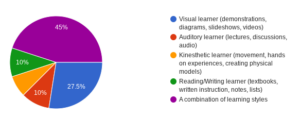
I asked two questions. The first—“Which learning style best describes you?”—produced fairly predictable results. Forty-five percent of students described themselves as having a combination of learning styles, which is reasonable given that most people rely on multiple sensory cues to process information. This was followed by visual learners at 27.5%, auditory learners and reading/writing learners tied at 10% each, and kinesthetic learners at 7.5%.

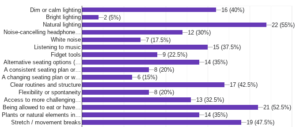
The second question—“What strategies or environmental factors help you focus best, both in and outside of school?”—generated a wide variety of responses. These included preferences for lighting (dim, bright, or natural), sensory tools (fidgets, music, white noise, noise-cancelling headphones, and movement breaks), routine styles (flexible, structured, or Pomodoro-style), and even preferred seating or learning positions within the classroom, such as the floor or standing desks. Some responses were more unexpected, including drawing—and even “Windex” (??). While I am unsure what was meant by this, the purpose of the survey was to represent student perspectives, so I can hardly leave it out.

I will not go into exhaustive detail here, but the data clearly shows that student preferences vary widely, although there is some consensus on factors such as natural lighting. In general, just as students’ brains process information differently, their learning needs also differ. This leads to my proposal of grouping classrooms by learning styles to reduce conflicting needs within shared spaces. However, this approach presents new challenges, such as potential social regression due to limited interaction with peers who think differently, which could negatively impact teamwork skills and empathy.

In conclusion, while it is understandable that classroom environment has not always been a top priority, creating inclusive and adaptable learning spaces could significantly improve students’ mental health, focus, and overall success in their educational journeys.

Sources

https://www.international.gc.ca/world-monde/issues_development-

The Quantum Garden: How Plants Hack Physics to Eat Light

0


For centuries, we solely saw photosynthesis as an extremely straightforward, if miraculous, chemical recipe: sunlight in, sugar out. As simple as that. However, the last few decades have shown scientists uncovering a secret layer to this process so strange and precise that it seems ripped from a quantum physics textbook. It turns out the green, arbrous world is performing feats of subatomic wizardry, using the bizarre rules of the quantum realm to harness light with near-perfect efficiency.

This isn’t simply plant biology, but more so quantum biology, a field that silently reveals the true quantum mechanics of nature and how ecosystems have been employing these techniques long before we even discovered them.

The Quantum Leap in Your Garden

In photosynthesis, specialized “antenna” molecules like chlorophyll absorb incoming light particles known as photons. The energy from that photon must travel to a reaction center to be converted into chemical energy. This was initially thought to be random and bumpy for decades, inevitably dissipating energy as heat along the way.

However, that picture changed when researchers began probing the process with ultra-fast lasers. They discovered the energy doesn’t just hop; it explores all possible paths at once. It behaves like a wave, not a particle, in a quantum process coined coherent energy transfer¹. We can envision this process as a traveler who doesn’t choose one winding road through a forest. Instead, it is like a ghost, one who tries every single path concurrently to instantly find the shortest, most efficient route to its destination. As a result, plants, algae, and some bacteria transfer energy with efficiencies close to 95%, a rate far beyond any solar panel we’ve ever engineered.

Why This Quantum Quirk Matters

For decades, scientists assumed that the warm, wet, and noisy interior of a living cell would rapidly destroy quantum coherence. They believed such effects could persist only in ultra-cold, tightly controlled laboratory conditions². The fact that quantum coherence persists, and remains functional, inside a sunlit leaf challenges that assumption at its very core, suggesting that nature has evolved ways to protect and exploit quantum behavior.

This insight has consequences that go far beyond the discipline of plant biology, raising queries on the abilities certain organisms can possess. If living systems can reliably maintain quantum coherence at room temperature, then can the same principles be engineered into human-made technologies? Consequently, researchers are actively exploring this concept, drawing inspiration from the unique process of photosynthesis to develop:

  • Hyper-efficient organic solar cells that mimic quantum-assisted energy transport, potentially reducing cost while increasing performance.

  • Quantum-inspired sensors and computing architectures that operate more efficiently and robustly than traditional, conventional designs.

  • New approaches in medicine, including light-activated therapies that use quantum principles to control chemical reactions with exceptional precision and accuracy³.

From Sunlight to Tomorrow’s Technology

The next time you witness sunlight falling on a leaf, it’s worth pausing to consider what’s happening beneath the surface, to take a deeper dive into what is truly going on. That leaf is not merely absorbing light, but actively navigating the probabilistic rules of quantum physics to power nearly all life on the planet!

When we take time to study these systems, we do much more than deepen our understanding of biology. We discover a blueprint for technologies that are more efficient, resilient, and sustainable, following nature’s very principles that have existed for millennia. In other words, learning from nature’s quantum strategies may help us realize that some of the most advanced solutions to modern challenges have been quietly at work in plants all along.

Sources: 1 , 2 , 3

What You Didn’t Know About Chinese Culture

When you think of Chinese culture, your mind probably goes to Chinese takeout, Mulan, or the stereotypical strict parents who demand perfect grades. However, China is a country that has over 3500 years of history, with details often undermined by popular western media.

The goal of this article is not to debunk stereotypes but to further explore other aspects of Chinese culture. 

Baby Names 

When parents conceive children, one of their top priorities is to ensure that the child has a bright future. One way they follow through with this is to consult a fortune teller to select an appropriate name to maximize potential.

Based on the hour of birth and year, the fortune teller will determine in what area the child is lacking out of 5 categories; metal, wood, earth, fire, and water. After doing so, they’ll choose a Chinese character that has one of these components to make up for it. So for example, if a baby was born in a dry season, their name may contain the water radical 氵to make up for it.

However, a lot of Chinese citizens view these fortune tellers as scammers and hogwash.


Fun fact


In 1950 when Chairman Mao found the People’s Republic of China, the patriotic sentiment was so strong that many babies in that era had names such as “卫国” (Guard the country), “建国” (Build the country), or even “国强” (The country is powerful.) 


Warm Water

People from the west will often give you a weird look if they discover your water bottle contains lukewarm water. However, in most Asian countries, it’s well-known that lukewarm and hot water has a lot more benefits than cold water. In fact, restaurants in China will serve hot water year-round, even in summer! 


Due to the fact that the body’s resting temperature is 37 degrees Celcius, (98 degrees Fahrenheit,) anything colder will be unfamiliar and “shock” the immune system. This will therefore put a larger strain on the kidneys, because most of the cold water is peed out rather than absorbed.


Water that is the same, (or preferably warmer) as body temperature will be absorbed more quickly, resulting in better digestion and circulation. So if you’re constipated, try having a glass of hot water! 


The Third Eye

The Taoist philosophy, commonly recognized for its concept for Yin Yang, has been popular in China for 2500 years. In Taoism, there is a claim that everyone is born with a sixth sense, or a “third eye.” This sense is coined intuition, the art of knowing without any evidence. For example, someone with good intuition could score high marks on a multiple-choice exam without knowing the material itself, but get correct answers just based on guesswork.


Methods to develop the third eye further involve meditation, yoga, and visualization. It’s easier for children to unlock their third eye, which is why there are special intuition classes targeted to children that could cost upwards to $1000. 


Conclusion

China is a big country with vastly different customs and traditions depending on region. The ones listed here probably only cover 0.01% of what really happens in China. All in all, this is your sign to ask your Chinese friends what other cool things go on in their country!


Sources

Naming Babies

Hot water 1

Hot water 2

My acupuncturist


What Can YOU Do About Child Labour

0

What is Child Exploitation?

Child exploitation in the context of child labor involves engaging children in work that is hazardous, and interferes with their everyday life. This could include forced labor, where children are forced into work against their will, or child trafficking for labor purposes. The work is often physically demanding, exceeding their capacity, and is often in unsafe and unsanitary conditions.

From a study conducted by World Vision,  it is estimated that globally, 1 in 10 children are labourers. These children reside in developing countries and are often born into a life of work. These children engaged in exploitative labor are denied access to education, proper nutrition, and healthcare, which compromises their well-being and future. This form of exploitation is a violation of international human rights standards, and organizations & governments work towards ending child labor and promoting protective measures for children worldwide.

International Measures Being Taken 

Internationally, the UNICEF has been firm on its stance on child labour of not allowing forced, or any type of dangerous work, before the age of 18. Light, willing work is permissible over the age of 12. These standards have been set by the UNICEF Document of Minimum Ages and Adolescents’ Rights. Other important regulations are listed below: 

  • ILO Convention No. 138 (Minimum Age Convention): Sets the minimum age for admission to employment, aiming to ensure that children are not subject to exploitative work at a young age.
  • ILO Convention No. 182 (Worst Forms of Child Labour Convention): Focused on eliminating the worst forms of child labor, including slavery, trafficking, and hazardous work that poses a threat to a child’s health and well-being.
  • United Nations Convention on the Rights of the Child (CRC): While not exactly addressing child labor, CRC outlines the fundamental rights of children, including protection from economic exploitation and hazardous work.
  • United Nations Sustainable Development Goals (SDGs): Goal 8.7 specifically targets the ending of child labor by 2025, calling for immediate and effective measures to eliminate forced labor, end modern slavery and child labor.

What You Can Do (Without Money)!

The main thing you can do to help end child exploitation and labour is raise awareness. For us here in Canada, the only relation we have to these children is through the clothes and brands we support. So, to help these children without money, we can promote ethical consumerism. Here is a step-by-step plan to help slow down the rates of child labour using the promotion of ethical consumerism : 

Research Child Labor-Free Brands:

   – Identify companies that actively commit to eradicating child labor from their supply chains.

   – Look for brands with transparent practices and a clear stance against child labor.

 Create Informational Brochures or Pamphlets

   – Develop printed materials containing information about child labor-free brands and the impact of ethical consumerism.

   – Distribute these materials in community centers, local businesses, and public spaces.

Engage Local Businesses:

   – Establish partnerships with local businesses that are committed to ending child labor.

   – Encourage these businesses to display information about their ethical practices in their establishments.

Encourage Responsible Buying in Local Markets:

   – Promote ethical consumerism in local markets by encouraging vendors to highlight products from child labor-free sources.

   – Engage with sellers and buyers about the importance of responsible purchasing.

Celebrate Ethical Initiatives:

    – Acknowledge and celebrate local businesses and individuals actively contributing to the fight against child labor.

Remember, the goal is to raise awareness, and awareness is always free!

Sources:

1, 2, 3

A Very Brief (and Slightly Humbling) History of the Atom

For something so small, the atom has taken centuries to figure out. Even now, we’re still arguing about how best to picture it.

The story begins in ancient Greece with Democritus (around 400 BCE), who proposed that matter was made of tiny, indivisible particles called atomos. There were no experiments, no microscopes, just logic. Because Aristotle disagreed and believed matter was continuous, Democritus’ idea was mostly ignored for nearly 2000 years.

Billiard Ball Model

Real progress began in the early 1800s with John Dalton, who used experimental evidence from chemical reactions to revive atomic theory. He suggested that atoms were solid, indivisible spheres and that each element had its own type of atom. This model explained laws like mass conservation and definite proportions, but it assumed atoms couldn’t be broken down any further.

Plum Pudding Model

That changed in 1897 when J.J. Thomson discovered the electron through cathode ray tubes. Playing with electric and magnetic fields, he proved that atoms were divisible. Thomson proposed the famous ‘plum pudding’ model, where negatively charged electrons were embedded in a positively charged sphere. It sounded neat until experiments once more proved otherwise.

Planetary Model

In 1909, Ernest Rutherford conducted the gold foil experiment, firing alpha particles at a thin sheet of gold. To everyone’s surprise, some particles bounced back (a very rare outcome). Rutherford concluded that atoms are mostly empty space with a small, dense, positively charged nucleus (which is what would have repelled the alpha particle). The atom had gone from solid to mostly nothing.

However, Rutherford’s model raised a major problem: according to classical physics, the orbiting electrons should lose energy and crash into the nucleus, meaning atoms shouldn’t exist. 

Nuclear Model

Niels Bohr stepped in to try to fix this. In 1913, he suggested electrons could only occupy specific orbits (based on observations with spectroscopy) or quantized energy levels, meaning they could only exist in certain orbits without radiating energy. When electrons jump between levels, they emit or absorb light, which explains hydrogen’s emission spectrum beautifully. It seemed perfect, until atoms got more complicated.

Quantum Model

Bohr’s model failed for multi-electron atoms, and so that’s where quantum mechanics rewrote the rules. Scientists like Schrödinger and Heisenberg showed that electrons don’t follow neat paths at all; they exist as probability clouds. Electrons now behave as standing waves as opposed to particles in this model, removing the issue of acceleration towards the nucleus and radiating energy. Still in orbitals, we can’t picture the exact location of electrons, but we know where they would most likely be spending their time. The modern atomic model isn’t a picture you can easily draw, but it works.

Everything considered, this is really impressive, considering it all started with a guess.


Sources

Canada-China’s Trade Deal: Was it a mistake or the right way to propel Canada?

0

Last Friday, January 16th, 2026, Canada and China‘s trade relations improved with beneficial news to both partners. As a part of Canada’s strategy to mitigate the effects of the tariff war with the United States, Carney became the first Canadian president since 2017 to meet with Chinese President Xi Jinping. The deal includes lowering tariffs on Chinese electric vehicles, allowing 49,000 EVs to enter the U.S. at a tariff of 6.1%. This is a result of the U.S. and China working together a year ago, which also led to Canadian agricultural products, such as canola seeds, experiencing lower retaliatory tariffs, now at 15%. Canadian citizens also do not require a visa to stay in China for at most 30 days. At the World Economic Forum on Wednesday, Carney described a new world order in the process. 


Canada had a history of depending on the U.S. for exports of automobile parts and its natural resources, but ever since President Donald Trump launched a trade war for the triumphs of American nationalism, the government has been aiding the economy by diversifying trade partners across the globe. Canada and China have experienced less stabilization and activity in their trading partnerships as China’s rapidly expanding economy has made it a leading exporter of electronic vehicles, competing against manufacturers in North America. Some Canadians have commented on the perspective that this information suggests Canada will soon depend on China, harming domestic business, and will invite an even lower downward trajectory in economic security and growth. Although Canada is a remarkably wealthy country, its biggest trader has also impacted business, and the only way to effectively work through an economic crisis of inflation and unemployment would be to recalibrate its trading relations to support its independence. 

Carney has shown his complete belief in what direction this will take Canadians, as quotas grow in number and increase foreign investment in several industries. Canada is struggling with unemployment and managing immigration to ensure a higher quality of life that has only been hit further by global economic instability. Even politicians like premier of Ontario Doug Ford— calling the deal a knee-jerk reaction, a big, big problem, have also expressed uncertainty about the future of domestic automobile industries, while the opposite with Premier Scott Moe praises Carney’s devotion to not compromising the core values that make up Canada and how it will continue to promote national unity as it’s in Canada’s best interest. President Trump has responded to this deal by withdrawing an invitation for Canada to join his collaborative Gaza Board of Peace. Tensions between the two countries have risen on account of tariffs, suggesting that searching for export markets is integral to Canada’s economy and what it should prioritize. Uncompromising these core values would also mean that Canadians would still struggle between their domestic priorities and economic stability and independence. 

Still, navigating a global trade chain in times of uncertainty is difficult, which was expected of Canadians as the government would attempt to work through trade relations and prepare with diligence for Canada to relocate its position and reputation. Sometimes, struggles can define a nation’s capability to resolve situations and redefine itself with complete confidence in what it promises to those who call it home. This deal should not be the most impressive milestone, and the government has only till to work through trade barriers and enact laws that can accommodate domestic businesses and workers. China can prove itself to be a reliable partner, but it can only be up to the government and its willingness to listen to the underlying issues of interdependence.  Either way, there is no single answer to this question; all we have to do is wait and see, and then act.

To anyone who is reading this, I suggest you keep updating yourself on news that no longer affects a single country. Remember your rights and that you do have a voice!


Engineering – A Career that Opens Unlimited Doors

0

From developing tiny microchip electronics to constructing skyscrapers, engineering is a field that has vast opportunities and helps develop a society. If you are in the process of picking the right career to pursue, you have come to the right place. This blog post explores what engineering is, the different types of engineering, how to become an engineer, and the qualities you need to thrive in this field.

What is Engineering, and the different types of Engineering

Engineering is essentially the application of science, mathematics and physics principles to design unique and innovative solutions to solve real-world problems. It involves designing and creating everything from daily objects to complex infrastructure. Engineering is a broad discipline with a variety of different subfields. Some of the most common engineering disciplines are: 

1) Electrical Engineering: Focuses on the study, design, and application of equipment, devices, and systems that use electricity, electronics, and electromagnetism.

2) Mechanical Engineering: From engines to complex mechanisms, Mechanical Engineering involves designing, analyzing, and manufacturing physical machines, engines, and mechanical systems.

3) Civil Engineering: Civil engineering focuses on the design and construction of infrastructure, such as buildings, bridges, roads, and water systems. 

4) Chemical Engineering: Chemical engineering focuses on applying chemistry and life sciences to convert raw materials into products that can be used for various applications.

5) Software Engineering: From designing websites to programming video games, software engineering focuses on designing and developing complex computer software systems.

6) Computer Engineering: Computer engineering focuses on designing and developing computer hardware and applying electrical engineering principles to design computer systems.

7) Aerospace Engineering: Aerospace engineering focuses on the designing and testing of specialized aircraft, spacecraft and defence systems.

8) Industrial Engineering: Industrial engineering focuses on optimizing complex systems and processes to enhance efficiency and quality.

9) Biomedical Engineering: Biomedical engineering focuses on combining engineering technological principles with medical sciences to develop and design healthcare devices, equipment and hardware.

Qualities of an Engineer

Thriving in a field like engineering, where the technology is constantly adapting and improving, can be demanding. Some qualities that can help you become an excellent engineer are problem-solving, creativity, curiosity, logical thinking, attention to detail, a passion for continuous learning and much more. Engineering is often referred to as Applied Science, and that is what it is: taking scientific knowledge and turning it into functional, innovative solutions that benefit society.

How to become an Engineer

Becoming an engineer is not an easy process and requires a genuine passion and immense dedication. First and foremost, to become an engineer, you must earn at least a bachelor’s degree in an engineering discipline from an accredited institution. You must also gain some hands-on practical work experience through the form of internships or co-op programs. Licensing as a professional engineer requires passing exams and completing years of supervised work experience as a junior engineer. These licensing requirements change from province to province and vary significantly in other countries, so be sure to do your own research! 

Sources: 1, 2

Showing Appreciation for Albertan Teachers

0

In October 2025, the teachers of Alberta went on strike, putting students out of school for over a month. But its impact seems to be lost on students just a couple months after. I feel grateful to be back in school, especially since I graduate this year, but I want to take some time to highlight a few teachers who have made an immense impact on my life in hopes of reminding our readers of the thanks we owe them.

Working Overtime

Forget reading multiple essays. Reading my own essay takes multiple attempts, and I am not meant to assess it. Teaching is more than the typical corporate 9-5 job because 9-5 mostly consists of instructional and prep time. Especially with colossal class sizes, marking must be time-consuming. My teachers tell me they need to fit in their overtime in the little space they have around family commitments and personal events.

It’s easy to complain about getting assignments and exams marked late, but it’s also important to carry empathy for our teachers who work so hard for so many students. Overtime is essential to finishing their work; I think it’s unfair to complain about their both their efforts and the fact that overtime is essential in the first place.

Extracurricular Responsibilities

High school students tend to expect a lot from school activities. Every student activity cannot represent the school unless there is a teacher sponsor present, and oftentimes they aren’t paid for this. Our teachers volunteer to help us pursue our passions and ambitions for post-secondary, but while we only do it for a couple years before moving on they volunteer to run clubs and athletics for years. When hiring teachers, their willingness to take on newer formed clubs carries weight as well.

It’s a lot of responsibility and additional work, and I want to take a moment to thank every teacher for their dedication to student success and career exploration. You truly make such a major difference in our lives and we are very grateful for it.

Letters of Recommendation and References

If you’re looking for post-secondary options, universities and companies often do not trust students to give accurate accounts of their own work and look toward “academic references” instead. Job applications require references from previous employers, but since most of us are going for our first part-time jobs, we don’t have real work experience and look toward our teachers for help.

Teachers speak to your character, work ethic, personality, and capabilities. They pour time and effort, both of which are much depleted from other parts of their job, and genuinely want success for you which is why they ask for so much time in advance.

Be sure to take some time to send thank-you gifts, or at least thank-you cards, to some of the teachers who have helped you out!

Tolerating Students

Both myself and my peers are far from perfect students. When we get bored, we can be noisy. When we are tired, we are unfocused. We can be chatty and a bit disruptive. We are human, but we’re still developing humans without mature frontal lobes.

Our teachers have to tolerate our silly behaviors and our emotional ups and downs when they teach. It’s not easy, especially when they get little to no engagement or thanks for it.

I’m sure you’ve sat in a class where the teacher asks a question and the response is dead silence. Crickets. You could probably hear a pin drop. And it’s not that people don’t know the answer, but rather that they don’t want to ask questions or that they can’t be bothered to engage.

But we’ve all given presentations to a deadbeat audience before, and it isn’t easy. It’s hard enough to fear your peers for a brief 5 minutes standing up by the SMART Board, so could you imagine presenting to students who are often choose to act exhausted and jaded every day?

What You Can Do To Support Your Teachers

Your teachers want to see you succeed. Nothing bad can come of small actions that help support those who believe in you! Here are a few examples:

  • Sign petitions for teachers rights
  • Be politically active – email your government/district representative
  • Show some more gratitude
  • Hold back your complaints
  • Come to class with an open mind and your best efforts
  • at the very minimum: engage with your teachers and participate in class!