
Home Blog Page 65

Ivory Consequences

The few wandering elephants that roam Mozambique’s Gorongosa National Park are the lone survivors of their formerly large community, all bearing the indelible markings of the civil war that gripped the country for 15 years: Many are tuskless. The conflict, as well as years of prior poaching, killed off about 90% of these animals in order to satisfy a quota of ivory to finance weapons or for meat to feed the militia. 
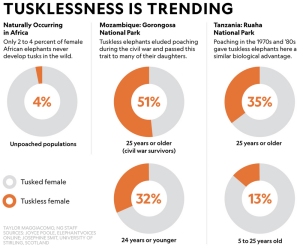
From 1977 to 1992, both sides in the war hunted the elephant populations for their prized ivory tusks leading to their eventual plummet in numbers. This same activity very well may have set off an evolutionary response in the species that favored tuskless elephants as the species numbers began to recover. Nevertheless, despite the fact that lacking these tusks may have saved some from being poached, the genetic mutation responsible for eliminating the tusks is lethal in male elephants. As elephant numbers dropped from the thousands to mere triple digits, with around only 200 surviving in the early 2000s, many female elephants survived the poaching but were overlooked as they already were naturally tuskless. These elephants were then able to pass on their gene of tusklessness down to their offspring after the war ended. A study by Princeton University has shown that the proportion of tuskless females rose from 19 to 51 percent during the conflict, and statistical analysis indicated this was extremely unlikely to have occurred in the absence of selective pressure. This loss of tusks has been documented in many other places as well; Sri Lanka has less than 5 percent of their male Asian elephants having tusks. Details of the study were published in the research journal Science.

Scientists began collecting data on the elephants at Gorongosa National Park to research this amplified natural selection towards tuskless elephants, and it was then that they realized that elephants with no incisors were usually female. The park has never seen a tuskless male, suggesting the trait related to tusklessness is not only sex-linked but it will lead to the death of any male elephants that the gene is passed down to. 

Using 11 females without tusks and 7 females with tusks, a research team was able to identify the two mutations involved. One of the said mutations is most likely to be in a gene X chromosome called AMELX, which plays a part in tooth formation. This same mutation appears to affect other, crucial genes nearby. Since females would have two copies of the X chromosome, if one copy is not mutated, the genes will still carry their function normally and the elephant will be healthy. However, since males only have one X chromosome, the mutation will be deadly to any males that inherit it. “When mothers pass it on, we think the sons likely die early in development, a miscarriage,” says study co-author Brian Arnold, a Princeton evolutionary biologist, to the Associated Press. 

It is still possible that further genetic changes could occur to compensate for the lethality and males would eventually lose their tusks too, but for now, this does not appear to be happening. However, even the loss of tusks in females can have all sorts of consequences for the environment and the species at large. The main researcher at Princeton who was in charge of the study, Shane Campbell-Staton, stated that, “Tusks are basically a Swiss army knife for African elephants.” They use them to strip the bark off trees, to dig holes for underground water or minerals, and so on, says Campbell-Staton, so the loss of tusks may spare females from poachers, but make it harder for them to survive in other ways. On top of that, other animals in the ecosystem still rely on these tusked animals to survive such as using the same holes dug by the tusks to get water for themselves. As Campbell-Staton best said in his report, “there are all these cascading consequences that can result from our actions that are quite surprising.”


 

Featured Image

Sources: [1] [2] [3] [4] [5] [6]

Is This the Future for Human Organ Transplants?

0

Medicine is a forever evolving subject, and scientists and researchers are constantly finding new ways to find innovative solutions to challenging medical problems. One such solution regarding human organ transplants gained attention in the past week when pig organs were partially revived after death. This landmark incident has unlocked huge possibilities with concern to the future of organ transplants and xenotransplantation. However, along with every medical breakthrough the question that crosses many is whether or not this practice is ethical?

Where It All Started…

You may be wondering how research regarding humans and pig organs even came about. Initially, I also found it absurd how humans and pigs could have compatible organs. Therefore, the event that occurred on January 7, 2022 at the University of Maryland Medical Centre was shocking. On that day, 57-year-old David Bennet, who had passed away in March, received a heart transplant from a genetically modified pig. This is where the concept of xenotransplantation became heavily conversed about in the medical community. To clarify, xenotransplantation is when cells, tissues, and organs are transferred between species, and this concept came about in the 17th century. However, the idea of pig organs is still peculiar especially considering the controversy surrounding their “cleanliness,” and some religions also prohibit their consumption. Despite that, pigs became a strong contender for xenotransplantation as they can be raised in a safe and sanitary environment, have their organs genetically modified, and grown to the size needed. Economically speaking, pigs are also cheaper to raise and reproduce quickly in comparison to other animals. Pigs are also agricultural animals, so the Animal Welfare Act is not applicable. For these reasons, pig organ transplants became a reality.

How Pig Organs Were Partially Revived

In the previous section, I talked about how pig organs came about in human transplants. With that in mind, another discovery regarding pig organs has been found. That discovery was that researchers were able to partially revive the circulation and cellular activity in some vital organs of pigs. Once again, this has led to new ideas circulating about death and ethics. The research team from Yale University used technology known as OrganEx, and the experiments involved around 100 pigs that were given previous ethical approval. Down below are key points from the research and experiments:

  • The scientists anesthetized the pigs and stopped their hearts from beating
  • A mixture of 13 compounds helped their immune system and stopped the cells from dying 
  • The cocktail of drugs also suppressed blood from clotting 
  • Then a device is used to mimic the beating of a heart
  • After six hours, the team realized they were able to start cell repair on a molecular level demonstrated through spasmodic responses from the animals
  • Neck jerking was one major response from the pigs 

Breakthrough Discoveries

After six hours, researchers began to notice that the OrganEx technology allowed oxygen to flow throughout the pigs’ bodies. At the same time, their hearts displayed some circulation and electrical activity. According to David Andrijevic, a neuroscientist from Yale University, the heart had not completely restarted, but other organs such as the liver responded more to glucose. As a result, it is believed that the animals’ metabolism had started. Additionally, genes used for cellular repair became active in all major organs. Furthermore, techniques used in this experiment could make it possible for brain activity to be restored after death. All of these accomplishments can translate to a new future for organ resuscitation and organ transplants.

Ethical Dilemma

All of the research regarding pig organ transplants and reviving organs is definitely an ethical dilemma for the medical community and society in general. Instances such as these force us to go back and reevaluate our approach to death and to what extent we can go to save lives. Additionally, it brings up concerns about how we treat animals, particularly pigs, who are often not given the same attention and care as animals such as dogs or cats. Imagine another animal other than pigs being researched for their organs. Would our reaction be different then? One of the main ethical challenges that arise from this research is the fact that brain activity could be revived after one is dead. Furthermore, it could completely change how our society views death. Traditionally, death is associated with the moment in which all organs shut down. However, now death might be considered a process in which more research needs to be conducted on cardiac death and brain death. In the future, there will be many more discussions in terms of animal rights and our perception of death.


Feature image/ [1]/ [2]/ [3]


5 Habits To Start Off A Strong School Year! 

School is approaching sooner than we all may have anticipated. My summer has been going at a pretty fast pace, and realizing that I only have less than a month left until the next school year begins. The most we want to do is make sure we start it off right and strong without any mistakes. Developing good habits is crucial to becoming a successful student in anything and everything you want to achieve. Here are a few things that can help you become the best student you can be this year. 


  1. Sleep, Sleep, Sleep 

A lot of us may find sleeping an issue, especially during school time, as you have a lot of homework with extracurricular activities. I find that the main reason you may be losing so much sleep is not being able to divide our time right, you have too much on our plate, or might just tend to procrastinate. In every way there is a solution, but sleep is necessary. Statistics show that 7 out of 10 high school students are not getting the average amount of sleep they need or even less. This has a huge toll on grades and how you may perform on tests and exams. You may find yourself content with studying for hours, but with less sleep is that information really sinking in your head or are you just reading words. This is super important to consider, yet as well as understanding that not sleeping can affect your mood and how you behave with those around you. Respect is key, and it’s important to try to be kind to everyone. Even if you might not mean it, with the lack of sleep you may say something out of anger that you may have not meant to say. 


2. Practice Good Study Techniques

Schedules are keen to make sure you divide your time just enough to make sure you are able to complete everything within a certain amount of time. It’s the stress that allows you to finish the work, if you have a busy schedule. You could also use the pomodoro technique, which is a technique where you make 25 minutes of dedicated study time and have a 5 minute break. This goes in repeat until you have your work completed. Your mind is relaxed and you’re able to focus with the breaks that you take during your study time, and scientists have found that there have been more memory retention in students who do take a break after dedicated study time. This way you have the ability to complete your work without feeling burnt out, and find yourself more relaxed than usual.


3. Clean Space, Clean Mind 

We all may have heard that quote that goes, “clean space, clean mind”, but do we all really consider that into our lives? I’m sure some of you reading this may find yourself to be organized, and please continue doing that. On the other hand, some of us may tend to find ourselves with a messy room. This is very common, but studies show that the more messier your work area may be the more it affects your thinking and your work. I find that I personally get distracted very easily, and it was mainly because of the environment I created for myself. Organizing your space can help you find the things you need quicker, and sometimes makes it easier not to lose your homework, especially if it’s on paper. 


4. Exercise/Stretch Everyday 

Finding ways to stretch and get your body moving is super helpful when we look at memory improvement, concentration, etc. Becoming a part of sports teams can help you do this, or just stretching on your own time can make your body feel more ready and motivated to learn. Studies have shown that people who are engaged in any sort of exercise or sports teams increase performance in grades. This is again because of the improvement in memory and concentration we have discussed earlier. Not only that, individuals who play sports are more likely to be competitive (this doesn’t mean that people who don’t play sports can’t get high grades or be more or less competitive), due to how they have learned to play that sport. Winning is sometimes considered the main factor, and that could drive someone to do better at another subject with the same competitive mindset. 


5. Change Your Mindset

I’m a firm believer that in whatever you want to strive for it comes with mindset, and how your look at the situation you are faced in. Even if you might find yourself in a situation where you think you can’t do it, tell yourself you can. This can help, make yourself believe you can, and it will allow you to achieve it. A lot of people tend to believe that you have to be talented or born with an ability to achieve something, but creating an optimistic mindset in a situation that you think you can’t achieve can make life better than you may anticipate. 


*Note*: Having a mindset towards something does have some extent. If you are performing an activity and you are in a sort of pain that doesn’t seem right, please try to be safe during those situations. 


– Have an amazing first day of school!

Sources: Featured Image  1 2 3

Fast Fashion: The Monster in your Closet

Every second, a garbage truck full of clothing ends up in the landfill. Do you know what the impact is of the clothing you wear every single day?

The Impact of Fast Fashion

Producing a single cotton T-shirt consumes 2,700 liters of water. That’s equivalent to that amount of water that could sustain one person for 900 days. And for a single pair of jeans, it can take up to 7,600 liters of water. It doesn’t end there. The textile industry has immense negative impacts, and it is important to be aware of these impacts in our every day choices[3].

Among synthetic fibers, the most common is Polyester, petroleum-derived plastic. These synthetic fibers can take many years to degrade naturally, the “average polyester item surviving for at least 200 years”. Once these textiles end up in landfills or our waterways, they continuously negatively impact the environment. Clothing tends to release harmful chemicals and dyes, particularly when they end up in our waterways. 20% of global industrial water pollution is the result of material dyeing and textile treatment. Furthermore, 35% of micro-plastics in the ocean are from textile waste[4].

Many people believe that the majority of clothing is donated or reused. However, of the clothing that is actually purchased and worn by consumers, 87% ends up in the landfill or is incinerated. Considering the material used to make clothing, less than 1% is actually reused to create new items. Over time, countries have restricted the import of used clothing. For example, China has already enforced this ban, and many East African countries will soon follow suit.

What can you do to help?

  1. Make Eco-Conscious decisions
  2. Purchase better quality clothing
  3. Buy second-hand clothing
  4. Invest in sustainable fashion brands
  5. Do your research and understand the source of the fabric waste problem
  6. Look at the fabrics that your clothing is made of


While it may be daunting to think that all of the clothing in your closet has so many negative impacts, I hope this article helps in ensuring that you aware of this immense problem of fabric waste.

Featured image/ [1]/[2]

Sources:

[3] https://www.triplepundit.com/story/2013/it-takes-2700-liters-water-make-t-shirt/54321

[4] https://www.commonobjective.co/article/fibre-briefing-polyester

[5] https://www.bbc.com/future/article/20200710-why-clothes-are-so-hard-to-recycle

Familial and Medical Conflicts Surrounding the Declaration of Death

0

How much involvement can a family have in an individual’s medical matters, particularly when they are not conscious or in a clear state of mind to advocate for themselves? There are a multitude of ethical dilemmas that arise from this, and medical professionals are expected to respond instantaneously to these questions, as their decisions literally determine life or death.Tips for Job Hunters in the Medical Field - Just in Time Staffing


Healthcare for patients who reside, work, or travel overseas can become complicated due to different cultural values, such as the Confucian values of countries such as China and Japan. According to Western standards, patient care comprises disclosure of medical information, patient consent, and voluntary decisions under all circumstances. Furthermore, medical professionals must provide sufficient information regarding risks, benefits, and complications of procedures without coercion. And the patient must understand the disclosed information and decide by free will.


Japanese regulatory agencies have integrated these policies within their healthcare policies. However, Japanese medical professionals prioritize familial consent over individual consent. This is because of a cultural belief that authorities such as families and physicians know better than the patient and thus, can better support them through their treatment. Therefore, familial consent is prioritized when diagnosing and treating brain death.


However, because Western medicine values individual autonomy, physicians are faced with the difficult task of reconciling their Western training with familial consent. So, Asian physicians, particularly senior physicians, face a dilemma: can a physician disregard Western principles and prioritize cultural values, or should they endure cultural repercussions after following Western policies?

What Job is Right for Me in the Medical Field?

Older physicians face increased pressure to follow societal and cultural norms when making decisions related to mortality. Although some younger medical practitioners value individual consent over familial consent, many are expected to conform to Asian medical principles due to parental influence. Therefore, the younger generation of medical practitioners will be navigating more stringent cultural and societal norms. As such, it can be argued that medical professionals often struggle to find a balance between familial and individual consent when declaring brain death. 

1 , 3, 4 ,5

What is Just and Unjust? Comments on Contemporary Justice

Recently, I have been reading Book 1 of The Republic by Plato and have come across some interesting philosophical comments regarding how the perception of justice varies depending on an individual’s own thoughts, opinions, and life experiences. What one might see as good can be seen as evil by the other person and vice versa, which we regularly see in law and justice. Additionally, I thought some of the book’s ideas could be applied to the current circumstances we have been witnessing regarding what people view as just and unjust. Therefore, today I will be talking about what justice means in our society alongside some of my own opinions.

What is Justice?

As you may already know, justice is used in law, courts, and sometimes even subconsciously as we do everyday tasks. A textbook definition of justice would pertain to moral righteousness and that people receive what they deserve depending on their actions. However, just like any topic regarding ethics, justice also has many different aspects to it. To begin with, justice is perceived differently in terms of politics and philosophy. From a political sense, one’s sense of “justice” is impacted by their political views, whether that is more conservative or liberal. On a philosophical note, justice is viewed in a moral sense regarding if justice is something we owe to everyone we encounter and to what extent that might be. According to the Stanford Encyclopedia of Philosophy, in terms of individual ethics, justice is also seen as charity and mercy. All in all, justice has a variety of meanings and is not a simple concept.

How is Justice Perceived Today?

With the recent outcome of Roe v. Wade in the United States, it can be said that what a group of people, like the judges on the Supreme Court, believe as a “just” verdict in terms of basic women and human rights is not what a vast majority of people, including myself, believe to be justice or correct. What some of us believe as unfair and extremely detrimental can seem like a fair outcome to others. This is an example of how an individual’s political and religious beliefs can greatly impact their perspective of “justice.” With this in mind, there are countless examples of legal trials in history that provoke the question, “Was this verdict a true instance of getting justice?” Questions such as these make it difficult to decide what is just and unjust, but how is justice viewed today? An article titled What “Justice” Really Means by Paul Bloomfield accurately sums up how people don’t necessarily understand that they need to judge themselves and others fairly. In an effort to find the best verdict, we often forget that our opinion of “justice” also applies to our actions and not just those of others. Furthermore, an individual that is a poor judge of themselves cannot possibly be a good judge of others. I believe this is a flaw that we see in many political leaders and people who are in high leadership positions today. In the end, reaching justice in society begins with eliminating personal bias when approaching outcomes that impact millions of people.

Just and Unjust

In The Republic, by Plato, one of the main ideas is answering the question regarding how justice impacts a person’s life and what it means to live a “just” life. Plato creates the idea that it is more beneficial to live a just life rather than one ridden with injustice. However, I still have a lot left to read and learn from the entire collection of The Republic, and I will continue to question how justice is achieved in our society and how this concept came to be? Sometimes, I feel like we never truly know what is just and unjust as it is ever-evolving. I hope that after reading this, you have gained some insight into justice and come to your own opinions and questions. I encourage you to continue your interest in justice and ethics and your perspective regarding this matter through research and life experiences!


Feature image/ [1]/ [2]


What is ADHD?

What is ADHD?

ADHD (Adult attention-deficit/hyperactivity disorder) is one of childhood’s most common mental health disorders. ADHD often lasts into adulthood as it is usually first diagnosed in childhood. It includes persistent problems such as trouble paying attention, controlling impulsive behaviours, and hyperactivity and impulsive behaviour. Unstable relationships, poor work or school performance, low self-esteem, and other problems are led by Adult ADHD. Usually, symptoms of ADHD symptoms start in early childhood and continue into adulthood. ADHD is not recognized or diagnosed until the person is an adult. ADHD symptoms in juniors are more clear than in adults’ ADHD symptoms.

watch this vide for more information!

Symptoms

Symptoms of ADHD can be divided into ADHD symptoms for children ADHD symptoms and adults ADHD symptoms. 

A child with ADHD might (It is typical for kids to struggle with their attention spans and manners occasionally. However, these behaviours do not just disappear in children with ADHD. The symptoms persist, can be severe, and can make it difficult to interact with friends, family, or coworkers):

  • daydream a lot
  • forget or lose things a lot
  • squirm or fidget
  • talk too much
  • make careless mistakes or take unnecessary risks
  • have a hard time resisting temptation

Adult ADHD symptoms may include:

  • Impulsiveness
  • Disorganization and problems prioritizing
  • Poor time management skills
  • Problems focusing on a task
  • Trouble multitasking
  • Excessive activity or restlessness
  • Poor planning
  • Low frustration tolerance
  • Frequent mood swings
  • Problems following through and completing tasks
  • Hot temper
  • Trouble coping with stress

Causes

The exact ADHD cause is not clear yet. Factors that may cause the ADHD are:

  • Genetics. 
  • Environment. 
  • Problems during development. 

Treatments

A combination of behaviour therapy and medication is a well-known and best-proven ADHD in most cases. Treatments for each individual depending on the child and family. 

Learn more about treatments

On your own

You can find information about ADHD through these websites!

Sources <1> <2> 

Featured image

Image sources <1> 


Advice for Incoming High School Students: What I Learned!

 I just finished my first year of high school this year, and I wouldn’t say it was the best experience, yet I was able to learn a lot out of this year. Although my middle school goes up to grade 9, some schools do start middle school at highschool, and with the lessons I have learned this year I would say it was definitely more like a high school experience than middle school. 

1. Don’t Expect Anything 

Before starting grade 9, I was in online school due to COVID, and hadn’t talked to my classmates in person in 2 years. I was really excited to see everyone, but at the same time I was nervous. I had heard everyone had looked different, and had changed. I had gone into grade 9 thinking that it was going to be the best year of my life, and had a lot of expectations about graduation and the overall turnout. It was the complete opposite of what I anticipated it to be. People had become distant from each other, no one talked to anyone except the friend groups that we were in, and the energy was overall very negative. I enjoy school a lot, but when I was in that environment it didn’t make me happy. It did change overtime with the help of my friends making everything so much more fun, but it was definitely hard at first. I would say, don’t go into highschool expecting anything and let everything happen naturally. This way you’re more likely to enjoy it, with no expectations


2. Be Open to People Changing

When going into high school there may be many friends that you may drift away from, but it’s super important that you stay open to it. As hard as it may sound, it consists of change, and people sometimes naturally leave based on they’re liking, and the friends they want to be surrounded by and that’s okay. Make sure you’re doing the right things, being kind, and just being yourself. Despite what may happen, you will find people in your life eventually that will stick by your side, and will stay close with you. 


3. Stay Organized

Organization is key to any place you go. Making sure you don’t lose the thing you have is important in case you need it later. Forgetting your homework is no excuse, and even if you completed your homework and you lose it, you will have to re-do it or you won’t get a mark if that teacher doesn’t agree. Getting folders, binders, a good backpack, etc will help you stay organized and put your school work/stationary in the right place. As little as this sounds, it’s bigger of an advice. 


4. Surround Yourself With The Person You Want To Be

There’s this quote that I heard a few years ago and really hit me in a way I didn’t expect. It goes, “show me your friends and I will show you your future” -(by unknown). It showed me that the people that you surround yourself with are the person you are striving to be. If you don’t agree with the mindset that your friends have or the morals they follow it’s best to find people that follow what you believe in. You don’t want your friends to convince you into something that you don’t want to become. Find friends that are inspire you to become better and be yourself during the process, because that will help you attract the people that share morals like you. 


5. Be Involved

If you find yourself having a hard time making friends, clubs, and sports teams are a great way to find people who share the same interests as you. You get to learn more about your interests as well as create long lasting memories and friendships. Being involved even in a club that you may think you don’t like is something that you should try considering. Joining clubs or trying out for teams that you may not think you may be good at might spark an interest of its own. 


I hope this advice helped, and know that you will have a great high school year. Make sure to make the most out of it, and you’ll do great. Be kind, and don’t be hard on yourself. You got this! 


Three significant moments in vaccine history

0

In our current society, vaccines significantly impact our daily lives regarding COVID vaccination, flu vaccination and many more. It is now mandatory and important in our human history to support humans’ longevity and health by increasing the quality of life. It was interesting to see each step of development in the science industry and human generation by discovering vaccines in history. I hope you can dive in with me about some significant moments of vaccination history. 

First Vaccine: The Small Pox Vaccine

Our first vaccines came from Edward Jenner in 1796. He was the first to experiment with a method to protect against smallpox in scientific aspects. Edward Jenner is often called the father of vaccines. Scientific approace of Edward Jenner proved the method worked but he didn’t invent the method.

Jenner’s testing method was about taking material from a blister from someone infected with cowpox. Then, he inoculated it into another person’s skin (arm-to-arm inoculation). However, large-scale vaccine production was possible from scientific knowledge that had developed enough by the late 1940s. 

The vaccines that protect against pertussis (1914), diphtheria (1926), and tetanus (1938), also known as the routinely recommended vaccines, were developed early in the 20th century. Then, in 1948, the DTP vaccine was invented, combining the three vaccines above. 

Polio Vaccine, Everyone Was Waiting for it!

Polio epidemics used to scare parents as parents kept their children away from swimming pools, sent them to stay with relatives in the country, and clamoured because of polio. They were desperate for the vaccine as they closely followed vaccine trials and sent dimes to the White House to help the cause. Then, in 1955, its inventor, Jonas Salk, became an overnight hero, and the country was celebrated. 

Measles, Mumps, and Rubella:

MMR vaccine is one of the most common live attenuated vaccines today. Although originally designed as three separate vaccines, attenuated strains of measles, mumps, and rubella. Dr. Maurice Hilleman combined these three vaccines into the MMR vaccine in 1971. It continues to be used to provide protective immunity against pathogens(an organism causing the disease to its host) responsible for what was once considered a common childhood disease.

These exciting moments impacted our history regarding the human race’s health care. If you want to find out more information about the history of vaccination, feel free to check out these sites:

Sources: 1, 2

featured image

Image source(s):

<1> <2> <3> <4> <5>


Potential of VR

The other day, I used my VR headset to go hiking in the mountains. I live in a place literally surrounded by mountains and vegetation, but I chose to go hiking in VR instead. If I am making these small transitions to become more reliant on tech, are other people too?


Becoming more technologically dependent/adaptable

It’s undeniable that the world is becoming a technologically driven one every day. Developments like NFTs and Cryptocurrency are making us rethink how we create and use physical art and money. As work and school become more desk-oriented, people are neglecting essential time outdoors. As a result, creative thinkers are creating new innovations and technologies to move the outdoors inside. Could we apply philosophies of living in a digital world, as famously adopted by Mark Zuckerburg, to change the way we think about nature? Understanding these technologies may bring us closer to adopting them in our everyday lives. This is why I wanted to share how VR works to achieve things like nature simulators (at least in simple terms). 


Basics of VR

VR functions similar to how we normally perceive images and the world around us. For example, in order to see, we process different images sent to our two eyes. From there, we combine the images and our eyes and brain work together to interpret the world around us. Seeing out of 2 eyes instead of 1 allows us to create a deeper, more accurate image of our surroundings. The same goes for VR headsets. This is why, VR nowadays has 2 lenses, each with their own image inside. They both work together so that when we interpret them, they feel like our surroundings in the normal world. Sensors are used to detect movement in the headsets, so the environment (images from the headset) changes as you move. Some headsets even have eye sensors to make this movement more realistic by changing depending on your eye movement. All of these factors allow users to experience a new reality with no trace of the actual world. With these factors and a ton of creativity, the possibilities are endless. 


Realistic VR

In order to create realistic environments like those found in nature walks, developers use photos, similar to panoramas. You know how google maps have a car that drives around to capture images of streets and buildings? With that same information, Google Maps Street view to pretend like we are moving through streets. This same method can be used to recreate environments for realistic VR. Designers can also create environments from scratch. This requires lots of skill and attention, but the results are amazing. 


Why does this matter?

No matter the specific method, the use of VR to bring nature indoors is an impactful development in tech. Utilizing VR to appreciate nature indoors is just the first step to how we’ll use this tech to enhance certain experiences that make the world so great.

Featured Image


I Hate Science and Math Class

0

This may be a hot take, but I dislike science and math.

I don’t dislike it due to the fact that it’s boring; I just dislike it for me currently. For some context, growing up, I had an influential pressure to enjoy classes like math and science (specifically math) because those were the stereotypes thrown toward Asians. This led me to neglect subjects such as English and social, but up till a couple of years ago, I did not consider English and social as important subjects, so I didn’t pay attention, and I neglected the subjects that years later I’ve learnt to love. But the problem with me and many other Asians is that I also didn’t enjoy math or science either, yet I always felt the need to enjoy the subjects. This may be due to countless environmental factors, such as my Asian friends liking math/science. But nonetheless, I didn’t like school, and I hated every class. I didn’t try, and I got average grades. It wasn’t until the pandemic hit that I started learning more about myself and what I enjoyed and disliked. So during the pandemic, I realized that I had a love for English and social. So the following year, as I went back to school in person, English and social were the classes I got the best grades in. these classes made me enjoy school more and improved the grades of all my other classes.

So yes, I am Asian, and yes, I did stray away from the stereotype of enjoying science and math. I don’t know if there will ever be a time I’ll enjoy science and math, but I found that I dislike math and science for me. Of course, I’ve only explored a portion of science and math, so I could like them in the future, but currently, English and social have been my favourite subjects. I mean, who knows? Maybe when I start taking STEM classes, ill learn to enjoy the subject more.

featured image 

5 bubble tea places in Calgary that you should try!

I love bubble tea (or boba, whatever you want to call it!), and now that it’s summer, bubble tea makes a perfect treat to beat the heat! Bubble tea originated in Taiwan during the 1980s, and now bubble tea is a sought after drink internationally! I love bubble tea as it makes me reminiscent of elementary school as my mom would always bring me a fresh fruit mango smoothie with pearls from the bubble tea shop near my house.

If you’re looking for some bubble tea places in Calgary, here is a list of  five places you should try!

Don’t Yell At Me

Don’t Yell At Me has two locations in Calgary, one on 17th Avenue (620A 17 Ave SW) and one in Crowfoot (63 Crowfoot Terrace NW). Their menu carries coffee drinks, milk teas, sparkling waters, and their old master formula drinks. The drinks are all under $10 ranging from $7-9 per drink. My favourite drink to order is the berries roselle sparkling water!

Try Again Beverage House

Try Again Beverage House is located on 111 3 Ave SE outside the Opulence Centre in Chinatown. Try Again has a special place in my heart as I grew up going here. Every weekend my grandmother would take me on a walk around downtown, and we’d usually hang out around chinatown. We’d both get drinks from Try Again, and I went there almost every-time I was downtown. It has been my go-to spot whenever I am craving bubble tea, and I’m in the area! They have a vast drink menu, and they also have special pearl flavours every month. Whenever I go to Try Again, I usually order their strawberry mango yakult smoothie with pearls and yakult poppin pearls!

Hi-Tea

Located a few blocks away from Try Again (312 Centre St S), Hi-Tea is another staple for me when I am looking for a quick snack alongside a bubble tea! They have quite a big drink and snack menu, as well as a meal menu where you can get something to eat plus a drink dependent on the day you go! Whenever I go to Hi-Tea, I do not have a set drink I buy consistently. I usually play around with different fruit combinations, but on my most recent visit I got a peach mango smoothie with pearls.

Yummy Q

Yummy Q, located in Kensington ( 2-338 10 St NW)  is an amazing spot right next to the train station. It is a five minute (depending on how fast you walk) walk from the Sunnyside train station. Yummy Q carries bubble tea drinks, gelato and waffles! My staple drink at Yummy Q is their brown sugar black pearls with milk, it’s a basic drink, but it is so good! 

JusFruit

JusFruit has a lot of locations, and I mainly go to their Sunnyside and Southview locations (here is a link of all of their locations: https://www.jusfruit.ca/locations). I love JusFruit because they have a diverse menu, and they also carry lots of street-food options. I usually order Japa Fries and an Avocago drink!


Featured image / [1] / [2] /  [3]


Give back to the community

With it being halfway through July, summer is in full swing, bringing numerous opportunities and experiences for you to explore. Whether your summer is action-packed with vacations and traveling, or you find yourself at home enjoying the warm weather, many people will occasionally find themselves with some free time on their hands. What better way to spend your summer than going out into the community, making some new friends, and lending a helping hand once in a while! 


The city of Calgary has long since provided youth with many opportunities that allow them to develop new skills, meet diverse people, interact socially, and support their community. If you want to utilize some of your free time in the summer, volunteering is always a great option to choose! The different organizations throughout Calgary can help people obtain new experiences while shaping and opening up opportunities for them along the way. Not only do you get more critical skills, but there are often many perks which include workshops, discounts, and other rewards on top of the personal gratification that you can help others and make someone else’s day just a bit better. Here I have listed some of my personal choices for youth volunteering in Calgary which can offer both training and experiences for everyone.


1) Youth Central

I would be amiss if I did not mention volunteering as part of the Youth Volunteer Corps at Youth Central. The organization has been running since 1992, empowering youth through its diverse range of activities both virtually and in-person. With the organization’s mission of “[engaging] youth in team-based service experiences that build life and work skills while inspiring a lifetime ethic of service,” said volunteers have a multitude of places to go to, including the Drop-In Center, Inn from the Cold, Salvation Army. There are also many other exciting opportunities that can align with your interests, such as special community events, social issues, arts and culture, sports, and environment-related projects. These activities all can lead to gaining a better understanding of your community, gaining a sense of leadership as well as the skills that go along with leading, and developing new friendships as you go. 

Currently, they are accepting volunteers year-long between the ages of 12-18. 


2) Calgary Public Library

Right beside volunteering at places such as the Calgary Food Bank and the Drop-in Centre, the Calgary Public Libraries have been a popular location for volunteering for years, and for a good reason. With 21 locations across the city, Calgary Public Library offers many volunteering opportunities for adult and youth citizens. If you’re a youth volunteer, you can share your knowledge as part of Math Quest, Coding Buddies & Code Club, and many other learning programs. The Bright Futures Scholarship is offered to the best volunteers in Calgary by the Calgary Public Library as well. 


3) Telus Spark 

This science-oriented organization is a non-profit where you are offered amazing opportunities to learn STEM skills and endure the experience of volunteering while being in an engaging environment. There are a variety of projects that involve welcoming guests, engaging them in workshops, and helping participants in summer camps. On top of that, you can build strong relationships in the science community, where you can also develop a future career. It’s both a convenient and free way to build volunteer hours, and you even have the ability to earn credits for school. Eventually, you can request a reference letter after 60+ hours of volunteering at Spark. After committing 100+ hours, you even get an annual membership to Telus Spark. Additionally, anyone is eligible if you are 16+ years of age and have a passion for helping a place of creativity and science.


While the volunteer options I named here are simply my personal recommendations, there are many more locations and volunteer groups where you can fulfill a passion for creating a difference within the community, and even shape people’s futures for the better. 


The best way to find yourself is to lose yourself in the service of others.

         -Gandhi


Featured Image

Sources: [1] [2] [3] [4] [5] [6]

Exercising the Mind, Body, and Spirit!

As the school year and our extracurriculars end, I know that most of us are feeling the stress of it all. I could give you a list of ways to stay calm and motivated during this last month, but I think most of us already know methods like eating, sleeping, and exercising well. These methods are effective, but I find it hard to simply do a list of things “well”. Towards the end of the year, simple tasks I once did with ease because of sports and school can seem daunting, so I wanted to share with you all the methods I use to maintain a healthy lifestyle when things feel a little out of routine. 

My dad first introduced me to this method when we were at the airport on our way to Mexico. We arrived early for our flight and decided to relax in the airport lounge for a bit.  I vividly remember reading a book and noticing something odd in my peripheral vision. When I looked over, I noticed my dad doing push-ups in the space our family was occupying. At the time, I was horrified. What the heck was my dad doing?! When I asked him, he told me about his body, mind, and spirit rule. Every day, he would find the time to do something for his body, mind, and spirit. No matter how busy or stressful the day is, he always makes it a priority to exercise all three parts of his person. 


1. Exercising the Body

There’s not much I can really explain about this. Basically, at least once a day, try to dedicate time to physical activity. It can be anything from an hour at the gym, to a light jog to the bus stop or a 5 minute Youtube workout. Before setting a broad, and maybe even hard to attain, goal like maintaining an intense exercise routine for the whole of the month, making this goal into something you can easily add to your routine will make it so much easier to attain while still achieving! Completing smaller tasks or goals as simple as a workout a day with success can also give you the motivation to continue that momentum and complete other tasks or goals you have set. 

Don’t take this rule too casually though! Every day, find a way to make your daily form of exercise challenging or interesting. The more challenging, the more beneficial!

For most of the week, I get physical activity from sports, but for the days that are a little more school-oriented, I have to prioritize exercising a bit more. My favorite times to squeeze in a quick workout are in the mornings before I take a shower or when I need a break from studying/homework. If you search for 5-10 minute workouts, I can guarantee you’ll have a wide selection of simple workouts to choose from. They may not be the most intense, but for those days where you just need to check off the “exercise box”, they’re perfect!


2. Exercising the mind

During the summer, it’s important to give our minds a proper break. However, avoiding tedious mental tasks you would normally confront, may not be the best option. It’s only going to make your transition back to school even more difficult. This is why it’s important for us to maintain a healthy level of more academic-oriented tasks during our breaks. Just like exercise, keeping your mind-gears oil can be made a little easier by prioritizing it at least once every day. 

These tasks can be as simple as reading a popular book or reviewing last year’s math content to stay caught up. Learning a new skill may even fall under this category! For example, this summer I’m hoping to take on playing the guitar again.


3. Exercising the spirit

When I was younger and learned the importance of well roundedness, I never really understood what people meant by spirituality; I thought it was the same thing as religion.  I am not a particularly religious person, so the idea of prioritizing spirituality felt like a big waste of time. However, during quarantine, I found myself getting more anxious and stressed. Even the smallest tasks would seem daunting. 

Because of this, I tried utilizing some of the meditation techniques my dad taught me. To be honest, I didn’t notice a significant difference the first few times I meditated. But, after this exercise became a routine, I noticed how it influenced my improved mental health. Spirituality doesn’t have to be something as definite as religion or even meditation. Finding something to value or believe in that is greater than yourself or allows you to take a step back and reflect is what I think spirituality can be. No matter how busy your day is, finding a little bit of time in the day to express something like kindness or gratitude is more than enough to achieve this goal.

Taking care of my mental health falls under all three exercise categories for me personally,  but  I think it can fall most directly under the “spirit” category. Taking the time to care for yourself is necessary for any type of success. Simply taking the time to look outwards (aka exercising yourself spiritually), in whatever form you want, can give you the mental break you need to stay positive and healthy.


Brief Conclusion

With all of these exercises, it’s your decision how much time and effort you want to spend on each one. This is where you can experiment to see what works best for you at a given time. For example, exam season has made it more difficult to achieve my goals as extensively as before, so I  modified it to meet my time frame easily while putting a bit more emphasis on my spiritual exercise. I hope you enjoyed my little pieces of advice! For those of you who have already completed exams: congrats! For those of us facing that final stretch: we’ve got this!


Featured Image

My Summer Reading List

During the summer, I have some time where I have the ability to explore some new interests, such as reading. Unlike others, I don’t particularly like reading as I usually only like certain genres or get bored easily. However, this summer, I thought it would be beneficial to get out of my comfort zone and try a variety of books. Therefore, listed below are some books I’m planning to read this summer, and hopefully, you can also find a book of your interest below too!

Verity by Colleen Hoover

As you may already know, Colleen Hoover is a popular author on various social media platforms and has written many well-liked novels. With that idea, I wanted to try the book Verity, as it had an interesting synopsis and was recommended by my friend. I have not previously read any Colleen Hoover books, so I’m anticipating reading this novel as soon as possible. I was initially intrigued by this book as many people said its genre was a thriller, which is something I generally don’t read. Verity is a fiction novel that centres around Lowen Ashleigh, who Jeremy Crawford hires to finish the remaining series his injured wife, Verity Crawford, cannot complete. Lowen Ashleigh eventually arrives at the Crawford home and is welcomed to an unorganized office and Verity Crawford’s unfinished autobiography. The autobiography consists of unfathomable details of her life along with information about her daughter’s death. Initially, Lowen Ashleigh hides the manuscript from Verity’s husband and must eventually overcome the dilemma regarding the contents of the autobiography. Based on Goodreads, the novel’s rating is 4.3 stars out of 5, so it is a very well-received novel, and I’m excited to read it sometime soon!


Verity by Colleen Hoover

A Court of Thorns and Roses by Sarah J. Mass

The next novel on my list is A Court of Thorns and Roses by Sarah J. Mass. Once again, this is a highly popular New York Times bestseller. I wanted to include this book as it is a fantasy novel inspired by Beauty and the Beast. This novel is about a young huntress, Feyre, who kills a wolf in the woods and then faces the consequences when a creature arrives to gain compensation. Thus, Feyre is taken to the magical land known as Fae and is held captive by a terrifying beast. While in Fae, Feyre develops feelings for Tamlin, who sometimes transforms into the beast, and she needs to find a way to stop the evil that is overshadowing the faerie lands. As you can already imagine, this book has a captivating plot and is rich with concepts about magic and mystical creatures. A Court of Thorns and Roses is an action-packed fantasy novel, and I am excited to try it out as I love the Beauty and the Beast movies. On Goodreads, it has a rating of over four stars, and it is internationally well-liked.


A Court of Thorns and Roses by Sarah J. Maas

Northanger Abbey by Jane Austen

Recently, I have started to enjoy watching all of the movies inspired by Jane Austen novels, and I also love reading historical fiction inspired by her books. Therefore, this summer, I want to try to read an actual Jane Austen novel rather than just watching the movies. From my understanding, initially understanding the vernacular in the novel is a bit harder as there is more complex vocabulary and some phrases that are commonly not used today. However, I’m still looking forward to the challenge of reading this book! Northanger Abbey is a coming-of-age novel about the importance of love and loyalty in all relationships, which is a different concept compared to the ideals of courtship present in that era. The novel’s main character is seventeen-year-old Catherine Morland, who is facing the complexities of life away from her family for the first time. Northanger Abbey is definitely among the classic novels from the 19th century, and I’m curious to see to what degree the writing style varies from the books written today.


Northanger Abbey by Jane Austen


Einstein’s Dreams by Alan Lightman

The next book on this list is Einstein’s Dreams by Alan Lightman, and it is a set of fictional stories dreamed by Albert Einstein about relativity and physics in 1905. During this year, Einstein was is in the process of developing the Theory of General Relativity, and the book focuses on his thought process during that time. The interesting part about this novel is that the author, Alan Lightman, creates a meaningful connection between the human connection to time and how it impacts the relationships around you. Through the dreams, themes about fear, anxiety, and manipulation are also explored. Overall, I think this will be a very thought-provoking read that reveals over-looked truths about humanity and science. As you may already know, Einstein’s Dreams is a highly rated novel, and its concepts are explored as essential themes in places of higher education, so this is definitely a great book to check out!


Einstein's Dreams by Alan Lightman

Additional Reads:

Now that I have gone into depth about the main books that I am considering reading over the break. I want to list below some of the other books that I think would also be worth reading!

    • All the Light We Cannot See by Anthony Doerr
    • Serpent & Dove by Shelby Mahurin
    • Persuasion by Jane Austen
    • Circe by Madeline Miller
    • These Violent Delights by Chloe Gong
    • They Both Die in the End by Adam Silvera

Sources: [1]/[2]/[3]/[4]/[5]/featured image