Home Blog Page 63

The Revolution to Save Our Earth

Recently we’ve all been hearing a lot about climate change, the negative impacts it’s having on our world and how we’ve probably doomed ourselves but, while focusing on these harsh truths we often forget to stop and look at the progress we’ve made. This past year the whole world has started fighting back against climate change. Here are just some of the steps we’ve taken, and why we should have the courage to be optimistic about out future.

On August 16, 2022, the US passed the Inflation Reduction Act (IRA) which is now seen as the most important climate and energy legislation passed in American history. It is giving billions of dollars to clean energy and low emission projects. It also provides tax credits helping to make energy costs less of a burden on households and tax credits that will help reduce carbon emissions. It also plays a big role in helping achieve one of the Biden Administration’s climate goals which is having a net-zero economy by 2050. This act being passed is a big deal because it shows how climate change isn’t an impossible challenge to tackle and that change can be made. (Sources: 1 / 2 / 3)

On November 20, 2022, at the United Nations Climate Conference a Loss and Damage Fund was established. This fund aims to provide financial aid for nations most impacted and hurt by climate change. The fund has representatives from 24 countries working on it together to create solutions to help the vulnerable, and some ideas have already been introduced. While it is still in its planning stages we know this fund is critical to helping those affected by climate change especially because it’s not the affected countries fault. Almost all the nations who contribute the least to climate change are affected by it most. For example, Pakistan now has around US$30 billion in damages caused by extreme flooding but emits less than 1% of the whole worlds emissions. This fund is long overdue but with its establishment we can usher in a new era of community and goodwill. (Sources: 1 / 2 / 3)

The whole 2022 year we have seen a steady increase in zero-carbon technologies around the world. Some of these technologies include solar and wind power which has had a huge increase from 2019 to 2021, solar going up by 47 percent and wind by 31 percent. Electric vehicles have also started gaining traction with the sales doubling in 2021 and still steadily increasing. (Source: 1)

We are starting to take the vital steps that are needed to save our planet. As we slowly start to get the breathing room to be hopeful about our future again, optimistically, with all the plans to continue solving the climate crisis in 2023, it will only get better.

Image Source: 1

The Pursuit Of Space Exploration: The Hubble Space Telescope

0

Learning about what lies in the vastness of space has been a focal point of human scientific pursuits for many years. Throughout time, we have displayed a unique interest in discovering what is beyond our planet, which is seen through the Hubble Space Telescope in a contemporary sense. The Hubble Space telescope gives humankind a glimpse of our future and what we still have yet to discover. At the same time, it instills us with hope, uncertainty, and a desire to learn more.

History

The Hubble Space Telescope was launched as a “journey of discovery” on April 24, 1990. It is solar-powered and orbits around the Earth at around five miles per second. Over the years, Hubble has made over one million observations that have helped scientists and provided us with many of the popular deep-space pictures we can easily recognise today. More specifically, the pictures from Hubble can tell scientists about galaxies, distant stars, and comets. However, what makes Hubble unique is its position above Earth, which is different from other satellites. Hubble orbits 535 kilometres above the Earth’s atmosphere and has played an essential role in the discovery of dark energy, which is a strange phenomenon that causes the universe to expand faster as time goes on. The Hubble telescope has also assisted in the discovery of black holes.

Iconic images from Hubble Space Telescope | CBC News        Hubble Space Telescope - Wikipedia

Instruments on the Hubble Space Telescope

The interesting feature of this program would be the variety of instruments on board the telescope. According to NASA, as the telescope orbits the Earth, the Fine Guidance Sensors program can detect and lock onto a target, which is a usually distant star. Once that occurs, Hubble’s primary mirror collects light that eventually bounces off of it and goes to the secondary mirror. From the secondary mirror, the light is refocused by a hole in the primary mirror. As a result, light reaches its scientific instruments that can then interpret the light in a variety of ways, such as analyzing individual wavelengths. Additionally, the Space Telescope Imaging Spectrograph, which is an instrument that separates light by frequency or wavelength,  is used to determine density, motion, temperatures, and chemical aspects. The other popular instruments include the Advanced Camera for Surveys, the Wide Field Camera 3, the Cosmic Origins Spectrograph, and the Near Infrared Camera and Multi-Object Spectrograph. Through the use of these instruments, Hubble has made astounding space achievements. One of the most prominent discoveries was the age of the universe and the rate at which it continues to expand. According to the data collected by this program, the universe is around 13.8 billion years old. Research revelations such as this continue to grow and evolve as the Hubble Space Telescope gathers new information and other NASA programs come into effect.

Hubble's Instruments Including Control and Support Systems (Cutaway)


Black Holes 

The Hubble Space Telescope has also profoundly contributed to black hole research. According to NASA, Hubble assisted in finding black holes using The Space Telescope Imaging Spectrograph. Furthermore, Hubble allowed scientists to understand the extensive role supermassive black holes play in the intricate fabric of the universe. A discovery such as this was unbenounced to astronomers before this program came into effect. Additionally, astronomers use Hubble to determine the velocities at which stars and other celestial objects move around a black hole. You can learn more about this specific aspect of the Hubble Space Telescope on their official website and NASA’s main page.

Future Prospects

The future of space pursuit is determined by the passion one has for continued space discovery. But, other social, political, and economic factors also play a role. Around the world, there are many supporters of continued space programs. However, some people share a different vision. A vision where more time and money are contributed to problems that are occurring on Earth. The future of space exploration will never be over as it is in our inherent nature to seek the unknown, and it comes naturally to us. As we look up into the night sky, there will always be questions about the unknown, and there will be people willing to solve them. As for Hubble, the telescope turned thirty years old in 2020, and there have been past missions where astronauts have repaired parts of it. However, the telescope will not get any new future upgrades or repairs. Currently, Hubble continues to work, and NASA has shifted its focus onto the James Webb Space Telescope, which is bound to bring many more scientific discoveries to light.

Pictures: [1], [2], [3]

Sources: [1], [2], [3]

Featured Image: [1]

Initiatives in Calgary During the Holidays

It goes without saying that the holiday season prompts joy amongst many populations. Festivities emerge as people wrap up the final chapter of their year, engage in self-reflection, and manifest goals for the year to come. While the holidays definitely promote positive values, like unity and optimism, not everyone is fortunate enough to experience this.

Vulnerable populations are at risk during the holidays. These include individuals who lack adequate food and shelter, are financially struggling, or are experiencing mental health issues. For many, the holiday season is not a call for celebration, but merely, a call for help.

I want to highlight and show my appreciation for some of the many initiatives that took place in Calgary during the holidays to help those who were struggling.

Homelessness

City of Calgary

During the month of December, there were many days where temperatures plummeted to below -20°C [1]. Mayor Jyoti Gondek released a statement, explaining that City of Calgary officials would be providing more resources and services to the homeless population, assisting them during the cold spell. Some main initiatives encompassed working with more local shelters and community groups, offering free shuttle services, and setting up additional warming spaces at diverse locations.

The Calgary Homeless Foundation

In addition to working with the City of Calgary to provide shelter, the Calgary Homeless Foundation launched an initiative this year to give out free coffee to individuals experiencing homelessness [2]. Locations like the Mustard Seed, Salvation Army, Dashmesh Cultural Centre, and Journey Church participated.

Empowered Futures

Hiba Badran is the Chair of Empowered Futures, a non-profit organization that supports emerging adults transitioning into adulthood [3]. She had an objective to provide gift bags full of jackets, warm clothing, and warm food to people who did not have access to these necessities. Ultimately, citizens and local volunteers crafted and distributed 250 gift bags.

Adopt-a-Family

Closer to Home Community Services

Closer to Home Community Services is one of many organizations that hosts the Adopt-a-Family initiative [4]. Fostering healthy relationships and home environments for children to grow up in is at the forefront of the organization’s mission. This project, specifically, aims to support families who may be struggling during the holidays; whether this is through mitigating trauma or offering temporary care plans, individualized solutions are delivered. This year, 650 vulnerable families across Calgary were assisted, which is 40% more than in previous years.

Food Services

Calgary Food Bank

The Calgary Food Bank launched their annual Stuff-a-Bus initiative in mid-November, in preparation for increased holiday demand [5]. Assisting a community that does not have adequate access to food, around 250 Calgarians gathered to collect non-perishable items,

Mayor’s Christmas Food Drive

Mayor Jyoti Gondek prepared to launch the annual Mayor’s Christmas Food Drive, inspiring the Councillors in Calgary to host a competition amongst themselves to generate food donations. She explained that as we come out of an economic recession and the COVID-19 crisis, many families would be struggling more than they have in the past.

Toy Donations

The Salvation Army

Annually, The Salvation Army hosts a Christmas toy program and partners with various organizations to meet their objective of ensuring every child has a present on Christmas morning [6]. For many children, holiday magic comes from the fact that they receive presents every year. However, many families that struggle financially are unable to provide their children with this experience. In order to maintain the holiday spirit, citizens donate toys during the holiday season to The Salvation Army, upholding the promise of gifts and presents.

Mental Health

The Government of Alberta

During the holidays, many individuals experience heightened mental health issues. This results from isolation, a divide between expectations and reality, and other phenomena. This year, the Alberta Government was very vocal about various hotlines that could be contacted for support, including ones specialized in mental health, addiction, family violence, incomes support, and others [7].


Sources: [1], [2], [3], [4], [5], [6], [7]

Images: [Featured Image], [1], [2], [3]

Effective Strategies for the Reading Comprehension Tests!

Reading comprehension tests always has been a hard time for me. However, I found terrific sources on the internet and started to study hard effectively. As I could see some improvements in reading comprehension from these tips, I want to share some tips for Reading Comprehension as Final / Diploma exams are approaching. And, of course, I am not an expert in Reading comprehension; all these tips are approved tips from Khan academy. I have condensed it for the sake of the blog, but if you go to the Khan academy site, they have much more tips, so I highly encourage you to look at it. Those website can be found at the end of this blog in the resource section! I also added some specific examples from a problem set to help you understand more about these strategies, so I hope you enjoy it!


Before Reading the Passage:

Read the title and the blurb- Before Reading. 

It is an essential step that will give you background information about the Passage, like the setting (where and when), character, and context. It will also let you know the Passage’s summary in advance and the author’s argument about a specific topic.

Knowing the basic plot before reading the Passage will let you understand more when you are reading. Also, it will make you not confused about the author’s main argument as, in most cases, the author’s main argument can be found in the blurb. Even if it is a literature passage, knowing the setting, character, and context will allow you to anticipate the plot correctly and make you more clear about the Passage.

Read the questions first!

Take a survey step before reading a passage. You don’t have to take a long time for this. There are some tips before reading about what kind of questions you have to read more carefully before actually reading the Passage. 

Find a keyword – Before Reading!

Ex) The author indicates which of the following about the use of screen-based technologies? 

This kind of question is very common, asking about what the author says about a certain topic in the Passage. In this case of question, highlight or circle that “certain topic” as a keyword. In this question, that certain topic is “the use of screen-based technologies” or “screen-based technology” highlight this in question and keep it in mind when you are reading the Passage. It will be much more effective than reading a whole passage before keeping in mind the keyword, and you have to reread it because you didn’t keep that keyword in mind to find an answer. You can solve that question much easier when you see that keyword in the Passage.

Another example for finding a keyword prior to Reading: The author of passage 2 refers to the novel War and Peace primarily to suggest that Woody Allen.

The keyword for this question is War and Peace and Woody Allen. During Reading, when you find those keywords, read carefully around that sentences and go back to the question and try to solve it!

Highlight the word!- Before Reading

Here, the word comes from the question like, “As used in line 40, ‘plastic’ most nearly means”

For this question, highlight the “plastic” and go to line 40 to emphasize that word. Fast process! It doesn’t take that much time, but it will make you look carefully and focus more on that word when you are reading.

Knowing some keywords in the question before Reading will allow you to anticipate what will happen in the Passage and have some focus points in the Passage.

However,

Do not care about questions like -Before Reading:

ex) which choice provides the best evidence for the answer to the previous question?

1) line 34-45 “xxxxxxx”

2) line 3-6 “yyyyyyy”

3) line 29-30 “zzzzz”

ex2) The main purpose of each Passage is to….

ex3)Which choice best describes the relationship between the two paragraphs?

You can skim through it, but don’t take much time for these questions before reading. Because it does not have any keywords that will help you understand the Passage before Reading, and you can only solve it after reading a whole passage or solving a last question. 

During Reading:

During Reading, grab a pen because there are a few things to do to solve questions and understand passages more accurately.

Highlight the keyword – During Reading

When you see some important keywords related to the topic, author’s argument, and/or character’s POV / significant action, highlight those! It will make you understand the key points in the plot and make it easier when you are solving the question, as the question asks about the central issue in most cases. 

Mark it with your symbol – During Reading

Ex) If the author is arguing and has a positive aspect, mark it with plus sign (+) next to it, and if the author is arguing with a negative aspect, mark it with minus sign (-) next to it. Therefore, when the question asks about the author’s arguments and intentions, you can easily find those points in the Passage with the eye-catching symbol next to the text. If you find an important character, circle it, find an important point underline it and when you find evidence that supports the important point, mark it with an arrow to show the relationship between the point and evidence. 

Making and marking it with a symbol is not a rule that you have to follow with those specific symbols. You can use your own that fits you the most. However, make sure that it doesn’t consume your time that much!

After Reading -Practical Strategies for the common question!

You might have seen a question like: 

“As used in line 40, “plastic” most nearly means.”

a)Creative

b)artificial

c)malleable

d)sculptural

There are a few strategies, too, that will make your life much easier.

When there is a sentence that contains that certain word, for example, 

If this is line 40, ” We know that the human brain is highly plastic; neurons and synapses change as circumstances change.”

 Tip 1) cross out the word “We know that the human brain is highly plastic.” and try to put your own word! 

For example, based on the evidence that the brain has “neurons and synapses change as circumstances change” in the Passage, we can infer that the brain is somewhat changeable. When we put that word in the original sentence, “We know that the human brain is changeable; neurons and synapses change as circumstances change.” Our own word, “changeable,” perfectly fit that sentence. So, we have to find a word that is synonymous with changeable in the option!

1) Creative -> Yes, the human brain is creative, but this sentence is mostly about emphasizing the ability of the brain that can change, so we can cross out this choice.

2) Artificial -> Hmm. The human brain itself is not artificial, so we can cross out this choice right away!

3) Malleable-> Yes! It is what we are looking for. Malleable exactly mean it is changeable. This is the right answer. HOWEVER, when you do not know the definition of this word, look over the last option.

4)Sculptural-> It means unchangeable, like a statue, so this is not an answer. THEREFORE, when you don’t know a certain word, then look over other choices. If those three do not make sense at all, number three is the correct answer. HOWEVER, if there is a potential choice and another choice with a fancy word, PUT THAT POTENTIAL CHOICE. The test maker wants to confuse us with the fancy word as it seems like it is an answer because it is “fancy.” In most cases, that fancy word is not an answer. Believe in yourself and put that potential answer and the fancy word as an answer when all three other choices are definitely wrong. 

The second way to solve that problem is to put each word in the sentence and checking it. Understanding what the sentence is intending (in this case, the brain is changeable) is still a key point of this strategy, but we have already done with the first strategy. Therefore we will skip that part of finding what the author is arguing with that sentence, but when you know what the author is claiming, put each option to replace “plastic” and find the right answer.

2) How to solve the “main purpose” of the Passage?

Definitely the most common type of question in Reading Comprehension tests. There are three simple steps to follow for this kind of question.

1) reread the title to recall the author’s intentions

2) Summarize each paragraph with one sentence

3) Compare each paragraph and describe how each paragraph is related.

These steps will encourage you to fully understand the Passage and the primary purpose (aka author’s intention).

3) RIP RAP!

RIP RAP is an acronym for Rephrase If Possible, Read Around and Predict. If there is a question that is asking for the relationship between paragraphs, or if there is a question with this format,” __xx______ primarily to suggest that…..”, RIP RAP is a good strategy. 

Firstly, rephrase the sentence, like “x character” loves doing this and hates doing that. The author disagrees with xx argument and yy character is a good example for rephrasing too. When you rephrase a specific part, it will gain your ability to comprehend. After that, read around and predict the answer. 

These are a few tips for reading comprehension. You can find much more advice, videos, and practice questions on these sites (below in the source section! + they are free too). I hope you do well on your reading comprehension test, whether it is a final or diploma exam! Good luck!

Resources:

reading practice questions: * Practice Dashboard | SAT | Khan Academy

Lecture videos for strategies : SAT strategy archive: Reading and Writing | Test prep | Khan Academy

Image source:

Image 1 

featured image


End Of An Era: The 2022 Calgary Flames

0

2022 marked the closing of a chapter in Calgary Flames history. Few teams have ever endured as much change within one year, and while change itself cannot be measured, the mark left on this franchise by an illustrious era can – with a visit back in time to all the victories, defeats, and special moments that made this team what it was, and what it is, because although this chapter may be closed, such moments are what continue to make the Calgary Flames what they are in their search for a Stanley Cup, which is perhaps the one aspect that has remained constant throughout the transformation that was sparked on July 13th, 2022.

The year began with hope. After an impressive start to the 2021-22 season, it seemed as though the perfect ending might finally be in store. And in terms of the regular season, a perfect ending is what the C of Red got. With Johnny Gaudreau finishing 2nd in the league with 115 points, the Flames were heading into the playoffs as Pacific Division Champions. However, that would be the only time the Flames were referred to as champions for the rest of the year, as the playoffs failed to result in anything close to the perfect ending. While the first round was a continuation of the bliss that would eventually prove to be temporary, the second round’s outcome was likely the worst case scenario in the minds of all those whose hearts reside in the southern part of Alberta. Following Gaudreau’s overtime heroics in Game 7 of the first round, the stage was set for the first playoff Battle of Alberta since 1991. Diving into the details of the series that saw the Flames’ Stanley Cup dreams extinguished is not something that I see as an ideal use of words, so I’ll leave this part of the story with the following sentiment: Game 5 of Round 2 against the Oilers was not only the last time the Flames would skate during their once euphoric 2021-22 season – it was the last time that the Calgary Flames era of Johnny Gaudreau, Sean Monahan, and Matthew Tkachuk would ever exist. This final breath meant more than a second round exit, for it was a sign that hope, like a flame, was put out. 

No longer would the numbers 13, 23, and 19 light up the Saddledome ice, nor would they continue to be found on the backs of thousands that found joy within that very building.

No longer would the C of Red experience the pulse that had kept them going for the past decade. 

For those that may think that this portrayal is overdramatic, it is only because it comes with the knowledge of what came after the collapse in Round 2. While this loss was utterly devastating, it does not come close in that category when compared to the events that followed. The collapse continued, or rather amplified, as the misfortune of the Calgary Flames bled into the 2022 offseason:

July 13th, 2022 – Johnny Gaudreau, the initial departure  (Signed with the Columbus Blue Jackets)

July 22nd, 2022 – Matthew Tkachuk, the second domino  (Traded to the Florida Panthers)

August 18th, 2022 – Sean Monahan, the first to arrive, and last to leave  (Traded to the Montreal Canadiens)

The era began with Sean Monahan, and it ended the same way. 

After years of trying to make the team work, after years of pursuing the dream that was taken away in 2004, and after years of falling short, the Flames finally clicked in 2022. And just as they were finally at their best as a team, the team fell apart. Reaching Round 2 was the furthest they ever made it in the last seven years, and while it didn’t end the way they hoped, it was a sign of better times to come. Early 2022 was the best the Calgary Flames had ever been during this era. But midway through 2022, the chapter was closed. Without ever getting to see how far they could go.

And so the next chapter begins. Saying goodbye hurts, but we must be willing to let go of the team we hoped to cherish for years to come, in order to succeed with the team that is now waiting for us. The offseason departures in 2022 made way for the arrivals of Jonathan Huberdeau, MacKenzie Weegar, and Nazem Kadri. And the next dream, the next era of Calgary Flames hockey, begins now.

For those who most treasure the Calgary Flames, the era of Johnny Gaudreau, Sean Monahan, and Matthew Tkachuk is one that will never be forgotten. And we may still find ourselves with the numbers 13, 23, and 19 on our backs for years to come, because even when they are replaced with the numbers 10, 52, and 91, they still represent the same dream which we move forward with today. The team may not be perfect, and it may not happen the way which we always planned, but the year ends the same way it began – for the C of Red, 2023 begins with hope.

Featured Image

Image Source 1/2

On Happiness – Epicurus

Founder of Epicureanism, Epicurus was an ancient Greek Philosopher and sage who put a high influence on school of philosophy. From the book called “On Happiness” (Published by Arcturus)  by Epicurus summarized with 40 sentences about “happiness: Our ultimate goal of life.”


It might take a time to read all these 40 points. However, maybe in the future you can use these to enhance the quality of your essay.

I wish you all my luck for your first day of school tomorrow!

Sources: On Happiness -Epicurus (Published from ARCTURUS

featured image


Planting Trees Isn’t the Future for Climate Change

I recently read an interesting article from the New York Times regarding how planting trees to tackle our environmental issues is a facade created by big corporations instead of developing viable and sustainable solutions to climate change. The article I am referencing is “Let’s Not Pretend Planting Trees is a Permanent Climate Solution” by Dr. Zeke Hausfather. Many individuals believe that planting as many trees as possible is the optimal solution to combating climate change as it is easy and inexpensive. On the other hand, others believe in this idea due to an overall lack of awareness.  

Why Did Society Choose Trees?

When you first think about the environment, what do you picture? For me, it is also trees. It seems like the simplest answer as we would assume that if some of our actions, such as producing excess carbon dioxide threatens the planet, then why not use trees, a plant that takes in carbon dioxide, as the perfect solution? Unfortunately, that is not the case. Trees are not essentially the climate saviour they are pictured to be. Of course, they are great for the environment, but they alone are not enough to reverse the extent of the damage. According to Dr. Hausfather, the “trillion trees” initiative launched in 2020 at the World Economic Forum is not the ideal solution as trees only temporarily store the carbon dioxide taken from the atmosphere. Thus, the majority of the daily carbon emissions will stay in the atmosphere for centuries to come. As stated previously, companies favour trees as a climate solution as they are cost-effective and less time-consuming, but they cannot rely on them as the only solution. Many influential actors, YouTubers, and government officials endorsed trees as a part of their efforts to take on climate change, but is that enough? 

Not the Best Solution

Planting trees is definitely a starting point for a greener tomorrow, but there are key aspects that make them a poor solution. Listed below are some of those reasons:

  • Trees would have to remain in place for thousands of years to effectively remove carbon emissions from the atmosphere, which is unlikely due to deforestation, urbanization, and wildfires
  • Companies that are proposing planting trees may not even be around in the next decade, leaving the trees unmaintained and open to be cut down 
  • Trees do not do permanent carbon removal 
  • Finding proper land for trees to successfully grow in can be difficult, especially in some other countries 
  • Temporary solution

What Can Be Done Instead?

While I was reading the article, I was often wondering what other solutions could present themselves in a case like this. Now that it is established that planting trees is not the first route we should go to deal with climate change, what else can be done? According to the article, another option for removing carbon emissions from our atmosphere would be to put carbon dioxide back deep into the ground. This can be done by putting carbon emissions in places far away from the atmosphere such as in the ocean or in the form of rocks. However, these technologies are fairly recent and are highly expensive. From that, it can be concluded that unfortunately, solutions that work for climate change are somewhat inaccessible for places in the world that are experiencing poverty and are also rare in North America. However, new advancements are being made and scientists are hopeful of reducing costs regarding this procedure in the upcoming years. Overall, we must begin to prioritize carbon removal, reduce fossil fuel emissions, and continue to raise awareness.

A Shift in Perception

I often wonder why the nature of laws regarding the environment is progressively becoming more exclusive rather than inclusive to threats of climate change. Concerning that, Hausfather states, “For carbon to be permanently removed by planting trees, forests would have to remain in place for thousands of years.” With that in mind, it seems unfeasible for trees to be the best solution as corporations that pledge to plant trees may not even be around by the time they are planted and deforestation continues to rise. Living in Alberta, the oil and gas industry is a major part of our economy, and trees are always brought up as a solution to combat fossil fuels. I understand the role the oil and gas sector plays in the lives of many people living in Alberta, but it is time that we shift our attention to more progressive and sustainable solutions while keeping in mind the livelihoods of those that depend on the oil and gas sector for their income. Currently, we cannot completely remove oil and gas from our economy, but we can consider moving forward for the sake of a better future. As a society, we need to stop pretending that trees are our climate saviour when in truth our saviour is a shift in perception to create more accessible eco-friendly products and to urge government investment in greener technologies.

Sources: [1]/ featured image


Ukrainia translaotrs are needed for the upcoming school year in Calgary

0

After a wave of newcomers from the Russian-Ukrainian war to Calgary, the Calgary Board of Education (CBE) and Calgary Catholic School District (CCSD), also known as the largest school boards in Calgary, are finding translators foreseeing the inurnment of students from Ukraine.

The registration process and other events throughout the school year will help the interpreter services to the family.

In the daily classroom instruction, there will be no incorporation of translators. 

621 Ukrainian students have enrolled as of early August in the Calgary Board of Education (CBE). 

The Calgary Board of Education (CBE) has 621 Ukrainian students enrolled as early as august, and the number will rise.

Andrea Holowka, superintendent of school improvement, CBE, said that there are more non-Canadians immigrants coming into CBE compare to what they see even before COVID -19.

She also emphasized that it’s important for us to make sure that we understand where they are at when they come and be able to structure programming for them when they enter the schools.

About 130 Ukrainian students will attend class this fall and expect this number to be inclined. 

Newcomer students and their families will get language support and direct links to other services from both boards.

Language services for both school boards are from many organizations, including the Calgary Bridge Foundation. 

Check out more information and Ukrainian parents’ aspects here! : source

featured image 


Step by Step- A Short Story

Reflecting on your previous pieces of writing and trying to improve it makes you become a better writer. Recently, I looked upon one of my pieces of writing from Grade 7. Looking back on it now, there are many places where I could change things, more particuraly my ending. However, it makes me realize how far I have come a writer. When you read this piece, reflect on how would you improve it?

  I sat sketching, in the warmth of my bed, one of the hundred lined up in the low lights and small creaking roof. The dim lights providing a ray of hope, comfort, and protection from the cruel outside layer, full of hatred. The crowdedness of this place creating a sense of community, and the creaking roof having an odd familiarity, from the day I was here. From the taunts of the warden to the laughing of my friends, the people were perfect. Even though it may not sound like the ideal house, every inch of it is cherished by me. 

   “Nia,” exclaimed the headmistress, Ms. Trunchbull, in a sugarcoating tone, “hurry up, will you dear!”

   “Coming madam,” I replied with a humble discipline, awaking myself from my concentrated thoughts.

    I placed my sketch down, jolted down the stairs, swung down the corridor, and slowed myself enough to walk the last few steps into the pink and ribbon-filled office of the Headmistress.

   “Nia, please sit down, honey,” comforted the headmistress, “ would you like some tea?” she offered.

   Politely I refused. Mrs.Trunchbull had never asked that before. The matter seemed serious.

    “You see, Nia dear, I will get straight to the point. The board has been recently talking about you and your growing age. I am very sorry to say that you are 14 and of age to be sent to society. We all know you have been quite a well-behaved student, but I am afraid, you have to empty the orphanage in just a week,” she informed sympathetically.

“ You to find a job, something other than your artwork, that would give you a wage!” Mrs. Trunchbull warned.

      Just as she finished the last sentence, my traumatized self stormed out of the room in agony. I could hear Ms.Trunchbull yelling my name, but even she knew I would not stop. Her words were brisk but they struck hard, pressurizing my innocent brain. They continued to haunt me, even as I regained my senses. 

          I was helpless, with no talent or skill, on top of my growing clumsiness, hopeless to find a job. The headmistress was right, my artwork would not receive much praise nor wage. No one in the society would even accept me as I am a disgusting orphan for them. In just one week, I would be rendered up homeless, treated with no respect, and living with barely enough to eat. 

 I could not bear these thoughts, I had to take action. I had to do something for my future. I consoled myself and promised to look for a job, and find a respectful place in society, step by step.


      As soon as the sun rose and people awakened, I set off in physical silence, to look in the village for employment. I trudged through the heavy snow, wearing torn snow boots, and the warmest cloak I could find. 

After 20 minutes of immense struggle, I finally arrived at the desired location.

From the moment I stepped in the village, I adored the picturesque scenery of the village covered with snow, full of warm, cottage houses, splendid smells of hot chocolate, and lined up wealthy shops. I strolled past each shop, and the new people, deciding about which plaza I should enter first, purposefully avoiding art galleries.

    Although as I explored through the village, people glared incessantly at me, gossiping about the stranger with tattered clothes. Just as I supposed, rumors about me accelerated and spread like wildfire through the rigid society, reaching the store owners, before my interview.

“ Look at her clothes. Ew!” they whispered, acting as if I hadn’t heard anything.

   “Ugh, get her out of the town,” others murmured.

   I could distinctly hear every voice, but I hushed myself so that my first impression would not turn, even worse.  

“It’s okay, my dear,” one generous lady comforted.

 I appreciated her and approached the most decent shop I found, which was a regular market, decorated in the festive and Christmas theme. I was trembling as I advanced to the counter.

“Sir, Mam, may I provide assistance to you?” I questioned compassionately. 

“You, how dare you!” reacted the owners, “Get out of here otherwise I will call the cops!”

“But..” I paused and exited the shop as commanded. I did not want to get in trouble with the cops. I assured myself that it was only one shop and gallantly made my way into the next one to meet the same response.

  I went from shop to shop, being rejected before my first introduction, again and again. Each and every shop dismissed me, shooed me away, gave me a loss of self-respect, and reminded me about my background. I stood strong in front of everyone despite the turning of my stomach and the blood-boiling agony within me.

It was almost dawn in the scenic village and I was clueless, without a job or any recognition. I settled at a corner on the streets, anxious for the next day. 

Suddenly, a ball tumbled pass me. 

“Hey,” a tiny toddler squeaked, “will you pass me my ball?” he cheerfully questioned.

“Sure,” I replied with a warm and sincere smile.

Although just as I was about to pass the ball back, the mother sprinted across.

“No,” she scolded, “Alexander, do not talk to strangers, especially this one!” 

She eyed me uttermost hatred with cold eyes, giving me a cautious look and hastily walking away. 

I collapsed onto the pavement, having a total meltdown, not being able to tolerate this behavior. Just as regained consciousness, and was about to flee the site, a voice interrupted my thoughts.

“Don’t feel discouraged, my child. You should work hard and learn to follow your dreams,” it encouraged. I glanced all around me to find an elder woman behind me.

“Who are you?” I inquired, puzzled.

She replied with a twinkle in her eyes, “Nia, it does not matter, just promise, you will follow your dreams.”

“Who are you, did I meet you before?” I questioned again, “why do you want me to promise, mam.”

I stood bewildered about this mysterious lady and within a blink of an eye, she disappeared into the thin winter air.

I trotted back to the orphanage, my head hung low, wondering about the mysterious words of the lady, and pondering about the disastrous day. I never realized that these people despised me to this extent. It was my mistake, these people would not accept me into their shops, lives, nor society. I had to make my own career, in my expertise, my artwork. Surprisingly, the old woman was right, though completely stranger, she had offered me the best advice and I would try to follow it, even if it meant putting my future in jeopardy. 

I woke up extra early, scavenging all the bits of artwork, I had created. I enclosed these precious in a bundle, and set off, in determination and nervousness for the future. 

I laid down a cloth on the hard concrete on the side of the road, and exhibited all my pieces, with care and gentleness. Slowly by slowly, despite the commotion about the stranger, villagers began to notice my artwork in a positive way. I saw their eyes twinkle, in the beauty of my paintings, nevertheless, they never stopped by to compliment my work.

The clock ticked by, it was the third day and I was getting disheartened, these people were stubborn, but so was I. I was going to follow my dreams.  

I set up my stall, every day, but no one cared less, to buy an artwork. Although, through my passion, people understood and communicated with me more and more. I realized I was getting accepted into society because of my artwork. That mystical woman was right. 

Surprisingly, on the last day of the week, an older woman with an odd familiarity came up and acknowledged my artwork work.

“What fine paintings. Will you please tell me the price?” she inquired, with her eyes twinkling. 

“Only five dimes, mam. You are very kind,” I answered. 

The stranger considered and paid the amount with some extra money. More customers started coming in and bargaining for the artwork. Soon enough, all my pieces were bought, and all the villagers started conversations with me. 

I was elated and could not express my joy. It was the last day and I had earned enough money for a shelter. Soon, I was gladly offered a small and amazing cottage. Before the sunrise of the 8th day, I vacated the orphanage with no regrets but promises to never forget this awesome family.

Another week passed by in seconds, and my career prospered, earning one of the highest pays in town. 

In just one week, I was named as an inspiration to all those who struggle to find acceptance in the world. I stand here now, nominated as the Artist of the Year, narrating my story, hoping to encourage people like me, to change the society from its judgments and its stereotype. I hope my story spreads, not for fame, but so that people realize the small little tragedies happening in towns and became more like the mysterious woman. My only desire right now is to change all societies, but that can only happen with the willingness of the people, step by step. 

Ivory Consequences

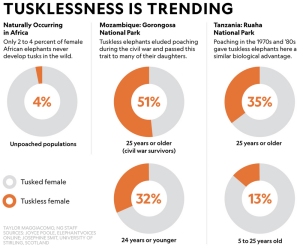
The few wandering elephants that roam Mozambique’s Gorongosa National Park are the lone survivors of their formerly large community, all bearing the indelible markings of the civil war that gripped the country for 15 years: Many are tuskless. The conflict, as well as years of prior poaching, killed off about 90% of these animals in order to satisfy a quota of ivory to finance weapons or for meat to feed the militia. 

From 1977 to 1992, both sides in the war hunted the elephant populations for their prized ivory tusks leading to their eventual plummet in numbers. This same activity very well may have set off an evolutionary response in the species that favored tuskless elephants as the species numbers began to recover. Nevertheless, despite the fact that lacking these tusks may have saved some from being poached, the genetic mutation responsible for eliminating the tusks is lethal in male elephants. As elephant numbers dropped from the thousands to mere triple digits, with around only 200 surviving in the early 2000s, many female elephants survived the poaching but were overlooked as they already were naturally tuskless. These elephants were then able to pass on their gene of tusklessness down to their offspring after the war ended. A study by Princeton University has shown that the proportion of tuskless females rose from 19 to 51 percent during the conflict, and statistical analysis indicated this was extremely unlikely to have occurred in the absence of selective pressure. This loss of tusks has been documented in many other places as well; Sri Lanka has less than 5 percent of their male Asian elephants having tusks. Details of the study were published in the research journal Science.

Scientists began collecting data on the elephants at Gorongosa National Park to research this amplified natural selection towards tuskless elephants, and it was then that they realized that elephants with no incisors were usually female. The park has never seen a tuskless male, suggesting the trait related to tusklessness is not only sex-linked but it will lead to the death of any male elephants that the gene is passed down to. 

Using 11 females without tusks and 7 females with tusks, a research team was able to identify the two mutations involved. One of the said mutations is most likely to be in a gene X chromosome called AMELX, which plays a part in tooth formation. This same mutation appears to affect other, crucial genes nearby. Since females would have two copies of the X chromosome, if one copy is not mutated, the genes will still carry their function normally and the elephant will be healthy. However, since males only have one X chromosome, the mutation will be deadly to any males that inherit it. “When mothers pass it on, we think the sons likely die early in development, a miscarriage,” says study co-author Brian Arnold, a Princeton evolutionary biologist, to the Associated Press. 

It is still possible that further genetic changes could occur to compensate for the lethality and males would eventually lose their tusks too, but for now, this does not appear to be happening. However, even the loss of tusks in females can have all sorts of consequences for the environment and the species at large. The main researcher at Princeton who was in charge of the study, Shane Campbell-Staton, stated that, “Tusks are basically a Swiss army knife for African elephants.” They use them to strip the bark off trees, to dig holes for underground water or minerals, and so on, says Campbell-Staton, so the loss of tusks may spare females from poachers, but make it harder for them to survive in other ways. On top of that, other animals in the ecosystem still rely on these tusked animals to survive such as using the same holes dug by the tusks to get water for themselves. As Campbell-Staton best said in his report, “there are all these cascading consequences that can result from our actions that are quite surprising.”


Featured Image

Sources: [1] [2] [3] [4] [5] [6]

Is This the Future for Human Organ Transplants?

0

Medicine is a forever evolving subject, and scientists and researchers are constantly finding new ways to find innovative solutions to challenging medical problems. One such solution regarding human organ transplants gained attention in the past week when pig organs were partially revived after death. This landmark incident has unlocked huge possibilities with concern to the future of organ transplants and xenotransplantation. However, along with every medical breakthrough the question that crosses many is whether or not this practice is ethical?

Where It All Started…

You may be wondering how research regarding humans and pig organs even came about. Initially, I also found it absurd how humans and pigs could have compatible organs. Therefore, the event that occurred on January 7, 2022 at the University of Maryland Medical Centre was shocking. On that day, 57-year-old David Bennet, who had passed away in March, received a heart transplant from a genetically modified pig. This is where the concept of xenotransplantation became heavily conversed about in the medical community. To clarify, xenotransplantation is when cells, tissues, and organs are transferred between species, and this concept came about in the 17th century. However, the idea of pig organs is still peculiar especially considering the controversy surrounding their “cleanliness,” and some religions also prohibit their consumption. Despite that, pigs became a strong contender for xenotransplantation as they can be raised in a safe and sanitary environment, have their organs genetically modified, and grown to the size needed. Economically speaking, pigs are also cheaper to raise and reproduce quickly in comparison to other animals. Pigs are also agricultural animals, so the Animal Welfare Act is not applicable. For these reasons, pig organ transplants became a reality.

How Pig Organs Were Partially Revived

In the previous section, I talked about how pig organs came about in human transplants. With that in mind, another discovery regarding pig organs has been found. That discovery was that researchers were able to partially revive the circulation and cellular activity in some vital organs of pigs. Once again, this has led to new ideas circulating about death and ethics. The research team from Yale University used technology known as OrganEx, and the experiments involved around 100 pigs that were given previous ethical approval. Down below are key points from the research and experiments:

  • The scientists anesthetized the pigs and stopped their hearts from beating
  • A mixture of 13 compounds helped their immune system and stopped the cells from dying 
  • The cocktail of drugs also suppressed blood from clotting 
  • Then a device is used to mimic the beating of a heart
  • After six hours, the team realized they were able to start cell repair on a molecular level demonstrated through spasmodic responses from the animals
  • Neck jerking was one major response from the pigs 

Breakthrough Discoveries

After six hours, researchers began to notice that the OrganEx technology allowed oxygen to flow throughout the pigs’ bodies. At the same time, their hearts displayed some circulation and electrical activity. According to David Andrijevic, a neuroscientist from Yale University, the heart had not completely restarted, but other organs such as the liver responded more to glucose. As a result, it is believed that the animals’ metabolism had started. Additionally, genes used for cellular repair became active in all major organs. Furthermore, techniques used in this experiment could make it possible for brain activity to be restored after death. All of these accomplishments can translate to a new future for organ resuscitation and organ transplants.

Ethical Dilemma

All of the research regarding pig organ transplants and reviving organs is definitely an ethical dilemma for the medical community and society in general. Instances such as these force us to go back and reevaluate our approach to death and to what extent we can go to save lives. Additionally, it brings up concerns about how we treat animals, particularly pigs, who are often not given the same attention and care as animals such as dogs or cats. Imagine another animal other than pigs being researched for their organs. Would our reaction be different then? One of the main ethical challenges that arise from this research is the fact that brain activity could be revived after one is dead. Furthermore, it could completely change how our society views death. Traditionally, death is associated with the moment in which all organs shut down. However, now death might be considered a process in which more research needs to be conducted on cardiac death and brain death. In the future, there will be many more discussions in terms of animal rights and our perception of death.


Feature image/ [1]/ [2]/ [3]


5 Habits To Start Off A Strong School Year! 

School is approaching sooner than we all may have anticipated. My summer has been going at a pretty fast pace, and realizing that I only have less than a month left until the next school year begins. The most we want to do is make sure we start it off right and strong without any mistakes. Developing good habits is crucial to becoming a successful student in anything and everything you want to achieve. Here are a few things that can help you become the best student you can be this year. 


  1. Sleep, Sleep, Sleep 

A lot of us may find sleeping an issue, especially during school time, as you have a lot of homework with extracurricular activities. I find that the main reason you may be losing so much sleep is not being able to divide our time right, you have too much on our plate, or might just tend to procrastinate. In every way there is a solution, but sleep is necessary. Statistics show that 7 out of 10 high school students are not getting the average amount of sleep they need or even less. This has a huge toll on grades and how you may perform on tests and exams. You may find yourself content with studying for hours, but with less sleep is that information really sinking in your head or are you just reading words. This is super important to consider, yet as well as understanding that not sleeping can affect your mood and how you behave with those around you. Respect is key, and it’s important to try to be kind to everyone. Even if you might not mean it, with the lack of sleep you may say something out of anger that you may have not meant to say. 


2. Practice Good Study Techniques

Schedules are keen to make sure you divide your time just enough to make sure you are able to complete everything within a certain amount of time. It’s the stress that allows you to finish the work, if you have a busy schedule. You could also use the pomodoro technique, which is a technique where you make 25 minutes of dedicated study time and have a 5 minute break. This goes in repeat until you have your work completed. Your mind is relaxed and you’re able to focus with the breaks that you take during your study time, and scientists have found that there have been more memory retention in students who do take a break after dedicated study time. This way you have the ability to complete your work without feeling burnt out, and find yourself more relaxed than usual.


3. Clean Space, Clean Mind 

We all may have heard that quote that goes, “clean space, clean mind”, but do we all really consider that into our lives? I’m sure some of you reading this may find yourself to be organized, and please continue doing that. On the other hand, some of us may tend to find ourselves with a messy room. This is very common, but studies show that the more messier your work area may be the more it affects your thinking and your work. I find that I personally get distracted very easily, and it was mainly because of the environment I created for myself. Organizing your space can help you find the things you need quicker, and sometimes makes it easier not to lose your homework, especially if it’s on paper. 


4. Exercise/Stretch Everyday 

Finding ways to stretch and get your body moving is super helpful when we look at memory improvement, concentration, etc. Becoming a part of sports teams can help you do this, or just stretching on your own time can make your body feel more ready and motivated to learn. Studies have shown that people who are engaged in any sort of exercise or sports teams increase performance in grades. This is again because of the improvement in memory and concentration we have discussed earlier. Not only that, individuals who play sports are more likely to be competitive (this doesn’t mean that people who don’t play sports can’t get high grades or be more or less competitive), due to how they have learned to play that sport. Winning is sometimes considered the main factor, and that could drive someone to do better at another subject with the same competitive mindset. 


5. Change Your Mindset

I’m a firm believer that in whatever you want to strive for it comes with mindset, and how your look at the situation you are faced in. Even if you might find yourself in a situation where you think you can’t do it, tell yourself you can. This can help, make yourself believe you can, and it will allow you to achieve it. A lot of people tend to believe that you have to be talented or born with an ability to achieve something, but creating an optimistic mindset in a situation that you think you can’t achieve can make life better than you may anticipate. 


*Note*: Having a mindset towards something does have some extent. If you are performing an activity and you are in a sort of pain that doesn’t seem right, please try to be safe during those situations. 


– Have an amazing first day of school!

Sources: Featured Image  1 2 3

Fast Fashion: The Monster in your Closet

Every second, a garbage truck full of clothing ends up in the landfill. Do you know what the impact is of the clothing you wear every single day?

The Impact of Fast Fashion

Producing a single cotton T-shirt consumes 2,700 liters of water. That’s equivalent to that amount of water that could sustain one person for 900 days. And for a single pair of jeans, it can take up to 7,600 liters of water. It doesn’t end there. The textile industry has immense negative impacts, and it is important to be aware of these impacts in our every day choices[3].

Among synthetic fibers, the most common is Polyester, petroleum-derived plastic. These synthetic fibers can take many years to degrade naturally, the “average polyester item surviving for at least 200 years”. Once these textiles end up in landfills or our waterways, they continuously negatively impact the environment. Clothing tends to release harmful chemicals and dyes, particularly when they end up in our waterways. 20% of global industrial water pollution is the result of material dyeing and textile treatment. Furthermore, 35% of micro-plastics in the ocean are from textile waste[4].

Many people believe that the majority of clothing is donated or reused. However, of the clothing that is actually purchased and worn by consumers, 87% ends up in the landfill or is incinerated. Considering the material used to make clothing, less than 1% is actually reused to create new items. Over time, countries have restricted the import of used clothing. For example, China has already enforced this ban, and many East African countries will soon follow suit.

What can you do to help?

  1. Make Eco-Conscious decisions
  2. Purchase better quality clothing
  3. Buy second-hand clothing
  4. Invest in sustainable fashion brands
  5. Do your research and understand the source of the fabric waste problem
  6. Look at the fabrics that your clothing is made of


While it may be daunting to think that all of the clothing in your closet has so many negative impacts, I hope this article helps in ensuring that you aware of this immense problem of fabric waste.

Featured image/ [1]/[2]

Sources:

[3] https://www.triplepundit.com/story/2013/it-takes-2700-liters-water-make-t-shirt/54321

[4] https://www.commonobjective.co/article/fibre-briefing-polyester

[5] https://www.bbc.com/future/article/20200710-why-clothes-are-so-hard-to-recycle

Familial and Medical Conflicts Surrounding the Declaration of Death

0

How much involvement can a family have in an individual’s medical matters, particularly when they are not conscious or in a clear state of mind to advocate for themselves? There are a multitude of ethical dilemmas that arise from this, and medical professionals are expected to respond instantaneously to these questions, as their decisions literally determine life or death.Tips for Job Hunters in the Medical Field - Just in Time Staffing


Healthcare for patients who reside, work, or travel overseas can become complicated due to different cultural values, such as the Confucian values of countries such as China and Japan. According to Western standards, patient care comprises disclosure of medical information, patient consent, and voluntary decisions under all circumstances. Furthermore, medical professionals must provide sufficient information regarding risks, benefits, and complications of procedures without coercion. And the patient must understand the disclosed information and decide by free will.


Japanese regulatory agencies have integrated these policies within their healthcare policies. However, Japanese medical professionals prioritize familial consent over individual consent. This is because of a cultural belief that authorities such as families and physicians know better than the patient and thus, can better support them through their treatment. Therefore, familial consent is prioritized when diagnosing and treating brain death.


However, because Western medicine values individual autonomy, physicians are faced with the difficult task of reconciling their Western training with familial consent. So, Asian physicians, particularly senior physicians, face a dilemma: can a physician disregard Western principles and prioritize cultural values, or should they endure cultural repercussions after following Western policies?

What Job is Right for Me in the Medical Field?

Older physicians face increased pressure to follow societal and cultural norms when making decisions related to mortality. Although some younger medical practitioners value individual consent over familial consent, many are expected to conform to Asian medical principles due to parental influence. Therefore, the younger generation of medical practitioners will be navigating more stringent cultural and societal norms. As such, it can be argued that medical professionals often struggle to find a balance between familial and individual consent when declaring brain death. 

1 , 3, 4 ,5

What is Just and Unjust? Comments on Contemporary Justice

Recently, I have been reading Book 1 of The Republic by Plato and have come across some interesting philosophical comments regarding how the perception of justice varies depending on an individual’s own thoughts, opinions, and life experiences. What one might see as good can be seen as evil by the other person and vice versa, which we regularly see in law and justice. Additionally, I thought some of the book’s ideas could be applied to the current circumstances we have been witnessing regarding what people view as just and unjust. Therefore, today I will be talking about what justice means in our society alongside some of my own opinions.

What is Justice?

As you may already know, justice is used in law, courts, and sometimes even subconsciously as we do everyday tasks. A textbook definition of justice would pertain to moral righteousness and that people receive what they deserve depending on their actions. However, just like any topic regarding ethics, justice also has many different aspects to it. To begin with, justice is perceived differently in terms of politics and philosophy. From a political sense, one’s sense of “justice” is impacted by their political views, whether that is more conservative or liberal. On a philosophical note, justice is viewed in a moral sense regarding if justice is something we owe to everyone we encounter and to what extent that might be. According to the Stanford Encyclopedia of Philosophy, in terms of individual ethics, justice is also seen as charity and mercy. All in all, justice has a variety of meanings and is not a simple concept.

How is Justice Perceived Today?

With the recent outcome of Roe v. Wade in the United States, it can be said that what a group of people, like the judges on the Supreme Court, believe as a “just” verdict in terms of basic women and human rights is not what a vast majority of people, including myself, believe to be justice or correct. What some of us believe as unfair and extremely detrimental can seem like a fair outcome to others. This is an example of how an individual’s political and religious beliefs can greatly impact their perspective of “justice.” With this in mind, there are countless examples of legal trials in history that provoke the question, “Was this verdict a true instance of getting justice?” Questions such as these make it difficult to decide what is just and unjust, but how is justice viewed today? An article titled What “Justice” Really Means by Paul Bloomfield accurately sums up how people don’t necessarily understand that they need to judge themselves and others fairly. In an effort to find the best verdict, we often forget that our opinion of “justice” also applies to our actions and not just those of others. Furthermore, an individual that is a poor judge of themselves cannot possibly be a good judge of others. I believe this is a flaw that we see in many political leaders and people who are in high leadership positions today. In the end, reaching justice in society begins with eliminating personal bias when approaching outcomes that impact millions of people.

Just and Unjust

In The Republic, by Plato, one of the main ideas is answering the question regarding how justice impacts a person’s life and what it means to live a “just” life. Plato creates the idea that it is more beneficial to live a just life rather than one ridden with injustice. However, I still have a lot left to read and learn from the entire collection of The Republic, and I will continue to question how justice is achieved in our society and how this concept came to be? Sometimes, I feel like we never truly know what is just and unjust as it is ever-evolving. I hope that after reading this, you have gained some insight into justice and come to your own opinions and questions. I encourage you to continue your interest in justice and ethics and your perspective regarding this matter through research and life experiences!


Feature image/ [1]/ [2]