Home Blog Page 60

BTS: The Cost of Nonconformity

0

Two times out of three, telling somebody that I am a fan of the seven-member Korean boy band, BTS, elicits a reaction rife with judgement, disdain, and snideness. Mostly, in these instances, I can know what assumptions these people harbour, because I have come face to face with it many times before, both online and offline. Things like oh, it’s just another boy-crazed teenage girl chasing after their silly pop songs and shallow, feel-good lyrics. It’s unlikely that she can even understand those lyrics, so why does she bother? But so what, it’s entirely in vain since they don’t even know she exists. Oh, and they’re probably gay anyway, I mean, what man flaunts around in that kind of makeup and acts like a girl? Hopefully, it’s just a phase. 

All in all, these assumptions stem from many, many prejudices that have been built up about the Korean part of BTS, about the boy band part of BTS, about the they wear makeup part of BTS, and many, many more. Most of these factors relate to the fact that BTS do not necessarily conform with people’s ideas of what should be taken seriously, or even be respected. That is what I want to talk about today.

Because this post is about the fact that yes, it could just be a phase, but who are you to claim that impermanence equates to insignificance when everything about life contradicts the existence of a permanent state of self? On what grounds can you claim to define what masculinity is or is not for a stranger, and what right do you have to wield queerness as if it is a weapon against others? Why do you assume you know what their lyrics are like when you obviously don’t respect their Koreanness enough to read through their Korean lyrics? Finally, why do you insist on viewing things that teenage girls and women enjoy as nothing but insignificant? These are all questions that I intend to explore through this post.

It’s Not Just a Phase — or is it?

Throughout much of history and pop culture, things that teenagers have shown interest in have been brushed off as insignificant by adults, as just a phase. Oftentimes, a teenager, who may feel as though they are not taken seriously enough will respond with defensive hostility.

However, an overlooked idea is one that proposes that maybe, just maybe… the fact that something is a phase does not make it insignificant. After all, if you truly think about it, one of the biggest lessons that many people have to learn is that as scary as it is, change is inevitable. Life is about phases, about different chapters, and about learning and growing from each of them. So who is to say that it is any different, or less important, because the person going through it is a teenager? Just because we are a little more confused, and a lot less experienced in life, does not mean that there isn’t something to be taken away from our experiences.

So to those who try to ridicule teenagers for liking certain things, or Armys (the official name for BTS fans) for liking BTS on the grounds that it is a phase, consider the following:

Perhaps we will continue to like this for many years to come, and perhaps we will lose interest in it very soon. However, regardless of the amount of time someone spends on something, the lessons, opportunities, and even just instances where they felt an open, inclusive community, will not disappear. Often, the most impactful of events happen in the briefest of moments, so it is about time for us to retire the idea that it is just a phase means it is unimportant, and it will pass soon. If we all adopt the idea that impermanence is not insignificant, I believe that a lot of unnecessary judgement, regret, and clashes can be avoided.

An Outdated Definition of Masculinity (And Queerness is Not Your Weapon)

One of the ways that people most often try to ridicule BTS and their fans is through insults relating to their identities and masculinity. They ridicule them for the makeup and outfits that they wear, the way they carry themselves, and even things like their vulnerability in talking about things like mental health and self love in their music. Above all, the problem lies in the fact that people will stick labels such as “girly” and “gay” onto them, as though those are derogatory terms.

The issue lies within things like the perpetuation of toxic masculinity, misogyny, and the harmful stereotypes that lead to the emasculation of Asian men in the Western world. 

Through the lens of toxic masculinity, BTS are treated as “less than” because they do not embody the harmful expectations that men should be physically strong but emotionally closed off, as well as aggressive, anti-feminist, and even discriminatory against those who are not cishet. This leads to the reasons why people slap the label “gay” onto BTS members; because through toxic masculinity and heteronormativity, gayness is seen as an insult. Through these standards, stereotypes like makeup and certain manners of dressing are immediately equated to queerness. Of course, if any of the BTS members happen to be queer, that is entirely alright and entirely their own, private, business. That is not the problem at hand. The problem at hand is that a bunch of people have it ingrained into their minds that being queer is a bad thing, and that is what we need to fix. Not to mention, slapping a label onto people that assumes that they are queer is a whole other problem regarding harmful assumptions, the loss of autonomy and their voice, and the possibility of outing someone when they are not ready or not in a safe environment to be outed.

Similarly, people jump to insult BTS with the use of misogyny, harming not only them, but many others in the process. The use of the word “girly” in a derogatory manner perpetuates the idea that girls and women are less than men, which is why being girly is seen as an insult. Though unfair to them, this has less of an effect on BTS themselves, who are entirely comfortable in their identities, and is more harmful to the public audience who may be conditioned into thinking that it is an insult to be girly. 

Finally, there is the issue of the emasculation of Asian men. This dates back to the mid-19th century, when there was an influx of Asian, mostly Chinese people immigrating to North America. These Asian immigrants were seen as a threat to Western, eurocentric culture, and thus, the depiction of Asian men as emasculate, effeminate, and even asexual was started. This idea has evolved and faded somewhat throughout the last 150 years, but has still stuck in North America, especially in depictions of Asian men in media. In the 20th century, Asian men were often portrayed as weak or villainous, and even in our present-day media, there are long lasting stereotypes that paint Asian men as emasculate and unattractive. These issues are present in the lives of many Asian-American and Asian-Canadian men today, and when these same stereotypes are used as insults against figures like BTS, they only serve to do more harm.

The Implications of a Boyband

Throughout the last few decades, boy bands have risen and fallen in different parts of the world. However, if there is one thing they all have in common, it is that they are not taken very seriously within the music world. Even a legendary, world-renowned band like the Beatles were originally not taken seriously by most people. 

Why, you may ask? Well, that is because boy bands historically have female-dominated fan bases, and that is the exact reason why people do not tend to take them seriously. I’m sure we’ve all heard, somewhere or another, the idea that boy band fans are just some crazed-teenage girls who only follow the bands because they are made up of attractive boys and men. These assumptions and implications were there when the Beatles became famous because of young women, and they are here now when BTS have become famous. Despite the fact that the majority of BTS’ fan base is made up of adult women in their 20s and 30s, they are stuck with the label that all their fans are hysterical, screaming teenage girls. Within that lies a few problems. 

Essentially, the problem of teenage girls showing their enthusiasm and gratitude at, say, a concert in the only way they can, through screaming and shouting lyrics, is all but reduced to the idea that they are hysterical and not to be taken seriously. This idea of hysterical girls and women goes back to the idea that women are overly-emotional, and should not be taken seriously. This can be harmful in that when a woman or girl tries to voice her feelings and emotions, or tries to have a serious conversation about anything that she feels the slightest bit emotional about, she can be dismissed with the idea that she is merely hysterical, or her concerns being reduced to something like, “it’s probably her just time of the month.

As a last thought, here is an interesting observation. There are many, many similarities between boy band fans and sports fans. These are things such as a strong sense of community, screaming fans (at concerts or games), buying and collecting merch, intense passion and loyalty, and being emotional over teams, athletes, idols and bands. In most parts, both are similar, except for one interesting factor: sports fans tend to have a prevalence for violence. However, these shows of violence, such as rioting when a team loses, are dismissed even when a little screaming from boy band fans are deemed as hysteria. This is because while boy band fans are mostly made up of females, sports fans are mostly made up of males. And that, ladies, gentlemen and nonbinary folks, seems to make all the difference in the world.

Dismissal on the Grounds of Foreignness

Finally, the last topic I would like to talk about is the impact of BTS’ Koreanness. BTS are a Korean band, as we all know. All seven members of the band; RM, Jin, Suga, J-hope, Jimin, V and Jungkook (their stage names, not their given names. You can think of them like pen names that authors give themselves) were born and raised in South Korea. Their native language is Korean, and so they speak, write, sing and rap mainly in Korean. This seems to have an effect on the way people view them—namely, through lenses of thinly veiled racism and xenophobia, not that many even attempt to hide it in the slightest.

In February 2021, German radio host Matthias Matuschik commented on BTS’ cover of Coldplay’s song, “Fix You,” calling it “blasphemy” and proceeding to compare BTS to the coronavirus.

Just a few months later, in April 2021, a comedy program from Chile did a parody where they dressed up as BTS and took it upon themselves to mock the Korean language by speaking gibberish, compare BTS to the North Korean dictator, Kim Jong-un, and yet again, joke about their connection to the coronavirus.

These are not the first, nor the last times that BTS have been victims of racism and the like. BTS are proud of their Koreanness, which they have spoken about in depth. In fact, in 2018, they were even the recipients of the Order of Cultural Merit, an award given out by the Korean government to those who have spread and promoted Korean languages, culture and customs around the world. However, these two examples out of many instances of hostility and racism speak to the fact that there is a long way to go. With the surge in anti-Asian hate crimes in the last few years, triggered in great part by the pandemic, it is more pressing than ever that we do not dismiss any of these issues. 

As we have seen in this entire vlog, problems that affect BTS such as toxic masculinity, misogyny, racism and xenophobia do not only affect them, but the rest of the world as well. And by looking at the way that the members of BTS have approached these topics and issues through their music and their advocacy, we can all learn a few valuable lessons. It does none of us any good to dismiss something on such trivial grounds like stereotypes that are hardly grounded in facts. I do not think that everyone should love BTS and their music, in fact, I believe that that is impossible. Each individual has a different preference, and some do not even listen to music. It is unfair to ask that everyone feel the same way about something as I do. However, through acknowledging their presence in the world and the things they go through without the barrier of assumptions and stereotypes, I believe that we can grow as people and a society.

Hopefully, through this blog post, you have learned something new. Thank you for reading!


Featured Image

Sources: 1, 2

Book Recommendation: The Life of Pi

Do you want a “story that will make you believe in God?”

Then, read Life of Pi, which delivers exactly this motto, promised at the beginning of this story. I won’t spoil the book for you, but let’s just say its about a boy surviving in the middle of the Pacific Ocean on a lifeboat, with an adult Bengal Tiger. And you won’t be disappointed.

Here’s a summary of the first part:

At the beginning of the story, we are introduced to an author who presents the very interesting story of how he ran into the story of Pi’s life with a man in a coffee house who says it is, “a story that will make you believe in God.” Then immediately after Chapter 1 begins, where the author interviews Pi and the actual book starts from hereon. 

Pi, fully named Piscine Molitor Patel, is brought up in Pondicherry, India, to parents embodying perspectives of a “modern India.”  His father is the owner and is the zookeeper of Pondicherry Zoo, where Pi often spends his time and gets to learn new life lessons. Oftentimes, Pi observes the animals in the zoo and their nature; for example, goats and hippopotamus live together in the zoo in the form of companions, zoomorphism, which is one the instances demonstrating the peculiar interactions between animals.

Throughout his childhood, Pi is also a person with very diverse, somewhat unconventional interests in different books, philosophies, and religions. He comes across all three religions, and becomes a practicing Hindu, Muslim, and Christian, all while he struggles with understanding the concept of God. Despite the objections from the priest, pandit, and the pope, who requests he chooses only one, Pi begins to practice all of these religious paths. 

Towards the end of this section, Pi talks about the political turmoils occurring in India due to Indira Gandhi, and his family having to leave Pondicherry due to it. He talks about all the processes that occur in transferring the Zoo (the paperwork, files, and letters) and the emotions involving moving from somewhere that he has been all his childhood. Eventually on June 21st, 1977, Pi and his family leave from Madras to Canada, sailing through the cargo ship Tsimtsum, in an experience he calls “terribly exciting.” 

The rest of the adventure continues from here.

Read or watch Life of Pi to find out more…

Featured Image

The Art of Show, Not Tell

0

Most of us, whether during a school class that you reluctantly sat through, or as an aspiring novelist or creative writer, have heard the saying “show not tell.” You may find these three words largely unimportant to your everyday life, or think that they are the most fascinating, useful piece of writing advice that you have ever heard. However, regardless of all of that, the idea of showing instead of telling is a vital part of creative writing of any kind. So, here are some useful little tidbits that I have learned about show not tell throughout my (admittedly short) journey as a creative writer.

What is “show not tell,” and how can we better understand it?

When seeking writing advice, one of the most common things that people hear is to show not tell. However, that idea can be difficult to understand at first, especially when no one takes the time to elaborate on the concept. Hence, here is a quick rundown of show, not tell.

Show not tell is a writing technique where the writer describes what is happening in a story, using descriptions to evoke emotions and lead the audience to conclusions and assumptions, without telling them point blank what is going on, or how they should be feeling.

Another way to look at it could be through the idea, “describe, don’t explain.” I first came across this through published writer and Youtuber, ShaelinWrites’ video, “My Top 12 Writing Tips! | Advice That Changed How I Write.” Although it is essentially just a simple rewording of the more well known phrase, it can help to see things in another perspective. Additionally, for someone who struggles more with things such as forming images in their heads or imagining scenarios, “show not tell” can be very confusing, whereas “describe, don’t explain” can make everything finally click, just as it did with me.

Now that we hopefully have a better understanding of show not tell, let us move on to the tidbits!

The Bigger the Issue, the Smaller You Write

There is a quote from American novelist Richard Price that can give a valuable insight into writing. He said: “The bigger the issue, the smaller you write. Remember that. You don’t write about the horrors of war. No. You write about a kid’s burnt socks lying on the road. You pick the smallest manageable part of the big thing, and you work off the resonance.”

Think about some of the most revealing or impactful moments that you have seen or read. Did they come from some vague description of overthrowing an evil oligarchy that dominates over the kingdom, or a drawn out explanation of how the protagonist’s mother was absent throughout a large part of her life? No, that was likely not the case. In fact, the things that tend to stick with an audience are more likely to be the satisfaction of seeing that one vile, overpowered antagonist finally being thrown over. Or that devastating moment when there is a wholesome interaction between a mother and child, and the camera pans over to the protagonist who is happy for them, yet is recalling painful, lonely memories of her own mother, and yearning for that kind of a relationship herself.

Essentially, the key in making an audience emphasize and feel engaged with your story is to give everything a face. Yes, it is bad to have characters and scenes that do not help move the story forward, but even worse than that is to explain to your audience that they should care about something without actually making them care. They will know what you, the author, want them to feel, but they won’t actually feel it. In fact, they are more likely to feel that the author underestimates their ability to infer and pick up on things, or disengage them from the story entirely, which is the absolute opposite of what you want to happen. It is much easier said than done, but you must find a balance between giving a character enough of a face and purpose to get your audience engaged, but do not try to explain the story to them as if they are children. Once again, show not tell. Describe, don’t explain.

Matching Perspective and Experience With Description

Understandably, while you are writing an exciting, fast-paced scene, you may want to describe all the exhilarating scenes in great detail, and not risk your audience not knowing every single thing that happens. Similarly, when writing a slower, more boring scene, you may feel the need to speed things up so that you can get to the exciting parts as quickly as possible. However, my advice is that you do the exact opposite of that.

You see, if you want your audience engaged, you must carry them away, and make them feel as if they were truly a part of your story. A valuable thing to keep in mind is that if you want to sweep people off their feet and straight into your fictional tale, you must be believable on all levels. This includes things that are significantly less obvious than thrilling descriptions of action and moving declarations of unconditional love. To match the level of description to the perspectives and experiences of your narrator. 

Think about this: what kind of person is your narrator? What kind of things would they notice, and what would they be oblivious to? If your narrator is someone who is a little clumsy, always in a hurry, and with their heads in the clouds, would they be the sort of person to notice minimal changes in someone’s body language that could indicate interest or attraction? If your character’s survival or career has depended on observation skills and manipulating people, would they really be ignorant of as many things as the average citizen? Descriptions of a scene should tell people what is going on, but they should also very much stay in character. A 12 year old child will have an inner voice that differs from a 16 year old athlete, and one that is not even close to the inner voice of a two thousand year old god.

Additionally, the amount of description in a scene should fit the experience. If your character is frantically fleeing from an authority figure, trying not to panic or make a slip up, they are more likely to notice the sparsest details of their surroundings. Perhaps how cold the air is as they sprint through the field, but not necessarily the suspicious nature of a young man, looking on from an alley. If your character is sitting alone in the brief “calm before the storm” period of the story, they have the time, space and interest to mull over the littlest details of the story. They are likely to reflect on what has happened so far, notice what is going on around them, and even stress over what may happen in the future.

Practice Descriptions Without All Five Senses

On another note, something that can really help improve your more descriptive scenes is to describe the entire thing without the use of one of the five senses. Often, the most widely used sense in writing is visual description, so we can use that as an example. You can write something from the perspective of a blind character. How would they notice things, or feel them, without the aid of a sense that most of us take for granted, not only in real life but also in media? How would a blind character react to the stimuli of the world around them? How would they notice the sounds, tastes, smells and feels of the world around them? This exercise can teach you to describe something, instead of seeing it and explaining it. You can polish up your ability to show things through the use of your select few senses, instead of telling the audience what is happening.

Write Around the Egg

Say someone gives you a sheet of standard white paper and a box of coloured pencils. Say they ask you to draw them an egg. You may have some concerns, such as if you don’t feel very confident in your drawing skills, or if they set a time limit that you don’t think you can match. However, a concern that you likely wouldn’t have is that you do not have a white pencil. To draw a white egg on a white paper, you do not need a white pencil. Instead, all you need is the colours to draw around the egg. The dark shadow that a light casts on one side of the egg. The yellow luminance of said light shining on the egg, and the reflection of a checkered cloth that you can see in it. You don’t need to colour the egg in with white, because we all know that the egg is white. Not to mention, the details around the egg tell us all that we need and more.

Writing is similar to this. We will know that having a boyfriend makes our character happy. So don’t tell us how much he loves his partner, or how overjoyed he is to have patched up an argument. Show us how he lights up when his boyfriend walks into the room. How his worries and concerns seem to melt away in the presence of his partner. How his eyes shine, and he becomes more determined than ever to achieve his goal, and how the boys express their love in tender, unspoken gestures. If you must have your characters kiss, or be intimately affectionate for the audience to understand that they are in love, you haven’t described it very well. Because through descriptions of a comfortable banter, or the way one looks at the other, you can write around the relationship and describe the love. It is a writer’s way of drawing around the egg.

Clear Before Clever

Finally, the last thing to keep in mind is that the most important thing is for your audience to understand the story. Yes, using big, fancy, “fifty cent words” is fun and appealing. However, big words are not what make you sound more intelligent, or what engages the reader. Those things are achieved by clarity, and clarity only. Knowing what you want to write, having a distinct author’s voice, and other such things are what really keeps a reader engaged. In fact, if your reader needs to put their book down every few paragraphs in order to look something up in a dictionary, it takes away from the experience of feeling like they are truly within the story. So, never forget the importance of show not tell, but never give up your clarity for cleverness.


Featured Image

Cover Me In Ambrosia: A Poem

Cover me In Ambrosia: A Poem


A diverging river flows through my delicate fingers,

tracing the lines of my palm like my mother once did.

On one side the river turns to silky gold,

gliding slowly along the imperfections of my skin.


Liquid gold, Me, Oil pastels, 2020 : r/Art I like to imagine this river pooling into a kantharos,

filling it to the brim with its rich golden hue.

I wish it would flow through my body like ambrosia,

Mend the wounds in my soul, and call upon my youth.


The diverging river flows from my hands to my body,

but the river of gold leaves only a trickle behind.

The larger side of the river turns to a murky sludge

and wraps me deep within its tainted liquid.


I wish this river would evaporate into the air,

leaving its role as a stifling Shirt of Nessus.

Instead I wait…

I wait trapped under a slurry of mud-stained hemlocks,

longing to be something more healing,

something more admirable,

something more like the very ambrosia,

we covered up and suffocated.


Featured image1/2/3

The Gender Inequality Crisis in Sports

With the FIFA Women’s World Cup just on the horizon the discussion around gender inequality in sports has become more and more popular, and for good reason. Women’s sports teams and players have faced discrimination for decades. They have been given less funding them men’s teams, less advertising and less opportunities.

The effort to bringing girls and women into sports has only started recently. In some places sports are still seen as something only men can do, more needs to be done to fix this way of thinking.

Another huge problem is the difference in wage gap for female athletes. Many people use the argument that men’s sports are watched more so from this they get more money but what they don’t consider is that women’s sports aren’t advertised as much as men’s sports so they receive less coverage and this results in a smaller paycheck. A study from USC/Purdue University found that the major sports broadcasting network, ESPN, has only 5.7% of their program consisting of women’s sports. This was in 2021! Sports new is almost always showing men’s sports. Discrimination like this is common and something needs to be done about it.

Luckily advocacy for change has been happening and with Women’s March Madness bringing in more fans then ever and the Women’s World Cup starting soon we’ll get to see talented female athletes thrive in a equal, welcoming environment.

SOURCES: 1, 2, 3

Featured Image

Tips on Effective Note-Taking

As a student, one of the main challenges is creating notes and establishing a study routine that will maximize your time and grades. Traditionally, many of us may gravitate towards passive study techniques, such as re-reading notes or the textbook. This may work for quizzes, but for unit tests or final exams with more experimental questions, active learning produces better results.

What is Active and Passive Learning?

Active learning involves engaging in your course material by asking questions, mind-mapping, and doing active recall sessions. This allows you to memorize and learn information engagingly. For instance, day one can involve reviewing information in your notes by highlighting and assigning specific colours to separate topics. On day two, before you start reviewing again, take a blank piece of paper and try to write down as much information as you can remember from the last day’s study session. Promoting this type of thinking allows for a better understanding and application of knowledge. 

  • Take additional notes in your own words during class 
  • Create flashcards by turning topic headers into questions 
  • Take into consideration research, experiments or other literary work that connects with what you are learning 
  • Ask questions about topics you are unsure about regularly 

Passive learning involves attending class and then re-reading material before the test. This learning style fails to develop critical thinking skills to the same extent as active learning. As a result, there may be discrepancies in learning by the time the final comes up.

Note-Taking Tips

Cornell Notes: This note-taking method involves creating separate sections for essential questions, vocabulary, questions, and an overall summary. 

Concept Maps: This involves taking the main concepts from the unit and creating a visual representation. Some examples include diagrams, vocabulary, and formulas. I like to use concept maps for science classes as often the units connect with an overarching idea. 

Charts: Great for summarizing multiple points and comparing concepts. 

Visual Notes: Diagrams that are engaging and memorable can be handwritten or digital. 


When taking notes, it is essential to focus on the main idea. Therefore, it would be a good idea to paraphrase and create your own shorthand to retain information. Creating topic lists and questions from the unit targets is very beneficial. AI is another tool you can use positively for your studying benefits. For example, if you are short on time, you can ask chat-bots, such as ChatGPT, questions about your topic. As a result, it will generate questions for you. You can then transfer these questions to a study guide and answer them periodically while studying. I also like making my online flashcards using Brainscape or other pre-made ones from various platforms. You can also use online resources such as Crash Course, MIT OpenCourseWare, The Organic Chemistry Tutor, and Khan Academy. For subjects such as biology, Khan Academy has some great practice questions and summarizing articles. Overall, I hope you find these study and note-taking skills helpful. 


Featured image: [1]

[1]/[2]/[3]


The Rise of Violent Crimes on Calgary Transit

0

On April 12, a man was taken to a hospital in a near-death condition after a shooting on a Calgary Transit bus. On March 28, at the Lions Rail LRT, two women were stabbed after a dispute with several people. On March 15, police found a man and women with stab wounds at an LRT station in downtown Calgary. These are only three of many violent acts that have been on the rise in Calgary for the past few years.

For many people traveling on public transit, especially through the downtown fare free zone, a single trip has become a dangerous risk. For more vulnerable demographics, such as women, disabled folks, Indigenous people and other POC, an already lingering fear for their safety has only sky-rocketed.

As a brown, teenage girl who relies on public transit to get to places like school, libraries and volunteering opportunities, it is impossible to relax, even during the 1.5 to 2 hour rides that I must take sometimes.

For many people, taking transit it not a choice, as Calgary is a massive city, and not everyone has access to a car. For these people, the best solution is to tackle the problem at its core.

These problems arise due to things like gun violence and drug abuse, but the core of the problem truly lies within Calgary’s homeless crisis, largely related to critical gaps in mental health care.

Violence within Calgary’s public transport system is relevant to every Calgarian, despite the fact that it may seem distant to those who have access to cars. It is up to us all to work together to tackle these issues, and speak up about how they may be fixed.


Featured Image


Career Day! – Awesome opportunity for Calgary students

Hello! I brought some exciting news for you!
If you want to investigate various careers or learn more about specific careers, I have a fantastic opportunity for you!

“Career Day” represented by the Calgary Mayor’s Youth Council, Careers and Opportunities subcommittee!

As a part of the MYC Careers and Ppportunities subcommittee, I am more than excited to introduce this opportunity.

This event will be held on Saturday, April 29, 1:30 PM – 5:00 PM at Westhillhurst Community Center (1940 6 Ave NW, Calgary, AB T2N 0W3), with various panels, including medicine, art/humanities, STEM, and miscellaneous. Exciting careers such as doctors, engineers, entrepreneurs and more!

If you are a youth in Calgary and want to get informed about career paths and discover what you are passionate about, please complete this form to register: https://docs.google.com/forms/d/e/1FAIpQLScubQFoZFQT-z47I9lbA678f0n7IbMcsajiHWclinU2HE2u8g/viewform

We hope to see you there!


Quantum Electrodynamics; A In-Depth Overview

Introduction

Should we describe our universe in classical terms or quantum terms? This question has sparked a lot of debate and the correct answer varies drastically depending on who you ask. But what if we could find the perfect middle? A way to describe our world with a mix of classical and quantum physics. This is called Quantum Field Theory (QFT). QFT is the blanket term used to describe the theories that combine elements of quantum mechanics with those of relativity and that aim to describe the interactions and behaviors of subatomic particles and force fields. 

Arguably one of the most precise and successful QFTs is quantum electrodynamics (QED). QED was the first QFT developed and its aim is to mathematically describe interactions of charged particles with themselves, with the electromagnetic field and light with matter. The theory’s foundation is the idea that there is not a continuous field but instead charged particles interact by the exchange of virtual photons. These photons are called virtual because they cannot be seen or detected as that would violate conservation of energy and momentum. The exchange of photons is a “force”. This idea of virtual particles has also been carried over into other theories that deal with fundamental interactions of matter. 

QED has a rich history, effective and simple mathematics, and a plethora of useful applications. 

History

In 1925 Paul .A.M. Dirac, an English physicist, read a paper by Werner Heisenberg that initiated the change from the Bohr atomic model to a new idea, quantum mechanics. This led him into his fascination with the quantum world and in 1926 Dirac’s Ph.D. thesis was all about his additions and developments on Heisenberg’s theory. In a few years he published a groundbreaking equation, one that would do something that had never been done before. He discovered a wave equation that incorporated both special relativity and quantum mechanics. We now call this equation the Dirac equation and it helps us study the motion and spin of electrons. This event kicked off the discovery of QED.

Along with helping in the creation of QED, in the 1940’s and ‘50s Feynman created a tool that has helped us visually explain particle interactions. He created the Feynman Diagrams. In quantum electrodynamics it helps us to visualize and calculate interactions between electrons and photons. 

The Dirac equation was discovered in 1928 and in the late 1940’s three scientists, Richard Feynman, Julian Schwinger, and Tomonaga Shin’ichirō, independently built a quantum theory of electromagnetism with the help of his equation. There were some faults in Dirac’s equation so all of these scientists found different ways to look at the problem so that they could solve it. They were awarded a shared Nobel Prize.  

Mathematics

Figure 1


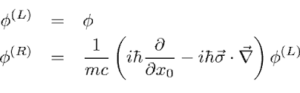
The Dirac equation (see Figure 1) laid the ground for QED. Its main purpose is to explain the spin of electrons. He said that spin emerged as a property of an electron, a property that is both a quantum particle and a relativistic one. His equation also predicted the positron, what Dirac called the “anti-electron”. If an electron meets a positron the two positive and negative charges cancel, the pair annihilates, and the mass turns into radiation, an exact representation of Einstein’s E = mc2. The equation has four wave functions. 

Julian Schwinger was a participant of a meeting where data was presented that contradicted Dirac’s equation. From there Schwinger made a calculation that incorporated notions of mass and charge re-normalization, a calculation that connected both theory and experimental data. This breakthrough was vital. Tomonaga Shin’ichirō and Richard Feynman also discovered and carried out calculations similar to this and in 1965 all three of them shared a Nobel Prize.

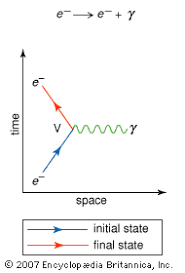
A Feynman diagram has one axis that represents space, the horizontal one, and the other axis, this one being vertical, represents time. Straight lines depict fermions–particles with half-integer values of spin, like electrons–and wavy lines represent bosons–particles that have integer values of spin, like photons. An interaction of particles is shown as a vertex of three lines. For example, the path of a basic electron as two straight lines intersected with a wavy line where the electron emits a photon (see Figure 2).

Figure 2

Applications

The most notable use of quantum electrodynamics is to explain the world around us. It helps us understand how light and matter interact, and how electrically charged particles interact with each other. It is a widely taught subject as the joining of classical and quantum is our future and many other quantum field theories have been modeled after QED. 

If we dissect the elements of QED then each of them have various other uses like, for example, the Dirac equation also helps scientists predict the existence of antiparticles. Like mentioned before the Feynman diagrams help explain all particle interactions and along with that give physicists a way to make very precise calculations on the probability of any process. 

Conclusion

Quantum electrodynamics is an amazing tool to help us look at and understand the world in a new way. It shows us that electrons and positrons–or any other charged particle–interact by emitting and absorbing photons. It is one of the most successful, simple and accurate quantum field theory so far devised. It is clear that quantum electrodynamics is a vital part of quantum physics. 


Featured Image

How to Expand Your Writing Vocabulary

“All of us possess a reading vocabulary as big as a lake but draw from a writing vocabulary as small as a pond.”

– Roy Peter Clark

Have you ever caught yourself using the same words over and over again in a single piece of text? Or perhaps you’ve been wanting to write and speak more eloquently, but don’t know where to start? Well fear not, for I have some vocabulary building tips that may just help you out!

Save New Words

Over the years, as we’ve all grown closer to the language, there have probably been less and less instances of coming across a word which you don’t know. However, in cases where that does happen, it can help to save the word. A quick search online or in a dictionary will give you the context you need when reading, and if it seems like a word that you’d use in your own writing or speech, take a screenshot or write down the definition. It really can come in handy when you least expect it!

Create a Vocabulary Journal

When I first heard of a vocabulary journal, I didn’t quite know what to expect of it. However, I’ve found that it has helped me quite a lot. Somewhat drawing on the previous point, you may eventually gather a massive pool of words that you don’t really know what to do with. Maybe you’ve gotten into the habit of using a handful of words, but have forgotten most. That’s completely fine — in fact, it would be absurd to expect you to immediately memorize every single new word. That’s where a vocabulary journal can come in handy.

A vocabulary journal can really be customized in any way to suit each individual. Personally, I don’t only stick with words that I do not know, but also use words that I do know, but would like to further ingrain into my daily vocabulary. Take, for example, the word ‘archaic.’ By the time I had added it to my journal, I had a vague idea of its appropriate use and meaning. To me, it is a fascinating word that can be used in awe striking and chilling ways. 

An entry to my vocabulary journal essentially looks like this:

Archaic – adj.
Very old or old-fashioned, no longer in everyday use.
Example sentence: “A term with a rather archaic ring to it” – Oxford Languages
Practice sentence: “Her eyes swept over the grand buildings, dusty and archaic in a way that should not be tainted by modern-day greed. They looked just as they had in her memories, and her chest clenched with something painful as she surveyed the landscape.”

Essentially, I write down the word and definition, then find a use of it, usually from a dictionary. Finally, I write one or two sentences using the word, and then occasionally come back to it to really familiarize myself with the word.

Make a List of Synonyms

Often, I find myself unintentionally using the same word over and over again in my writing. More specifically, I tend to use the term “as though” and similar iterations of it multiple times in one paragraph alone. In a situation like this, I’ve found that a list of synonyms helps. Ever since I learned how to use one, the thesaurus has been my best friend, more so than even a dictionary.

However, to prevent yourself from having to pause in your writing to look up synonyms for a word online, it may just help to put together a list. The first thing you should do is to go through your writing, and identify those words and terms that you seem to use repetitively. Take my example of “as though.” My synonym list for that term consists of words like similarly, akin to, evidently, such as, and namely. These lists have sped up my writing speed by taking away the time when I have had to stop to search up synonyms.

Download Vocab Apps

The last piece of advice that I have for expanding your writing vocabulary is to download a word of the day app, or even one with flashcards so that you can practice the vocabulary that you already know. In a way, this trick is similar to learning a new language.

A word of the day app can introduce you to new words and meanings within a relevant context, and you can take screenshots to use later in a vocabulary journal, or put into flashcards and sentences.

Enjoy the Writing Process

Though it is a sentiment that has become somewhat of a cliché, it is still very true. Expanding your vocabulary and practicing with sentences, entries, and other methods are all things that help you to further enjoy and immerse yourself into your writing. Never forget that practice is the best way to improve, and through understanding the context that a word belongs in, and the time and place to use each synonym, you can become better spoken, better received, and considered more cogent.


Featured image

Let’s self-appreciate today!

Self-appreciation is an essential aspect of our lives that often goes overlooked. It is the act of recognizing our worth and value as individuals, regardless of external validation or accomplishments. While self-appreciation may seem trivial, it can have a significant impact on our mental and emotional well-being. In this blog, we will explore the importance of self-appreciation and offer some tips on how to practice it, specifically for teenagers.

As teenagers, it is common to feel like we don’t measure up to the expectations set by society, our parents, or even ourselves. We may struggle with low self-esteem, self-doubt, and a negative self-image. However, it is important to remember that our worth and value are not determined by external factors, such as our grades, social status, or physical appearance. We are all inherently valuable and deserving of love and respect, regardless of our achievements or circumstances.

One of the first steps towards self-appreciation is to practice self-compassion. This means treating ourselves with the same kindness, understanding, and empathy that we would offer to a friend who is struggling. When we make mistakes or fall short of our goals, it is important to remind ourselves that we are only human and that it is okay to make mistakes. We can offer ourselves words of encouragement, such as “I am doing my best,” or “I am proud of myself for trying.”

Another way to practice self-appreciation is to focus on our strengths and accomplishments. While it is easy to dwell on our shortcomings, it is important to celebrate our successes, no matter how small they may seem. This can include academic achievements, personal goals, or even acts of kindness towards others. By acknowledging and celebrating our accomplishments, we can boost our self-confidence and reinforce a positive self-image.

It is also important to practice self-care as a form of self-appreciation. This includes taking care of our physical, emotional, and mental well-being. This can involve getting enough sleep, eating a healthy diet, exercising regularly, and engaging in activities that bring us joy and relaxation. When we prioritize our own needs and well-being, we send a message to ourselves that we are deserving of love and care.

One of the most challenging aspects of self-appreciation is learning to accept ourselves as we are, flaws and all. It can be tempting to compare ourselves to others or strive for an unattainable standard of perfection. However, it is important to remember that everyone has their own unique strengths and weaknesses. By accepting ourselves as we are, we can cultivate a sense of self-love and self-respect.

Another way to practice self-appreciation is to surround ourselves with positive influences. This includes spending time with friends and family who support and encourage us, seeking out mentors or role models who inspire us, and consuming media that promotes self-love and body positivity. By surrounding ourselves with positivity, we can counteract the negative messages and societal pressures that can erode our sense of self-worth.

Finally, it is important to remember that self-appreciation is an ongoing practice. It is not something that can be achieved overnight, but rather a mindset that we must cultivate and reinforce over time. It is important to be patient and compassionate with ourselves as we work towards a healthier and more positive self-image.

In conclusion, self-appreciation is a vital aspect of our mental and emotional well-being. As teenagers, it can be especially challenging to cultivate a positive self-image in the face of societal pressures and personal insecurities. However, by practicing self-compassion, celebrating our strengths and accomplishments, prioritizing self-care, accepting ourselves as we are, surrounding ourselves with positivity, and being patient with ourselves, we can begin to cultivate a sense of self-love and self-respect.

featured image

Image 1

Welcome to Calgary, Matt Coronato!

On Sunday, March 26th, 2023, Matthew Coronato signed a 3-year entry-level contract with the Calgary Flames. Coronato, who flew to join the team on Monday, was drafted 13th overall by the Flames in the 2021 NHL Draft.

In his draft year, Coronato scored 48 goals in 51 games for the Chicago Steel in the USHL. After being drafted, he spent two seasons at Harvard University – tallying 72 points in 68 games over that span. Coronato also represented Team USA at the 2022 World Juniors, putting up seven points in five games.

Matt Coronato carries the puck up the ice for Harvard University.

Matt Coronato, a right-handed shot, has played at both center and right wing throughout his career – and he hasn’t failed to produce at either position. Given his position, handedness, and nature as a pure goal scorer, Coronato resembles the likes of Tyler Toffoli and Elias Lindholm, the latter of whom has also served as both a center and right wing during his time in Calgary. During an interview that followed Coronato’s signing, Calgary Flames Head Coach Darryl Sutter compared his play style to Andrew Mangiapane, another young winger with a knack to find the back of the net. 

Defenseman Rasmus Andersson (left) at practice with Matt Coronato (right).

In past years, the Flames have been short of goal-scoring talent, especially on the right side. While players like Tyler Toffoli have recently stepped up in that regard, Coronato’s value to the Flames shouldn’t be underestimated. In addition to his similarities in play style to the players mentioned above, Coronato’s path towards the NHL closely resembles that of the greatest star in recent Calgary Flames history – Johnny Gaudreau.

Both Coronato and Gaudreau are regarded as smaller players, at 5’10” and 5’9”, respectively. However, this hasn’t hindered their ability to produce in the slightest, and they have each had very successful college careers in the NCAA. 

Johnny Gaudreau won the Hobey Baker Award in 2014 as the NCAA’s best player. This year, Coronato has been nominated for the same honour.

Johnny Gaudreau after winning the 2014 Hobey Baker Memorial Award as the nation’s top college hockey player.

In the 2011 NHL Entry Draft, Johnny Gaudreau was drafted with the 13th pick in the fourth round. Ten years later, Coronato was drafted with the 13th pick in the first round. Safe to say there’s plenty of potential upside when it comes to the 20-year-old product of Harvard.

Coronato is the Calgary Flames’ highest draft pick since Matthew Tkachuk went 6th overall in 2016. And the last time the Flames drafted a “Matthew” who wore number 19, it went pretty well. Until 2022 free agency, that is. Like Gaudreau and Tkachuk, Coronato is a U.S.-born player – and fans can only hope that he won’t head south to play closer to home down the road, like the Flames stars that came before him. For now, Coronato seems pretty excited to get started in front of the C of Red.

Matt Coronato skating in his very first practice as a Calgary Flame.

Coronato will initially be wearing number 39 as he begins his NHL career with the Calgary Flames, rather than his usual number 19. Similarly, Gaudreau started out wearing number 53 before switching to his iconic number 13.

Gaudreau joined the Flames a few years after being drafted, and made his NHL debut in April of 2014 after his season ended at Boston College. Coronato’s season ended at Harvard a couple days ago, and he could potentially make his NHL debut this upcoming April.

While many NHLers choose to go pro right after being drafted – either making their NHL squad or being assigned to its minor league affiliate – both Gaudreau and Coronato chose to stay in school for a few years. Gaudreau earned a communications degree after graduating from Boston College, while Coronato has been studying psychology at Harvard.

According to General Manager Brad Treliving, the Flames are planning to take things slow, in order to ease Matt Coronato into his role in the National Hockey League. It’s easy to get caught up in comparisons between past stars and future prospects – I’ve been a victim to this very temptation – but it is equally as important to acknowledge that Coronato’s development will be a steady journey that takes time. However, one can certainly dream – and in the meantime, all Flames fans can do is support Coronato throughout the process, as the Flames gear up for a late-season push towards the Stanley Cup Playoffs.

Image Source 1/2/3/4

Featured Image

A Flashback Into Time: The Relationship Between Scents and Memories

The sun is beginning to peak from the horizon, filling the adamant blue sky with its orange hue. Around, morning dew leaves its mark on leaves, and the petrichor emanates from the grass, a reminder that a new season of life is yet to commence. For a moment, you are transfixed back into time, lost in the memories of your childhood. Drifting between the comfort and nostalgia from the lingering scent of the first rain and the softness of the grass, you find yourself amidst a distant memory. Transfixed, you lose sight of the present moment as you fall into a pleasant flashback and one that you may never experience again. 

You may have gone through a moment such as this many times, as scents have the ability to suddenly trigger vivid memories in our brains. Moreover, our brains can associate life experiences with certain odours. These scents transport one back into time, bringing along with it a reflection of the moments that established an individual’s existence in the world.

Protuesian Moment

… I carried to my lips a spoonful of the tea in which I had let soften a bit of madeleine. But at the very instant when the mouthful of tea mixed with cake crumbs touched my palate, I quivered, attentive to the extraordinary thing that was happening inside me.

-Marcel Proust

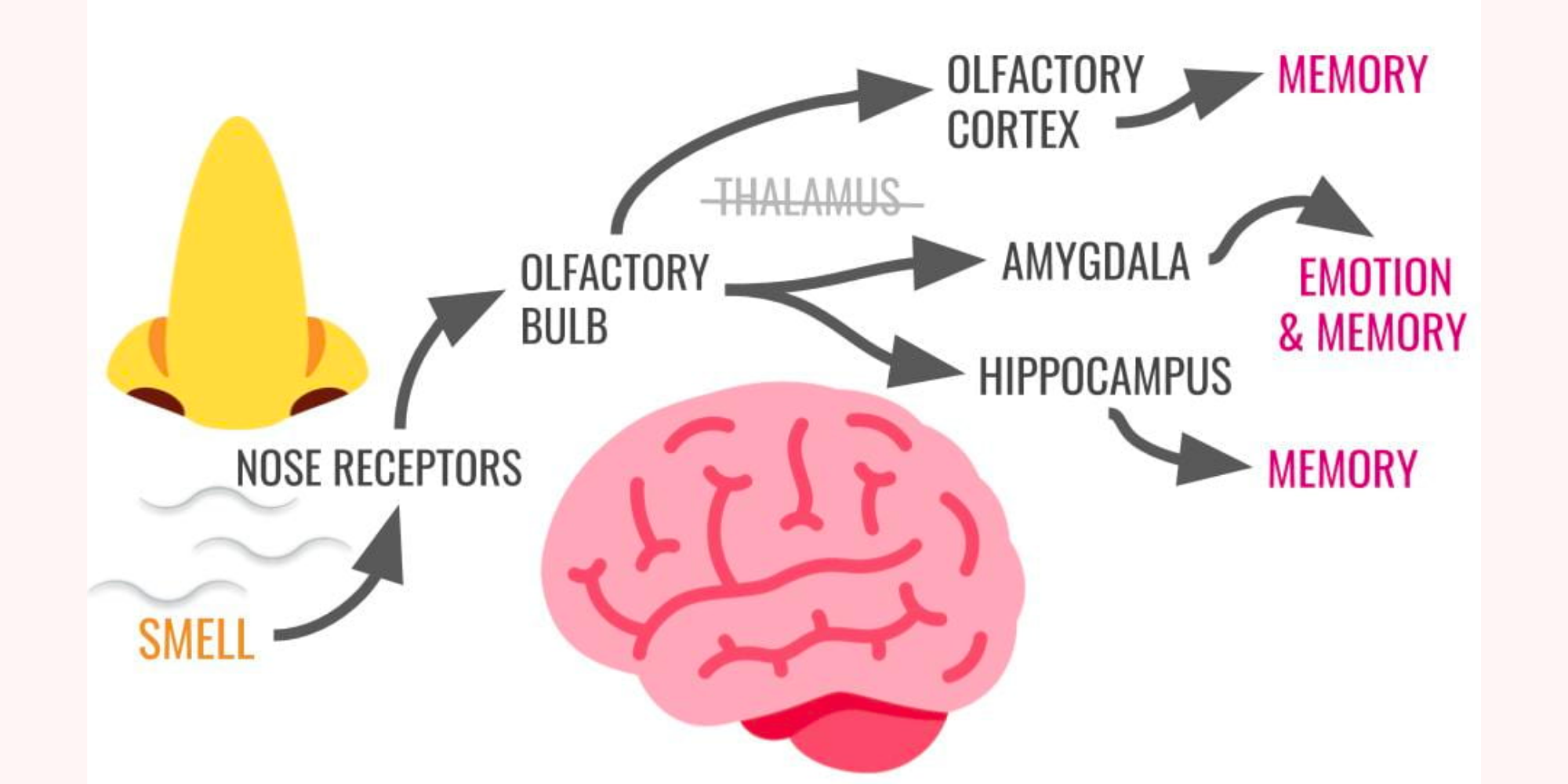
This interesting phenomenon has been categorized in literature as the Protuesian Moment, which comes from the excerpt above found in Marcel Proust’s “À la recherche du temps perdu.” It is used to describe a sensory experience that triggers a rush of memories that seem to be long forgotten. However, as surprising as this may seem, smell and memory are closely related to the brain’s anatomy, which makes this entirely plausible. More specifically, scents are up taken by the brain’s olfactory bulb. The olfactory bulb is a structure at the front of the brain that sends out information to the body’s central command for processing. Humans have around 400 types of different olfactory receipts, and our nervous systems categorise inputs from those receptors. This justifies the idea of why certain smells can only correlate to specific recollections that are otherwise forgotten in your daily life. Furthermore, odours also go to the limbic system, which includes the amygdala and hippocampus, which contribute to emotion and memory.

Why Do We Link Scent With Memories? – Olivia's Haven

Scents and Brain Function

Flavours are another factor that an individual may associate with flashbacks into the past. On the contrary, those flavours are made tangible to the brain through smell, or rather one’s nose. When food is consumed, its particles reach the nasal epithelium. Thus, much of what your brain may process as “flavours” are actually aromas of certain ingredients in the food you are consuming. Additionally, our brains track the distinct smells we are subjected to in our daily lives. Sandeep Robert Dutta, a neuroscientist, and his team at Harvard Medical School have done a variety of tests that show the connection between smell and memory. His experiences suggest two main outcomes: 

  • Exposure to odours prompts smell-sensing cells to heighten the activity of genes that attenuated their responses to scents they were exposed to
  • Memories from smells are coded in the brain

In the first outcome, when neurons pick up a scent, their sensitivity to the second decreases in that present moment. As a result, individuals become unaware of that certain scent when they are in a specific environment. In the second outcome, researchers witnessed how the brains of mice would change the location of where specific odours are mapped in the cortex when exposed to different smells at the same time.

A Deeper Dive into the Olfactory Bulb

It can be concluded that the olfactory receptors play a vital role in associating our senses with the brain. However, researchers in 2017 discovered that memories may be saved in the olfactory bulb itself, which is the piriform cortex. The piriform cortex connects to other sensory response regions in the brain. More specifically, this structure is called the orbitofrontal cortex, and its function is to make deductions about sensory inputs. Christina Strauch and Denise Manahan-Vaughan from Ruhr University Bochum used electrical impulses to stimulate this region, which consequently led to memory changes in the piriform cortex. The takeaway from this is that the piriform cortex can act as a long-term storage for memories, but it needs instruction from the orbitofrontal cortex. The orbitofrontal cortex indicates to the piriform cortex which memories need to be stored long-term.

Unfortunate Duality

Up until this point, memories triggered by scents were stated in a positive context. However, for some people, aromas can lead to past negative recollections or PTSD. War veterans are susceptible to this as fragrances of food can remind them of traumatic war zones. Some researchers suggest that other scents, such as coffee grounds or vanilla, can be used to counteract this emotional response. But, it should be noticed that this process would be subjective to each person. In recent research projects, scientists have also attempted to use the power of scent to aid people in recalling information. Advances in research studies such as this can lead to astounding new revelations in how smells can impact one’s test performances and memory processing abilities. More specifically, can associating scents with patterns or other images cause people to remember them more distinctly when compared to other traditional memorising techniques?

Sources [1]/[2]/[3]

Image [1]

Featured image [1]

Coming To Terms With My Koreanness

0

I first started to resent my Koreanness when I was six years old.

It wasn’t some kind of falling out within my family, or the revelation of something huge and controversial. In fact, it happened during the lunch hour at school, as many things tend to happen. I was surrounded by my fellow six-year-old classmates, just as excited as they were, if not more, for the thirty minute break. You see, that day my mother had prepared my most favourite food ever — jajangmyeon. A very delicious noodle dish with black bean sauce, often topped with pork. It was very popular in Korea and many other parts of Asia, yet you’d be hard pressed to find anyone who knew the dish in Canada in the early 2010s. However, there was no way for little-me to know that, nor would I have cared.

So, beyond excited, I retrieved my lunch kit from the depths of my backpack, opened up my Tupperware container, and—

Ewwwww. What is that?” a girl to my right scrunched up her face and plugged her nose, pointing to my food with her free hand. “That looks disgusting.”

Shocked, I stumbled to defend my favourite dish, but before I could get a single word in, another girl butted in.

“Yeah, ewww. They look like worms! Are you really going to eat that?”

“Yes,” I said earnestly, pushing the dish towards the girls, convinced that if they at least tried it, they’d love it. “It’s really good, I promise. Not worms.”

But instead of the reaction I was hoping to get, the girls began to shriek.

“Ew, gross! Get that away from me! It smells disgusting! Eugh!” they said, scrambling away from me, and drawing the attention of everyone in our vicinity, including one Korean girl. The moment I saw her, I stood up, calling out for her.

“Hey,” I desperately drew her attention, switching to speaking Korean amidst my hurt and confusion. “Hey, you know this, right? You know jajangmyeon, right? Please tell them it’s not gross, please stop them. You understand me, right?”

But instead of responding to my Korean, like I knew she could because my mother knew her mother, she just backed away. She turned to her friends, and in English, proceeded to berate me for speaking Korean and pretend that she didn’t understand. She validated the girls who had made fun of my jajangmyeon, saying that she didn’t know what it was, but it sure did look disgusting. 

Back then, I didn’t cry. I didn’t yell, or try to defend myself anymore. I didn’t hate that Korean girl for what she did, and nine years later, I still don’t blame her. I now understand why she said those things, and I understand that she was already going through what I would soon go through. But to six year old me, none of it made sense. I wasn’t mad, because of the way they made it seem like I was in the wrong. No, I was worse than mad. I was sad, and scared, and confused, and felt utterly, completely alone.

That day marked the first time that I didn’t eat my jajangmyeon. I have a vague memory of coming home that day and unpacking my bag. My mother, who couldn’t understand why I did not eat my favourite meal, became angry at me for not eating anything. I, not wanting to tell her what had happened, let her believe that I had just had too many snacks to be hungry.

Eventually, I must have repressed or forgotten about that memory. I would not mull over it, or try to understand what had happened until many, many years later, by which time there would have been no point in confronting my classmates about what they had said to me. However, even when I had forgotten it, the effects of that day continued to affect me in many different aspects of my life. By age eight, I had lost nearly a third of my Korean skills due to an insistence to speak only English and Spanish, languages that I regularly used in school. By age ten, I became overwhelmingly proud of my Canadian identity, proudly posting a Canadian flag on my wall and bellowing the Canadian anthem at any chance I got. Perhaps it was a coping mechanism, or perhaps it was my way of rebelling against my Korean mother. All I know is that I would beg my mother to pack me “Canadian” lunches and refuse to listen to Korean music. 

What must have devastated my mother the most occurred in late-2018, just before I turned 11. She announced to me that, come February 2019, we would be visiting South Korea. My first reaction, much to her dismay, was an open reluctance and annoyance. It was only made worse when I learned that I would be attending school while in Korea. I did not understand why I had to go to school, nor did I understand why we had to visit again, despite having visited multiple times throughout my life. I was convinced that it would be the worst experience of my life. And oh, how utterly wrong I was.

By the time we left Canada in 2019, I had already warmed up to the idea of going to Korea, as well as toned down the flag-waving and anthem-singing that I had had going on the past year. Upon landing in Incheon Airport, near Seoul, I enthusiastically greeted my grandmother, who had driven out to pick us up. Although she didn’t show it, I’m sure my mother was relieved that I wasn’t being petulant and rude.

The first month in Korea was to re-familiarize ourselves with the country after not having been there for a couple of years. We explored the city, made some friends among the neighbourhood children, and drove out to Lotte World and a couple close cities. By the second month, my mother had managed to enroll me into an elementary school a few neighbourhoods down, and I learned how to take the bus. Luckily, all of my new classmates were amazing and kind and very welcoming. It didn’t hurt that they were endlessly curious about Canada and my ability to speak both English and Spanish. I made many new friends, and my Korean began to improve in strides. I helped out during English class, and experienced a whole different way of learning Phys Ed. Ironically, I loved lunch time and couldn’t imagine not eating Korean food every single day. In fact, being in Korea helped improve my rocky relationship with food, although that is a whole other story.

Without me even realizing it, my visit to Korea began to chip away at the unconscious bias and anger that I had harboured against my Koreanness. I was having fun, speaking in Korean, learning in Korean, singing in Korean, and blissfully surrounded by Korean culture and traditions. However, that wasn’t the end of my journey to accepting my Koreanness. In fact, it was only the beginning. 

Years of hurt and bias did not disappear that easily, especially not when I wasn’t even aware that I was hurting and biased. When I returned to Canada later that year, I went right back to speaking English and having my mother pack me “Canadian” lunches. The only minor differences were that I enjoyed bringing Korean food to school sometimes, and delighted in my friends’ fascination with my chopsticks. I did not know it then, because I wasn’t yet online or on social media, but by the late 2010s, the Western world had warmed up considerably to the idea of Korean culture. Through its cuisine, music, movies, and TV shows, South Korea had begun to take the world by storm, giving it no choice but to pay attention to its remarkable beauty and people. In fact, it was exactly that that pulled me through to the most important stretch of my journey.

The events of 2020 are fresh in all of our minds. The sudden, chaotic hold that Covid-19 had on our world, the control that slipped from between our fingertips. The protests, controversies, and tragedies that took place, and the devastating events that happened one after the other. Amidst all of that was us, the children and teenagers who were robbed of some of the most fun, precious years of our lives. It wasn’t easy on any of us, but the world’s children experienced the pandemic through very, very different eyes than the adults.

To ignore everything that was happening, many of us found outlets and new hobbies to take up our time. For me, that outlet served as not only an outlet, but a huge source of comfort, happiness, and connection to my Koreanness. The South Korean band that had previously taken the world by storm: BTS.

BTS is a group made up of seven members, whose stage names are RM, Jin, Suga, J-hope, Jimin, V, and Jungkook. They debuted in June of 2013, and at the time of writing this, is nearing their 10-year anniversary. In the summer of 2020, when I was first introduced to them, they had just celebrated their seventh anniversary, which was supposed to be huge, as seven is a very important number to them. However, because of the pandemic, all of their plans and their entire world tour had to be postponed, until eventually, cancelled. It was rather hard on them, and they didn’t attempt to hide that. They openly talked about their concerns, confusion, and struggles while coming up with things to do in their spare time. 

But most relevant to what we’re talking about today is how much BTS has acted as a bridge between me and my Koreanness. Since 2020, my mother hasn’t been in my life as much as she used to, which has led me to feel very detached from my Korean side. I’ve lost a lot of the language, and begun to feel like I’m just not Korean enough to call myself Korean. That is not helped at all by the fact that I take after my father in that I have a very brown-skinned, Filipino complexion. However, BTS’ presence in the media that I consume has really helped to ensure that I remain proud of my Koreanness.

The fact that BTS sing and speak in Korean while doing things like attending the Grammys, speaking at the United Nations multiple times, topping the Billboard charts, and many other activities in the west is absolutely amazing. They have amassed a fanbase of tens of millions of people from all over the world, who love and respect them, regardless of their Koreanness. Despite receiving hostility and being faced with racism and xenophobia more than once since their American TV debut in 2017, they have stayed true to their roots and their culture, and have introduced many people to the Korean culture and language. All of these factors, and more, have instilled a sense of pride in me regarding my Koreanness. The three years that I have spent as an Army, or a BTS fan, have benefited and helped me to accept and love me for who I am and where I came from. Finally, to top it off, I have had a huge amount of growth in my ability to read and write in Korean, and even my vocabulary has grown to include many more words.

As I grow older, I know that my relationship with my identity and Koreanness will not stay the same. Identity is not something that remains stagnant, because as you grow and age, you experience and learn new things that change your perspective. But if there’s one thing that I’m certain of, it is that I will forever have pride in the fact that I am Korean. This struggle that I have with my ethnicity is a very common one among children of immigrants or second and third generation Canadians. I only hope that each and every one of them — of us — will one day be able to connect and reconnect to our roots and cultures, and learn to love and appreciate who we are, and where we came from. Because if nothing else, it sure feels good to tell people that I am a Korean-Filipino who was born in Canada, and that I can speak multiple languages.


Special thanks to Mr. Joon Lee, whose February 2022 article led me to reflect upon my own journey with my Koreanness:

How BTS helped me bridge my Korean and American identities


Featured Image

15 Jokes to Make You Smile!

0

Sometimes days can be a bit tiring or heavy, but a funny joke always manages to bring a smile. That’s why I love telling jokes, and to make your day better, I spent my time gathering a plethora of jokes that I hope you enjoy.

  1. I sold my vacuum the other day.

All it was doing was collecting dust…

      2. Did you hear the story about the claustrophobic astronaut?

All he needed was just some space…

      3. Why did the M & M go to school?

To be a smartie…

      4. Why are skeletons so calm?

Because nothing gets under there nerves…

     5. Can February march?

But April may…

     6. Why are ghosts such bad liars?

Because they are so easy to see through…

     7. How do trees get online?

They just log in…

     8. Why is 6 scared of 7?

Because 7 eight (ate) 9…

     9. Why couldn’t the leopard play hide and seek?

Because he was spotted…

      10. What did a fish say when he swam into a wall?

Dam…

       11. Why do we tell actors to “break a leg”?

Because every play has a cast…

       12. What do you call a bagel that can fly?

A plain bagel…

       13. What do you call a bagel that can fly?

A plain bagel…

       14. What do you call a fake noodle?

An impasta…

       15. Why did 0 and 2 break up?

Because some 1 came between them…

Featured Image / Sources