Home Blog Page 5

For the Love of Reading

0

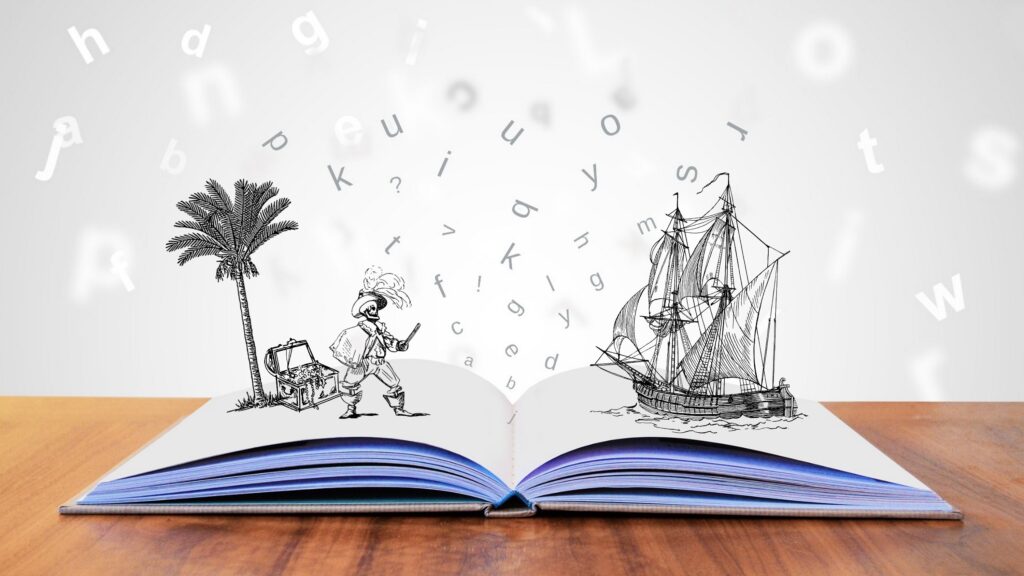
Reading is a habit that is very useful in life. Many people like different types of genres including: Action, fantasy, comedy, drama, horror, science fiction, dystopian, mystery, thriller, and many more. However, all books have one thing in common: they are words written by a person on a page.

Benefits of Reading Books

Reading helps increase your vocabulary. A poll, conducted by Cengage, in 2019 said that 69% of employers are more likely to hire people who can communicate beneficially. You should read to increase your vocabulary.

Reading is a stress buster! A study discovered that 25 – 30 minuets of reading a day helps reduce heart rate and blood pressure. Some people say reading is stressful but that is just their beliefs. If you are stressed out then you should read books.

Reading is your best friend. Books are loyal companions which provide us with knowledge, comfort, and much more. If you are lonely then you should read books. Also you can tell books anything you want and they will listen. Sometimes friends aren’t willing to listen, however, that is never the case with books.

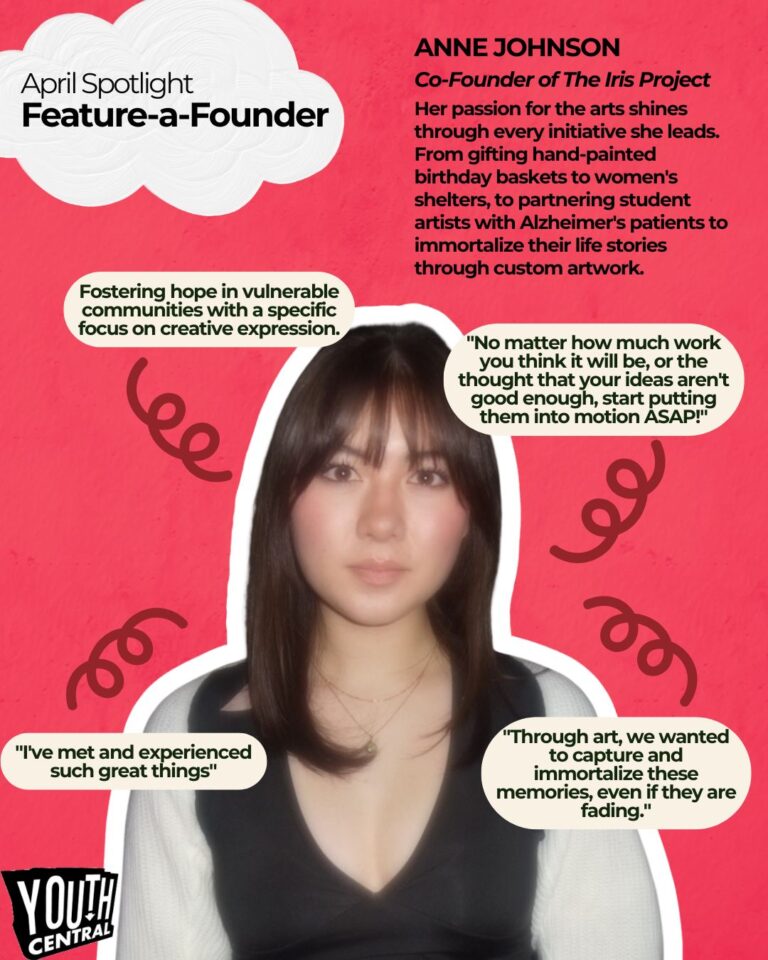
Feature-a-Founder: Planting Hope in Unlikely Places: An interview with Anne Johnson

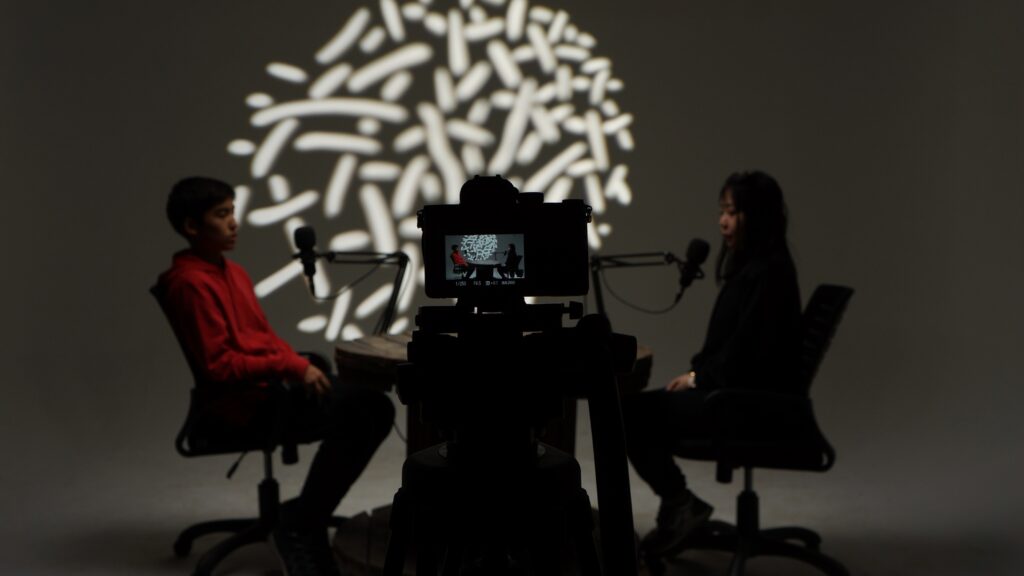
Presented by the Mayor’s Youth Council (MYC), our Feature-a-Founder spotlight is designed to highlight youth-led initiatives in Calgary making a positive impact. This month, we’re featuring Anne Johnson, the co-founder of The Iris Project.

Have you ever stopped to look at an iris? Aside from it’s vibrant petals, there is something remarkably resilient about this flower. You’ll find them in the most unlikely places clinging to the cracks of a sidewalk, bordering a forgotten pool, or blooming where most people assume life isn’t meant to thrive. To Anne Johnson, the co-founder and president of The Iris Project, this flower is more than just a wonder, it is a symbol of hope and a reminder that “warmer days are coming,” even in the toughest environments.

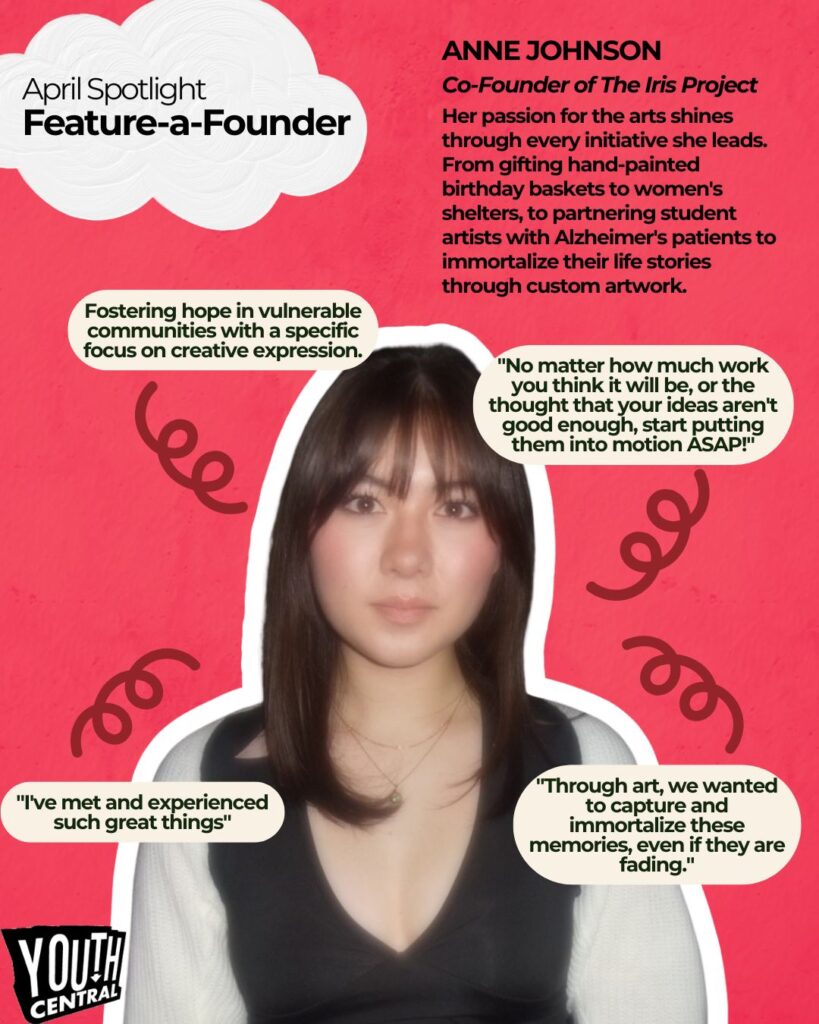
At an age when most students are just beginning to navigate the pressures of high school, Anne has built a movement. With active chapters in both Calgary, Alberta, and Temecula, California, The Iris Project is a student-led non-profit dedicated to supporting the community’s most vulnerable members through the power of the creative arts.The Iris Project Anne
Her Vision

The seeds of the Iris Project were planted during Anne’s 9th grade year. Alongside her co-founder, Michelle, Anne was already a frequent volunteer with Youth Central. However, they felt a calling to do something more personalized to bridge the gap between their love for the arts and the tangible needs of their community.

“I have always played various instruments, and all my extracurriculars revolve around the arts,” Anne shares. When she and Michelle saw an opportunity to apply for a micro grant, they jumped at it. They didn’t just want to start a club, they wanted to create a mission: fostering hope in vulnerable communities with a specific focus on creative expression. 

For Anne, the organization is important not just for the impact it makes but also for the community it builds among youth. “I’ve met and experienced such great things, working alongside some of the most intelligent and wonderful people in my peer group,” she says. Today, she leads a dedicated team of women, delegating tasks and heading initiatives that prove youth are changemakers.

Art as a Bridge Between Generations

While The Iris Project has launched several successful programs including distributing over 100 hand-painted “Birthday Baskets” to women’s and children’s shelters and creating “Affirmation Chairs” for cancer centers there is one initiative that holds a particularly special place in Anne’s heart: Capturing Memories.

In collaboration with Club 36, an Alzheimer’s support program, Anne recruited student artists from her school to partner with seniors. The goal was simple yet profound: spend time together. Once a week, the pairs engaged in conversation and shared activities, allowing the students to truly “see” the person behind the diagnosis.

The students then translated the seniors’ life stories into custom artworks. At the end of the program, a showcase was held where these pieces were gifted to the seniors and their families as “keepsakes”.

“The creative fraction of the brain is often the last to deteriorate,” Anne explains. “I’ve worked with patients who might not remember who they are with, but they know every single lyric to their favorite song. Through art, we wanted to capture and immortalize these memories, even if they are fading.”

For Anne, this wasn’t just about the art, it was about breaking the stigma surrounding Alzheimer’s. She wanted to ensure these seniors didn’t feel “othered” or distanced from society. Seeing the intergenerational bonds form was, in her words, “heartwarming” a testament that we should never distance ourselves from common human experiences, no matter how difficult they may seem.

Defending the Arts in a STEM-Focused World

One of the most profound lessons Anne has learned through this journey is the essential role the arts play in our personal and social lives. In a world where high schoolers are often pressured to prioritize STEM (Science, Technology, Engineering, and Math), Anne noticed a disheartening trend.

“It’s clear that STEM subjects are held at a higher value, and people are sometimes made fun of for considering the arts in post-secondary education,” she observes. Through The Iris Project, Anne is actively challenging the idea that creativity is just a “frivolous hobby.”

She believes that every creative has something valuable to contribute to the world. Her work has shown her that art isn’t just about aesthetics, it’s a tool for empathy and a way to communicate when words fail.

Navigating the Difficulties of a Youth Founder

Running a nonprofit while still in school isn’t all showcases and flower-themed branding, it comes with significant logistical hurdles. For Anne, the biggest obstacle has been funding. “It’s difficult getting funding when you aren’t a registered charity or if you don’t have of age board members,” she admits. Most traditional grants are gatekept by age requirements. However, Anne’s resourcefulness has been her greatest asset. She has successfully secured youth-focused grants through Youth Central and the City of Calgary, while also looking into partnerships with registered charities to gain more access to resources.

Her journey proves that while the system may not always be built for young founders, there is always a way through if you are willing to look for “cracks” in the sidewalk.

Advice for the Next Generation

If you’re a student sitting on a big idea but waiting for the “right time” to start, Anne has a message for you: The right time is right now.

“No matter how much work you think it will be, or the thought that your ideas aren’t good enough, start putting them into motion ASAP!” she urges. “The fear of doing something new is absolutely nothing compared to the regret of never trying.”

Final Thoughts

Meeting Anne makes you realize that being a “founder” isn’t about having a fancy office or a decade of experience. It’s about having the empathy to see a need in your community and the courage to use your unique talents, whether that’s painting, music, or leadership to fill it. Anne Johnson isn’t just planting irises, she’s planting a legacy of compassion that will bloom for years to come!

Next Steps
Started a project? Apply to Feature-a-Founder to be featured and share your impact – submit your story here!

Need help getting your idea off the ground? Explore our grants and funding opportunities: youthcentral.com/grants.


How Did April Fools’ Day Begin?

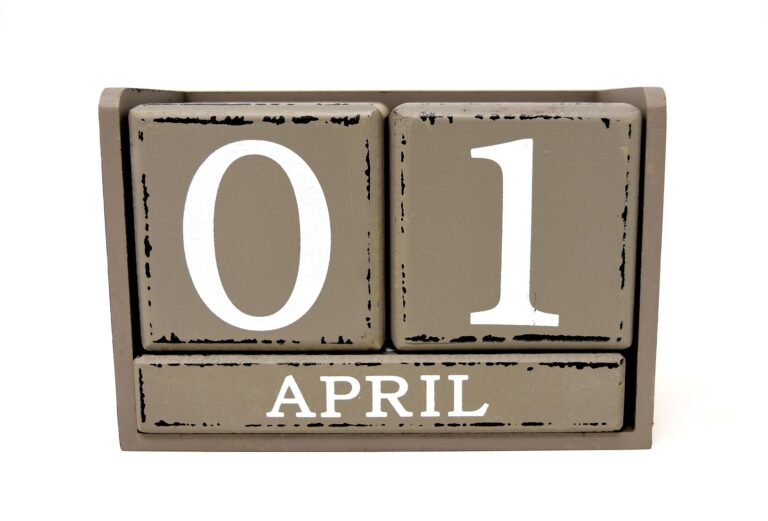
Every year on April 1, people around the world play harmless jokes and funny tricks on each other. This special day is called April Fools’ Day. But have you ever wondered where it came from?

Even historians are not completely sure how it started. There are a few popular stories about its origins.

A Popular Story from France

One of the most famous explanations goes back to France in the 1500s.

At that time, many people followed the Julian calendar, where the new year began around April 1. Later, France changed to the Gregorian calendar, which moved New Year’s Day to January 1.

However, news did not spread quickly in those days. Some people did not know about the change and continued celebrating the new year on April 1.

Because of this, others made fun of them and called them “April fools.” Over time, this became a tradition of playing jokes on that day.

Other Theories

Some historians believe April Fools’ Day may be even older.

One theory connects it to spring festivals in ancient Rome, where people celebrated with fun and playful activities.

Another possible origin comes from England in the Middle Ages. Some scholars believe the writer Geoffrey Chaucer may have mentioned an April 1 prank in one of his stories.

Because there is no clear proof, the true beginning of April Fools’ Day remains a mystery.

Why Do People Play Pranks?

April Fools’ Day is all about lighthearted fun.

People often play small jokes on friends, family, classmates, or coworkers. These jokes should be harmless and funny, not hurtful.

Some famous organizations, such as news channels and companies, have even created clever April Fools’ jokes that fooled many people.

Final Thoughts

Although no one knows exactly how April Fools’ Day began, it has become a fun tradition celebrated around the world.

Whether it started in France, England, or even earlier, one thing is clear: it is a day for laughter, surprises, and harmless fun.

Just remember to stay a little extra skeptical on April 1!

Source: [1], [2], [3]

5 Ways to Make This Summer Unforgettable Without Spending a Fortune

0

Summer is almost here and it’s the perfect time to slow down, have fun, and make memories that last. You don’t need to spend a lot of money to make it feel special. With a little creativity and planning, even the simplest days can turn into unforgettable moments. Here are five ways to make this summer one you will always remember.

  1. DIY Fun at Home
    You can turn your home into a little summer haven with easy DIY projects. Try making your own room decor, creating a summer photo wall, or even starting a small craft project like friendship bracelets, painted plant pots, or homemade candles. These projects are not only fun but also give you something tangible to show for your summer creativity. Plus, spending time making something with your own hands feels surprisingly satisfying.
  2. Backyard Picnics and Sleepovers
    You don’t need to go far to make a day feel special. Grab a blanket, some snacks, and your friends or family for a picnic in the backyard. Add some fairy lights, portable speakers, or a simple homemade dessert for extra fun. If you want to go a little further, turn it into a mini backyard sleepover with movies, star-gazing, and late-night storytelling. It’s amazing how a little effort and imagination can turn a familiar space into a magical summer hangout.
  3. Creative Challenges
    Keeping your brain and hands busy can make summer feel exciting and fulfilling. Start a 30-day photo challenge to capture something beautiful every day, sketch a little each morning, or try cooking a new recipe every week. Even small goals like writing in a journal, learning a few words in a new language, or experimenting with music can give your summer structure while keeping it fun. By the end of the season, you will be amazed at how much you created and learned.
  4. Explore Free Local Events
    Your city or neighborhood probably has more to offer than you realize. Keep an eye out for free concerts, workshops, art exhibits, or community festivals. These events are a great way to try something new, meet people, and discover hidden gems around you. Even a simple trip to a local park for a free yoga session or a street performance can turn an ordinary day into a memorable adventure.
  5. Mini Experiments and Adventures
    Adventure doesn’t have to mean traveling far or spending a lot of money. Take small risks that feel exciting. Go for a morning hike, try a new sport, explore a nearby trail, or even experiment with a little science or tech project at home. These tiny adventures make each day feel like a new experience. Sometimes, the small discoveries like finding a secret park, trying a smoothie recipe that actually works, or nailing a skateboard trick, can make the entire summer feel memorable.

Summer is almost here, and it’s the perfect chance to slow down, enjoy the little moments, and make memories that you will look back on with a smile. With a little imagination, creativity, and a sense of adventure, this summer can be your best one yet.

Wellness Through Games

Generally, when we think of wellness, we think of meditation and yoga practices, but that might sound boring, especially for youth. Most people associate silence and boredom with well-being activities, but what if someone told you that improving your mental health can come alongside fun!. Many games are mood boosters that also sharpen cognitive thinking. While gaming for several hours isn’t beneficial for the mind, here are the top 5 popular games that can be played as a way to reduce stress, refresh your mind and improve cognitive functions.


Sudoku:

Pixabay. By franzl34. Published on December 1st 2014. Sudoku

Sudoku Puzzles lower stress levels by allowing users to enter a “flow state”. Through playing, you are training your brain to analyze patterns and create focus. Sudoku can help cope with anxiety through creating a distraction-free environment. It also improves your self-esteem through creating a sense of accomplishment. Many health professionals suggest incorporating 5-10 minutes of Sudoku into your routine as a way to take a mental break. Oftentimes, when individuals are overwhelmed, they cannot focus on meditation techniques; therefore, isolating from distractions through puzzles becomes an effective alternative.


Wordle:

Unsplash. By Joshua Hoehne. Published on March 30, 2022

Whether it be for well-being or for fun, Wordle is a popular game that only takes 5-10 minutes to complete. Wordle helps with identifying patterns similar to other puzzle games. Wordle allows users to use creativity and strategic methods to solve a puzzle. Not only is it a daily dopamine booster, but it also improves cognitive health. On top of all the well-being benefits, you are strengthening the part of your brain responsible for language interpretation!


Tetris:

Pixabay. By MusicTobi. Published on November 23, 2017

Tetris is a game that has been around for multiple decades, and while it was an arcade game when it first came out, recent research proves that it actually improves mental health. Specifically, Tetris can reduce immediate involuntary memories for individuals who have been exposed to trauma. While it isn’t an independent cure to PTSD, playing the game does help with managing trauma flashbacks. Other research claims that Tetris helps with visuospatial processing, specifically through mental rotation and recognizing shapes. Similar to other games for improving well-being, incorporating 5-10 minutes of Tetris in your routine will help reduce overwhelming thoughts.


Flowy:

Unsplash. By Fabian Moller. Published on October 4, 2017

FLowy is a game designed for individuals struggling to manage panic attacks. This game uses your breathing patterns to control the puzzle you will encounter. The interactive game helps keep your breath under control in stressful situations. Plus, the game has a low-stress and engaging visual layout that helps create a calm environment. While this game does not replace treatment or professional therapy, it is a great way to manage the symptoms of anxiety and panic.


Just Dance:

Unsplash. By Vitaly Gariev. Published on September 22, 2025

Last but not least, Just Dance is a wonderful way to improve your well-being. The music, social interaction, and engaging movements in just dance create a stress-free atmosphere. Dance allows people to express themselves, leading to the release of positive emotions. Research shows that Just Dance and other forms of dance release neurotransmitters like serotonin and dopamine. Altogether, these neurotransmitters help reduce symptoms of anxiety and depression. The best part is, you don’t have to be great at dancing to start a Just Dance. Just call a few friends and follow along!


As we approach World Health Day (April 7th) and International Wellness Day (April 15th), remember that maintaining good mental health doesn’t have to be a serious task. Playing games, spending time outdoors and doing what benefits you most are all a part of well-being.


1,2,3,4,5,6,7,8,9,10,11,12

The Ultimate Dopamine Menu

With World Health Day coming up on April 7th, this month is a great opportunity for all of us to step back and assess how we’re doing, both mentally and physically. In a society where extreme productivity is encouraged, being “on the grind” is mandatory, and hustle culture is glorified, prioritizing mental health is becoming increasingly more difficult. It’s hard to stay on top of everything without burning out, and to achieve your goals without ruining your sleep schedule? Unheard of.

This kind of culture needs to stop being romanticized, especially with impressionable youth on the line. The benefits are outweighed by the detrimental impacts this lifestyle has on students and their developing brains, with cortisol levels hitting all-time highs.

For anyone feeling the mid-semester mental slump creeping up on them, you may benefit from some dopamine in your system.

What is Dopamine? 

One of our body’s most vital neurotransmitters and hormones, dopamine plays a major role in several life functions. Whether it’s memory, sleep, or movement, dopamine is mainly known for being the “happy” hormone, part of your body’s reward system. When released into your bloodstream, it is closely tied with emotions like joy and pleasure, and heavily impacts your motivation to do tasks.

During stressful times, it becomes evident that your dopamine levels are low if you’re feeling burnt out, fatigued, and unmotivated. In order to care for our mental well-being, it’s important to take breaks to participate in activities that bring us happiness, increasing our dopamine levels enough to get back on track with the less-exciting stuff. When your mind is armed with a hit of dopamine, your motivation to get things done and overall productivity rise, allowing you to tackle problems with less mental turmoil.

It’s important to remember that too much dopamine can be hazardous to our brains as well. Short-form content on apps like TikTok isn’t a great choice for breaks, as they make your brain more fatigued from the constant sensory overload. Too much dopamine can lead to sleep problems, impulsivity, and a lower attention span.

Fluctuating levels of dopamine are normal for youth, but always remember to reach out if you feel like something is off, as many health conditions are related to high or low dopamine levels.

If you’re feeling low, look at the Dopamine Menu below for activities to lift your spirits!

Dopamine Menu

Appetizers

For those of us who need a quick pick-me-up. Small activities that make us feel a little lighter, more energized, and ready to take on the day. 

  • Blast your favourite song
  • Make yourself a fun drink
  • Change into your favourite (or comfiest) outfit
  • Do the Wordle (and other NYT puzzles!)
  • Grab a snack
  • Talk to your pet (or your plant!)
  • Do 20 reps of one exercise (e.g. jumping jacks, push-ups, burpees, etc.)
  • Go outside
  • Stretch
  • Clean desk
  • Plan your day/afternoon/evening

Entrees

Longer and more immersive activities for enjoyment and relaxation

  • Put on a comfort show or read a comfort book
  • Light a candle and journal/colour/draw/read/knit (pick any relaxing activity!)
  • Go to the gym or do a workout at home
  • Try out a new recipe
  • Listen to a new podcast or audiobook
  • Call your friends/family
  • Pick a random topic you know a lot about and write about it
  • Go for a bike ride
  • Learn a new skill/take on a new hobby
  • Play a board game

Desserts

Take more planning, time, and money- special activities

  • Join a new fanbase for a day. You can pick a random sport, show, or band, and learn everything there is about it. Pretend you’re a hardcore fan!
  • Go shopping, or plan a different solo date activity
  • Book a massage or a spa day
  • Go to a concert
  • Visit a new cafe in your city
  • Plan a meetup with your friends
  • Travel to a new city/go on an excursion
  • Go to the movie theatre and pick a random movie you know nothing about

Conclusion

There’s no shame in admitting that you need a break. The constant need to be productive isn’t healthy either. Sometimes, doing activities that we enjoy just for the sake of having fun is more beneficial than spending that extra hour on work. It’s vital to plan out times in your day for relaxation and to take those breaks without the pressures of all your responsibilities looming over you.

Having a dopamine menu takes the decision fatigue away. Seeing a list of activities and the time you’ll take to complete each one allows your brain to choose without wasting time on planning. When you find yourself overwhelmed with work, pick one of the appetizers to recenter your mind and gain motivation to begin your tasks. If you have more time throughout your day, try one of the entrees, ensuring that you stay present in the moment for at least an hour, without external pressures plaguing your thoughts. For weekends off of work and school, the desserts are a great way to spend your day away from productivity!

If you have the time, make your own dopamine menu with activities specialized just for you and your lifestyle. It’s fun and a great excuse for taking a break. 😉

Sources: 1

What Your Wordle Strategy Says About You

1

I first discovered Wordle in my seventh grade math class, where my teacher would do the daily 5 letter guessing game with us at the start of each class. I remember how fun it was, how we all used to yell our suggestions, brainstorm word ideas, and beg to do more after we inevitably succeeded or failed. I continued doing these Wordles well after my grade seven year – and still to this day – and find them such a fun little treat to do on the train to and from school, before bed, or even on the treadmill. As I was doing today’s Wordle, shamefully getting the word on the very last try, I began to think about what the best strategy would be to winning in the most effective manner. Then, I thought about why I was getting upset over not guessing the Wordle fast enough, and thinking about whether my “POISE” starter was not good enough. After that I thought, why can’t we all just guess the words we want? What makes “CRANE” so much better than “BEEFY”? I guess some words are just more equal than others huh…I see how it is. In this line of thinking, I came up with 3 different approaches to the daily Wordle, and what it says about you (yes this is definite and absolutely true). Enjoy!

The Strategist

This individual will start off with a carefully crafted starting word, including as many vowels as possible, as well as common letters such as R, S, T, and N.

  • i.e POISE (this one is good trust), CRANE, AUDIO, TRACE

After this, they will carefully strategize their next moves to maximize potential of winning in the least amount of tries possible, NEVER EVER putting a letter where they know it doesn’t belong, or (god forbid) re – use a letter they know is not in the word.

If you are this person, you are probably an intense planner, perfectionist, and analytical. You enjoy figuring out the most logical route to maximizing your wins, and take a similar approach to your pursuits – careful, strategic (as the name suggests), and interested in efficiency and excellence (maybe to an unhealthy degree, maybe).

Play it Safe

The “play it safe” individual is a little bit hesitant, terribly afraid of seeing the doomed fate of 5 gray letters flipping onto their screen after they press enter. These people have a method, and stick to it. Perhaps they stick to the same tried and true starter (guilty…), or hesitate guessing weird words.

If this is you, you value stability and steer clear from surprises in your life. You may not necessarily care about winning in the best way possible, you probably just care not to fail. You rarely lose, but win in the 4th – 6th try typically. You value your streak, and I respect it.

Chaotic, or just Whimsical

This individual essentially just puts whatever word they feel like. Hm, maybe start out with “BIRDY”…oh, there’s no B or D? Just throw in “BREAD” because I’m hungry…okay no E or A…why don’t we try “TREAT” ! 😀

This person is someone I enjoy greatly. So full of whimsy and life. Guess whatever you want to, it’s a 2 minute online word game. These people are carefree and free – spirited, and I admire them. Go whimsical player, keep guessing “QWERTY”, “PSALM”, and “CRYPT”. Keep going out on your beautiful whims – and you know what? These are the type of players who will have the most first – second try wins. Risk taking and being yourself is the best way to go for these people.

Conclusion

I hope you enjoyed reading this article – maybe you gained some new insights on your personality, or scoffed at my poor, armchair psychology efforts. Maybe you picked up a new strategy for these daily puzzles, or perhaps you will continue the whimsical approach of entering whatever word your heart desires.

Either way, thank you Wordle for being something small we all look forward to everyday!

From Podcasts to Perspective

If you have ever listened to a podcast, think back to what you were thinking when you were listening to it. Did it feel interesting? Did you find something relatable between you and the speaker? Did it bring back memories of experiences in your life? 

Whether it be listening to a podcast on Spotify or liking a podcast reel on Instagram, podcasts have been loved worldwide.  Podcasts have an unprecedented effect on listeners, which is often overlooked. No matter who the interviewee is, ideas brought forth through podcasts provide relatability and spark questions in the listener’s mind. The topic might be as simple as whether you would put milk in the bowl first or cereal, but through listening to the answer, you unintentionally reflect on your thoughts. This form of reflection and conversation has many layers, so without further ado, let’s dive into it!


The Art of Storytelling:

Pixabay. By Tumisu. Published on May 14, 2019. Storytelling

Whether it be driving home from work, sitting on a train, doing a chore or simply going for a walk, podcasts follow a similar pattern to music in which users feel engaged in listening while working on tasks. The best part about storytelling through podcasts is the emotional human connection that makes each podcast unique. Podcasts drive listeners into a realm of imagination and they allow the mind to focus on a specific topic. Listening to a podcast makes you want to dive deeper into multiple perspectives. Similar to stories, podcasts have multiple genres, whether it be conversational, fictional or a real-life story. Within the genres, you can choose from current events and lifestyle. Habits, character-based stories, business mindsets, drama, pop culture, etc.. While everyone has preferences on what genres they prefer, a well-crafted podcast of any genre will grab your attention.


Relatability:

Pixabay. By Daniel Chrisman. Published on April 10, 2024.

Even if you haven’t heard a full podcast, you might have come across a glimpse of an interview through an Instagram edit. Whether it be a businessman saying something about productivity or a famous actor talking about their own life experiences, podcasts have the ability to inspire. 

Oftentimes, we disassociate the social media world from real life by comparing our lives to those of famous people. Through podcasts, however, a listener starts to realize the similarities between them and their idol. Most people think it is impossible to become a successful celebrity because their life trajectory doesn’t match that of Taylor Swift or Bill Gates. In that case, you need to listen to a podcast featuring a famous icon. By listening to a podcast where such people are interviewed, you can foster relatability. Listening to podcasts stimulates motivation, and it provides hope for people aspiring to achieve big dreams that otherwise seem impossible.

A study by the National Center for Biotechnology Information found that youth find comfort and trust through relatability, which boosts their well-being. Relatability is a gift that helps people feel supported and motivated. While you might not find every podcast relatable, there will definitely be ideas that you feel connected to, and they might come from the most unexpected individual. 


Learning Through Podcasts:

Pixabay. By Sik Life. Published on January 24, 2018

Learning is significantly more effective when the topic is presented interestingly. Unlike traditional school methods, podcasts can teach you concepts in a conversational manner, which makes learning feel less like a task and more like an experience. 

Podcasts are also a more effective method of active retention. You are allowing your brain to conduct cognitive thinking while you comprehend the ideas being discussed. With videos, you can understand concepts but through podcasts, you are forced to imagine the concepts. This way, you can trace your memory back to the same concept without having to memorize it. Most podcasts add details in storytelling or conversations through texture. On the other hand, your teachers and professors use a monotone voice, which makes the content disengaging. 


A New Perspective:

Pixabay. By White Crows Nest. Published on August 16, 2022.

A unique trait of a podcast is its ability to challenge the listener’s perspective. No matter how strong a supporter you are, podcasts influence your way of thought through presenting an alternate perspective. 

Unlike real-life conversations, where both parties present different perspectives, podcasts force you to listen instead of respond. In the era of scrolling through endless reels that demand instant reactions, podcasts promote slow thinking. 

This creates an opportunity to gain knowledge on viewpoints that you would otherwise strongly oppose. By the end of the podcast, you might not agree with the speaker, but you will become more open to accepting new ideas. This is an important soft skill to develop because it helps you form stronger arguments, make well-rounded decisions and become a better listener. 


Podcast Culture:

Unsplash. By Haerul Ambiya. Published on February 15, 2026. Listening on a Train

Interestingly enough, the podcast culture has gained popularity in the past decade with more podcast creation and listeners. Multiple sources claim that around 619 million people globally are listening to podcasts in 2026, which is a significant rise from 2024 when there were 546.7 million listeners. 

So why are so many people listening to podcasts? Oftentimes, especially among Gen Z, thinking about the world around us becomes overwhelming. Listening to podcasts helps debrief the situation while creating an authentic and relatable environment for everyone. Plus, with the hustle culture taking rise, people can easily listen to podcasts on the go. Unlike movies, you do not have to sit for multiple hours to entertain yourself when you can multitask by simply wearing headphones.


Conclusion:

Altogether, podcasts are a delightful way of entertainment that doesn’t require much effort. Listening to an episode of a podcast not only boosts your mental health but it also enhances your cognitive thinking. No matter what you enjoy, there is definitely a podcast out there that will spark a question or help you dive deeper into your thoughts. So the next time you are bored with your normal life, put on a pair of headphones- you might be fascinated by a new perspective!

1,2,3,4,5,6,7

The Joys of Spring

1

Spring is the season of fresh beginnings, growth, hope, and happiness. Spring is also noticed every time when we go outside to take a breath of fresh air. The colors of the trees, grass, bushes, shrubs are all appealing to our eyes.

Every season has its own qualities, however, spring brings the powerful message of revival. Whenever the leaves come back on trees or the flowers bloom again there is hope of life returning from the sluggishness of winter to the happiness of spring.

The season of spring also brings longer days, that allows more people to spend their time outside. People could play sports, go for walks, have picnics without the cold conditions of winter.

Furthermore, spring can have boosts in creativity and productivity. People can be inspired by nature and clean their surroundings and do new activities. People can also find their inner talent and be motivated to set goals.

Spring is one of the best seasons in the world and is also thought to be the best season out of all four. The Chinook winds also take place in spring reducing amounts of snow and making life better. The winds come from the Rocky mountains causing temperature spikes to 20 degrees Celsius.

Thankfully we know that there is a season that can give people such an amazing time. I also like spring more because the temperature starts to rise without any annoying bugs and dragonflies flying around. With no mosquito bites and bee stings all people should like spring.

The Hubble Telescope – Simplified

0

The Hubble Space Telescope, the first sophisticated telescope, allowed humans to view space from a perspective never seen before, taking never seen before images and transmitting them back to Earth. The clearest photographs of space have been provided through the aid of this telescope.

The idea of sending a telescope into space emerged in the 1940s but it took over forty years later to make that dream a reality. This first major telescope was launched into the orbit on April 24, 1990, by NASA. It was named after Edwin Hubble, who greatly contributed to our knowledge of universe and introduced the concept of expansion of universe. The Hubble’s first picture was taken on May 20, 1990.

It has enabled us to have more clear view of objects in the space and marked a new phase of observation of the universe. The Hubble was involved in many world-shattering findings, namely:

• Revealing the age of the universe
• Gaining more insights into how planets form
• Discovery of two new moons orbiting Pluto
• Unveiling the mystery surrounding stars as they burn out
• Increasing knowledge on comets and black holes
• Exploring the history of the universe
• Mapping dark matter in 3D
• Measuring sizes of planets
• Viewing asteroid collisions in space
• Detecting water vapor eruption on one of Jupiter’s moons

All of these discoveries show that the invention of the Hubble Telescope has been  so incredibly important to modern science. It has not only provided us with better views of the universe, but has changed the way we look at our universe and made it more familiar to us.

Sources: 1, 2, 3

Regular Chemistry to IB Chemistry Survival Guide

0


Hi! My name is Diya and I am currently a full ib student finishing up by first year in the IB Diploma program. One of the courses I am taking is Chemistry HL, which stands for “higher level” and is a first-year university course. Personally, chemistry has never been my best subject and I’ve always found myself struggling so much in it. I am not entirely sure if I’m the best person to give advice, but I’ve definitely learned a lot about handling it as I’m currently taking it and somewhat surviving now. Here are 3 tips I wish someone told me before I started!

  1. Develop a strong foundation of core chemistry concepts

If you are starting chemistry IB right after taking chemistry 20, you need to be prepared. By “prepared”, I mean you need to fully understand all of your chemistry 20 material. Without a strong foundation in it, you will struggle in chemistry without it. I don’t want to scare you of course, but I do recommend that before you start IB chemistry you must take some time to review key concepts. You should also not forget about labs. You have to be able to deal with lab write-ups and doing multiple experiments accurately too. I’ve never been really great with labs (both doing and the write-up) and I thought it wasn’t that big of an issue until before I started IB chem. Basically I would say to just make sure to have a solid foundation in both theory and practical information. 

2. Develop your speed + accuracy

One of the biggest issues I had was starting out with exam timing. What I mean by this is that you get 1.5 minutes per question. This may seem like a lot but when IB style questions are thrown at you and it takes longer to understand the question than actually answering it, it is such an important skill to be able to process information quickly and accurately. You need to be able to understand what the question is asking and how to use the information you are provided with to answer the question. The only way (from what I know) to get better at this is to practice. Practice so much that you know what to do when you see any question type. The exam can only test one concept in so many different ways so use that to your advantage. When you are practicing one thing I would recommend doing is timing yourself to figure out which question types are costing you the most time. If you are doing 10 questions you can put a timer for 15 minutes, but one really good tip one of my friend’s told me is to reduce the timer 3-5 minutes less so it properly simulates exam conditions. Like during the test you will probably be pretty nervous and won’t be as comfortable as you are at home, so if you can answer the questions correctly under even harsher time constraints you should definitely be good to go. 

3. Find good practice material

Your textbook is your best friend. Personally, I have never really been a fan of using textbooks and I usually did pretty well just doing assignments given in class, but once you enter this (or any ib class really), you need to utilise your textbook as much as you can. It explains concepts in a different way than your teacher did and sometimes that can really help engrave the information in your brain. Like I said earlier, practice is key to doing well however you need to be using IB style questions. When you’re first starting out in chem ib, it can honestly be pretty tough to find IB questions for the very niche topic your teacher is teaching, therefore I think a great resource is AI. Whether you’re a fan of Chatgpt, Gemini, or whatever you use, one thing I like to do is upload my notes for whatever topic my quiz/test is on and ask it to make hard ib-style questions. This is helpful maybe like 75% of the time, but then again it is AI so it will never really be as accurate as the question types you will come across on the test. However I would still recommend it as it’s better than nothing as it also helps explain concepts really well. I know that at school sometimes when a student doesn’t understand a concept they might feel shy to ask the teacher more than once to explain it, and in this case AI can be your best friend. Other than the textbook and AI, you can also search on specific websites such as “Revision Dojo” as it also has practice questions too. Overall it doesn’t matter what you use as long as you specifically practice IB style questions under time constraints. 


As someone who is not the best at chem, I think that those were the three main tips that I would give to someone starting out in chemistry in IB and dealing with the massive transition!


Marie Curie and Her Incredible Achievements.

0


In honor of Women’s day falling in March, I thought it very fitting to talk about Marie Curie for this week’s blog. We know Ms. Curie for her incredible accomplishments in science that propelled us forward as a race even though the price that she had to pay was her own life. It is due to her hard work and many sacrifices that we are able to use radiation in medical technology today. Alongside discovering radium and polonium, she is also the only person to win two Nobel prizes in different fields. She was the first female professor at the Sorbonne in Paris, part of the Physics Solvay council as well as the Academy of medicine in her time. All in all, she was a very accomplished woman.

Photo by Giacomo Ferroni on Unsplash

She also had beliefs deeply personal to her that I believe still apply to the world today. Ms. Curie faced plenty of discrimination during her time as a physicist and chemist. Not many women had the privilege of working in such male dominated fields. However, even beyond that, she contributed to the advancement of feminist ideas in sciences. It is at this point, dear reader, that you must remember feminism by its definition, means “equality within genders” and not “females are superior”. By promoting feminism, Marie Curie was able to advocate that women deserved the same opportunities as men in stem fields.

Even now, decades after Marie Curie’s time, her story forces us to confront the uncomfortable truth: progress does not happen passively. It is pushed forward and fought for by people who are willing to endure resistance to change, doubt, and in Ms. Curie’s case— personal loss. While it is easy to look back and remember her for her accomplishments and hard work, we must also remember her for all the things that she had to fight for quietly. It is disheartening, to think that even after all these decades, many women face the same mistreatment and judgment that she had to face. Her legacy challenges us to ask ourselves whether we are simply benefiting from the doors she helped open, or actively working to keep them open for others. In that sense, honoring her on International Women’s Day should go beyond admiration—it should inspire action, awareness, and a continued commitment to the very ideals she stood for.

sources: 1, 2, 3

History of the “Mean Girl” Clique in Cinema

0


History of the “Mean Girl” Clique in Cinema

One of the most influential characters in modern cinema is the “Mean Girl,” with most teen movies featuring characters that adhere to this archetype. The conversation surrounding these characters reflects their complexity; should they be idealized or seen as a cautionary tale?

The most obvious reflection of this dynamic is in the classic 2004 film Mean Girls, written by Tina Fey and based on the book Queen Bees and Wannabes. This movie features the complex social hierarchies within high schools and has cemented itself as an iconic film. Its relevance continues today, and there have been multiple attempts to remake/remodel this film, with a musical and musical movie both reimagining this story. However, this trope of the high school female “queen bee” is not remotely original.

While the origins of this story have been debated, in cinema, the 1978 film Grease is considered to be one of the first iterations of this trend, feeding into the mass amounts of teenage-based films in the future. This film featured the sly and manipulative Pink Ladies, who played into social hierarchies and tormented other characters.

The 1988 film Heathers also served as one of, if not the most, influential films that was based on these themes. Heathers informed later movies such as Jawbreaker and Scream Queens, which all used a similar framework that started with Heathers.

Heathers features a dark element in which our protagonist, Veronica, tries to break down her high school hierarchy and ends up murdering multiple classmates with the help of her boyfriend, who is clearly sociopathic. The relationships between the four main female characters Heather Chandler, Heather McNamara, Heather Duke, and Veronica had never been done before on screen. Heathers centers around a commentary on high school as well as the complex relationships and power dynamics that contribute to the interactions of the main characters.

This film was incredibly controversial for the time and had mixed reactions upon release; however, it is now considered a “cult classic.” Heathers touched on taboo subjects like eating disorders, sexual assault, and suicide while using avant-garde storytelling topics to move the plot forward.

This film had incredibly quotable moments, including “how very” and “did you eat a brain tumor for lunch?”, and has been translated into other retellings, including a very successful musical.

This laid out the framework for its more successful and well-known successor, Mean Girls. This film is slightly more lighthearted and doesn’t engage with as many difficult topics; however, it is still very insightful in its overall messaging about relationships and popularity.

In Mean Girls, our protagonist, Cady, finds herself unsure of how to navigate the ever-evolving world of teen girls and the complex social dynamics within high school. She finds herself in the “Plastics” friend group, following every whim of our queen bee, Regina George.

However, with these teen flicks centering on female relationships, it is also important to identify some of the sexist traits associated with these characters. The “cat-fight” nature of female aggression that is portrayed in the media can be incredibly harmful and paint women in a certain way. The ditsy blonde characters, excessive slut-shaming, and sexualization of teens are all focal points of the genre.

Additionally, the notable “queen bees” are all penalized for their seemingly male characteristics. Heather Chandler is a leader, aggressive, and short-tempered, all stereotypically masculine traits. Regina George also carries these traits and is headstrong. So why are these characters so heavily judged, even though male characters engage in the same behaviors or exhibit the same characteristics? Their actions are obviously cruel, but why are they considered more wicked than their male counterparts?

This comes down to how women’s relationships are often dramatized or misinterpreted by male writers and directors. So, it’s important to understand how these stories contribute to broader gender stereotypes.

Overall, while the mean girl trope can be traced to the 1970s for its original inception in cinema, this idea goes far deeper and farther back. These movies include intricate themes and have become classics of their eras; it is also important to identify aspects that don’t align with our current values and play into sexist ideas.

The Mid-Semester Lock-In: Spring Opportunities for Teens

Spring break has arrived for high school students in Calgary! As students return from well-deserved vacations, they may feel panic thinking about Monday closing in, when school resumes in full swing. Most of us are in shock at how quickly the first half of the semester went by, realizing that final exams will be upon us in less than 3 months. As you reflect back on how your school year has gone, the feeling of “not doing enough” or being “behind” all your peers may arise.

If you feel like stepping out of your comfort zone, adding something new to your resume, or setting yourself up for success as summer vacation approaches, keep reading for information on upcoming opportunities for Calgarian teens!

Career Day: Youth Central

  • Date: April 11, 2026
  • Time: 12:30-4:30 p.m.
  • Location: Platform Innovation Centre, East Annex
  • Registration Form

About The Opportunity

Hosted by our very own Mayor’s Youth Council here at Youth Central, Career Day aims to give Calgarian youth exposure to various professions through panels, Q&A’s, and several guest speakers. This year, youth are welcomed to network with individuals from fields like law, healthcare, business, and engineering. This event is free, and guests will be provided with complimentary snacks, as well as the opportunity to participate in a raffle!

Why Should You Participate? 

Deciding on your future career is a big decision that seems to arrive way too soon for high school students. This life-changing choice puts lots of pressure on teens. It’s quite unrealistic to expect a 17-year-old to decide what they want to do for the rest of their lives, and it certainly shouldn’t be an expectation. Instead, attending events like Career Day will allow youth to gain insight into the professional world without the stress of having to make a monumental decision with no previous background information. Youth can explore various fields and receive advice firsthand from experts in diverse industries. Planning for life after high school will be less daunting after gaining exposure into possible post-secondary pathways. When your senior year rolls around, you won’t have to make decisions completely unprepared!

CAREERS Internship Fair

  • Date: March 31, 2026
  • Time: 6:00-8:30 pm
  • Location: Notre Dame High School
  • Registration Form

About The Opportunity

CAREERS Next Gen is an organization that aims to foster connections between youth and employers, facilitating communication and streamlining the process of receiving an internship. This internship fair will feature booths with employers from a wide range of industries seeking potential employees. Students are advised to bring copies of their resume and come prepared with questions to ask employers.

Why Should You Participate? 

Students looking for a summer internship, a part-time job, or even just wanting to explore potential pathways after high school will find this fair to be incredibly eye-opening. CAREERS does the work of hunting down available employers for you. If you attend, you receive the chance to speak with professionals directly, and you may even snag an interview from a company or two! For youth feeling lost and apprehensive about traditional post-secondary pathways, this internship fair will alleviate those worries and present a plethora of hands-on learning experiences for students to explore. If online job-finders aren’t working for you, this internship fair might be the answer.

Calgary Public Library: Youth Volunteer Programs

  • Date: Applications ongoing throughout the year
  • Location: Various library branches throughout the city
  • Link to Apply

About the Opportunity

The CPL offers several programs for teenagers in Calgary to dedicate their time to as volunteers. Anyone above the age of 12 can apply and choose which programs they would like to help out with. For example, you may choose to volunteer with the math tutoring program, working with younger kids to develop their numeracy skills, or the Reading Buddies program. If coding is more your style, or even art, there are programs for those as well.

Why Should You Participate? 

If a part-time job, internship, or other long-term commitment just doesn’t work for your schedule, volunteering at the Calgary Public Library is a great way to build your resume while maintaining flexibility in your schedule. You earn volunteer hours in a relaxed environment and develop leadership skills without the pressures that come with a corporate position. Using your experiences from volunteering, you can enrich your university application while giving back to your community. This is an enjoyable, low-stress experience with a high reward!

City Of Calgary: Summer Student Jobs

  • Application Deadline: Check specific positions for precise deadlines, but most roles will not accept applications past April 30, 2026
  • Location: City-wide
  • Link to Opportunities

About the Opportunity

The City of Calgary hires hundreds of students every summer for roles in parks, recreation, water services, and even office administration. They have unique job opportunities in various locations throughout the city, all catered towards teens. Most of these positions start at above minimum wage, making it one of the best-paying summer options for students.

Why Should You Participate? 

Working for the City of Calgary gives you a behind-the-scenes look at how our city actually functions. Whether you’re interested in urban planning or just want to spend your summer outdoors in the parks, it’s a great professional endeavour that proves you can handle responsibility and work within a large, reputable organization. By applying today, you can set yourself up for success and be prepared for the summer. This experience will allow you to develop valuable skills that are vital for any future career.

TELUS Spark Volunteering

  • Check the website for specific application deadlines. Summer camps run from July to August.
  • Location: TELUS Spark Centre
  • Link to Apply

About the Opportunity

TELUS Spark is looking for enthusiastic high school students (ages 14+ for camps, 16+ for general roles) to join Team Purple. As a Summer Camp Volunteer, you can spend your weeks helping kids dive into hands-on STEM projects, from introductory coding and robotics to cooking and chemistry. You’ll lead games, manage workshops, or help campers navigate the facility. If you prefer a more variety-filled schedule, you can also apply for Interpretive Science roles, where you work in the galleries like The Health Zone or Creative Kids Museum, explaining the physics of the exhibits or assisting with massive events like Spark After Dark.

Why Should You Participate? 

Volunteering at TELUS Spark is a chance to go from being a student who simply learns science to a leader who can actually communicate it. For anyone interested in pursuing competitive fields like medicine, engineering, or research, the ability to translate complex theories into something engaging for the public is a massive professional advantage. Beyond the resume boost, TELUS Spark offers a unique environment where you can network with professional educators and scientists while earning perks, like specialized reference letters for university and free passes for your family.

TL;DR

Spring is the season of fresh starts, new beginnings, and new experiences. There’s no better time than now to get involved in your community. Here are a few exciting opportunities for you to explore!

  • Youth Central Career Day (April 11, 2026)
  • CAREERS Internship Fair (March 31, 2026)
  • Calgary Public Library – Youth Volunteering
  • City of Calgary – Summer Student Jobs
  • TELUS Spark Volunteering

By participating in unique opportunities, you can enrich both your mind and your resume. 😉

Where Animation Began

Animated movies have shaped cinema for all ages. Throughout the years, we have all been introduced to some sort of cartoons, whether it be Cinderella, Cars movies, Despicable Me, The Lego Movie, Marvel, etc. Animated movies have been sparking imagination and creativity in young minds for decades. In this article, we will explore the fascinating journey of animation from the first ever animated film to the future techniques that will change animation once again.

Where it Began:

Early animations set the foundation for new discoveries in the industry. The Humorous Phases of Funny Faces, composed by J. Stuart Blackton in 1906, used standard picture film to create an animation. While the 3-minute film shows a mix of animation and physically drawn characters, it was a huge success at the time. Soon after, in 1908, Fantasmagorie became one of the first fully animated films made through double-exposed drawings. This simple 2-minute-long movie consisted of 700 individual drawings that were arranged in a stop-motion technique. The producer, Emile Cohl, was a French Caricaturist in Paris, and many recognize him as the founding father of animation!

A Digital Shift:

Pixabay. By tylijura. Published on August 14, 2025

Fast forward to 1937 when Snow White and the Seven Dwarfs came out. By this time, several discoveries around Technicolour, multiplane cameras and cel animation were made. Technicolour allowed for movies to be made in colour with the help of different shades of black and white (monochrome) that would be combined as negatives to make a full positive print with complementary colours. Snow White and the Seven Dwarfs was the first full-length movie to use cel animation throughout. In cel animation, characters would be drawn on celluloid transparent sheets that would be placed on top of various backgrounds to avoid drawing them out every single time. Winnie the Pooh was one of the last times cel animation was utilized, after which most animations shifted to computer animation.

Initially, 2D movies used the Computer-Animated Production System (CAPS) starting with The Rescuers Down Under from 1990. CAPS was a method where hand-drawn characters would be enhanced through the computer with colours, layers and smooth movement. Blockbusters like The Lion King also used CAPS with a combination of Computer Generated Imagery (CGI).

3D Animation

Unsplash. By Chauhan Moniz. Published on Published on November 1, 2019

The first full CGI movie was Pixar’s 1996 Toy Story, which brought texture and depth to the theatres. From the plastic details in Buzz’s suit to the stitched fabric on Woody’s skin, Toy Story was a groundbreaking achievement for the animation industry. Soon after, animation started catching the eye of all ages. Cars, The Incredibles, Finding Nemo, Despicable Me, and other computer-animated movies helped create a new genre of movies that shaped our childhood. Fast forward to the release of Avatar, which once again revolutionized the industry. Avatar (2009) used surreal 3D characters with real actors who were integrated through CG character animations. The movie had 800 digitally generated characters with intense detail on the setting. From the first Toy Story to Avatar, which captures the simplest details of human behaviour, animation has truly transformed.

What is Next?

Pixabay. By Jcoope. Published on September 20, 2023. This image is AI generated

As we step into a new technological era with artificial intelligence, anyone can create animations with the help of a simple prompt. But the real question is, how are animated movies advancing? While AI can be a helpful tool, creativity is a special tool that filmmakers continue to use in storytelling. As of now, AI has increased productivity through simplifying the boring repetitive tasks so that creators can focus on uniqueness. Machine learning algorithms can understand elements of the real world to make lifelike animations.


Sources:1,2,3,4,5,6,7,8,9,10,11