

Home Blog Page 36

Celebrating Holi in 2025: The Inside Scoop

2


Holi is one of the most vibrant festivals in the world. With roots in the Indian subcontinent, it has been coined as the “Festival of Colours.” During this holiday, families and friends come together to celebrate themes like love, life, and the arrival of spring.

It will be celebrated this year on March 14th, which is only a few weeks away. To prepare for this festival, this blog post will educate you about the history, meaning, and traditions that come with the holiday, and how you can participate!

What is Holi? 

Holi is a traditionally Hindu festival that marks the arrival of spring, and also the triumph of good over evil. This theme is common in Hindu mythology, which the festival was created from. It is celebrated with an abundance of colour, music, and delicious food.

During the festival, people throw coloured powders at each other, and even participate in a water gun fight with coloured water! It’s also a common practice to wear white during this celebration, so all the colours that you are hit with show prominently in beautiful patterns.

These coloured powders are usually made up of cornstarch with very small amounts of food dye. According to the Holi Colour Powder website, “Traditionally people used natural, plant based colours from turmeric, Indian lilac, dhak (also called flame-of-the-forest), and kumkum (a combination of turmeric and slaked lime or Calcium hydroxide) but now commercial, water-based, non-toxic, food-grade pigments are used.”

Despite being traditionally celebrated by those who practice Hinduism, today the festival is open and welcoming to people from all backgrounds. I believe that you need to participate in this celebration at least once in your life, since the experience is one you’ll never forget. This is a festival that brings everyone together, and focuses on unity and joy!

The Meaning Behind the Colours

If you look up pictures of the festival online, many images of people covered in bright pigments are seen. Despite celebrating the holiday since I was a kid, I learned through my research online that each colour actually has its own meaning and symbolizes a specific theme. Here are a few listed below:

Rishi – Unsplash

Yellow: symbolizes happiness and positivity

Red: symbolizes love and passion

Green: represents new beginnings and growth, highlighting key themes of the spring season

Blue: represents calmness and peace

Pink: illustrates affection and compassion

Throwing these colours at each other is fun, but it also symbolizes joy, positivity, and the act of leaving behind all negativity.

Holi Traditions

Prichi Palwe – Unsplash

Despite being popularized for the colour-throwing and water fights, Holi comes with many other traditions.

A ritual called Holika Dahan is carried out the night before, in which people gather around a large bonfire and perform prayers around it for health, prosperity, and happiness. It’s usually a big family gathering, allowing you to bond with other members in your community. Like any celebration, there is almost always food involved. 🙂

What I look forward to the most during this festival (other than the colour fight) are the delicious sweets that are made during this day. A sweet called gujiya is famous for being made on Holi. It is a sweet dumpling stuffed with khoya, dried fruits, and coconut, and is fried and topped with sugar syrup. A traditional drink is also consumed, called thandai. It is a refreshing beverage made with milk, nuts, and spices.

Most people choose to wear traditional Holi attire for the festival, usually all white clothes. It is recommended to choose something old, since the clothing will end up being drenched in colour by the end of the day. After the celebration, the stained clothes are a fun keepsake. Think tie-dye, but Hindu edition.

During the festival, it is common to see people visiting each other’s homes to exchange sweets. This is to wish each other a happy Holi! During the colour fight, lots of dancing will take place, with joyous music playing in the background.

Celebrating Safely: Holi Safety 101

If you are invited to participate in a Holi celebration, here are some tips to help you stay safe!

Protect your skin and eyes: Ensure that organic and natural colour powders are being used, they are gentler on your skin and safer for the environment. Most Holi celebrations will already take this into account, but if you’re someone with a medical condition, it doesn’t hurt to ask the organizers first.

Wear old, comfortable clothes and shoes: Ensure that you’re not too attached to the clothes you wear. Don’t worry about looking good, everyone else will be wearing old, white clothes as well. Make sure you wear comfortable shoes, since it is a festival that requires you to be actively moving!

Hydrate: This festival can be physically draining, which means it’s a good idea to bring a water bottle or find a source of water before you begin participating. It’s also important to take breaks!

Respect boundaries: People who are participating are most likely already aware that they’re going to be drenched in colour, but it doesn’t hurt to ask them first. Try not to throw anything directly into someone’s face!

Conclusion: See You On March 14th! 
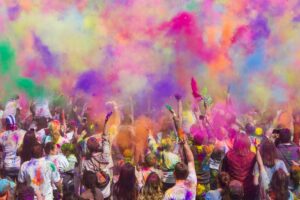
John Thomas – Unsplash

Holi is a welcoming festival celebrated all over the world in places like New York, Sydney, London, and India. Whether its a celebration in the streets or a small gathering with friends, this holiday (see what I did there?) is incredibly fun to celebrate. Many traditions include throwing coloured powders, eating delicious sweets, and gathering around a bonfire. Holi is an experience that’ll leave a positive impact on those who participate.

It’s also the perfect excuse to go out with your friends, and you’ll get some great pictures out of it. Your Instagram feed will thank you after this one.


Sources: 1, 2, 3, 4, 5, 6

Self – appreciation

0

How much time do we take to heal during the day? Even if it’s for a few moments? For those, who have lives that are in perpetuated cycles of responsibilities and obligations or feel they need to do more to feel more accomplished, have you ever considered reflecting on your behaviours, attitudes, and victories throughout the day? Have you ever considered looking at your accomplishments from a different point of view? What you need is a boost of self-appreciation.

For those who constantly identify themselves with what they do not have and have not achieved, those limiting beliefs, slowly become catalysts for these cycles. We are blinded by others’ advances and their higher status when it comes to things we are good at, but what we don’t do, is align ourselves with the merits that meaningfully transform us into better versions of ourselves. It all comes from reflecting and doing an analysis on how you have changed before you decided to carry on these obligations that had a genuine impact, and who you are now after the journey, omitting any beliefs that you have not advanced because you have not taken grasp of something that someone else has.

The foundation of your journey is the most important element, it is ok to want nicer things, more skills, and it is fine if you want to be better. But without self-love, trust, and appreciation, and your only source of motivation is looking at what others have, there is no room for the weight of meaningful outcomes to create a better you, because when you dream of being someone else you stop valuing yourself. If you find yourself trapped in these cycles, you need to remember what is important, and that the value of your accomplishments is not dependent on the quality or advancements of others. Once we get a better view of how much we have grown, (which is the hardest part) the skills we have inherited from our obligations, and the maturity we have gained, we can come to appreciate ourselves more, solidifying that foundation further.

Easter Island: The True Meaning Behind The Moai

0


Free Easter Island Statues photo and picture


First Of All, What Is Easter Island?

Easter Island, or known as Rapa Nui, is a territory of Chile and is located in the southeastern area of the Pacific Ocean. This island is famed for its hundreds of rocky statues, called Moai. The island was originally inhabited by the Rapa Nui people, indigenous Polynesian peoples who build these structures from around 1200-1500. The distinct features, differing from other structures built around this time, fascinated travellers and archaeologists. Thus, many questions have arised about the representation of these statues and why they were built, which I will be illustrating the answers to.

Free Chili Easter Island photo and picture


Why Were These Statues Built?

The Moai are depicted as enlarged heads and towering statues made of volcanic tuff. Moai can range from having only a head, or posessing a full body. Due to oral traditions and Rapa Nui culture, the meaning of these statues is that they were meant to represent respected ancient ancestors. They would build multiple of these to face inland and to protect the Rapa Nui living inside the island. In addition to this, they would also place some facing the ocean, in order to protect travellers. The Rapa Nui did this because they believed that these statues possesed a power called mana, which is a spiritual energy that provides protection to their people.


Debunking Common Beliefs About The Moai
  1. The Moai Only Consist Of Heads

It may be easy to assume that the Moai mainly consist of heads due to their common appearance in Easter Island. However, due to excavation, some of them have been revealed to actually have full torsos buried underground, with hands and intricate details engraved into them.

2. The Moai Were Built By An Ancient Civilization

Some people believe that the Moai were built by an ancient civilization whom mysteriously dissapeared. Although, as you may already know, the Moai were built by the Rapa Nui people, who still live and thrive to this day.

3. The Moai Statues Are “Eye-less”

From first glance, it may seem that this myth seems to be true. However, the Moai originally had volcanic rocks inserted into their eye sockets. There are some restored statues that have these eyes in order to depict how they may have looked before.Free Moai Easter Island photo and picture


Unseen & Unheard : The Teen Subcultures That Define the Next Generation

0

In the age of social media, it can seem like the world of teen culture is limited to what we see on Instagram, Tiktok, and Snapchat. From viral trends to the mainstream popularity of certain styles, it’s easy to think that all teens are following a set script. However, there’s another side to teen life, one that thrives in the shadows of the internet and tight-knit, offline communities. These are the hidden teen subcultures, the lesser-known movements and alternative scenes that often don’t get the media attention they deserve, but are just as impactful in shaping the identities and experiences of young people today.


What are Hidden Teen Subcultures?

Hidden teen subcultures are groups of young people who come together around shared interests that fall outside the mainstream. These subcultures can manifest in a variety of ways: from underground music scenes and alternative fashion trends to grassroots activism and DIY art movements. What makes these subcultures “hidden” is that they often operate under the radar, away from the watchful eyes of major media outlets, advertisers, and influencers. They are often built around niche passions, philosophies, or aesthetics that don’t align with the mainstream, but they provide a sense of community and belonging for those involved.

While the world might be obsessed with the newest TikTok dance or viral meme, these subcultures are quietly shaping the youth experience in more meaningful ways. Lets take a closer look at some of these fascinating movements.

  1. Underground Music Scenes : A world beyond mainstream pop

Music has always been a powerful force in teen culture, but not every teen is following the same chart-topping hits. Some teens are venturing into underground music scenes that thrive outside of the main stream. Genres like vaporware, hyperpop, and lo-fi chillhop are gaining traction among younger audiences, offering a sound that’s experimental, nostalgic, and often far removed from top 40 playlists.

In these subcultures, teens are not just fans; they’re creators. Platforms like SoundCloud and Bandcamp have made it possible for young people to share their own music and art with the world, creating DIY music movements that reflect their personal experience, frustrations and desires. Underground music scenes give teens the opportunity to express themselves in ways that traditional pop music often cannot.

2. Alternative Fashion : Defying Trends & Building Identity

When it comes to fashion, teens are no longer just following the latest trends, they’re creating their own. Alternative fashion scenes are on the rise as teens move away from the thrill of fast fashion towards more individualized, meaningful styles.

Dark academia for example is a fashion trend that celebrates intellectualism, vintage aesthetics, and a moody academic vibe. Cottagecore, on the other hand, embraces a rural, nature-inspired aesthetic with soft, vintage dresses and an idealized vision of pastoral life. Teens in these subcultures use fashion as a way to express their personal identities and counter mainstream beauty standards. These alternative styles often create communities where teens can find their solidarity with others who share similar interests, away from the pressure to conform.

3. Digital Activism : Teens fighting for change in the Virtual World

While many young people are exploring their creative interests online, others are using the internet as a tool for activism. Digital activism has become a powerful force among teens, with movements like #BlackLivesMatter,  #FridaysForFuture, and #MeToo gaining momentum through social media. However, there are also lesser-known grassroots movements led by teens who are passionate about issues like environmentalism, LGBTQIA+ rights, and social justice.

These movements often exist in smaller, more localized online communities, where teens organize protests, petition drives, and awareness campaigns. The anonymity and reach of the internet allow them to mobilize quickly and spread their messages without the barriers that traditional activism might face. Teens today are redefining what it means to fight for change, using their platforms to amplify voices and issues that are often overlooked by mainstream media.

4. DIY & Maker Culture : Building a New Generation of Creators

In the world of DIY and maker culture, teens are no longer passive consumers; they’re creators, innovators, and entrepreneurs. Whether it’s designing their own clothing, starting small online businesses, or creating heart that pushes boundaries, DIY culture empowers young people to take control of their creative expression.

The rise of platforms like Etsy, Redbubble, and YouTube has made it easier than ever for teens to share their handmade goods or creative tutorials with a global audience. This subculutre is all about self-reliance, hands-on learning experiences, and breaking free from mass-produced culture.


Why do Hidden Teen Subcultures Matter?

Hidden teen subcultures might not always be in the spotlight, but they play a crucial role in shaping youth identity, and culture. They offer safe space for self-expression, creativity, and resistance against societal norms that may feel restrictive. In these subcultures, teens find belonging, inspiration, and the freedom to explore their passions without fear of judgement.

Understanding these subcultures also helps break down stereotypes about young people. While mainstream media often portrays teens as obsessed with social media trends and consumer culture, these underground movements reveal a different reality, one where young people are deeply engaged in artistic expression, activism, and meaningful subcultures that push boundaries and challenge the status quo.

Teen culture is far more complex and diverse than what’s portrayed in the media. Beneath the surface of viral trends and mainstream influences, hidden subcultures are thriving, offering young people a sense of community, purpose, and identity. Whether through underground music scenes, alternative fashion, digital activism, DIY culture, or urban exploration, teens are constantly reshaping the cultural landscape in ways that are innovative, rebellious, and deeply personal.

These secret worlds may not always be visible to outsiders, but they are undeniably shaping the next generation. By recognizing and appreciating these hidden teen subcultures, we gain a deeper understanding of the dynamic and ever-evolving nature of youth culture today.

Crisis Beneath Our Nose: Violence in Manipur, India

For the 11th time in Indian History, President’s Rule has been enacted in Manipur in hopes of quelling the ethnic violence that has devastated this Indian state for the past 2 years. The polarity between the people of Manipur has been brewing through the region for decades, but in May 2023, it erupted into a two-and-half-year clash that resulted in the deaths of nearly 260 people and over 60,000 people displaced. The people of Manipur have dealt with violence against women and children, and insurgent groups targetting young boys over these last 2 years.

Refugee Camp in Imphal Manipur

The Conflict

Introduction

North Eastern India, while comparatively small to the rest of India, comprises over 200 different ethnic groups. Within the 8 North Eastern States, these groups are recognized as tribes under the Indian Constitution. Among the eight states of North East India is Manipur, which can mostly be split into three groups. The Meitei, who make up 60% of the population, and the Kuki-Zo and Nagas, who, along with other tribes, make up the rest of the population but live on 90% of the land.

Over the years, tension has begun to grow between the communities within this Indian State for a multitude of issues, ultimately causing an implosion of violence on May 3rd, 2023. The violence began during a peaceful march from the All Tribal Students’ Union Manipur protesting against Meitei people gaining Scheduled Tribal Status.

The Opium Battle

Before the final factor that led to this violent conflict, for decades prior, resentment has grown between the Meitei and the Kuki. One of these reasons is the opium crisis between the India and Myanmar border.

Myanmar is one of the biggest opium producers in the world, and Manipur has become a site for illegal drug trafficking. Illicit poppy growing in Manipur is most commonly found in the hill districts, and from 2019-2020, 1420 acres of poppy crops were eradicated by Indian Law Enforcement.

This war on drugs has greatly destroyed the economy of Manipur by limiting shipments of resources and has targeted the health and safety of youth in Manipur.

Tribal Status

As stated previously, the main conflict in all of this is based on Tribal Status. More specifically, who should be entitled to it?

Certain Meitei felt entitled to Tribal Status, which would provide them protection under the Indian Constitution and certain benefits, such as reserved government seats. The Kuki people, who are majority Christian, did not want the Meitei to gain this status as they are largely Hindu and already hold most power in government positions.

These are 2 of the many factors contributing to this conflict.

President’s Rule Effect

The Manipuri and Indian Governments have been largely criticized during this conflict. Previously, they have utilized internet shutdowns, curfews and deploying thousands of troops throughout the State, but no change has been made. Now, the Indian government has enacted President’s Rule after Chief Minister N. Biren Singh resigned, which gives the President full control over the situation and dissolved the state government.

What Awaits?

Many believe that the enactment of the President’s rule is a step towards peace for this North Eastern Community. After nearly 2 years of death and destruction plaguing this once beautiful state, citizens hope that this ushers in a new era of unbiased politics regarding who will be elected to be Chief Minister after the President’s rule.

While the future has been uncertain for Manipur for a while, it seems that there is a glimmer of hope down in the tunnel and a chance for stability in this state teetering on the brink of destruction.

This blog only grazes the surface of this conflict, and I urge you, if you are interested in this topic, to do your own research, as this multifaceted conflict cannot be summarized in one blog.

Resources

1,2,3, 4


What Do Dreams About Being Chased Really Mean?

Have you ever had that dream where you’re running away from something or someone, and no matter how fast you go, you can’t escape? Being chased is one of the most common and terrifying dreams, often leaving people awake with hearts racing. But what exactly do dreams about being chased signify? Are they a reflection of real-life fears, or might they have a deeper psychological or cultural significance? Let’s dive in and explore what this unsettling dream scenario might have to say.


The Psychological Standpoint

One of the most widely accepted interpretations of being chased in dreams is that it reflects a deep-seated fear. Psychologists believe these dreams can symbolize a desire to escape from something you’ve been avoiding.

When you dream that you’re being chased, your subconscious might be telling you that you’re not facing something that needs your attention. Perhaps you’re running from a difficult conversation, an upcoming deadline, or unresolved trauma. The ‘chaser’ in your dream can represent a person, situation, or issue you don’t want to confront.


Fight or Flight: A Natural Response

From a biological standpoint, being chased in a dream taps into the ‘fight or flight’ response. When we experience fear, our body activates this mechanism to prepare us for danger. In a dream, this can manifest as running away from something, whether it’s a threat or something more abstract like failure or rejection. 

However, the dream might also indicate that you’re not confronting issues head-on, further creating a sense of anxiousness. The more you avoid the chase, the more intense the dream becomes, mimicking a cycle of fear and avoidance.


What’s Chasing You? The Significance of the Chaser

In these dreams, the identity of the ‘chaser’ can be essential to understanding the message it may be conveying. Here are some common ‘chaser’s and their possible meanings:

  • People (Past partners, friends, authority figures): If someone you know is chasing you, this can suggest unresolved feelings or unfinished business with that individual. An ex-partner might symbolize unresolved emotional attachment while a boss could represent pressure or anxiety about expectations.
  • Animals (Predators, creatures): Wild animals or even more fantastical creatures could symbolize primal fears, unprocessed emotions, or a lack of control in your life. The animal chasing you might be a representation of an instinct or raw emotion you’re trying to avoid
  • Monsters or Unknown Entities: A dream of being chased by a faceless monster or an entity you can’t recognize might point to an unconscious fear, something unknown that you’re avoiding. This could be a metaphor for uncertainty in your life, such as major life changes or fear of the unknown.


In general, these dreams often reflect the anxieties, fears, and unresolved issues that lurk beneath the surface of our daily lives. These dreams invite us to confront what we might be running from. The next time you find yourself running, take a moment and reflect on what I am really running from? Understanding the answer might just help you outrun the fear, both in your dreams and in reality.

Sources:

Reading Comprehension 101: How to Ace Reading Comprehension

0

It is one of the main components you will inevitably encounter during high school English, and the only component that doesn’t involve writing. Reading comprehension tests seem to be one of those assessments that leave you either glowing with the knowledge of your adept literature analysis skills, or despondently mourning your GPA.

Despite the common belief that reading comprehension is an inherited trait however, there are ways you can improve your score. As someone who now scores consistently high, I  vehemently encourage you to continue reading this article if you are struggling in English. Try something new and watch as your scores skyrocket.

1. Improve your vocabulary.

If my use of longer and more complex vocabulary in the introduction was insufficient for you to infer that I am actively trying to employ foreign words more often as well, return to the beginning and read the passage once more.

One of the most significant (and simple) ways to increase your reading comprehension score is to expand your vocabulary. But how do we do that?

a) Merriam Webster’s Word of the Day

This one is pretty self-explanatory. Learn a new word every day and assiduously integrate it into your speech, your texts, and your emails. Aim to use the word at least 7 times to have a higher chance of remembering it.

Here’s the link: https://www.merriam-webster.com/word-of-the-day 

You can even sign up for their newsletter to get the word of the day delivered to your email inbox every day. It’s a perfect bite-sized amount of learning and does wonders if you manage to stay consistent.

b) Flashcards

I like to use spaced repetition software, like Anki, but you do whatever works best for you. The goal of using flashcards is to get a sense of how well you can actively recall the words. Make sure you understand them and you aren’t just memorizing meaningless baloney.

c) Read more classical literature.

Reading classical literature can be thrilling when you do so intentionally. It is less enjoyable when you read it in class and are forced to perform the desolate task of deconstructing each and every sentence, but for your own enjoyment it is a highly efficient way to naturally expand your vocabulary comprehension. Err on the side of caution when choosing books though; it is very important that you balance having a plot that you enjoy and a decent level of vocab complexity. Too complex and you won’t finish, but a fast-paced teen romance is not going to advance your vocabulary at all.

Some suggestions that helped me develop my vocabulary a lot:

  • Anne of Green Gables, by Lucy M. Montgomery
  • The Lord of the Rings, by J.R.R. Tolkein
  • Tom Sawyer, by Mark Twain
  • The Adventures of Huckleberry Finn, by Mark Twain

Classical literature does a wonderful job of effectively keeping you engaged while bamboozling you just enough with its complex language. Reading these books will build  stronger vocab inferencing skills. This helps immensely when you don’t know what the word on the test actually means, because chances are you’ll be able to make better guesses.

2. Mark up your test.

Also an extremely helpful way to guide yourself through dense reading passages during a novel study.

a) Summarize. Summarize. Summarize.

I’ve been doing a miserable job of staying concise since I’m simultaneously attempting to achieve another goal that I’ll explain later, but as you read through a passage you should attempt to summarize it in chunks. This will help you when you need to go back and answer questions about the piece.

Summarize in your own words. Summarize chunks like passages of parallelism, paragraphs, and stanzas. It will make a world of a difference when you analyze later, because you won’t need context for a specific line anymore.

b) POE

The famous “Process Of Elimination”… but more literal. Here are some tips to make your POE a little bit more effective:

  • When you read an obviously incorrect answer, strike it all the way through instead of just crossing out the letter.
  • Identify your wrong answers:
    • “Half right” (HR) – only one portion of the response is accurate to the question
    • “Too specific” (TS) – mentions an irrelevant idea or topic that is not mentioned in the text or in the question
    • “Too general” (TG) – an answer that makes a general statement that neglects to fully respond the the question
    • “Similar wording” (SW) – an answer that is incorrect but contains a lot of the same words as the question

For example:

Which of the following states the main idea of the article about high school English that you are reading?

a) To express the author’s opinion about the high school English

b) To teach monkeys how to tie their shoelaces

c) To inform the audience about reading comprehension test tips

d) To offer reading comprehension advice to students in Grade 10

The correct answer is clear, if we mark up the page a bit:

Which of the following states the main idea of the article about high school English that you are reading?

a) To express the author’s opinion about the high school English SW, TG

b) To teach monkeys how to tie their shoelaces

c) To inform the audience about reading comprehension test tips

d) To offer reading comprehension advice HR to students in Grade 10 TS

(C) is the correct answer.

3. Write effectively

Now that you’ve learned all this vocabulary in Step 1, it is time to put it into actual use. This is actually one of the reasons I blog. While most of the time, my language is quite plain, blogging provides a plethora of opportunity for me to not only encounter and consume a wider range of words, but also to manipulate them in my own writing.

If you’re not a blogger and you don’t want to become one, here are some other ways you can incorporate writing into your life:

  • journaling
  • texting… but in a sophisticated way
  • essay writing
  • debate construction
  • writing emails… but in a sophisticated way
  • sticky notes and reminders… but in a sophisticated way

It is possible to integrate reading comprehension skills into every aspect in life where understanding something is involved. The more you do it, the better you will become. However, it’s important to note that effective use of vocabulary will actually shorten your writing (most of the time) and make it clearer (most of the time). While it’s exhilarating to experiment, if you find yourself rambling for sake of utilizing every new word you can think of, your writing will not help you improve.

All said and done, it is obviously unnecessary to employ your newly learned vocabulary into writing in order to do well in reading comprehension tests – all you really need to do is have an outstandingly confident sense of inferencing and a decent knowledge of literary devices. But writing does help engrave words and establish deeper memories of them.

TL;DR

No! Go back and read the whole thing, don’t just scroll to the end. An important part of reading comprehension tests is to have a decent attention span. You’ll need it when you’re analyzing Shakespeare, so why not develop it by reading my article from start to finish?

Crossover Between Social Media and Learning

In modern society, social media and learning comes hand in hand. There are many benefits to their connection as there are drawbacks. With this blog, let us explore this fascinating yet harmful crossover.

The Fascinating Part Of The Crossover

Clearly, technological advancements are useful from our day to day lives. As part of a globalized society, social media certainly holds an incredible grasp on us. Because of this, we should be thankful as it allows us to communicate across the world, obtain information quickly, and provide a new dimension to express ourselves in.

Knowing that, social media undoubtedly gives us the opportunity to learn anything. Also, they are a means of a communication with the convenience of typing on a keyboard.

Social Media, such as Instagram, YouTube, and Discord can promote learning. From videos, reels, to voice chat, we are able to learn concepts, and, if provided, visually see its applications. There are many opportunities throughout the digital world that allows us to learn a vast amount of things, a blessing that earlier generations did not possess. On top of that, we are able to communicate with others when studying and when doing a project.

Laptop
Image by Firmbee from Pixabay

The Harmful Part Of The Crossover

However, social media and learning may not be compatible, especially when it comes to addiction. These are unfortunately many opportunities where social media prevents us from learning new things.

Ranging from negative impacts on mental health to pure addiction on social media, it could cause a setback on our learning. In fact, these setbacks have become very common to the point where actions have been made to take away social media from classrooms.

Social media takes over person
Image by Gerd Altmann from Pixabay

The Crossover Itself

Depending on how it is used, social media can play well when it comes to learning new things. There certainly are many instances where media encourages us to think about something new; an example of which would be this blog post. However, social media can also derail us from that ability. Sometimes, social media and our ability to learn does not cooperate at all.

Blog post creator
Image by Werner Moser from Pixabay

Final Thoughts

Personally, I came across this topic because it’s so applicable to our lives that it has become integrated into it. Social media has more or less became part of many people around the world. However, our ability to learn has always been part of us; it has been part of us ever since we learned how to make our first breath.

Although this is a short blog, it should hopefully encourage you to think about how social media relates to learning. Consider those moments like fun facts, instructional videos, or educational Instagram reels, and remember that learning through social media is possible. These moments can expand to the usage of chats and applying what you learned with your peers. However, also consider things like scrolling, comparisons, and even false information; distractions that take us away from the beauty of this crossover.

While this blog is a reminder to be more mindful with social media, it is also a chance for us to recognize that there are many others crossovers where you can learn something new. With our modern world, there are many more opportunities of learning other than through the source of social media. While there are benefits and drawbacks to both, our ability to learn is always enhanced after balancing our exposure to many different sources.

Learning
Image by Manfred Steger from Pixabay


Sources: 1 , 2 , 3

Money Management for Teens: A 2025 Guide

Who doesn’t love money? Whether it’s to fund their hobbies or buy into the latest clothing trend, money plays a huge role in the lives of teenagers. Although, managing your finances as a youth can seem overwhelming. Some kids just don’t know where to start. Others are not familiar with the benefits of educating themselves early about banking.

With so many financial options and responsibilities around, it’s easy to get lost. This 2025 guide is here to help you navigate money management, with the latest scoop on tips and strategies to organize your finances as a teenager. Your future self will thank you!

Budgeting Is Your New Best Friend

Alexander Grey – Unsplash

Budgeting is a great skill to build while you’re young, you don’t have to worry about hidden expenses and taxes. Whenever you receive a sum of money, split it up and dedicate a few portions to specific expenses. Ensure you dedicate a specific portion of the money (e.g. around 60%) to save for the future. I’ll speak more on the importance of savings later on in this post!

Planning ahead for your expenses like this will allow you to save money more effectively in the long run, and this habit will make it easier for you to stick to your budget as an adult.

The most important part of budgeting is sticking to your budget! Give yourself a set amount of money to spend on something specific, and ensure you don’t go over that amount. Holding yourself accountable this way will allow you to use your money smarter, and pay attention to your spending habits. Also, budgeting will ensure you don’t accidentally overspend, and you won’t end up with fewer dollars in your bank account than desired.

A Credit Score? What’s That?

Tierra Mallorca – Unsplash

A credit score is a three-digit number that represents your financial habits. This number will determine your ability to get permission from the bank to take out things like loans and mortgages.

It is calculated based on factors like:

  • How you pay off your credit card bills/loans (which is why you should ensure you pay off your credit card bills ASAP! Not paying off even a small amount can be detrimental to your credit score)
  • The length of your credit history (AKA how old your bank account is, which is why it’s a good idea to get a credit card as soon as you can)
  • Any other data involving your payment history (including missed payments and debt)


If your credit score is too low, the probability that your purchases will be approved is low. Having a high credit score can get you financial benefits, like paying lower interest rates on your account.

If this sounds like a whole lot of yap to you, that’s totally understandable. You don’t have to worry about credit scores or other financial jargon just yet, but it’s good information to know.

Although you can’t build credit without a credit card (which you have to be a legal adult to own), educating yourself on the importance of building credit is vital. Ensure you understand the difference between a credit v.s. a debit card, and explore different ways to build a credit score. You can also look into saving up for a credit card, which would allow you to get one as soon as you turn 18 and begin building your credit as soon as possible.

Build Your Savings

Brano – Unsplash

At the ripe old age of 14, what most teens want to do is spend their freshly-acquired bills on their favourite things. Being able to spend your own money for the first time is an incredibly freeing experience, but it’s important to remember that saving money is equally as essential. As a teenager, saving for your future goals and emergency funds is where most of your cash should be going.

An example of a future goal that some teens save towards is university. Post-secondary education is unfortunately very expensive, and it’s always an added benefit to begin saving as soon as possible. Future goals can also be things like a big trip with your friends, or an expensive item that you would benefit from purchasing. Having an emergency fund available to use in unexpected situations is a good idea, since you never know when you may need it.

You may be wondering, “Where can I put all the money I save?”

If you are saving cash, having a separate wallet (one you don’t carry around with you) to keep in a secure location is ideal. Some families use safes for added security. If you don’t want the hassle of dealing with physical money, getting your parents to help you set up a savings account (if they haven’t already) is a great alternative. This way, your money will be secure for when you need it, and you can deposit money into the account without too much hassle.

Shop Smarter

Charles Deluvio – Unsplash

Being shopping smart is an acquired skill, one that a lot of teenagers should work on before embarking on adulthood. It’s knowing that sometimes, the clearance aisle is where the party’s at, and spending an $50 on a shirt that you’ll wear once is not great for your wallet.

Shopping for clothes seems to be where most teenagers (including myself) lose their money management skills. At this age, a lot of youth are still figuring out their style and what they enjoy wearing, which is why spending $450 on a single trip to Garage for a few fast fashion items is detrimental to both your bank account and the planet. I’ve learned this from experience.


While shopping, seek out items that you see yourself using/wearing often, and invest in the basics. Thrifting is also a great hobby to start. A smart idea is to make a list of what you’re looking for before going out, so you’re not buying unnecessary items.

Take inspiration from the millennials in your life and chase those discounts!

Track Your Spending

Ruxipen – Unsplash

Tracking your spending is essential when it comes to understanding where your money is going and how you can make improvements. There are many apps you can use online to do this for you, but using simple spreadsheet or writing it down in a notebook will get the job done as well.

Knowing where your money is going will help you identify areas where you can cut back. For example, if you’ve noticed that you’ve been splurging too much on entertainment, you can work on allocating that money to a different cause in the next month.

Tracking your spending will help you with knowing how much you need to save in order to meet your goals, or it can also come in handy when you’re creating a budget for yourself. If you know you spent more than you should’ve in a day, you can give yourself a lower budget for the next time you go out. Just a small shift in your spending habits can have a significant impact on your savings.

Look Into Investing

Joshua Mayo – Unsplash

While you may not have a ton of cash to throw around, it’s never too early to learn about investing. The earlier you start, the more time your money has to grow. There are various platforms available that allow you to start small, such as websites and apps for beginners.

Consider starting with stocks, or even cryptocurrency (but remember to do your research first!). By starting early, you give yourself more time for your investments to potentially yield returns.

This doesn’t mean you need to go all-in right now, but gaining knowledge about how the stock market works and how investing can benefit you in the long term is a good asset to have.

Conclusion: Managing Money Is (Mostly) Light Work

Managing your money as a teen might seem intimidating at first, but in reality, it’s all about creating habits now that will help make finances easier for you in the future. From budgeting to saving, tracking your spending, and even learning about investing, each step you take now will pay off in the long run.

Don’t stress if you don’t have it all figured out yet. It’s important that you begin by educating yourself as a teenager, no matter how much or how little you learn. Your future self will thank you for getting an early start on your financial education.

Sources: [1], [2], [3], [4], [5]

The Most Unique Weather Phenomena

0

As Calgarians, we all know weather, temperature, and climate in its extremes. From -40 degrees with windchill, where Celsius and Farenheit converge, to summer heat waves cresting up to the mid 30s, Calgary has had its fair share of extreme temperatures and a varied climate. Our unique geography also treats us to chinooks, where a change of 20 degrees or more in a single day isn’t unheard of. But today, I wanted to look at some other unique and, to us, foreign weather phenomena! The Earth is a vast and beautiful place, one worth protecting, in all her wonderous and mysterious ways.

1. The Fogbow

The fogbow, or white rainbow, looks almost like a monochrome rainbow. It’s created similarly to the rainbow, where sunlight interacts with water droplets to form a visible arch. Some physical processes that fogbows go through, including diffraction, are what gives it a vague, colourless look that is distinct from the rainbow.

A fogbow over an open field
Image by George Straughan from Pixabay

2. Snow Rollers

Snow rollers are the natural formation of snowballs, formed when wind and gravity push and pull snow down an inclined surface. Unlike snowballs, they are usually hollow on the inside and made with rolled-up layers of snow, like a cinnamon bun. They are often found at the bottom of hills, and can be anywhere from the size of your palm to bigger than a car. Snow rollers only occur in very specific conditions, including needing wet, loose snow, so they are very rare.

3. Waterspouts

Waterspouts are almost like water-tornadoes. They are cylindrical, rotating columns of air over a body of water, known to have picked up sea creatures and rained them down on land in the past. They most commonly occur in tropical and sub-tropical areas, but are not limited to them. Records of waterspouts date back to as far as the 15th century.

4. Volcanic Lightning

Volcanic lightning occurs similarly to regulary lightning, only it’s due to the collision of volcanic ash. Volcanic lightning occurs in explosions that release large amounts of ash and not those that mostly release lava. This has occured all throughout the world and recorded human history.

Volcanic Lightning
Photo by Marc Szeglat on Unsplash

4. Blood Rain

Blood rain has spooked people for centuries. It is a phenomenon that can last anywhere from minutes to days, and was often considered a bad omen. However, despite its name, it is not actually made of blood raining down on the Earth. Instead, blood rain occurs when red dust or tiny red particles in the air mix with precipitation, creating the image of blood-like water.


Featured Image

1, 2, 3, 4, 5, 6, 7

All About Birds, The Truly Amazing Creatures

What are birds?

This might feel like a question with an obvious answer, but we can “dig deeper” and explore in depth just what makes a bird a bird. Birds are considered to be vertebrates. That’s right, they have backbone (or spine), just like we humans do. They range vastly in size, from the “nine-foot-tall ostrich” to the “two-inch-long bee hummingbird.” The diverse species and appearances of birds is precisely a product of evolution!

Interesting facts about birds

Birds aren’t only capable of flying; some can also “run, jump, swim, and dive.” Did you know that even penguins are technically classified as birds? According to National Geographic, they also have wings, but they “lost the ability to fly.”

Evolution and migration of birds have led them to be found in all sorts of different habitats. I guess their ability to fly allowed them to find more spacious habitats with greater resources, such as islands in the middle of a giant ocean!

More on bird anatomy

From an anatomical perspective, birds are really interesting animals. Birds are generally able to fly because of how their wing is shaped: “The leading edge is thicker than the back edge”. This allows the creature to gain lift, which is the upward force that propels it into the air.

Birds are not mammals, but some of their bones are similar to those mammals possess; for example, the humerus found in birds “is similar to the upper arm of a mammal.” However, it’s just that it is “hollow instead of solid”, better enabling it to fly. In fact, many bones within birds are connected to its “air sac system”, that is then connected to “its lungs”.

Birds generally have an interesting digestive system; they can eat something now but digest it later! In terms of bird reproduction, the reason birds lay eggs can also be credited to its need to fly! Unlike mammals like humans, birds cannot “[carry] the extra weight of [the] developing young inside their bodies”!

Image by xiSerge from Pixabay

Other information about birds

Different species of birds also have different “social behaviors”, as some prefer to live and hunt on their own, while other types of birds opt to fly together in “close proximity.”

Whether we are talking about the grey parrots, rumored to be the “most intelligent [type] of bird”, or the kori bustard, “the heaviest flying bird” that is pictured above, birds are truly amazing creatures that deserve to be respected. Sadly, just like many other animals, there are also lots of bird species that are facing the threat of extinction, due to reasons such as habitat loss and global warming. Birds are truly valuable organisms that play a large and important role in the ecosystem; they deserve to be protected and loved.

Revolution in Robotics: The Journey of “Rule Breakers”

0

No matter where it is, women have always been a minority in STEM, especially in countries where women have been restricted from the fundamental opportunities to develop and inspire others. This article is a glimpse into the story of young women who raced to victory in a setting where making one move was life-threatening.

About the Movie:

Rule Breakers, a movie produced by Angel Studios highlights the struggle of women in Afghanistan who are trying to learn computers and join the FIRST robotics challenge. This empowering and emotional movie is set to release on March 7th, 2025 (right around International Women’s Day) and reflects on the true story of Roya and Elaha Mahboob who introduced and inspired women in Afghanistan to pursue an interest in computers, technology, and STEM. A movie directed by Bill Guttentag features Ali Fazal, Nikohl Boosheri, and many more incredible actors.

The movie is specifically based on an all-girls robotics team (“The Afghan Dreamers”) in Herat (a city in Afghanistan) which was established in 2017 by Roya and Elaha Mahboob. The all-girls team had to deal with plightful situations to learn how robots work and progress in creating their own. Despite all the challenges, this team made it to the FIRST Global Challenge in Washington where teams from more than 160 countries were present. All their hard work paid off when they arrived back in Afghanistan with a medal for the Courageous Award along with ranking 114 out of 163 teams!

“Roya and her Team is a theatrical story; every day we filmed, we endeavoured to capture that drama. Along with Elaha and the rest of our production team and cast, we wanted to create a film that would have an audience connect with the amazing story, while also highlighting the importance of STEM education for girls. We are thrilled to be partnering with the team at Angel Films to tell Roya and her team’s inspiring and powerful story.” -Bill Guttentag (from the Angel Studios Website).

This_Is_Engineer. “Engineer (Female In STEM).” Illustration. Pixabay. 2020-03-17.

What is Next:

While the team itself has progressed in breaking stereotypes and overcoming the obstacles the story isn’t over just yet. A few weeks after the return of the 6 girls who represented the Afghan Dreamers team, the Taliban and Afghanistan war escalated, making it extremely hard for these women to continue their work safely. While the situations aren’t as tense as of now, the barriers that existed before they went to Worlds still exist in their communities in the current day.

One remarkable achievement they have performed during COVID-19 was addressing the lack of ventilators in Afghanistan. Considering the heavy cost of ventilators and insufficient funds, it was harder to treat COVID-19 patients. This girls’ team used their innovative minds to develop an automated bag valve mask ventilation unit. The creation of this cost-effective ventilator device was fraught with setbacks including limited tools and closed shops during the lockdown. Once again these women overcame the challenges and were successful in their mission.

“We used locally available second-hand car spare parts to assemble the device,” says Somaya. “We worked around the clock to fill a gap on a direly needed ventilator to treat COVID-19 acute cases.” -Soumaya Farooqi (captain of the Robotics Team). This quote was captured in a UNICEF article that emphasizes these resilient women.

More on Roya and Elaha Mahboob:

These women were the ones who went on the journey to convince young women to initiate their journeys in STEM. Apart from this, they established the Digital Citizen Fund (DCF). The DCF has a goal of supporting women and girls in getting basic resources like technology and education to build financial independence.

If you would like to learn more about the DCF you can visit their website.

Sources:

1,2,3,4,5

Recognizing the Importance Of Family Day: Three Ways to Celebrate It

First of all, what is Family Day?

Family Day was a day created to emphasize the importance of family and give people a break to allow them to spend quality time with their family. It was created in Alberta, Canada by Premier Don Getty 1990. Due to charges placed on his son for posessing drugs, he wanted to create this holiday to allow people to spend more time with their families, believing that more family time could prevent these type of issues. In honor of this holiday, I’ve compiled a list of three things you and your family can take part in, in order to celebrate this important day.

Free Tv Popcorn photo and picture

  1. Set up a Family Board Game Night                                                                           
  • Put away phones and other distractions: By putting these distractions away, do this to become more present with one another, and encourage happiness and genuine connection
  • Put on a movie that you are all comfortable with: This can foster an experience that is inclusive and that allows everybody to feel at home

Free Family Hike photo and picture 2. Go Out For a Hike

  • A family hike allows more chances to talk, laugh, and have fun without the normal distractions of phones, or work, only peace-inducing nature.
  • By working together to complete trails, a sense of teamwork can become established
  • Hikes also allow opportunities for everlasting memories and photos, whether it be having a picnic, skipping rocks in a river, taking pictures of beautiful scenery, etc.

Free Restaurant Cooking photo and picture

3. Have a Family Cooking Session

  • Instead of the usual 1-2 people cooking the food the family usually eats, a family cooking session creates a rewarding way for family members to bond and create delicious food together!
  • To make the experience more enjoyable, you can set up a food theme such as Mexican or Japanese food, bringing a new twist compared to the food your normally eat
  • By dividing tasks such as mixing ingredients or cutting vegetables, you can encourage a sense of teamwork, responsibility, and fulfillment to each member of the household

In Conclusion….

In short, Family Day is a holiday that was created for a specific and valuable purpose, spending time with your family. It’s easy to feel trapped in distractions such as work or school and overlook what really matters, family connection. Therefore, we shouldn’t let this holiday go to waste. I encourage you to go out of your way to spend time with your family on this important day, and I hope my ideas have inspired you.


Curiosity: The Secret to Lifelong Growth and Success

Curiosity is one of the most underrated and powerful traits a person can have. It fuels creativity, drives personal growth, and fosters opportunities that would otherwise remain unseen. In our current world, which is becoming increasingly competitive and fast-paced, staying curious is not just an asset—it is a necessity.

Photo by Justin Heap on Unsplash

Curiosity matters. The most successful people never stop learning. Whether it’s exploring new ideas and perspectives, learning a new skill, or questioning how things work around them, curiosity keeps the mind active and engaged. Learning doesn’t stop after graduation from school—it’s a lifelong journey. When you embrace curiosity, every mundane movement becomes a brand-new opportunity to grow as an individual. Studies suggest that lifelong learners have improved cognitive function and are better equipped to adapt to change. 

Photo by Joseph Rosales on Unsplash

Curious people ask “why” and “how” rather than just simply accepting situations as they are. This mindset is what leads to breakthroughs, innovations, and inventions in every field, from science to business. Think about inventors like Thomas Edison or visionaries like Elon Musk—an insatiable curiosity drove both to solve problems and to revolutionize their respective industries. Without curiosity, life may feel repetitive and dull. When you nurture your desire to learn more about the world, instead of indulging in boring, daily routines, you are able to view life as adventures and explorations. 

Photo by Andrew Neel on Unsplash

Surprisingly, a mindset of curiosity brings more than personal growth and achievements. It also strengthens interpersonal relationships—studies have found that people who demonstrate a higher level of curiosity to learn more about strangers that they meet for the first time will make these strangers regard them as “warmer and more attractive.” Thus, it is more likely for these curious individuals to establish stabler, closer, and warmer bonds and friendships, as curiosity is a strong indicator showing that they truly care about and wish to learn more about their friends’ circumstances. In other words, it is also about understanding and empathy: we listen more attentively and develop deeper relationships by cultivating empathy and emotional intelligence. 

Photo by Hasse Lossius on Unsplash

Now the question is, how do we cultivate curiosity? 

Photo by mohammed idris djoudi on Unsplash

The simplest first step is to train ourselves to be never afraid of asking questions, asking “why” and “how.” Whether in a conversation, at work, or while learning something new, questioning prompts us to dive deeper into the root reasons behind superficial phenomena thus achieving more profound insights and unexpected knowledge. Books, articles, and research from various fields can also be prime resources to grasp the most cutting-edge knowledge; even if something isn’t directly related to our interests, we never know for sure when it might become particularly useful. Reading and learning actively outside of our comfort zone, whether it’s philosophy debates, history fun facts, scientific discoveries, or fictional literature, we will ignite new passions through these learning experiences manifested by the simple act of flipping through books. 

Photo by Gary Butterfield on Unsplash

Further, curiosity can also be developed by purposefully placing ourselves around people with varying perspectives and cultural backgrounds. When we engage in meaningful conversations with those who think significantly differently than ourselves, their knowledge and experiences can spark new ideas and expand our repertoires. This can be done by seeking out and reaching out to mentors, joining discussion groups in school, or browsing and searching for points of view that challenge our own viewpoints. This also trains us to be open-minded; this means the willingness to reconsider and challenge our own opinions and beliefs that we perhaps held for a long time. 

Photo by Bing Frost on Unsplash

Perhaps starting today, we can keep a journal to track our growth and our curiosity. Write down questions that come to our attention; news articles that we found interesting; conversation notes that we found inspiring; and discoveries that blew our minds. Stay engaged—if you’re taking one takeaway from this blog—and stay curious. 

Sources:

https://greatergood.berkeley.edu/article/item/six_surprising_benefits_of_curiosity#:~:text=Curiosity%20boosts%20achievement.%20Studies%20reveal%20that%20curiosity,and%20interested%20in%20what%20we%20are%20doing

The Importance Of Being Curious


How to slow down in a fast-paced life

0

One current issue that I think so many people of countless ages are struggling with is the speed of which the world is going at. What I mean by that is, almost every single aspect of our life is so fast-paced that it’s becoming more and more difficult to embrace each and every moment. Of course we can’t do much about this fast-paced world that we are a part of, but I want you to take a look below at some ideas to SLOW DOWN. Life is hard. School, family, friendships, sports – everything is hard, challenging, and fast to a huge extent. Today, why don’t we take a step back and look at 10 ways to SLOW DOWN. 


1. Embrace SLOW mornings:

Now I’m not talking about school days here (where practically everybody is rushed), but instead I’m talking about the weekends. Sure, sleeping in late counts as being “slow”, but what I mean by this method is, instead of reaching out for your phone immediately or rushing to get stuff done, start your day off by doing something relaxing. Such as drinking a cup of tea while sitting in the sun, or going for a walk, or just talking with a family member. 


2. MINDFUL eating:

I’m not talking about whether or not you’re eating nutritious food, but instead I am referring to how you eat your food. Instead of smashing food in your face because you’re hungry (which is completely valid because I do that way too often), take the extra couple of seconds to embrace the flavours and the textures. Savour each bite instead of eating on autopilot while your mind wanders elsewhere. 


3. Go on a walk WITHOUT a destination:

When the weather is not -30 degrees outside (referring to all the people living up north), go outside and embrace the sunlight. Put on your airpods, listen to your favorite jam, and walk outside. But here’s the catch : You don’t have a destination. We are so used to always having a million tasks to complete and a million places to go and be, so practicing walking without a destination can definitely be a great way to slow down. Pro tip: Don’t get lost in the process. 🙂


4. Do ONE task at a time:

Multitasking has become so regular in our everyday routine. We jump from one task to another in a matter of seconds in an attempt to get everything done as soon as possible. I’m definitely guilty of this one because if I start off with math homework, I somehow end up crying over a thesis statement in a couple minutes. The point is that we should try and finish one task at a time, which will inevitably slow down our hectic lives – just a little bit more.


5. DECLUTTER your living space:

I hate cleaning my room. It’s a collective identity shared by many teenagers. My mom always tells me that, “A cluttered room leads to a cluttered mind” – which she is actually 100% right about (yet I will never admit it). I believe that when your mind is cluttered, every aspect of your life will seem like chaos. Even the smallest of tasks and responsibilities will feel like climbing up Mount Everest. The point is, we should try and take out some time from our day just to clean things up. It doesn’t have to be a full deep cleaning session, because even the smallest changes can lead to huge improvements.


6. ENJOY a hobby without monetizing it:

When I use the word, “monetize”, I mean it as a way of saying that not everything we do has to be productive. If you like doing something, it doesn’t have to be productive and you shouldn’t try to make it productive either. Just try and partake in the hobby just for the sake of pure enjoyment. Not everything has to have a high “Return on Investment”, sometimes the enjoyment is just enough.


7. SPEND a day without a “to-do” list:

This one is quite similar to #3 (which was to go on a walk without a destination). We always have SOMETHING to do in our lives. Whether it’s studying for a test, walking the dog, chores, etc.. . Unfortunately, these everyday tasks will never cease. However, if we plan the time right, we can spend a day without all of this. Not necessarily like a “vacation at Disney World” day or something similar, but instead just a day without a goal to achieve. I bet you could do so many things that you enjoy in that one singular day. 


8. Write down your thoughts in a JOURNAL:

Our minds are constantly at work 24/7 absorbing countless pieces of information and making countless connections with one another. Sometimes, when we are stressed or anxious, these thoughts can spiral out of control. Our motor scales (such as writing) don’t work as fast as our brains. Therefore, if we are writing, our thoughts can be more coherent on paper. Take some time to write down what you’re feeling at a given moment in time. Don’t focus on anything else. Just you and your thoughts.


9. Try out some YOGA:

What better way is there to unwind your mind and body than to engage in one of the most relaxing forms of exercise there is? Hitting some fancy poses (the tree pose being a personal favorite) while taking in some deep breaths will slow you down without a doubt. It’s extremely beneficial to both your mental and physical health, while also being very relaxing.


10. DOODLE for fun:

Instead of doodling in your notebook while your teacher is explaining a math concept, doodle on a blank sheet of paper when you have nothing else to do. See where your mind takes you and to what great lengths your creativity will push you. When engaging in the exquisite and intricate art of “doodling”, make sure to concentrate on the process and not the final product. We should take that piece of advice into our daily lives too. Enjoy the moments that make up life, not just the wins, losses, achievements, and failures.


Conclusion:

There you have it folks, here are 10 awesome ways to SLOW down. The world is moving faster and faster as we know it, and even though it might not seem like it, this can be a huge problem for our mental health. Take a few extra hours, minutes, and seconds to embrace the wonderful world around you. You’ve got this.