Home Blog Page 157

Why Everyone Should Join Model UN

0

On February 25 and 26, the University of Calgary hosts its annual  Model United Nations Conference for high school students across the city. This two day conference is filled with intense discussion, resolution writing and much more.

As a grade twelve student who has participated in Model UN for my entire high school career, the thought of attending my last ever high school MUN conference fills me with sadness. It’s been a wonderful three years, and I’ve learned a lot.

I am exceedingly grateful I chose to join the team at the beginning of grade 10, and firmly believe everyone should do the same. Here’s why:

  1. Confidence and Practice

Model UN is scary. Even after three years of practice, whenever I stand up in a room filled with over 100 people and begin to speak, my heart races, my palms become sweaty and I might even stutter. However, it is precisely because MUN is so scary that it is worth doing.  When I make a successful speech, or receive a note saying my points are well thought out,  it builds my confidence. Each conference becomes a little easier, and soon, I find myself enjoying the moment when I can speak and be assured that the entire committee is listening intently. MUN allows students to practice their public speaking and critical thinking, skills that are essential to any career. As a result of my MUN journey, I have become less self conscious and more confident in my abilities.

  2. Friendships 

Generally, MUN conferences are huge. Committees can range from 10 to 100+ people, and at each conference there is bound to be someone new. Because MUN is all about working together, it is easy to meet others, form new friendships, and even network. The social aspect is an integral part of the MUN experience.


3. Knowledge 

At each MUN conference, I learn more about the UN and its structure, the different countries I represent, and important issues in the world. I also learn how to be diplomatic, research well  and connect with other countries, and tips and tricks to make me a more successful delegate. What I learn in Model UN transfers to real life, and these are skills I will need later on.

4. FUN!!

MUN is fun!! It even rhymes 🙂 it is a lot of work, but Model UN is a very satisfying experience that leaves you wanting more.


Model UN is an asset to any students resume, and gives the opportunity to improve skills, gain more knowledge, meet others and have fun! I would highly recommend that any student in any grade sign up for their school team, and if there is no school team, then create one! Trust me, it’s worth it.


Image sources: 1/2/3


5 Calgary Instagram Accounts That Will Brighten Up Your Feed

1

The rise of Instagram has given us the Instagram model, a new way for brands to promote themselves, and more importantly, a way for everyone to share their life in pictures with people all across the world. Never has it been easier to see what people living in different cities are up to and to find inspiration and beauty in their photos. That being said, there is also an abundance of social media savvy Calgarians out there whose feeds will make you amazed at the amount of beauty — right in our city. Read on to find just five of the many terrific accounts that use the #yyc hashtag.


@Coutukitsch

Calgary is home to many unique and interesting small businesses, and jewelry makers CoutuKitsch is no exception. Business partners and husband-and-wife duo Dorian Kitsch and Kofi Oteng came together in 2010 to start this hobby-turned-business. You may have seen their booths at local festivals and pop-ups, but now, they are stationed at The Livery Shop in Inglewood, where you can check out products from other Albertan businesses and explore CoutuKitsch’s wide selection of rings, earrings, hair accessories, and necklaces. A company that has seen so much local success would not be complete without a bomb Instagram feed to accompany it, and CoutuKitsch’s Instagram showcases their jewelry on Calgarians, as well as provides aesthetic-fodder to make your feed look that much better.


@Lifesetsail

Calgary-based Blogger Brittany started her blog lifesetsail.com in 2012 as part of a class she was taking in university, but it soon transformed into a place where she shares her thoughts and experiences in life. An avid traveler and seeker-of-beauty, her Instagram feed is filled with pictures of her journeys, giveaway opportunities, and gorgeous lifestyle inspo that will surely get you noticing the beauty all around you.


@_Carolcheung

 Instagram fashionista Carol Cheung uses her account as a way to share her unique fashion tastes and travels. All of her outfits are documented, making it both a great page to follow for inspiration and for flagging your next must-have article of clothing. A totally grass-roots based account, there’s no reason not to give it a follow!


@Milkandhoney.yyc

Kenzie Conrad is a maker of her own success, and is the owner of home decor store Milk and Honey. Her Etsy shop is popular with people across the world, and her versatile and cute designs make her a master of the colourful aesthetic she channels on her Instagram account. You can pictures of her products and the work of other local artists on her feed, as well as parts of her life in Calgary. Plus, there’s tons of pictures of dogs.


@Sisilia.Z

If you’ve ever stopped by Philosafy Cafe on 17th, chances are you have met Sisilia, a local student, barista, and owner of a gorgeous Instagram feed. Sisilia shares photos of her many and diverse travels, including cool local stops she has been to in different cities. She also often shares pictures of her cat, snapshots from her life in Calgary, her fashions, and — of course — coffee. If you’re a fan of a minimalist feed, this is the account to follow.


BONUS ACCOUNT: @Youthareawesome

How could I not mention Youth Are Awesome’s very own Instagram page in this post? Follow us on Instagram for daily inspiration, pretty snapshots of our city, updates on new blog posts, and to catch up on the activities of our bloggers. Keep your eyes peeled on our social media accounts for a unique giveaway opportunity — coming soon!


Cover Image: CoutuKitsch

What’s Up With Marvel ANAD Part 1

0

If you call yourself a Marvel fan but don’t read comics (an MCU fan) you might not notice what’s been happening recently. However if you do read Marvel comics recently there have been dark times in the current line up of comics. While there have been some amazing issues and series the vast majority of issues and events have seriously been affected by the ANAD curse. You might wonder what curse I’m talking about but fear not, I’m here to tell you all about the curse. In this blog and the following 3 parts I will tell you all about the curse currently plaguing Marvel ANAD.


Event Fatigue

Image result for civil war 2Image result for x men vs inhumansImage result for monsters unleashed marvel 2017

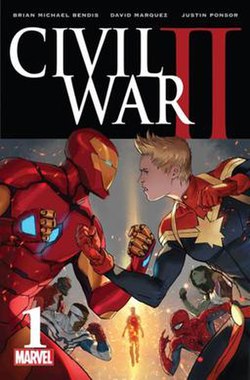
The first part of the curse includes the event fatigue experienced by many readers of Marvel Comic. If you’ve been living under a rock for the past 2 years you wouldn’t have noticed the absurd amounts of crossovers and events coming out. After Secret Wars, which was a big deal and an all around great event, we have been bombarded with events! Right after Secret Wars we got Avengers Standoff, followed by Civil War 2, Inhumans versus X-men. Granted that the last one is still going on however all this happened during one year! Not only this but the year was riddled with crossovers and much more! It was a crazy ride however it seems that 2017 will be just as crazy with Monsters Unleashed, Secret Empire and another event recently teased. It seems that the onslaught of events will continue for now.

Conclusion (Part 1)

While it seems we can’t do anything but vent our anger and issues out onto the internet all hope is not lost. While it seems that there is no end to this madness in sight all we can do is hope Marvel realizes that we are done with all the events and starts to tone down the amount of events a year.

However, this is not the entire curse that plagues Marvel right now. Stay tuned for Part 2 in which I cover another part of the curse.

Your One-Stop-Shop on Morse Code

It’s always fun to learn neat things every once in awhile. In the past year, I pushed myself to learn how to knit, solve a rubik’s cube and whistle. Morse code has always been one of those things where it’d be cool to learn but:

1. It’s not exactly applicable to my daily life and,

2. It takes way too much brain power (seemingly), especially since memorizing isn’t a strong point of mine.

But then I thought: I may as well give it a try. It’s not everyday we have the time to learn these things.

To start off, I dived into the history of morse code and why it’s still used in modern time.

Morse code was named after Samuel F. B. Morse, the noted inventor of the telegraph. Within a telegraph, pulses of electrical current is sent through a wire to be received as a marked message on the other end. At the operator’s end, a button is pushed to activate these electrical pulses and on the receiving end, a device marks these patterns as dots and dashes on a piece of paper. These patterns were recognized sequences that formulated the Morse Code. Eventually, people found that it was much quicker to decode the message just by listening to the sound of the clicking patterns, rather than having to transcribe marked messages back into English.

The telegraph was a great substitute for current long distance communication at the time, which included smoke signals and drumbeats. This invention came about when methods of audio transmissions had not yet been discovered.

The original morse code created by Morse and his partners was slightly modified to make a Continental Code, which was constituted by Friedrich Clemens Gerke. In designing the code, a correlation between the duration (the time it takes to sound out the dots and dashes that a single letter is composed of) and use frequency of each letter was kept in mind. For instance, the letter “e” is most frequently used in the English language so it was given the shortest duration: a single dot. Less commonly used letters like “j” or ”q” were accordingly made longer, with additional dashes and such.

We can convey morse code in several forms. Tapping, blinking, flashing lights and of course audible beeping and written patterns. Single letters, numbers or punctuation are each consisted of a special sequence of dots and dashes. When reading the codes out loud, “dit” and “dah” are used respectively. Saying “dit” a few times in a row doesn’t sound as smooth as saying “dah” successively. In this case, the “dit” is further shortened into “di”. “Dit” then, is only used when there is a dot at the end of a sequence of dots and dashes. I realize this explanation seems confusing but to put this into context, let’s read out the letters “f” and “v”.

F → . . – .
Read as → di-di-dah-dit

V → . . . –
Read as → di-di-di-dah

So now we see that “dit” is only used for ending dots.

Although not strictly followed, it is said that the duration of a dash should be 3x as long as the duration of a dot. Between letters in a word, there should be a pause as long as a dot duration. Between the actual words, the pause extends to a duration of a dash.

Regular language convention with punctuations can result in excessively long messages so to make up for this, there are prosigns. Prosigns are much more complex and detailed for me to explain fully but from what I understand, they are special patterns for commonly used messages. In other words, they are standalone sequences that represents a word without the space between the letters in the word or abbreviation. Take SOS.

The signal should be . . . – – – . . .
It’s actually . . . – – – . . .

I’ve exaggerated the spacing in the first version to show that the only difference is that the spaces have been eliminated to make the second version. My example barely grazes the concept of prosigns but prosigns are worth a search if you’re interested.

There are two prominent methods of learning morse code that I came across: the Koch method and the Farnsworth method.

1. Koch method:

For this, you need a computer or trainer to send you messages. It or they will send you the morse coded messages at around 15-20 words per minute for 5 minutes (which is the typical speed a message is sent. At this rate, one dot is about half a second long). You copy down the character. Repeat this entire process until you’ve hit a 90% or higher accuracy in translating the message into letters. At this point, one character is added to each word and you go through the same steps as with two characters. Some argue that this method is much more efficient because you’re learning to read the code at regular speeds at all times and no long term practice is needed.

2. Farnsworth method:

With this method, you are still given the code at the same speed as the Koch method, except additional space is put between each character in a word. You learn to recognize the messages and decrease the spaces to make the overall messages faster when you pick up familiarity. It may be harder to speed up decoding but many prefer this method because it’s somewhat easier to pick up at first. It’s similar to most methods of learning morse code initially: learn each character at a slow rate and increase your pace of decoding with practice.

Besides these traditional methods, mnemonics in the form of phrases and pictures help us memorize the individual patterns associated with each character.

Some of my favourite mnemonics for letters are:

E = . = eh?
H = . . . . = hip-pi-ty hop
K = – . – = kang-a-roo
U = . . – = giddy up
/ = – . . – . = shave and a hair cut (catchy tune here)

After all of my research, I think learning morse code isn’t as difficult as I first thought. Picking up something new that may not seem particularly handy is still an inspiring process to experience. Honestly, there’s so much to learn and learning is a lifelong process. It’s important to always give something new a try and take everything one step at a time.

Sources /1/2/3/

Images /1/2/3/4/

Interview with 17 year old published author: Sam Buer

0

This past summer at SHAD Waterloo, I got the chance to meet Sam Buer. Sam has gotten a couple of his stories published in a book titled, “Sci-Fi From the Rock.” The following are his answers to the questions in regards to publishing his works as a teen:

1. When did you decide to become a writer? What made you decide to sit down and actually start something?

I decided to become a writer at the behest of my then-girlfriend, after she told me I was good at telling stories. It was challenging at first, with my first novel attempt being a rather cringy fantasy story starring me and my friends.  After a bit of growing up and reading some other literature, I tried my hand at writing again. This one was more promising, about a planet of super-powered people, with crime rampant, strange alien creatures, and rest of the whole sci-fi thing. That one fell apart around chapter 2 or 3, where I felt that the world was unbelievable (in a bad way). Then, I found my publisher, a small local company by the name of Engen Books. They were holding a contest for submissions to be in the “Sci-Fi from the Rock” anthology for the tenth anniversary of the local Sci-Fi convention here in St. John’s. I wrote my story, titled “The Locket,” submitted it, it got accepted, and now I’m never looking back.

2. What genre are your books? What draws you to this genre?

I don’t really have a favorite genre as of yet. I’m still new to writing, and I have tried horror (which I love), sci-fi (which I adore), fantasy (which I have difficulty with), and that’s it as of now.

I think I enjoy Sci-Fi because of my strong science background that lets me ask “What if” about a variety of subjects, and then research and build a world, or plot, or characters from that initial “What if.”

As for horror, I have no clue what draws me to the genre. I enjoy the work of Edgar Allan Poe and H.P. Lovecraft, as well as a local author also associated with Engen Books by the name of Matthew LeDrew. It could be my fascination with the macabre, or my longtime fear of the dark, or an infinitude of other factors.

As for my difficulty with fantasy, I have no clue. I adored Lord of the Rings, and I enjoy Gary Gygax’s work as well, and I am an avid player of Dungeon and Dragon’s. I am not at a lack of material, so it may just be a flaw in my mindset. That is my experience, but I am eager to try other genres, such as historical fiction and westerns.

3. Where did you get your inspiration for your story written in, “Sci-Fi from The Rock?” 

Well, first of all, it’s not really my book, it’s an anthology. My story is one of nineteen from other local authors, ranging from horror to sci-fi to fantasy. I got the inspiration for mine, “The Locket” from a fair amount of Poe and Lovecraft. The idea of the “sinister mental hospital” also appealed to me, but other than that, it wasn’t inspired by any one thing.  In my experience, ideas for stories, even short ones, are more built than created in an eureka moment.

4. Do you face any challenges as a young author? If so, what are they? 

Not really. The local community of authors has been super accepting, letting me help sell the books, to listen to my delirious rambling about story ideas, to even inviting me to go out and have dinner with them during the Sci-fi convention. My biggest difficulty is finding time to write, and juggling that responsibility with my social life, my education, and my other responsibilities. All in all, I’m very thankful that the local community of authors was so accepting.

5. Are there any writers that inspired you to write your book? If so, who? 

Where do I start? As I said earlier, Edgar Allan Poe and H. P. Lovecraft have influenced me, particularly when I write horror. Isaac Asimov’s Foundation series really inspired me to write harder science fiction, and, funnily enough, Quentin Tarantino’s films have inspired me to write a historical fiction novel. Terry Pratchett’s Discworld series is amazing and has helped me play around with archetypes and tropes. Matthew LeDrew’s Black Womb and Xander Drew series have both helped me develop my characters better, as has the Infinity series, which he has written in collaboration with Ellen Curtis.

6. What are you working on at the minute? Do you plan on writing anymore books?

Well, I’ve got a few things in the pipeline right now. I have a novel about the invention of faster than light travel in a somewhat dystopian future in the works for one, but that has unfortunately been pushed aside for some other projects. I have another novel in the work that takes precedence, that one being about a one armed World War 2 veteran who hunts nazis after the war. That one takes precedence just because my publisher has already green-lighted it. This is all interspersed with various short stories that I write when the inspiration hits me, as well as a few secret projects that I’m not allowed to talk about. All I can say is to keep an eye out for some good stuff from Engen Books!

First of all, polish your work. Nobody is ever going to accept a first draft. By editing it yourself you show that you are committed to your work, and mature enough to edit it yourself. Also, it’s easier to read, so that helps you not get rejected right off the bat.

Second, don’t go to large publishers first. They have massive piles of submissions, and it’s unlikely that your’s will be accepted, even if it’s very good. I recommend small scale publishers, who might be invested in seeing young authors grow. This is an excellent environment to start writing in. I cannot count the number of ways that the good people at Engen Books have helped me with research, direction, and even ideas.

Third, don’t get discouraged if your story gets rejected. See if they gave you any constructive criticism and if so, use it and move on.  I got beyond lucky with the anthology, and didn’t have to approach the publisher myself. You probably will have to approach the publisher, and it might get rejected. It happens to everybody, and you just need to keep at it.

Lastly, just do it. Don’t sit at home with the cursor blinking at your face when the last edit is done. Save your work and email it in. I cannot imagine what my life would be like right now if I didn’t hit that send button. Don’t ever let that final draft sit in a filing cabinet, or under your bed, or on your hard drive. Send it in. The worst that can happen is it is rejected, and then you’re just back to where you were when you hit the send button. The best thing that can happen is that it changes your life.

If I haven’t bored you to death, and you want to ask me questions, feel free to email me at green.flamefighter@gmail.com.
Thank you Sana for interviewing me, and to all of the people still reading at this point, I wish you success in all your writing!

Fantastic Books To Add To Your Reading List

0

I have read lots of amazing books and I have taken it upon myself to share with you guys a couple of my favourites that I think will earn a spot on your reading list. These books are the only ones I have ever reread because they’re just really that good. But take this warning: after reading these books you may or may not become obsessed with the story, emotionally attached to every single character and cry for hours. Read at your own risk. 🙂


Asylum||By: Madeleine Roux

  (source)

DO NOT READ THIS BOOK WHILE HOME ALONE AND/OR AT NIGHT. The genre of this novel leans more towards horror but also has a fair amount of mystery and comedy. It’s my favourite horror themed book of all time. It’s centered around this adopted boy named Dan Crawford and the two friends he meets at a summer college prep camp. The camp is situated in what used to be an Asylum (a mental institute). Little by little, Dan and his friends start to notice strange things happening and unravel an old mystery about the Asylum’s warden who just so happens to have the same name as Dan. It’s so suspenseful, I guarantee it will send shivers down your spine. It is the first book of a trilogy and if I were you, I’d go out and buy all three right now.


The Selection||By: Kiera Cass

 (source)

Can we just take a moment? This book. Is. A. Life. Changer.

It’s the only book where I’ve ever highlighted because the quotes are just that good. I’ve shared many laughs and many tears with this series. Never have I ever finished a book as quickly as this one. And the plot twists, holy moley, this is literally the best book. It’s set in the future, after WW3 where America had been renamed Illéa. There, they live in a society that is separated by castes, one to eight where, the higher the number, the more wealthy and elite you were. So, of course, One meant the elitist of the elite: royalty. It has been a tradition that whenever the prince became old enough to require a wife, 37 girls from all over Illéa would be selected to participate in a competition called “The Selection. It’s like “The Bachelor” where the winner gets to marry the prince. Usually, all girls in the country dream about being chosen, staying in the castle and showing up on TV, but not America Singer. America already had a sweetheart at home so she didn’t want to be in the Selection to win the love of a snobby prince she didn’t even like, but after meeting Prince Maxon, America’s not so sure anymore. This is also a trilogy but before buying it, I advise that you make sure you have a full supply of tissues because you’re going to need them.


Miss Peregrine’s Home For Peculiar Children||By: Ransom Riggs

(source)

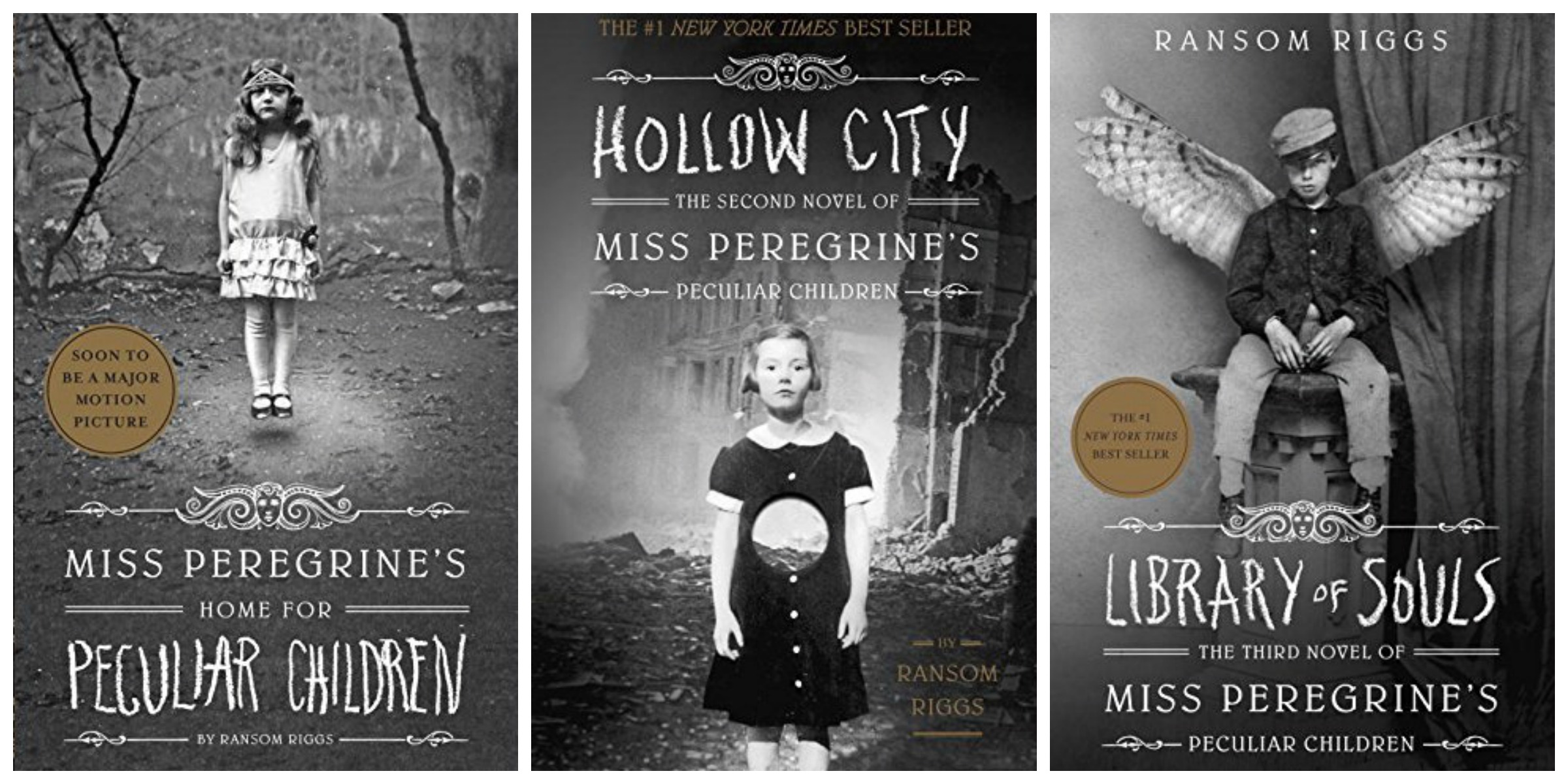
If you’ve read my blog about my favourite movies of 2016, you probably know that I love this book more than life itself. But I will say it again. This. Is. My. Favourite. Book. Ever. Ever. Ever. It’s got adventure, comedy, drama, romance, horror; you name it, they have it. The plot is just simply AMAZING and the characters are so loveable I just can’t. If you’ve watched the movie, you’ll love the book, because like all movies based on books, the book is 100 times better. It, like the first two novels I mentioned, is a trilogy as well. They’re based on  a boy named Jacob Portman who had recently lost his grandfather. They had a close relationship so it devastated Jacob when he died. To cope with his passing, Jacob goes to Cairnholm, Wales and follows to the instructions his late grandpa had left him. There, he discovers a whole new world he and his grandfather belong to: Peculiardom. Peculiardom is where Peculiars live, they are just like us except the fact that they have a “superpower” that makes them special. Miss Peregrine’s Home For Peculiar Children tells the story of the journey Jacob and the peculiars go on to save their headmistress. Everything in the book fits together so well and makes so much sense that you can’t help but think that maybe peculiars live among us today but we just don’t know…


The Outsiders||By: S. E. Hinton

  (source!)

Even though I had to read this book as a part of a novel study for English class, it has become one of my favourite books. It includes the best quote I have ever come across: “Stay Gold”. It made me think a lot about life. What the characters tell each other are actually pretty deep and gets you wondering “what can I do to live life more?” It reminds you that in the end, life becomes something amazing if you just wait. It gets better and you shouldn’t give up so early. I know it sounds cliché, but trust me, life is a gift you should enjoy. And let me tell you I have never cried so hard in a book. I cried after I finished the book and the morning after as well. Sorry I have a problem of getting too attached to fictional characters… The book focuses on a gang in Tulsa, Oklahoma where there is a feud between rival groups Greasers and Socials (Socs). The main characters, Ponyboy and Johnny, belong to the greaser group. After they get into a little fight that ends in the death of a Soc, Ponyboy and Johnny must run away so they aren’t caught. By the end of this book, I couldn’t tell whether S. E. Hinton wrote this because she liked us or hated us. Why did she have to make my favourite characters die?? So before you read this, take this into consideration: don’t get attached to any characters because you will cry for a long time if you do. :'(


Hope some of you guys get around to reading some of these books. I apologize in advance if any of them make you cry. You’ve been warned!

featured image

How To Dodge a Question

1

Have you ever been pushed into a corner with a slew of questions? Have you ever wished you could get out of what feels like an FBI interrogation? Well you’re in luck today, as we’ve found an experienced question dodger that can share her skills with everyone.

Meet Kellyanne Conway, Donald J. Trump’s campaign manager.

She is well-known and respected around the world for successfully running Trump’s presidential campaign, and also for meticulously defending some of Trump’s most controversial policies. When you take a closer look and really analyze how Conway goes about her interviews, you begin to truly realize that often she does not answer the questions from her interviewers, but rather she dodges them artfully. Take a look at this Vox video that breaks it down:

To sum up the video, Kellyanne Conway does four things to maneuver around questions. They are:

  1. Change the topic: Hearing a keyword or concept in the questions, repeating it, and using it to talk about something else
  2. Knowing the interviewer’s limits: Understanding that an interviewer will not ignore what you have said and will eventually move on to the next questions
  3. “Passing the buck”: Leaving a bit of ambiguity with her response, such as “I don’t know” or referring the interviewer to someone else with more knowledge
  4. Altering positions: Changing the meaning of something to be more defensible

Wow. Personally, I was extremely impressed by Conway and how she is able to maneuver around just about anything that comes her way. Hats off to her.

So the next time you’re faced with tough questions, such as your friends grilling you about your crush, make sure to keep these tips in mind! They might just be enough to get you out of a sticky situation.


Further Reading/Watching:

Vox’s YouTube channel

“Question Dodging Time”, a YouTube Series

Disclaimer: I do not guarantee the success of any of these tactics to dodge questions, use at your own discretion. This post is only meant to share this video with everyone and discuss the intriguing concepts behind it.


The Hype Around Hyperloops

0

“3… 2… 1… Start!” The whir of the engines, the clacking of the rails, and then the release of the breaks. What follows is deafening cheers and applause. In May of 2016, Hyperloop One successfully publicly tested the first transport system that could run at the speed of sound, one that they called the hyperloop.

(x)

Although it might not seem like much at a first glance, the amount of scientific and technological innovation behind this new potential mode of transportation is enormous. Hyperloops accelerate using the simple technology of linear electrical motors, and would operate in a near-vacuum tube, where it would levitate above the rails magnetically. The design and concept of a hyperloop was first introduced by Elon Musk, tech billionaire and CEO of Tesla and SpaceX.

Short of figuring out real teleportation, which would, of course, be awesome (someone please do this), the only option for super fast travel is to build a tube over or under the ground that contains a special environment. This is where things get tricky.

-Elon Musk, talking about the concept of a hyperloop in 2013


The hyperloop design has an incredible degree of potential in our futures as a fundamental(and of course, extremely fast) mode of transportation. It can go at speeds up to 1,300 km/h, which is incredibly fast. In comparison, an airplane only goes at around 900 km/h. This would mean that a trip from Los Angeles to San Francisco, which normally would take 6 hours by car, would only take 35 minutes using a hyperloop.

Now here’s the exciting part. The Alberta provincial government is starting to consider proposals for a Calgary-Edmonton transport corridor in the future. Most of the current proposals are for high-speed rail systems, but the idea of using a hyperloop has been expressed by many, including Willem Klumpenhower, Ph.D. candidate at the University of Calgary. He thinks that if we are serious about a high-speed Calgary to Edmonton transport path, we should look at the hyperloop instead.

From a planning perspective and from a technology perspective – I don’t think it’s the stuff of science fiction anymore.

Although the hyperloop may only become a reality in quite a few years, that’s the same case with a high-speed railway in Alberta getting approved. So the timing may just be right for us to see a hyperloop in Alberta sometime in the near future.

 (x)

The problem is that none of the current methods of getting from Calgary to Edmonton are ideal: Flights are too costly, while car drives can be annoyingly long.


What does this mean for youth in Calgary? Well for one, all of us Calgary-Edmonton commuters would have a much more easily accessible way to move around the province. Hyperloops would be a time-saving, cost-efficient, and innovative solution that would benefit all Albertans. Everyone knows someone who works shifts up in Fort McMurray would know how much a fast mode of transportation between here and Edmonton would be beneficial, and it would certainly be practical. So the next time you hear about a hyperloop in a conversation, bring it up. It might just be an integral part of our futures.

Further Reading:

The Metro News: http://www.metronews.ca/news/calgary/2017/02/07/edmonton-calgary-corridor-perfect-distance-hyperloop-expert.html

Fortune Magazine: http://fortune.com/2017/02/09/new-hyperloop-company-arrivo/

Hyperloop One Official Website: https://hyperloop-one.com


Featured Image: (x)


Modern Magic: How It has Changed for the Worse

0

I think we have all experienced the feeling of awe that came from watching people perform magic. It is what leaves you with the feeling of mystery, shock, surprise, and even though we eventually find out that none of it is actually supernatural by any means, we still feel wonderment at the stunt. To many, we can almost consider being “a spice of life”.

The world of magic really has changed, way back to the Middle Ages, where the use of magic was thought to have truly supernatural powers, such as curing sickness, or turning the tides of war. The idea of magic spread even further into the Renaissance, where the development of witch-hunting and catholic powers became popular in large parts of Europe. People were afraid, not because the magic was necessarily harmful or dangerous, but because it was more powerful than they ever could have imagined.

In our society today, magic is much more of a cheap stunt than anything of real importance in our hectic lives. But still, we can find some enjoyment in it…

https://www.youtube.com/watch?v=ZTy3qG_qInU

https://www.youtube.com/watch?v=Qj7REndHqmc

The following performances, done by Jon Dorenbos, Smoothini and Mat Franco, are all performed on live television. As you can tell, just by the number of views for each video, they were quite popular. Back in the old days, people would always ask the question: “How did you do that?”, a feeling of curiosity as to the secrets behind such a craft. With that curiosity, magicians were able to make a living blowing people’s minds. However, with the widespread of social media across the corners of the globe, it isn’t hard to learn what were once “forbidden” magic tricks within days. And naturally, there are consequences. With the realization of how a magic trick works, the popularity of the magic trick decreases drastically, and magicians have to find new gimmicks and moves in order to attract fans. Let’s be real, seeing the same magic trick more than twice becomes something you either know how to do yourself, or something you just don’t want to do. To most, it can be both.

Because of the lack of interest in magic these days, magicians often have to go further into magic in order to still be amazing. And we have seen not long ago, this is costly.

David Blaine is a magician and stunt artist, and to increase his own fan base and popularity, he has literally defined the idea of insane. He’s stayed underwater for over 17 minutes, stuck needles through his arm, and even going days without food and water. To many, he is considered incredible, inhuman, phenomenal, but to more, he is considered a fool, a poor role model, and a maniac. In his most recent special, David Blaine’s biggest magic trick wasn’t even magic, it was just shooting a live bullet into his own mouth. “The Bullet Catch”, a trick has been around since the mid-1700’s, and numerous magicians have been killed in the process. Regardless, David Blaine chose to do the actual performance of the “Bullet Catch”, meaning that there was NO MAGIC involved whatsoever. Yup, he literally shot himself. No tricks, no moves, just reality. Though it may have been promising during the practice, you can already guess that it wouldn’t always be so consistent… (SPOILER: He almost decapitated himself.) It raises the question: Is this magic? And more importantly, is this ethical?

In a United Kingdom Telegraph Article, some of David Blaine’s most dangerous stunts had their secrets released, and they are genuinely shocking. It is the development of basic self-torture, and David Blaine himself admitted that some of his needle stunts were simply him jabbing a needle into his hand and hoping that he didn’t hit a nerve. To many, his actions are considered inappropriate for younger audiences, as they might strive to become someone like him. It is the development of such actions in his work that raises controversy, fading the line between magic and insanity. Though people often believe that some of David Blaine’s stunts are gimmicks with tricks, David himself has often acknowledged that almost all his work is simply training, failing, and training again.

Though the work of magicians like David Blaine are often jaw-dropping, and appreciated for their entertainment value, it doesn’t necessarily mean they are acceptable within our society. It is often difficult for people to have something be entertaining without stirring a bit of controversy, but where do we draw the line?

Featured Image

Other Information


Vertical Forests – A Solution to Pollution?

0

Today, pollution and overpopulation are looming problems in the global community. Growing cities not only increase fossil fuel usage, but an increase in infrastructure leaves little natural land to help mediate the accumulation of carbon emissions in the atmosphere. An innovative method to deal with this problem involves not building left or right, but up.

The Vertical Forest Model:

From an environmental perspective, the concept is pretty simple: plants can be grown on a building by slightly altering a building’s physical structure so thousands of square yards of forest can be confined to this growing space.

Italian architect Stefano Boeri is the designer for these “breathing buildings”. The Bosco Verticale in Milan, Italy is a working example of this vertical densification of nature: the 900 trees would normally span across 7000 square metres of forest. There are a staggering amount of factors to take into account while constructing the building, including the suitable plants, irrigation system, relative positioning of plants and ensuring the plants receive enough nutrients for the forest to be sustainable. This breathtaking building introduces a microclimate that absorbs carbon emissions and produces oxygen.

Bosco Verticale – Milan, Italy

As one could expect, the vertical forest has high potential for environmental mediation in overpopulated countries. In fact, it was recently announced that the Nanjing Green Towers will be built by 2018! These two buildings will feature:

  • 1100 trees across 23 species
  • 2500 plants/shrubs
  • 25 tons of carbon dioxide absorption per year
  • 60 kg of oxygen produced per day
  • Tall tower: Offices, museum, green architecture school
  • Small tower: Hyatt hotel, shops, restaurants and a rooftop swimming pool

This added greenery has been welcomed, as Nanjing has an Air Quality Index (AQI) that fluctuates around 150-170 (according to the Real-Time AQI), classified as “unhealthy”. And although it’s only two buildings among many in this city of 8 million people, there have been plans to establish more of these buildings across the Jiangsu province in China. In fact, the architect’s firm has released their plans for creating a Forest city in the city of Shijiazhuang, China. It is a fascinating project with many potential implications, so I highly recommend to check it out!

This evolution in architecture is a wonderful innovation that takes advantage of amicable weather while addressing the resources that are available. It will be exciting to see how this project unfolds, and to see if there is a way to make this model more universally accessible. (I’m looking at you, freezing Canadian winters!)

Image Sources: (x) (x) (x)

Sources: (x) (x) (x) (x)

Featured Image Source

Best Events For This Long Weekend

We have come to know chinooks as “not that cold weather” which grants everyone to have more fun outdoors than inside. Fortunately, there are some great events happening this long weekend!

1.Science in the Cinema Presents: Seven Pounds (free) Feb 16

Location: Globe Cinema 617-8 Ave SW Calgary, AB

Are you a Science lover or just a curious individual? Science in the Cinema brings together science and popular culture in a fun and engaging way.

Come watch the film Seven Pounds, a drama about a man who sets out to change the lives of seven people he doesn’t know. Then learn about the miracle of organ transplantation and in particular, heart transplantation from Dr. Imtiaz Ali, Chief of Cardiac Surgery at the Libin Cardiovascular Institute of Alberta, Alberta Health Services (Calgary Zone) who will lead a discussion after the film.

The Event starts at 6:30 until 9:00. Admission is FREE and first come first serve, all attendees will receive a voucher for a free small popcorn.


2.Glow Downtown Winter Light Festival (free) Feb 17-20

Location: All over Downtown

Party at Downtown? Each night from 6:30 pm to 11 pm public spaces throughout the downtown core will be lit with one of- a-kind installations, projections, theatrical experiences and interactive light art commissioned from artists, representing local, national and international talent.


3. Funderful Family Day Celebration (free) Feb 20

Location: Trico Centre

Want to celebrate Family day with the fam? Come out and join 88.9 Shine FM and AM 700 The Light at Trico Centre for the Funderful Family Day Celebration! Activities include food trucks, trampoline leaps, theatre, the fun zone and much more!

Intriguing experiments on measuring common emotions

0

Is there really a way to measure our emotions? They aren’t concrete things like a finding a shoe size or how much water is in a cup. But, countless studies have been conducted in the past as a way to measure certain emotions. Here are just a few:

1. Excessive Trust:

An interesting trust experiment shows the so-called “excessive trust” that we as people put into others. The game begins by you being handed $5. Your choices are to either:

a) keep the $5 or
b) to donate.

In the case that you keep the money, the game ends. On the latter choice the money gets inflated to $20. You are then given another two choices:

a) give the money to a stranger again or
b) flip a coin.

The $20 is then given to the stranger and it’s up to the stranger to decide whether you get to keep $10 or none at all. Otherwise, flipping the coin would determine if you’d get to keep $10 or not. For this, more than half of participants in an execution of this study chose to put their trust into the stranger. This was odd as most students expected to get the money back less than 40% of the time.

This wasn’t an experiment that measured individual trust within a specific person, but was something that came up and I thought was really cool. Living in a place like Canada, the outcomes of this experiment didn’t surprise me (yes, I’m referring to our ‘polite’ stereotype).

2. Self-Confidence:

This next experiment was not geared towards self-confidence but it definitely shows some correlation to this emotion. Children where split into two test groups A and B.

Both groups were given a relatively simple puzzle. When each participant finished the puzzle, those in Group A were told, “Great job, you’re so smart!” whole Group B participants were told, “Great job on your effort!”

Next the groups were again given a puzzle, this time much much harder. Now the children had a choice whether to complete the puzzle or not. Those in group A almost always rejected to offer but the opposite was seen for those in group B.

The children in group A who took up the challenge were incredibly discouraged when they couldn’t complete the puzzle. Group B children gave the puzzle their best and were content with themselves even if they couldn’t solve it.

This experiment is definitely more about exposure and but on the confidence side of things, we can see how outside influences on our confidence may or may not be a good thing.

3. Jealousy:

For this emotion, I was not able to find an experiment but instead looked into several aspects that lead to feelings of jealousy.

a. Low self-esteem: Generally the most common theme that is seen in jealousy is having low self-esteem. When someone’s experiences make you feel ‘lesser’ in a sense, you’re left with a lack of self-happiness.

b. Neuroticism: When you constantly feel that you aren’t in control of your emotions and are anxious on a regular basis, it’s hard to find content in yourself and your own abilities.

c. Insecurity: This is basically the same idea as low self esteem except focused on specific aspects of your own body or skills. we see insecurity as a form of weakness but often times it’s an unstoppable emotion.

d. Dependence: In our world, it’s incredibly important to be independent. But when you’re someone like me, who has always relied on someone being at my side, your inability to do certain things on your own definitely sparks jealousy.

e. Inadequacy: Constantly feeling like you’re not good enough makes you want, even need, to be that one person who is supposedly good enough.

Trust
Picture

Self-confidence
Picture

Jealousy
Picture

Featured Img

Nutrition Is Essential In Weight Change

0

Many individuals trying to attain their ideal physique like the “Dorito shape” for men or a relatively slim and curvy figure for women generally approach it in the wrong manner. The media and advertisements have given the misconception that physical activity is the most vital aspect in achieving your fitness goals. This ad from Coca-Cola states that Coca-Cola is “Helping families get fit.” High amounts of sugar have been known to be a leading cause of obesity, while this ad from Coca-Cola says otherwise. However, whether you are trying to lose weight or gain muscle, nutrition should be what you focus on the most, as nobody can outwork a bad diet.

Find your Caloric Intake

Calories are consumed by our bodies for energy and calculating the amount required by your body on an average day will help us determine how much calories you need to gain or lose weight. Calorie calculators only require your age, weight, height and other basic information to calculate a rough estimate of the amount of calories required to have your body function properly. Knowing the general amount of calories required by your body will allow for you to find your caloric surplus and caloric deficit which will help you achieve your fitness goals. For example, if you were trying to lose weight and your body required 2500 calories a day not only would you have to exercise, but your caloric intake would have to be below 2500 for efficient and optimal results and vice versa for trying to gain weight.

Basic Understanding of Calories in a variety of foods

We all understand that junk food is bad for you from the high cholesterol or the high amounts of sugar and salt found in these types of foods. Generally, junk foods particularly that Big Mac you enjoy indulging every week contains 520 calories. In order to burn all those calories, one needs to perform around 45 minutes of cardio or around 65 minutes of intense weightlifting. Next time you want to eat one of your guilty pleasures you might want to rethink your decisions and cook your own meal at home. However, consuming some of your favorite junk foods occasionally is not bad for you. Eating natural foods such as vegetables and fruits may be the better option as they are low in calories and contain many micro-nutrients, therefore you can consume more and feel more satisfied than consuming foods high in calories.

Consuming foods high in calories is not bad for you if you regulate the amount and have breaks in between. The objective of this post was to make others more aware of what they are consuming and how it dictates whether they can achieve their fitness goals. Although exercise is important, nutrition is much more important than physical activity. It is much more plausible and realistic to not consume one of your favourite meals than to spend hours performing some intensive physical activity.

Image Sources: 1/2

Video of the Day: Power Posing

0

Ever have those moments right before you go into something nerve-wracking, an interview or perhaps the first day of work? I’m sure I’m not the only one who has felt uncomfortable prior to going into something like that, and in times like those, you just wish you could have a cure-all fix that will make you move beyond your doubts and most importantly, FEEL great. I was introduced to the concept of “power posing” in my Professional Development in the Arts class, and as artists, confidence is often a major deciding factor between a mediocre performance and a great one. The concept is simple: by holding “powerful” postures for a few seconds before heading into something stressful, you will feel more confident, and your body’s chemistry will even reflect that. Check out the Ted Talk by Amy Cuddy, a Harvard Business School social psychologist, for more information about it and the science behind it below:

Not convinced? Try it the next time you could use a confidence boost. I definitely have used this tip to my advantage and I suggest everyone give it a chance! You’ve got nothing to lose.


Featured Image Source: (x)

The History Behind Valentine’s Day

0

With Valentine’s Day here, love (and maybe some resentment) is in the air. Couples are yet again reminded to declare their undying love for one another by gifting heart-shaped chocolates, beautiful fresh flowers, cuddly teddy bears, and….good ol’ consumerism. Whether it be a store bought card, a diamond necklace, or a plush toy heart that sings “I Will Always Love You”, there’s no denying that like most other holidays, the true meaning behind Valentine’s Day has gotten a bit of a makeover thanks to our slightly materialistic, remarkably holiday obsessed, consumerist society. Of course, there’s no harm in engaging in a little Valentine’s Day spirit, it is a day to celebrate love after all, but is that how it started out to be? Curious about the origins of this cheesy little holiday, I decided to look into the history behind Valentine’s Day and how exactly it began.

a painting of Saint Valentine

As it turns out, there’s not quite one singular, definite origin but it’s commonly agreed that the Romans most definitely had something to do with it. The festival of Lupercalia, celebrated on February 15, was a annual ritual practiced by the ancient Romans to promote fertility. Although I won’t go into detail about all of the practices commemorated during this — um, “unique” holiday, it’s worth mentioning that one of them involved an interesting matchmaking lottery. Young men were to draw the name of a woman from a jar and then, subsequently that pair would be partners during the festivities. If the match stuck, and it often did, the partners would get married post festival.

Another theory stems from Roman-Catholic connections. During the 1400’s, Saint Valentine was described as a priest who assisted in the marriage of Christian couples despite direct orders of Emperor Claudius II. The Emperor looked down upon marriage as he believed single men made for better soldiers. St. Valentine found this to be unfair and oversaw several marriages in secret. However, the Emperor eventually found out about St. Valentine and his black market marriages, sentencing the Saint to jail and ultimately, execution. Saint Valentine’s execution was martyred by the public and February 14th, the day of his death, was celebrated in years to come. It is also thought that while he was in prison, Valentine had sent a card to a lady whom he had fallen in love with, signed “From your Valentine”.

a Victorian floral dictionary depicting the symbolic connotations of flowers

As time passed, the holiday slowly began to commercialize into something more sentimental. Romanticized by the likes of Shakespeare and medieval poet Geoffrey Chaucer, the idea of celebrating love on February 14th quickly gained steam in Britain and the majority of Europe. Handmade paper cards were commonly exchanged during the Middle Ages. In the 1700’s, the poetic “language of flowers” was introduced and ladies began to fawn over floral dictionaries that described the symbolic meanings of a variety of blossoms. Thought to be favoured by Roman goddess of love, Venus, the red rose came to embody her likeness.

a vintage valentine

Finally, the holiday began to make its name in more recent times with help from the industrial revolution. In the 19th century, factories began to make cards, setting the stage for modern day Valentine’s greetings. Then, with the establishment of Hallmark Cards in 1913, the mass production of valentines set in motion the manufacturing of a variety of other commercialized Valentine’s Day memorabilia.

Since then, February has become a month of doting lovers and angry single people who just want some peace. Despite its long, winding, and slightly dark, history, it’s now most commonly known as a day to love Love! Whether you’ll be celebrating the 14th with your loved one, or simply eating half-priced chocolate the next day, have a lovely Valentine’s Day!


[image 1 // source] [image 2 // source] [image 3 // source] [header image // source]