

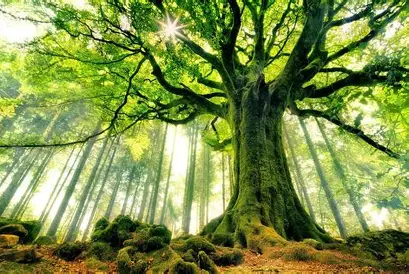
When most people walk through a forest, they think it’s peaceful and quiet. You might hear the wind brushing through the leaves, a bird chirping in the distance, or the crunch of twigs beneath your feet. But if you stop and really think about it, there’s something mysterious happening around you. Beneath the soil, trees are talking to each other. Not with words or sounds, but through an underground network that scientists have started calling the “wood wide web.”
This isn’t a fantasy idea. It’s a real scientific discovery that has completely changed how we understand forests. For centuries, people thought trees simply grew side by side, competing for sunlight, water, and space. But now we know that forests are full of cooperation. Every tree is part of a living system that quietly communicates, shares, and even protects its neighbors.
If you could look underground, you would see that a tree’s roots are connected to something called mycorrhizal fungi. These tiny thread-like structures form relationships with almost every plant species on Earth. In return for sugars that the tree produces through photosynthesis, the fungi help gather nutrients and water from the soil. What’s truly fascinating is that these fungal threads can stretch out and connect multiple trees together.
Through this hidden web, trees send each other chemical messages and nutrients. When one tree is struggling, others nearby can actually share resources to help it survive. For example, if a young sapling is growing in the shade and not getting enough sunlight, older trees can transfer carbon through the network to keep it alive. Scientists have even seen “mother trees,” which are large, ancient trees, sending extra nutrients to their own seedlings. It’s almost like a parent looking after its children. Trees can also send warnings through this network. If one tree is attacked by insects, it releases distress signals underground that alert nearby trees to produce chemicals to make their leaves taste bad to pests. In a way, it’s like the forest version of a group chat where everyone warns each other when danger is near.
When scientists first discovered this underground communication system, they were stunned by how similar it was to the internet humans created. The fungal network acts like cables, transferring information and resources between trees. The trees are like users, each with something to share. Some even send more data than others, depending on their size and strength. What’s even more interesting is that trees seem to understand balance. They don’t send signals all the time because the system would become overloaded. Instead, the forest operates with a quiet rhythm, always making sure that the community stays healthy. This kind of collaboration shows that survival in nature isn’t always about competition. Sometimes, it’s about working together.
Learning how trees communicate isn’t just something cool to think about. It’s also incredibly important for our planet. Human activities like deforestation, mining, and urban expansion are destroying these networks. When we cut down a forest, we aren’t only removing trees. We are tearing apart a communication system that has existed for millions of years. Scientists are now trying to apply what they’ve learned from forests to help create sustainable farming systems. Imagine if crops could share nutrients with each other like trees do. Farmers could use less fertilizer, reduce waste, and still maintain healthy soil. Understanding the forest’s cooperation could help us design a future where technology and nature work side by side.
What makes this discovery so significant is that it forces us to rethink what it means to be intelligent. We often assume that intelligence requires a brain, but trees show that information can flow in other ways. They can sense, remember, and respond, all without neurons or thoughts like ours. Now, whenever I walk through a park or see a line of trees along the road, I can’t help but imagine what’s happening beneath my feet. Are they sharing resources? Are they warning each other about changes in the environment? It’s strange to realize that something so silent can be so alive with communication.
Maybe the forest isn’t quiet after all. Maybe it’s whispering, in a language we are only just beginning to understand.
This was a really interesting post. As you said, I always viewed trees and forests are quiet, peaceful places that offer us refuge. But understanding this underground tree network not only adds a whole other dimension to how we view trees, but can also offer us valuable evidence to study effects of climate change, land rezoning on wildlife. Thanks for sharing!
Comments are closed.