

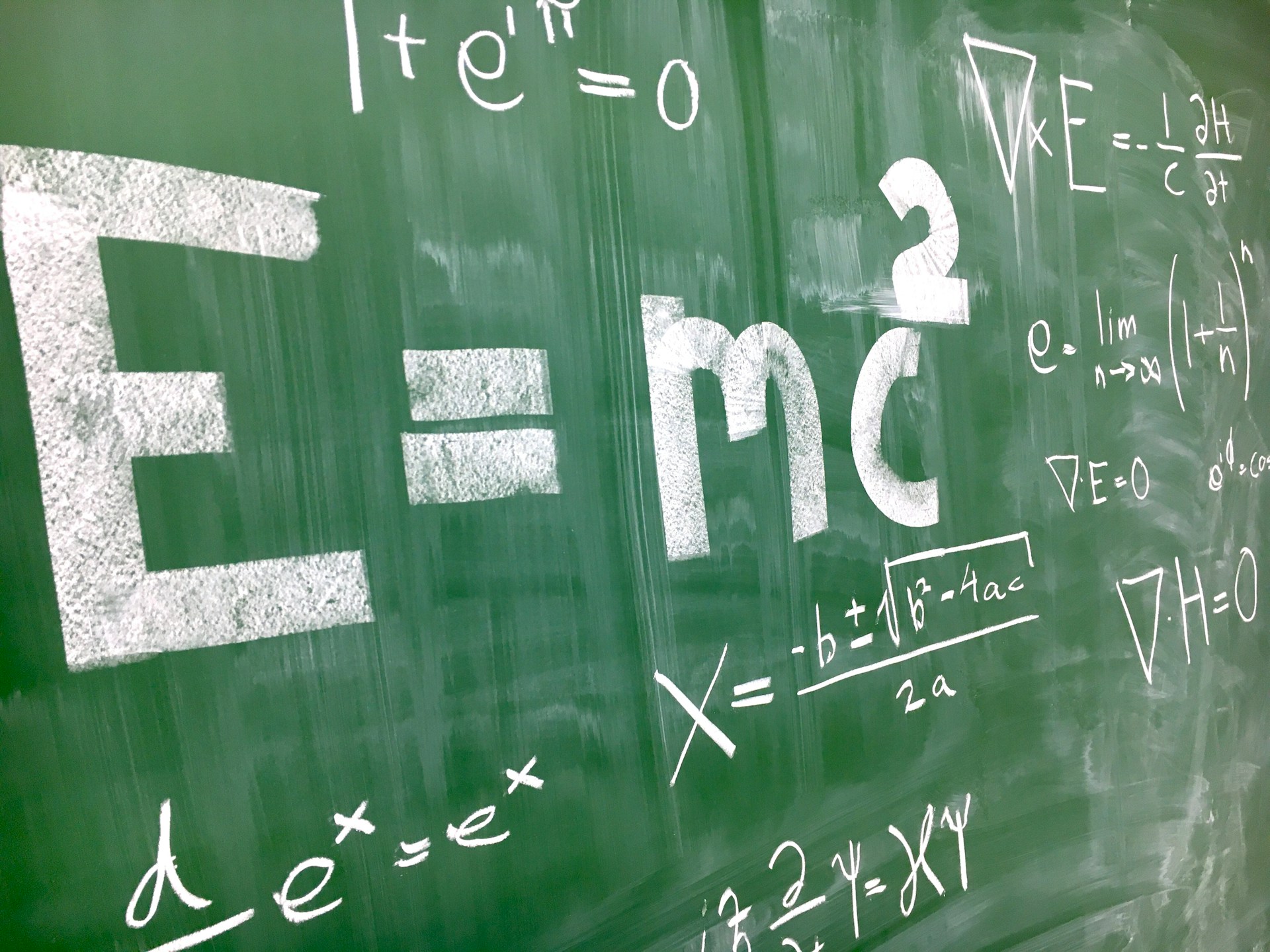
It is always easy to flip through a physics textbook and see laws and concepts as if they were always there. But physics was not figured out from the start. Our current understanding of physics came from centuries of research, theorizing and testing. In this blog post, we will be taking a deep dive into the field of physics and the major contributions made by physicists. This blog post will explore the developments made by the pillars of physics: Isaac Newton, James Maxwell, and Albert Einstein.
Isaac Newton – Universal Gravitation
Universal Gravitation is a fascinating discovery made by Isaac Newton in a time period dominated by plagues and superstition. During his early stages of life, Isaac Newton is said to have observed an apple falling from a tree, which caused him to wonder why objects always fall straight down. He was very curious and determined that there must be a force that causes this.
He then connected this force to the moon and discovered the idea that the force of gravity is what holds the moon in orbit around the Earth. Using complex mathematics and discovering calculus, Isaac Newton was able to come to the conclusion that this force weakens with distance.
He also came up with Newton’s three laws of motion, which are shown here:
Newton’s First Law of Motion: This law states that “An object at rest stays at rest, and an object in motion stays in motion with the same speed and in the same direction unless acted upon by an unbalanced force.” This law describes the fundamental ideas of inertia.
Newton’s Second Law of Motion: This law states that “The acceleration of an object depends on the mass of the object and the amount of force applied.” Mathematically, this law establishes that force is equal to mass times acceleration.
Newton’s Third Law of Motion: This law states that “For every action, there is an equal and opposite reaction.”
James Maxwell – Classical Theory of Electromagnetic Radiation
Electromagnetic waves are produced by an acceleration of charged particles. This change in the electric field, for example, induces a changing magnetic field perpendicular to the electric field, which induces a changing electric field perpendicular to the magnetic field and so on. These waves propagate in a direction that is perpendicular to both the electric and magnetic fields.
James Maxwell is the first physicist to discover electromagnetic waves theoretically in the 1860s by combining Gauss’s Law, Faraday’s Law, and Ampere’s Law. He even calculated the speed of electromagnetic waves to be approximately 300,000 km/s. Maxwell also came to the conclusion that light was also a form of electromagnetic waves. Maxwell also used various equations, existing laws and differentiation to create Maxwell’s Laws, which are laws that explain how electric charges create electric and magnetic fields and how they propagate as waves.
Albert Einstein – Quantum Mechanics and Relativity
Albert Einstein contributed immensely to the world of physics in various topics such as quantum mechanics, relativity, thermodynamics, mass-energy equivalence, cosmology and much more. He is most famously known for his discovery of mass-energy equivalence, which is mathematically expressed as E=mc².
Albert Einstein’s mass-energy equivalence states that mass and energy are equivalent and are different forms of the same thing. He put forth the idea that mass can be converted to energy and vice versa, breaking the classical understanding that they are two different entities. This explains how nuclear fission and nuclear fusion release large quantities of energy, where the products have less mass than the reactants. This missing mass, also known as mass defect, is released as energy.