

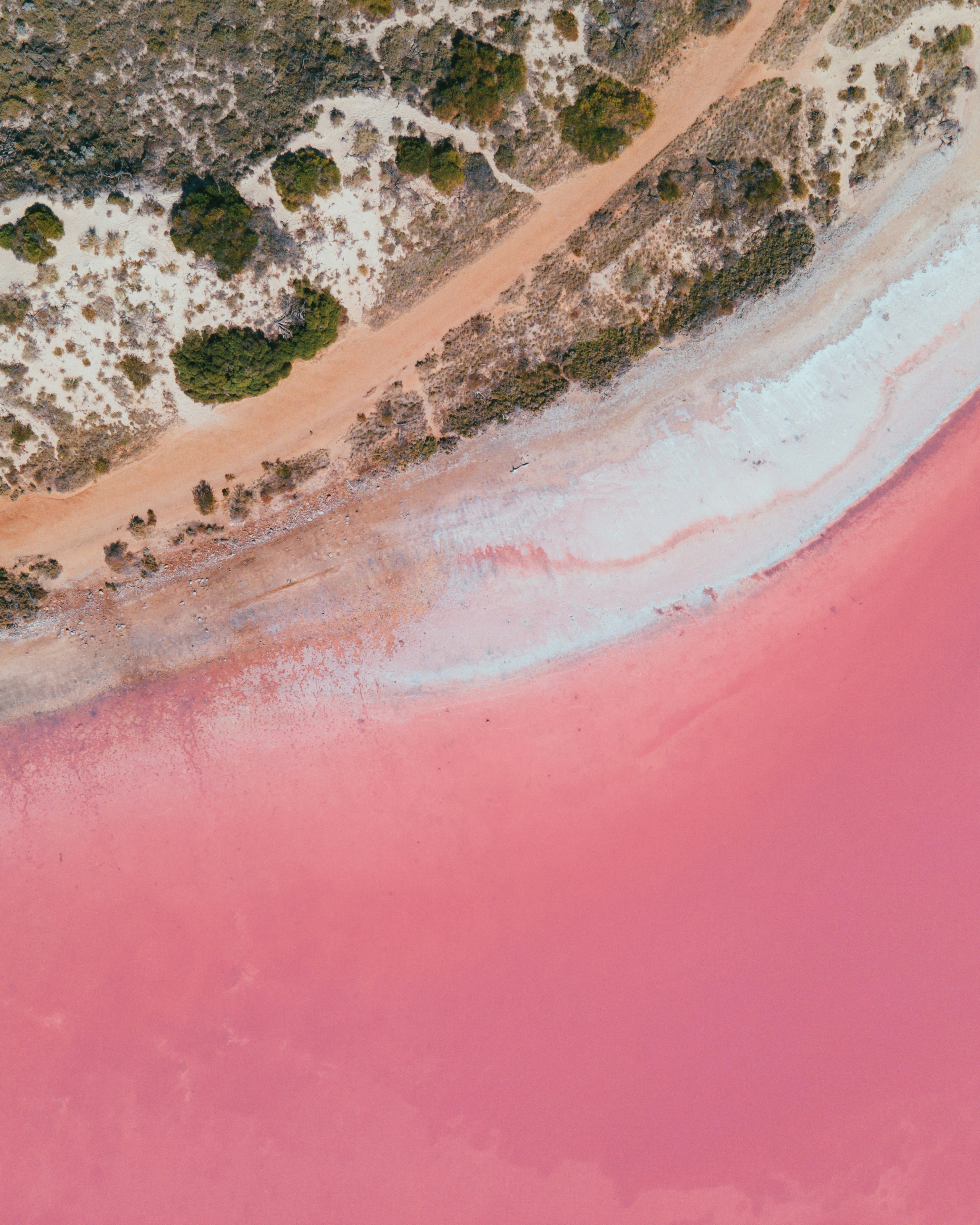
The unbelievable phenomenon of pink lakes is one which very few people are aware of. Although you may have seen it on Instagram, this natural phenomenon is observed in many locations worldwide. Most often, pink lakes are seen in Australia, where the dry weather conditions and other natural factors force certain bodies of water to become pink. In this article, we will delve into the formation of these magical lakes and explore why they are limited to specific areas.
Conditions:
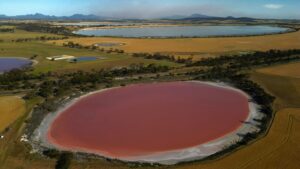
Most often, bodies of water range on a scale of blue; therefore, pink lakes are unexpected to be seen in an ocean. Throughout the images in this article, as well as other images on Google, you will notice that each pink lake has a different pink tone, similar to normal oceans, where each gradient of blue is distinct. This is due to the levels of salinity. The primary reason for the pink colour is extremely high levels of salt in these lakes. For reference, Pink lakes in areas such as Australia consist of up to 10 times the amount of salt as an ocean!
How Do They Become Extremely Saline?
Pink lakes are often seen as “terminal lakes,” meaning the lake is enclosed within itself. Since there is no way to merge this body of water into another, the only way it escapes is evaporation. Henceforth, the water develops minerals and excessive salts. Furthermore, high salt levels in water stimulate the production of Dunaliella salina. This algae is a prominent reason for many lakes to appear in a strong pink hue.
The Effects of Beta Carotene
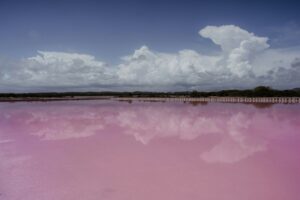
Salinas, Puerto Rico.
Furthermore, Dunaliella salina is the species that produces Beta-Carotene, a specific pigment reaction that occurs when certain algae are placed in saline environments. The reddish-orange colour produced is not only a reaction but rather an act of self-protection. Think of the beta carotene pigment as sunscreen for the algae, in which the layer prevents them from UV absorption while still absorbing light energy to stimulate reproduction.
Pink Lakes Around the World
You may be wondering why these lakes are only seen in certain areas, such as Australia and Puerto Rico. The simple answer is due to the climate. As previously stated, saline lakes only form when there is high evaporation and no outflow of the water. Additionally, the climate for pink lakes must be warm and dry. With high precipitation in the monsoon season, you get to see a faded pink due to the dilution of extra water into the pigmented water. When there is precipitation, the water does not evaporate as fast due to high humidity. Lakes such as Hutt Lagoon and Lake Hillier are the most popular pink lakes, which reside in Australia. Other lakes around the world include Lake Rebta in Senegal, Las Coloradas in Mexico, Las Salinas de Torrevieja in Spain, and Laguna Colorada in Bolivia.
Conclusion
In conclusion, these pink lakes are a wonderful treasure which must be explored and maintained with environmental precautions. Protecting such lakes while limiting industrial activity in such sites is a crucial step in preservation. Nevertheless, these lakes are a great addition to your bucket list, especially if you are going to Australia!
Sources: