

I took driver’s ed this week. Or at least, I took my in-class sessions with a teacher and books and corny movies. All my friends told me it was boring, but I’ve really come to appreciate it. I took my course with A Driving, and have found the classes very useful. However, the classes have also converted me- I’ve become a stickler for road laws and defensive driving. Whereas before I didn’t really pay attention to the road, I now find myself suffering from “backseat driver” syndrome- constantly nagging at the driver and criticizing their driving.
“You’re supposed to wait until all ten of the pedestrian’s toes are on the other end of the sidewalk before you drive! It’s an $800 fine if you don’t!”
“Look left, then right, then left again before entering the intersection.”
“You’re speeding!”
I am no longer blissfully ignorant. Furthermore, I’ve become concerned about other drivers on the road. Today, my driver’s education teacher mentioned a new study of Albertan drivers that was in the news.
The study, released October 5th by the Schulich School of Engineering at the UofC, revealed that out of 2,394 Albertans surveyed, nearly 89% failed a basic road test. As my driver’s ed teacher said, “that’s scary.”
The questions ranged from “what does a solid white line mean?” to recognizing “bicycle crossing ahead” signs. The survey concluded that Albertans just weren’t driving properly. As a resut, I’m afraid of the teenage boys that like to race, but I’m also concerned about the middle aged business people rushing to work and cutting corners.
While it scares me, it also frustrates me. New drivers like myself work hard to earn the privilege of driving, but the vast majority of Albertans on the road have to do very little to maintain that privilege. Hopefully the Alberta Motor Association will take the study into consideration and implement some of the researchers’ suggestions, which included refresher courses and online educational games.


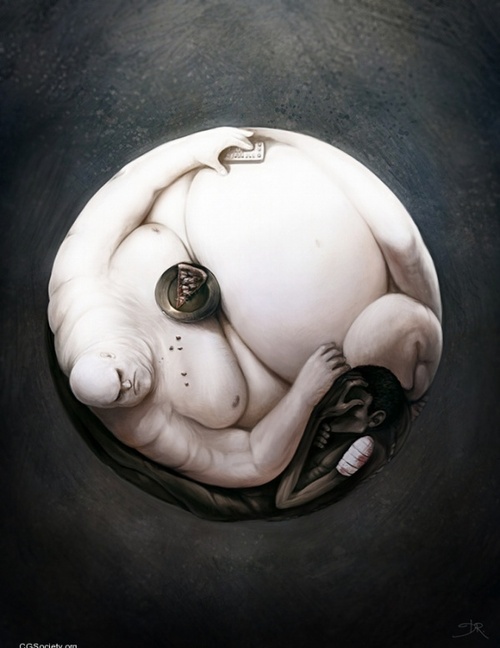 This photo speaks for itself. The world is harsh, the fat man stays fat and the poor stay poor. Living in North America already puts us on the wealthy part of the spectrum, and it is clear that other parts in the world are suffering, without much help. To put this in perspective, imagine a poor homeless man on the street who is ill. He does not get the help he needs because he can’t afford it, he stays poor, he stays hungry. And some may disagree with this analogy because they believe that homeless men do not deserve help, because they are not willing to work as if they brought this misfortune on themselves. This may be true in some cases however, some are not capable to work, and if they do, it usually amounts to nothing in a society that revolves around money. This image may seem harsh but it reflects the truth in the world.