Home Blog Page 155

SAVE THE BEES!

0


SAVE.


THE.


BEES.

x


Starting in 2006, the honeybee population started to decline drastically. We need these bees! They help pollinate 80% of food crops and are responsible for $40 billion worth of our national produce each year. If we just sit here and do nothing while the bees slowly slip into extinction, we’ll feel regretful forever! Honeybees are wonderful creatures that help us in our everyday life and we need to start appreciating them for it. Without bees, we would lose one-third of the food we eat right now. The extinction of honeybees will not only lead to trouble in the agriculture industry but also the diary and cotton industry. Honeybees affect more things than we can imagine. These little guys do so much for not only us humans, but mother nature as well and it’s about time they get some recognition! Now, when people hear about this, they don’t usually like to pay attention because they don’t like bees and think they’ll sting you. I do understand that most people will confuse bees with wasps or hornets, but let me tell you, THEY ARE NOT THE SAME THING!

Know the difference between honeybees and wasps/hornets! Honeybees are quite small (2.54cm) and are hairy with either black or brown bodies and yellow or orange stripes. Wasps are narrow with shiny and smooth skin (have no hair? Get out of there!) and bright black and yellow patterns. Honeybees will not attack you unless you provoke them and will die after they sting once. If you come across a honeybee, don’t be scared, it obviously doesn’t want to sting you and practically commit suicide, just don’t make it angry! Wasps/hornets, on the other hand, are far more aggressive and can sting you multiple times. Most people think that they’re allergic to bees because of the reaction they have after getting stung, but it’s better to go to a doctor to get an allergy test and see if you’re really allergic to bees. The swelling of the place of the sting is pretty normal, it doesn’t necessarily mean you have allergies. That would be a more serious issue and would most likely require medical treatment. Watch yourself before killing what you think might be dangerous when it could be an innocent little bee! Don’t add to their disappearance! And even if you are allergic to bees, it doesn’t mean you can’t still support them! Visit this site to sign a petition banning bee-killing pesticides and hopefully raise enough awareness so that the government and big companies will notice and take action!

x

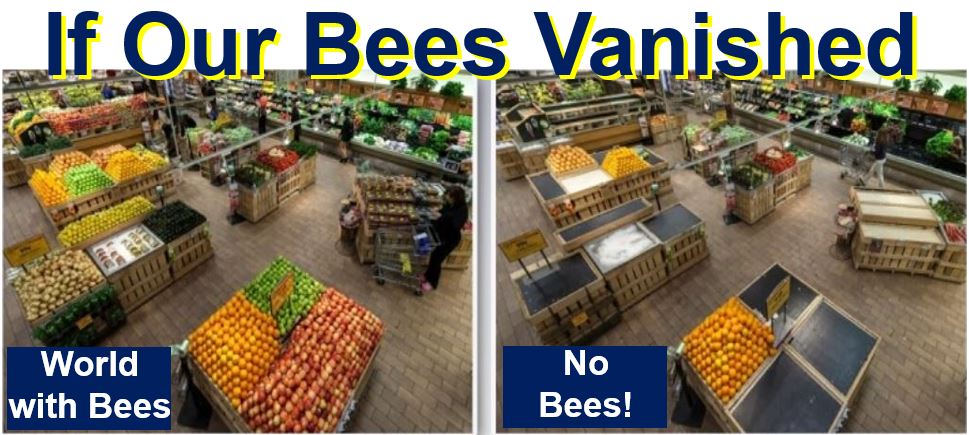
Look that this! LOOK AT THIS!!! Is this how you want our grocery stores to be like? Bees are vital to our everyday existence. We have got to step in and take a stand!  Colony collapse disorder (CCD) is one reason of the bee disappearance. CCD is when all the worker bees vanish, leaving their queen and larvae. Scientists still have no clue what causes this. There are also three other theories as to why the honeybees have been dying so rapidly.

1) Parasites and pathogens: Varroa mites are tiny parasites that infest beehives. They suck the fluids from the bees’ bodies, leaving them weak and with a bad immune system. They also leave big wounds in the bees so that it’s easy for viruses to enter the body. Those two things combined together create a lethal effect for the bees. 🙁

2) Bad nutrition: Some bees don’t have access to a variety of pollen. They need nutritious pollen to keep energised and healthy but they can’t always find it. Bees need a diversity of plants and the increasing number of one-crop farmland aren’t helping. If bees can’t get the nutrition they need, it will be difficult for them to survive. 🙁

3) Pesticide: Pesticides are obviously toxic and is meant for the use of keeping away nasty pests from crops. But not only does it stop pests, it has grown to affect many different species, bees being one of them. Neonics is a type of pesticide that is applied onto the seed instead of being sprayed straight onto the crops. Since the neonics is in the seed, as the plant grows, the pesticide incorporates itself into the plant’s tissues so when the bees come to pollinate, they get affected by the neonics. It can make the bees sensitive to bad weather and cause poor sense of direction. 🙁

I can’t even begin to imagine how we would live without honeybees!

What you can do to help SAVE THE BEES!

-Plant bee-friendly plants in your garden!

-Don’t use chemicals/pesticides on your plants!

-Put a bucket of fresh water in your garden for the bees!

-Support your local beekeeper!

 x

For more ways, visit this and this!


HELP US

SAVE

THE

BEES!!!!!!

featured image

source souce2 source3

Tips for Before & After Exams

0

Have you ever gotten an unexpected mark on your test just because you made so many careless mistakes? Have you ever thought you would get a 100% if you paid more attention to the questions? Have you ever regretted not checking your work before you handed the test in?

If this has ever happened to you, then here are some tips for you.

Before the test

Get enough sleep

A good sleep can help us focus well during the exam. This means you become better at detail-oriented tasks which is helpful for difficult exams. If we don’t get enough sleep, we will end up losing many tiny details that could contribute to making a careless error.

Review all the mistakes that you have made in the previous tests and quizzes.

A mistake should be your teacher, not your attacker. A mistake is a lesson, not a loss. It is a temporary, necessary detour, not a dead end.

This is a significant part of preparing for a test, because you are able to look at what kind of error you usually make in the tests, so that you can remind yourself not to make the same mistake again.

During the Test

Be organized and neat when you are taking a test

If you have neat handwriting and you are able to put all of your work on the paper in a logical flow instead of scattering the work everywhere, you will most likely get a higher mark. The teacher will see the hard work you have put in the test and she will award you partial credit if you deserve it, so that’s a very good trick. It is also very easy for you to go back and check if you make any mistakes once you finish your test.

Do not skip steps

Even if you feel really confident in specific method or type of problems, you can still have the chance of making silly mistakes. Some students like to skip several steps and do the mental math which has higher risk of making a careless mistake.

Keep track of all of your formulas

This tip is really useful in math and science tests. Each formula can be used in different types of questions and each different variables in the formula represent specific values. It is imperative that you are clear with writing the formulas.

Always check your answer especially the scantron

After you finish the test, take at least five minutes to check for any missing questions or any careless mistakes on the scan-tron. It is really important to go through the answers in the scan-tron and the paper to check if you skip any questions or if you put the answer in the wrong row because once you do make a careless mistake you will lose a lot of points.


Picture Source1,2,3,4,5,6,7


http://www.thecollegehelper.com/sat-scores-for-colleges/

Calgary Youth Foundation – Grants for Youth Driven Initiatives

0

Have you ever had an amazing idea that could benefit Calgary and the world around you but, the project seems out of reach because of those expenses that come with it? Calgary Youth Foundation (CYF) can solve those problems for you.


What is the Calgary Youth Foundation?

CYF is a youth-driven committee that offers grants to deserving individuals in the Calgary area. The foundation has been running since 1994 and has helped countless projects get off the ground since. Every year $10,000 is distributed between two granting cycles with a maximum grant of $2,000. The amazing part of the entire application process is the youth-on-youth contact that applicants experience. The sincerity of the members and intentions of the committee are for the sole purpose of making individuals comfortable with making a difference and not feel intimidated throughout the process.


How can you get funding for your project?

Back to those ideas… do you have a real vision for your project? If so make a plan, design a website, create something that will benefit other youth and of course be passionate about your project! Now that you have an idea and a suitable plan…

Apply:

  • Send in an application with all the necessary information. It is conveniently laid out on the grant application page.

Be Patient:

  • As the committee makes those initial decisions it is important to leave nothing out of the application that could influence a decision. These first impressions will support the validity and originality of your idea!

Interview:

  • If you are chosen for an interview come equipped to answer any and all questions that the committee may have regarding your initiative but most of all come with a smile and be passionate of what you have to share.

Money!!

  • Now that the committee has narrowed down those difficult choices your project could be funded up for to $2000! This could be the starting point to something truly extraordinary!


The current granting cycle is opening and taking applications until April 10th!

Do You Believe in Conspiracy Theories?!

0

According to dictionary.com, conspiracy theory is defined as “a theory that explains an event as being the result of a plot by a covert group or organisation; a belief that a particular unexplained event was caused by such a group.” I define it as “an eye-opening theory that could be totally true and makes you question everything you’ve ever known.” Seriously, after reading only a couple of theories I was so convinced. Some conspiracy theories are really far fetched but some actually make a lot of sense and could possibly be the answer… 

Ranging from fake moon landings to celebrity clones, conspiracy theories covers a wide variety of subjects. I have collected a few of my favourite theories that I think are super convincing and the most likely to be true.

Most of you guys have probably heard of the Mandela Effect, but for the people who have not, it’s basically something that we think happens when someone has a clear memory of a specific detail that never existed. It’s called what it is because many people clearly remember Nelson Mandela dying in prison when he actually passed away in 2013. This theory is bizarre because a majority of people report remembering the exact same things/events that never happened. For example, Febreeze is actually spelt like Febreze, but almost everyone had remembered it spelt the first way. That brings us to the theory that parallel realities do exist and we’ve been transporting between them without realising it, causing us to have glitches in our memories. If you remember it being the BerenstAin Bears, you may or may not have accidentally slid into a parallel universe because, in reality, it’s actually the BerenstiEn Bears. Other examples of the Mandela Effect include the monopoly man (he actually doesn’t wear a monocle!) and Curious George (he never had a tail!).


This theory argues that aliens have made a few trips to Earth, based on the unidentified flying objects shown in these ancient arts. There are pieces from different time periods that have the same spaceship looking object in the background. Coincidence? I think not. Realists say that the UFO’s painted in the art are representations of demon arrivals from the bible (since during the middle age, Christianity was what most artwork focused around) but what if during when the first bible writings were being written, aliens had actually visited Earth and scared all the humans into thinking they were demons, therefore being recorded in the bible as demons–instead of aliens–in flying saucers (chariots of fire). Hmm? Convinced yet?

*this is not meant to offend anyone of religious beliefs.

This theory lowkey ruined my childhood. It says that the characters in Winnie the Pooh are based on mental disorders. Winnie the Pooh has ADHD and obsessive fixation. Since Pooh is so careless, it is only fair to conclude that he has ADHD and his obsession with honey leads him to have obsessive fixation. Piglet is based on anxiety because he’s always so nervous and scared. Tigger has ADHD which explains why he’s always so hyperactive. Eeyore has depression. Don’t you notice that he’s so negative and sad all the time? He’s also blue because the colour blue is a representation of depression. Rabbit has OCD and that’s why he’s so obsessed with keeping everything a certain way and how come he gets so frustrated whenever someone messes up his carrots.  And do you ever wonder why Kanga is so over protective of Roo (her kid) and never wants him to go out? It’s because she has social anxiety, causing her to act that way. Finally, Christopher Robin has schizophrenia. His inner emotions are expressed by the imaginary characters in Winnie the Pooh.


So after reading a couple of these conspiracy theories… What do you think? Are you convinced?

Featured image: source

Credits to @conspiracypost.s on Instagram.

**Disclaimer: THESE THEORIES ARE NOT MINE!***

Go Watch A Ted Talk Right Now…

0

In some of the most difficult moments of my life, it’s always been hard to find inspiration, joy, motivation and even simple humour. What do you do? Well, for me, I creak open my laptop screen, and I type in “TEDx” on the YouTube search bar, and I get lost. Lost in a world of brilliant thought, a world of fascination, guidance; thousands of speakers who speak to you, their experiences, their knowledge, their advice. Whether you agree with their thoughts or not, it is always time well spent.

Be Amazed:

With the world so small, it isn’t hard to find some brilliant minds and gifts out there on plant Earth, and thankfully these individuals demonstrate gifts that only leave us in awe and admiration. So make sure you are sitting down, relax and enjoy.

A musical genius-Usman Riaz

Beatbox Brilliance – Tom Thum

Faster Than a Calculator – Arthur Benjamin

The art of cognitive blindspots – Kyle Eschen

Balance Goddess – Lara Jacobs

Be Inspired:

Life was never meant to be easy to any of us, and these people know it. They have trudged through thick and thin, and they are to tell you their stories, experiences and motivations. They have often faced greater struggles that you could ever fathom, but they will remind you: If they can do it, so can you. Whenever you need a pick-me-up, or is perhaps struggling to find purpose, look no further than here.

My philosophy for a happy life – Sam Berns

Overcoming hopelessness – Nick Vujicic

Own your face – Robert Hoge

How to become a memory master – Idriz Zogaj

The storyteller in all of us – Zach King

Be Fascinated:

You know the saying “The more you know?”. Well, beyond the inspiration and amazement that Ted Talks bring to the table, if also has some cool perspectives and teachings from fascinating individuals. Why not give it a shot?

Paper Towns – John Green

Do Schools Kill Creativity? – Sir Ken Robinson

Inside the Mind of a Procrastinator – Tim Urban

What if you could trade a paperclip for a house? – Kyle MacDonald (NOTE: A few “choice” words are used in this Ted Talk, so be aware of that)

How to come up with Good Ideas – Mark Rober


Rethink.

0

Rethinking.

They say that you’re an over thinker- that you pick and choose every word you say, that you never know how to make decisions, that you’re continuously wrought with anxiety. As cruel as their words may seem, it’s so easy to believe them. And now, only their words matter. No amount of comfort from friends and family can change what they have said.

Why? Why are we so willing to accept such averse comments but entirely reluctant to believe the brighter truths? Just, rethink. Considering multiple outcomes of a situation isn’t a flaw. In fact, it should be encouraged, praised even. And it all comes down to being mindful.

They don’t realize that you are the embodiment of the future, the expression of new thinking. You envision the solutions to the problems we face today and redefine what’s already known. It’s about time to make them rethink.

Rethink the future.

1. The Classroom:
There’s a universal agreement on the importance of education: it’s vital. But now, more than ever, we’re realizing that the traditional classroom environment needs improvement, and fast. Our biggest change in classrooms since the beginning of the schooling system is the addition of all sorts of tech. But the general teaching style hasn’t seen a single change. As much as lectures are an effective method of teaching, there’s great demand to make school more engaging. That way, at younger ages we can eliminate the bland association to the classroom helping more kids stay in school. What’s pushing us back is our limited capacity in renovating current school environments into more open, modern spaces. It’s time, to rethink and react on schooling matters.

2. The Home:
Fairly recently, the concept of home automation has seen a drastic spike in development. Everything from your sprinklers to your counters and doors to your walls have been automated and transformed your basic home into a digitalized setting. Concerns about home security and a likely rise in couch potato lifestyles should be carefully evaluated. Nevertheless, there’s incredible potential in rethinking the home and the entire prospect is elevating to an unimaginable level.

3. Our Lives:
It’s pretty common to hear: “It’s time to rethink everything you know,” and honestly, that’s a very valid statement. We’ve barely smudged the surface on all there is to know. Much of what we know still has blanks that we have yet to fill or could even be untrue. Taking your studies further whichever field you choose will make you rethink just how much out there we are on the path to find answers for. On an introspective level, I take genuine surprise towards how insignificant human progress seems relative to the universe. Don’t get me wrong here, what we’ve accomplished as of today is insanely mind-blowing after how we first started off. But, humans have only been alive for less that one millionth of a fraction of time that the Earth has been around for. That’s not even considering the time the entire universe has been in existence. There’ll come a time in your career that will make you rethink about how far we have come and how far we will go.

Rethink all that you know.

In perspective, there’s a lot that we’re currently rethinking. And that’s the beauty of the entirety of human life. All in all, it’ll be all of you over thinkers out there who’ll create the definition for rethinking our world.

Sources /1/2/
Images /1/2/3/4/5/6/

Top 3 Hot Chocolate Drinks in YYC Hot Chocolate Festival

If you didn’t know, The YYC Hot Chocolate Festival happened during the month of February with shops and cafes participating. The goal was to make a special hot chocolate drink and win the “Best Hot Chocolate in Calgary.” Furthermore, when you buy a hot chocolate in participating shops and cafes, a portion of the proceeds from each purchase is being donated to support Calgary Meals on Wheels.  A win-win situation!!!!.  I visited many cafes and shops that sell hot chocolates in Calgary during this festival but here, for me, Top 3 Hot chocolate drinks in the Festival.

1. White Chocolate Matcha Kiss from The Light Cellar

This was my last hot chocolate I tasted in the month of February since you always save the best for last but before I came here,  I was feeling sick and had a cold that lasted for three days yet I thought about curing my sickness by drinking this hot chocolate and I can tell you “IT LITERALLY  WORKS.” This hot chocolate was beyond my expectation, I never realized you could combine Matcha (powdered green tea) with a hot chocolate, it tasted amazing because the sweetness was not overpowering the drink and it had a lot of flavours inside it like peppermint, green tea, and had a spicy aftertaste due to the flavour oil they put in which gives a unique taste and awesome blend to the drink.


2. Taj Mahal from The Bean Stop

When I ordered this drink, the guy asked me, “have you ever tasted handmade chocolate?”  I said “Wait, what ‘Handmade chocolate,’ no way.” I waited for 5 mins for this drink and each second I waited was worth it. The guy who made this was very passionate making this drink and was like a chef making his signature dish pretty much like “Salt Bae” if you know what I mean.  I was amazed by this guy because he’s the only one making drinks and handling the cash register at that time and many people were in line. When I got my drink, It contained many spices which tasted sweet and spicy. It feels like eating a very spicy food without water because it’s also sweet and you get this refreshing aftertaste a very cool combination.


3. The Hobbit from Hexagon Board Game Cafe

By far, one of the sweetest drink I ever tasted in the festival plus it had smoked bacon on it. I came here with my friends to play board games and also bought their hot chocolate.  I don’t really know how to react with that when they said: “You want bacon with that?” But thankfully, I said yes, because the bacon saltiness works together in their caramel hot chocolate. It was weird but heavenly good. When I bought mine, my friends said, “Yup, I’m buying that too,” and they rushed to the counter. The bacon really helps balanced the drink and also gives the drink its smoky flavour which was really fascinating to taste. In the end, that made my day during that cold weather with my friends.

The Search for Validation

I sometimes call my Grade 12 year the year of applications, and I’m only half joking. From September to now, this year has been a whirlwind of essays and deadlines looming ahead, many of them for scholarships. With all these applications, it seemed certain that I would get a scholarship, right? Wrong. From polite rejection letters to flat out silence, each rejection had me wondering, where did I go wrong? I was academically strong, and I had many extracurricular activities and strong reference letters. So, what then was the problem?

Where did I go wrong?

At the beginning, I was filled with hope, but as each opportunity failed to manifest, I found myself sinking into despair. But after the despair came self-doubt. My self-confidence plummeted; I got discouraged, and I just didn’t see the point in applying to any other scholarships anymore. To make it even worse, all around me, there were smart, talented individuals who were constantly applying for and gaining these same awards I had applied to. What were they doing differently?

What were they doing differently?

No matter in what context, rejection stings. It serves as a reminder that you weren’t good enough, and that is something nobody wants to be told. Recently, however, I took a good look at the motives behind my disappointment and low self-confidence, and what I realized was that this lack of self-confidence stemmed from a reason deeper than simply not receiving awards. I understood that at some point along the way, I had begun to equate my self-worth with these awards. If I received an award, it would serve as validation and prove that I had the ability to achieve these prestigious awards. I recognized that it was natural to be upset about the rejections, but my ability to succeed would depend on my ability to bounce back, and keep trying. Why was I allowing a selection committee halfway across the country to determine how I felt about myself? Why was I depending on their results for validation?

Why was I allowing a selection committee halfway across the country to determine how I felt about myself?

Ultimately, nobody was putting pressure on me to receive an award, or telling me I wasn’t good enough. That was all me, and it came from inside my head. Unconsciously, I was hurting myself in my desire to be perfect. Sometimes, you truly are your own worst enemy.

I was hurting myself in my desire to be perfect

To all the overachievers, the perfectionists, the worriers, and those who stress about every last thing: it’ll be alright. You may not achieve everything you want to, and that’s okay. What matters most is the effort you put into your activities, and your ability to persevere.

I may not (yet) be an award-winning student, and I may not have received a full scholarship to the university of my choice, but I am an intelligent, hardworking person, and I will keep trying. I will celebrate each small success because the sting of rejection makes them all the sweeter.  I will be my own biggest cheerleader, and you should be too.

March Madness Begins!!!

0

It’s that time of the year again. The NCAA basketball playoffs begin! For those who play basketball, like me, the NCAA playoffs are one of the most hyped-up professional sporting events of the year, behind only the NBA playoffs. For those who are a little confused right now about what is going on, let me give you a quick run-down. The NCAA Men’s Basketball Tournament is a competition of the top 68 college basketball teams in the USA. This games are extremely competitive and often are taken by the schools as a championship of great honour, and these games are mostly played in March, thus the name “March Madness” was born.

March Madness gains a lot of media attention and coverage across the USA and also internationally. In fact, it’s such a big deal that even Barack Obama released his predictions for the winners of this year’s NCAA tournament:

The NCAA tournament is also a great reason to get together with you friends and hang out. Sometimes you can run out of ideas of what to do with friends, and this is a perfect idea to grab some popcorn and pop, head over to a friend’s house, and have a fun time watching the game!

So who’s going to win? Well, according to statistical analysis experts, Villanova was favoured to win:

However, despite all the predictions by the statistics experts, Villanova was eliminated from the first round by the N0.8 Wisconsin!

(this one too) <iframe src=”https://www.facebook.com/plugins/video.php?href=https%3A%2F%2Fwww.facebook.com%2FNCAAMarchMadness%2Fvideos%2F10155187498603760%2F&show_text=0&width=400″ width=”400″ height=”400″ style=”border:none;overflow:hidden” scrolling=”no” frameborder=”0″ allowTransparency=”true” allowFullScreen=”true”></iframe>

Seeing the volatility of the entire playoffs, I’m sticking with my belief that Kentucky will be the real winners. GO KENTUCKY #1!!! Remember, three weeks from now, that you heard it here first. Now go out there and watch the Madness unfold on the court!


Further Reading/Watching:

FiveThirtyEight’s comprehensive analysis: https://projects.fivethirtyeight.com/2017-march-madness-predictions/

Highlights from March Madness: https://www.youtube.com/watch?v=sV7vq4ABXpA

Fill out your own bracket!: http://www.ncaa.com/interactive-bracket/basketball-men/d1


Featured Image: [x]

The Most Underrated Sport in North America

0

Between Canada and the United states, we have two staple sports that we love: hockey and football. Both are adrenaline inducing, testosterone pumping massive sports with big hits and intense competitions. Both these games are fun to watch and both are ingrained in our culture. However, these two sports are both pretty limited to North America. What is the rest of the world doing?


In the majority of Europe and Africa, soccer, or “football,” is the big thing. Kids grow up kicking soccer balls around in fields compared to our street hockey. Although I could never personally get into “football” -there’s far too much flopping (faking injuries for penalties) for me to enjoy- I get that it’s pretty big in the rest of the world and fair enough. It’s the fastest growing sport in the United States though, so in couple years we might see competitive football as big as American football. I guess the question then is what we’ll call it. Let’s keep moving.


In the majority of East and South Asia, badminton dominates the headlines. The density which it can be played is very valuable in crowded countries. Badminton is also responsible for the fastest recorded ball speed generated by a human in sports. On a record smash, the shuttlecock was clocked at going 493km/h. That’s more than a third the speed of sound. If you have a chance I recommend you watch some men’s doubles. Contrary to stereotypes, it is probably one of the most exciting and fast-paced sports you can watch. But just because of the dull nature of the sport, I don’t think badminton will ever make it big in North America. Let’s keep moving.


In a small corner of the Pacific lies New Zealand and Australia. What do they do down under? In Australia they have their own football, -look at that, a third form of football!- and if you watch a couple minutes of it, you will have no idea what is going on but it will be exciting. It has all intense hitting of American football, the continuity of soccer, and blocking of volleyball, but I don’t think it’s viable to play in school because it’s a bit too reckless and dangerous and requires too large a pitch. The infrastructure just wouldn’t support it. It is still very interesting to watch, so I recommend checking it out.


Alas, we have reached the holy grail: Rugby Union: the “hooligan’s game played by gentlemen”. It’s very straightforward: you run across the field trying to touch the ball to the other end zone. You can pass backward and you can kick. There is also enough complexity with rucks and scrums and lineouts that keeps it fresh and non-repetitive. Of course there are massive hits by the tackler and the ball runner (check out GOAT Jonah Lomu for some of the latter). Of all the sports I’ve played I’ve had my most memorable moments in Rugby. It’s really hard to appreciate the feeling of being on the pitch beside your new brothers just watching the game so I encourage you to go out and try (a goal or “touchdown” in rugby is called a try). The season is starting and this game will change you. I promise.


Image sources: fi/1/2/3/4

My Quora Picks – Part 1

0

If you have ever searched up an ambiguous question on Google, chances are that one of the search results on the front page is from Quora. Think of Quora like a sophisticated version of Reddit: users comment on the main thread, which is in the form of a question. I have spent SO MUCH time surfing through my Quora feed, but unlike surfing through other social media websites, I always feel more enlightened, inspired and fulfilled after reading some – okay, more like a few dozen – Quora answers. I would highly recommend getting a Quora account and subscribing to some of their topics. Maybe you’ll like posting some of your own answers, or simply enjoy the answers being posted by others!

Here are some of my favorite answers that I have come across while reading:

1) In honor of the graduating class this year, a priceless grad prank:

Read the full answer to “What was the craziest thing you ever did in high school?” here!

2) This brilliant bet made between a high school student and his teacher:

Read the full answer to “Have you ever seen a teacher get completely roasted by a student in high school?” here!

3) A scammer being dealt some karma:

Read the full answer to “Have you ever scammed a scammer?” here!

4) Adam’s answer giving an insightful perspective into helping the homeless:

Read the full answer to “What is the most soul-satisfying thing you have ever done in your life?” here!

5) And finally, Poodle.

Read the full answer to “Did your child ever hear you say a word that they now repeat?” here!

Featured Image

The Myth of “Trickle-Down” Economics – Why Don’t They Work?

0

Whether or not you follow politics, you may have heard the phrase “trickle-down” economics before. Maybe it was in your social studies class, or on the 660 News radio one morning. Just in case you aren’t too clear with the term, trickle-down economics essentially refers to policies that funnel wealth into people who already have quite a bit of wealth (the richer portions of society). By doing so, these wealthy individuals who hold the means of production can invest in their own capital and decrease the prices of products for consumers. Everything would be cheaper, consumers could spend less for more, and ultimately everyone will benefit. Sounds like a pretty good idea, right?

Unfortunately, trickle-down economics are a myth. They don’t work.

But before the explanation of “why”, we can do some more exploration into the concept’s background.

In the 1980s, trickle-down economics was heavily promoted by U.S. President Ronald Reagan. His office used the official term of “supply-side” economics, while political opponents opted for terms such as “Reaganomics” or “voodoo economics” to enhance their criticism. “Trickle-down” also started as one of these terms, referring to the idea that wealth, after being spread at the top of society, would eventually “trickle it’s way down” through the rest of society.

Reagan’s policy involved tax cuts on businesses, high-income individuals, and capital gains. With a tax reform act, passed by Congress in 1986, Reagan lowered the highest income tax rate (for the wealthiest individuals) from 50% to 28% and increased the lowest tax rate from 11% to 15%. Reagan kept his policies for his term, but the results weren’t exactly fantastic. Economic growth in the US was stimulated, and unemployment rates did decrease. However, at the same time, the public debt practically tripled from $712 billion in 1980 to $2.05 trillion in 1988. Additionally, economists today will argue that the limited benefits of Reaganomics came solely from increased government spending, averaging 22.4% of the GDP during Reagan’s term, which was well above the ~20% average from 1970-2010. These economists would tell you that it was Reagan’s increased spending that stimulated the economy, rather than his policies of tax cuts to trickle-down wealth.

So all of this would continue to beg the question “why don’t these trickle-down policies work?”

The answer is twofold.

Firstly, I want to go back to an earlier term I mentioned: “supply-side economics”. Trickle-down policies don’t work because supply-side policies don’t work.

What do I mean by this? Most of you will remember the ideas of supply and demand from Social Studies. As demand for a certain product increases, and more and more people want to buy said product, businesses and individuals with the means of production will invest in their capital in order to meet this demand. This would include job creation, like building more factories to make the product, or spending more on existing assets, like buying better machines for your current factories. Similarly, if demand for a certain product decreases, businesses will invest less into their capital.

This is the idea that would drive supply-side policies, which puts more resources into the “supply side” of the supply and demand balance. These policies hope that more money to the rich will lead them to invest in their capital, so they can increase jobs and improve production, lower prices, and spread the wealth.

Except that isn’t how supply and demand works. Artificially inflating supply does not also inflate demand. A business will not randomly begin building more factories just because they have the money to do so. They would only build more factories if they need them because demand is high. As a result, when trickle-down policies are established, none of the job creation or economic growth actually happens.

The second reason trickle-down economics don’t work is because, just in general, people are greedy.

As we’ve established, rich people and rich businesses, as they get richer, will not invest that money into their capital. Rather, they invest it in the stock market or real estate, or stash it in a tax-free haven outside of the United States under the radar. Either that, or they can just spend their money on luxuries like foreign travel, sports cars, yachts, or other extravagant items. Why not? There are no regulations in place that state exactly how a person is required to spend their money. If a middle-class individual is able to buy a car or take a vacation, then a rich individual can do the same, multiplied tenfold.

When trickle-down policies offer more money to the wealthy, the wealthy simply see more opportunities to improve their own lives. Unfortunate as it may be, we can’t assume that people will want to share prosperity and wealth when there is no incentive for them to do so. But instead of taking my word for it, we can also look at the statistics. It has now been over 30 years since Reagan introduced the idea of trickle-down economics, and for the longest time, it has remained a driving economic theory. And yet, the wealth gap in the US continues to grow every day, to the point where the richest 1% owns more income than the combined bottom 90%. Additionally, the richest 8 people in the world, 6 of them being Americans, are worth as much as half the human race.

Once you realize that trickle-down economics does not work, you will see the excessive tax cuts for the rich as what they are – a simple upward redistribution of income, rather than a way to make all of us richer, as we were told.

-Ha-Joon Chang, South Korean economist


Furthermore, in 2015, the IMF (International Monetary Fund, an impartial organization built to promote global monetary cooperation) released a report arguing that there is no trickle-down effect as wealth is funnelled into the richest of society. In an analysis of over 150 countries, it was calculated that for every 1% more income the richest 20% of society made, the annual rate of economic growth would decline by 0.1%. Conversely, for every 1% more income the lowest earners of society make, the annual rate of economic growth would increase by 0.4% over the same period.

In light of all this, I would say that ultimately, it makes far more sense to “build up” an economy, than it does to “trickle one down.”

But the reason that trickle-down economics are becoming relevant again today is because Donald Trump is now the President of the United States. You may be sick of hearing his name by now, and I wouldn’t blame you. But hear me out on this one. His economic policy is one of trickle-down economics, and he plans to cut the top marginal business tax rate from %35 to %20. On top of that, he has proposed a “tax holiday” for corporations to stash earnings overseas at a mere 10% tax rate. And on top of that, he is cutting taxes across the board, but the overwhelming majority of cuts will go to the highest-income households.

It’s quite concerning that outdated economic policy, proved to be ineffective, is still somehow in use today.


Sources:

1. Congressional Budget Office. (2017, February 02). Budget and Economic Outlook: Fiscal Years 2011 to 2021. Retrieved March 18, 2017, from https://www.cbo.gov/publication/21999?index=12039
2. Investopedia Staff. (2004, March 23). Reaganomics. Retrieved March 18, 2017, from http://www.investopedia.com/terms/r/reaganomics.asp
3. Nunns, J. R., Burman, L. E., Rohaly, J., & Rosenberg, J. (2015, December 22). Analysis of Donald Trump’s Tax Plan. Retrieved March 18, 2017, from http://www.taxpolicycenter.org/publications/analysis-donald-trumps-tax-plan/full
4. Petroff, A. (2015, June 15). The “Trickle Down Theory” is Dead Wrong. Retrieved March 18, 2017, from http://money.cnn.com/2015/06/15/news/economy/trickle-down-theory-wrong-imf/

Image Sources:

[Banner] [1] [2]

IB or Not to be?

0

With Grade 11 almost ending in a couple of months and Grade 12 beginning in early September, I was reminiscing about the many happy times that high school has brought, but all the stressful periods during my high school career. If you decided to open this blog post looking for an answer on whether you should join IB or not, I do not have the appropriate experience to give you an affirmative answer like yes or no. However I can give you my general opinion about the IB program. Just a few days ago, I was having coffee with one of my friends which I have known since junior high we were chatting about high school and university. Him and I both regretted not pursuing higher learning through the International Baccalaureate program commonly referred to as IB. The International Baccalaureate  program is an international educational program that develops social, intellectual, emotional and personal skills for success in post-secondary and in the “real world.” The program has been associated with words like grueling and hellish which makes individuals regard the program with many negative connotations. I was convinced that IB would result in many sleepless nights and no free time but the reality of IB is that it is totally manageable if you schedule your time properly and efficiently.

Student stressed over his studies

Personally, I feared failure and underachieving in my studies which swayed me from taking the IB program. I was never a dumb kid or top of my class; I was a bit smarter than the average student. However, the sole fear of failure influenced my final decision in not pursuing IB. Rumors were commonly spread about the harshness and difficulty of the IB program and the many sleepless nights you would have to endure. Coffee would be your best friend and 6 hours of sleep would be the norm. It was only talking with one of my friends who decided to take IB that I realize the program was not as demanding and challenging as I had imagined it to be.  I was convinced the program was only for the most gifted and brightest students of the bunch, but it is only now that I realize that most students are not intellectually superior in the program instead have strong work ethics and determination. Students who struggle with the program often procrastinate, with time management skills IB is easily manageable. I have met many IB students who volunteer on a weekly basis as IB does not necessarily have to be stressful if you organize your time well.

Time Management

One of the lessons to be learned is to not believe all the rumors you hear whether about a teacher being terrible or a program being challenging. Let yourself be the judge and have your own opinion not dictated by others. It was a major flaw that I had going into high school trusting others more than myself, as I lacked confidence in my own decision making skills. Fortunately, high school has progressively improved this terrible habit of mine and I no longer lack confidence in my decisions.

One advice I can give you is to experience new things whether you like it or not. Our decisions are influenced by prejudice, however try new things without forming any preconceived notions. So, whether if IB is right or wrong for you, it depends on yourself through your personal experience. Remember if IB is not right for you, you can always drop out before the start of grade 11 something I wish I knew. Not achieving the grades, you expected in grade 10 due to IB is nothing to worry about, ultimately its your grades in grade 12 that are looked over during your university application. I suggest that you join IB and evaluate whether this program is for you or not.

Spring Arrives

0

If you’ve gone outside at all for the past couple of days, you would have noticed something peculiar. The snow seems to be melting, the temperature seems to be rising, and animals seem to be appearing. Could it be? Spring, long at last, is here!

What does the changing of the seasons mean? Well, we can begin to look forward to the tips of new growing plants popping out of the soil, the singsong voices of birds, and opening the window in the morning to take in the warm, refreshing spring air. There’s also Easter and Spring Break for all us students. Don’t forget that now we also get to pack away all our bulky winter clothes and bring those shorts back to your wardrobe!

As we begin to clean out our houses in preparation for the better season ahead, here’s a list of things for youth to do during spring in Calgary:

  1. Get into the mountains!

    The snow has melted and the wildlife in the mountains is beginning to flourish again, creating a beautiful vista that people of all ages can enjoy.

  2. Visit the Calgary Zoo!

    The animals there become more active and energetic in the spring, and if you plan on visiting the Zoo ever, spring is the time to do it.

  3. Celebrate in a parade for a holiday!

    Whether this be for St. Patrick’s Day or Easter, parades are always in order and always amazingly fun.

  4. Calaway Park

    Need to explain more?

  5. Visit one of Calgary’s downtown hotspots.

    Try Prince’s Island Park or Stephen Avenue, for a brief break from your work to be with nature or to shop and have fun with friends!

Of course, there’s much more that you can do. Whatever you decide to do with your spring, make sure you make the most of it, before it’s gone!

Featured Image: [x]

Cutting My Hair

0

Last week, I chopped 5 1/2 inches of my hair off. Now to some, this may not seem like a big deal, and to be honest, it really didn’t end up being one, at least not in a negative way. However, considering I had been growing my hair out since grade 3, this was a pretty big step for me. Growing up, I always wanted long, luscious locks. When I was little, I aspired to have flowing, beautiful hair like the dainty princesses and gorgeous mermaids I read about in stories.

However, as I grew older and started junior high, my long hair became less so a fulfillment of my inner 5 year old and more of a crutch in terms of my physical appearance. The thing is that I have tons of hair. Like a lot. So much hair. When I had longer hair, this meant that everyone was amazed by the sheer amount of keratin that came out of my scalp. As narcissistic as it may sound, the constant compliments and positive feedback I received about my hair from others really did a lot to raise my self esteem, but maybe not in the healthiest way. I began to see my hair as something that defined me, made me different and distinct. Although I wasn’t the most confident in other aspects of my physical appearance, I always had my hair to make me special and I invested a lot of my self worth into this aspect of myself.

a glimspe into my long hair days

The mistake in this way of thinking is that I became very close minded as to what I expected of my outwards appearance, extremely reluctant to try anything different or new in regards to my hair for the longest time. It took me months to even convince myself to get something as simple and non-threatening as layers. I also felt that while I enjoyed the positive attention I received towards my hair, it really limited me as I was absolutely convinced that if I were to cut my hair, nothing about how I looked would be interesting or beautiful to others anymore (yay insecurites!). I also have a pretty round face shape and there seemed to be so many rules surrounding what “suits” people with less defined bone structure, and in my mind, short hair was definitely a no no for people with my face type.

So what changed? After all of this unnecessary value I put into this one tiny facet of my manifestation, what inspired me to just chop it all off? Well even though it was sort of a snap judgement one day, I do feel like it was a long time coming. With some more recent developments, I’ve come to understand the flaws that come with pouring most of your self love and significance into a single element of yourself. It’s unhealthy and limiting, and I truly do feel like I missed out on the important experience of exploring my look and appearance when I was younger. The fact of the matter is that I’m a multi-faceted human with so much more to offer than just some strands of protein that come out of my head. I have passions, quirks, interests, talents, and idiosyncrasies — those more meaningful and personal elements of my personality are more important to me now than my hair ever was and I’m so glad I’ve progressed onwards from that point. In terms of my confidence in my physical appearance, I’ve also come a long way and I am able to appreciate my body and features for what they are, accepting myself rather than hiding behind some odd disguise.

Overall, yes, cliche as it may be, I found the process of implementing this change to my hair to be so completely liberating. I love the feelings of renewal and revitalization that came with letting go of all of those stigmas, falsehoods, and sentiments I had been clinging on to for so long. Like I said, it turned out to not even be as big of a deal as I had always made it out to be, and maybe you’re reading this and thinking “jeez, what a drama queen”, but that’s ok! Maybe I am being dramatic but hopefully I still got my point across. My story was about hair, but yours doesn’t have to be. I’m not saying you shouldn’t put value or self worth into your own appearance, it is completely valid and important to have parts of your physical manifestation or personality that make you feel happy or unique. Instead, reserve the choice to  define and appreciate these aspects of yourself and try not to let how you present yourself ever define you or your self worth.


[featured image // source]