Home Blog Page 118

How to Deal with Anti-Vaccinators

0

Among HIV, climate change, and ebola, vaccine hesitancy has been named one of the world’s greatest health challenges by the World Health Organization. The World Health Organization began a five year plan, the 13th General Programme of Work, focusing on a triple billion target: ensuring 1 billion more people benefit from access to universal health coverage, 1 billion more people are protected from health emergencies, and 1 billion more people enjoy better health and well-being. Anti-vaccinators stand in the way of that goal.

Image result for anti vaxxing rates
Vaccine hesitancy has been on the rise in recent years.

In the spring of 2013, Canada’s vaccination rate was 84%, 11% lower than the global goal of 95%. However, the personal choice to not vaccinate isn’t that personal. Young babies, the elderly, and other individuals with compromised immune systems rely on ‘herd immunity’ to provide indirect protection from infectious disease. As well, statistics consistently show that vaccines work and claims of autism risk and dangerous chemicals are also unsupported by scientific evidence.

Image result for rate of anti vaxxers
Death rates of two infectious diseases.

There have been many recent stories of children going against their parents and vaccinating themselves. An Ohio teen, Ethan Lindenberger, recently sought online help.

My parents think vaccines are some kind of government scheme,

he wrote in November.

But, because of their beliefs I’ve never been vaccinated for anything, god knows how I’m still alive.

As an eighteen year old, he wanted to get vaccinated, but he wasn’t sure how. Lindenberger has shared his story on the news and is attempting to inform people about the misinformation on the internet. With children at serious risk of essentially cured diseases, many are wondering what is the best way to deal with and convince anti-vaccinators of the benefits of vaccines.


The World Health Organization has recently addressed the six common misconceptions surrounding immunization. They are as follows:

  1. Diseases had already begun to disappear before vaccines were introduced because of better hygiene and sanitation.
  2. The majority of people who get disease have been vaccinated.
  3. There are ‘hot lots’ of vaccines that have been associated with more adverse events and deaths than others. Parents should find the numbers of these lots and not allow their children to receive vaccines from them.
  4. Vaccines cause many harmful side effects, illnesses, and even death, not to mention possible long-term effects (such as brain damage or autism).
  5. Vaccine-preventable diseases have been virtually eliminated from my country, so there is no need for my child to be vaccinated.
  6. Giving a child multiple vaccinations for different diseases at the same time increases the risk of harmful side effects and can overload the immune system.

These claims have been consistently disproven by scientific discovery and real life statistics around the world. However, the history of the anti-vaccination movement has allowed these claims to survive in today’s world. Even though vaccination has been described as one of the top ten achievements of public health in the 20th century, opposition has existed as long as vaccine shave themselves. In the mid to late 1800s, England and the United States opposed the smallpox vaccine with anti-vaccination leagues. Recently, there have been vaccination controversies surrounding the safety and efficacy of the diphtheria, tetanus, and pertussis (DTP) immunization, the measles, mumps, and rubella (MMR) vaccine, and the use of a mercury-containing preservative called thimerosal.

Widespread smallpox vaccination began in the early 1800s, following the experiments of Edward Jenner. Jenner’s cure was extremely novel for the time, and it was faced with immediate, public criticism. The criticism varied from sanitary, to religious, to scientific, and to political objections. Parents feared the vaccine because it involved scoring the flesh of the child and inserting lymph from the blister of a perviously vaccinated person. The local clergy believed it to be ‘unchristian’ because it came from an animal. Other anti-vaccinators at the time showed their distrust in medicine and issues regarding personal liberty, which worsened as the government developed mandatory vaccine policies. The Vaccination Act of 1853 required mandatory vaccination for infants up to three months old. The Vaccination Act of 1867 extended the age to 14 years old, adding penalties for refusal. The laws were met with resistance from citizens who demanded the right to control their bodies and those of their children. The Anti-Vaccination League and the Anti-Compulsory Vaccination League formed in response to the laws. Numerous anti-vaccination journals also were created.

An escort was formed, preceded by a banner, to escort a young mother and two men, all of whom had resolved to give themselves up to the police and undergo imprisonment in preference to having their children vaccinated…The three were attended by a numerous crowd…three hearty cheers were given for them, which were renewed with increased vigour as they entered the doors of the police cells.

Image result for edward jenner
Edward Jenner.

The Leicester Demonstration March of 1885 was one of the most notorious anti-vaccination demonstrations. There, 80,000-100,000 anti-vaccinators led an elaborate march, complete with banners, a child’s coffin, and an effigy of Jenner. This opposition led to the development of a commission designed to study vaccination. In 1896 the commission ruled that vaccination protected against smallpox, but suggested removing penalties for failure to vaccinate. The Vaccination Act of 1898 removed penalties and included a “conscientious objector” clause, so that parents who did not believe in vaccination’s safety or efficacy could obtain an exemption certificate.

Toward the end of the 19th century, smallpox outbreaks in the United States led to vaccine campaigns and related anti-vaccine activity. The Anti Vaccination Society of America was founded in 1879, following a visit by leading British anti-vaccinator William Tebb. The New England Anti-Compulsory Vaccination League and the Anti-Vaccination League of New York City followed. The American anti-vaccinators waged court battles to repeal vaccination laws in several states including California, Illinois, and Wisconsin. In 1902, following a major smallpox outbreak. the board of health of the city of Cambridge mandated all city residents be vaccinated. Resident Henning Jacobson refused vaccination because he believed the law violated his right to care for his own body. The city filed criminal charges against him, and after her lost his local court battle, Jacobson appealed to the Supreme Court. In 1905, the Court ruled in the state’s favour, ruling that the state could enact compulsory laws to protect the public from disease. This was the first U.S. Supreme Court case concerning the power of states in public health.

In the mid 1970s, an international controversy over the safety of the diphtheria, pertussis (whooping cough), and tetanus (DTP) vaccine erupted. In the United Kingdom, a report from the Great Ormond Street Hospital for Sick Children in London, claimed that 36 children suffered neurological conditions following DTP immunization. Television and newspapers drew public attention to the controversy, leading to the creation of the advocacy group, The Association of Parents of Vaccine Damaged Children (APVDC). They gained public interest in reporting the potential risks and consequences of DTP. In response to a decreased vaccination rates and three major epidemics of whopping cough, an independent expert advisory committee in the United Kingdom, the Joint Commission on Vaccination and Immunization (JCVI) confirmed the safety of vaccination. However, the image was immunization was tainted and public confusion continued, in part due to diverse opinions within medical professionals. A survey in the late 1970s found that medical providers in the United Kingdom were reluctant to recommend immunization. An outspoken physician and anti-vaccinator, Gordon Stewart, published a series of case reports linking neurological disorders to DTP. In response, JCVI launched the National Childhood Encephalopathy Study, which identified every child between 2 and 36 months hospitalized in the United Kingdom for neurological illness, and assessed whether or not immunization was associated with increased risk. The study found that the risk was very low, lending support to a national pro-vaccination campaign. APVDC member continued to demand compensation, but were denied due to the lack of evidence linking DTP immunization with harm.

In the United States, a 1982 documentary, DPT: Vaccination Roulette, described alleged adverse effects of vaccination. In 1991, the book, A Shot in the Dark, further outlined potential risked. In parallel with the United Kingdom, advocacy groups began to form against vaccinations. However, response from medical organizations, like the Academy of Paediatrics and the Centres for Disease Control and Prevention, was stronger in the United States. There was a lower drop in immunization rates than in the United Kingdom, but there were several lawsuits, increased vaccines prices, and fewer manufacturers of DTP.

Almost 25 years after the DTP controversy, the United Kingdom was again a hotspot of anti-vaccination activity, regarding the measles, mumps, and rubella (MMR) Vaccine. In 1998, British doctor Andrew Wakefield recommended further investigation of a possible relationship between bowel disease and autism, and the MMR vaccine. Later, Wakefield alleged the vaccine was improperly tested before it was put into use. The media used these stories to ignite public fear. The Lancet, the journal that published wakefield’s work, admitted in 2004 that the journal should not have published the paper. The General Medical Council, found that Wakefield had a,

fatal conflict of interest.

He had been paid by a law board to uncover evidence to support a case made by parents who believed the vaccine has caused harm. The original journal formally retracted the paper in 2010, after the British General Medical Council ruled against Wakefield in several areas. Wakefield was struck from the medical register in Great Britain. In January of 2011, the BMJ published a series of reports outlining the evidence that Wakefield committed fraud. A large body of research has concluded that there is no link between the MMR vaccine and autism.
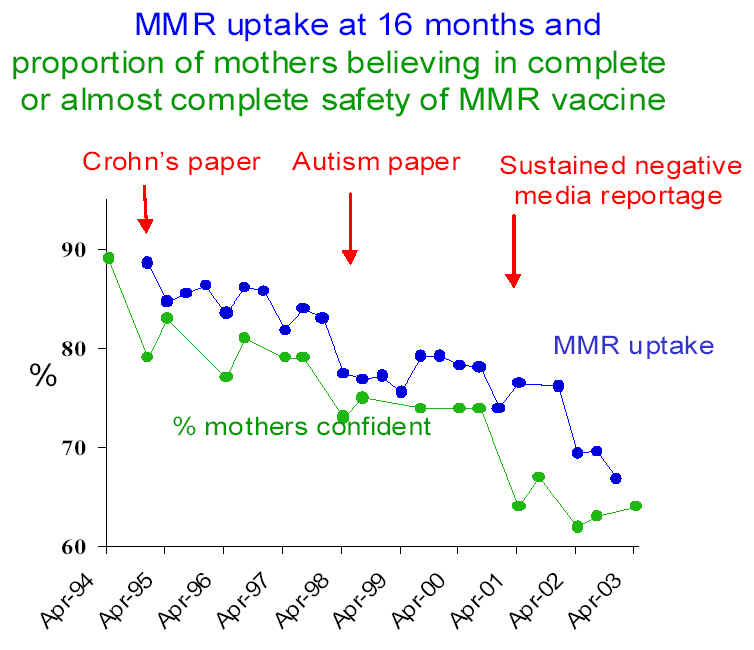
Image result for andrew wakefield effect on vaccines
Impact of Wakefield on MMR vaccine rates.

Even more recently, there has been a call to ‘green’ vaccines. Thimerosal, a mercury containing compound, has been used as a preservative in vaccines. It has also been the centre of the vaccination and autism controversy. Although there is no clear scientific evidence that small amounts of thimerosal in vaccines cause harm, in July 1999, leading U.S. public health and medical organizations agreed that thimerosal could be reduced or eliminated as a precautionary measure. In 2001, The Institute of Medicine’s Immunization and Safety Review Committee issued a report concluding that there was no evidence to prove or disprove the claims that thimerosal in childhood vaccines causes autism, attention deficit hypersensitivity disorder, or speech and language delay. Recently, a report by the committee,

favours rejection of a casual relationship between thimerosal-containing vaccines and autism.

Even with this conclusion, many researchers continue to study a possible link. Regardless, thimerosal is no longer used in most childhood vaccines, though some form of the influenza vaccine available in multi-dose vials may contain the preservative. Despite the fairly overwhelming evidence, concerns over thimerosal has led to a public ‘Green Our Vaccines’ campaign, which aims to remove ‘toxins’ from vaccines, in fear of their relationship to autism. Celebrity Jenny McCarthy’s advocacy group, Generation Rescue, and the organization, Talk About Curing Autism (TACA) have spearheaded these efforts.

Clearly, the emotions regarding vaccination, whether they are political, spiritual, or health related, has existed for a long time and remained relatively consistent. This leaves many to wonder what is the best way to dismantle vaccine fears.


The rise of social media in today’s world has created a completely new playing field for vaccine conspiracies to drive. Facebook groups and social media clubs has created deep echo chambers sharing misinformation that gets continually reaffirmed by individuals with parallel beliefs. A Facebook page, ‘Stop Mandatory Vaccination,’ created in 2015, has over 125,000 likes. Its incredibly active, private Facebook group counts nearly 160,000 members. The mission statement says,

Vaccines are dangerous and unnecessary for vibrant health. Unfortunately, we’ve been lied to. On this website you can find numerous videos of parents talking about vaccine injury or why they are vaccine free, read comments from over 180 parents who share why they stopped vaccinating, discover how to raise a healthy child without any vaccines, learn the many horrors of vaccines and how dangerous they actually are, and find out how we have been lied to about the need for vaccines for public health.

The United Kingdom’s Advertising Standards Authority (ASA) found that the founder was guilty of spreading false information through ads.

Stop Mandatory Vaccination.

The internet is allowing false information to thrive, as it can be spread and multiplied so quickly. Fear of health and government institutions only elaborates on the vaccination hesitancy held by an increasing number of people across the world. Even with the internet providing information to children of anti-vaccination seeking vaccinations as adults, its clear that the internet has played a vital role in accumulating false information not only regarding vaccination, but the government institutions that provide them.

https://twitter.com/parismartineau/status/1095792353489629185

The World Health Organization has reported,

Measles, for example, has seen a 30% increase in cases globally. The reasons for this rise are complex, and not all of these cases are due to vaccine hesitancy. However, some countries that were close to eliminating the disease have seen a resurgence.

Recently, it seems that anti-vaccinators have become the newest joke of the internet. A new wave of fear tactics and humour has been targeted towards anti-vaccinators in an attempt to decrease vaccination hesitancy. The New Brunswick Health Council reported that a media research company, Cormex Research, found that despite the recent messages in support of vaccination online, there has been no decrease in anti-vaccination chatter on social media. On Twitter, 75% of posts related to vaccination were pro-vaccination. However, tweets against vaccination only dropped from 17% to 14% from the summer of 2014 to the first two months of 2019. Cormex concluded that even with negative publicity, information about the benefits of vaccines, and the increased risk of disease contraction,

not only failed to change hearts and minds about vaccination, it may not even have been sufficient to diminish or further marginalize the visibility of anti-vaccination statements.

The negative media storm against anti-vaccinators and in support of vaccines and the institutions that provide them, seems to have had no effect on the rate or intensity of anti-vaccination talk. The echo chamber is strong, and the negative response is pushing anti-vaccinators deeper into their beliefs. The media has consistently and extremely bashed anti-vaccination, especially on social media. It’s true, anti-vaccinators are dangerous and the belief is unfounded, based on false claims that forever tarnished the reputation of vaccines, but the current attempt at change has been fruitless. It is necessary to rethink the conversation surrounding vaccines.


In the 1960s, 75% of Americans had trust in the government and medical industry. Today, that number is 25%. The attacks against anti-vaccinators have been unsuccessful because the attacks are coming from a source that is seen as untrustworthy by much of the public. Frankly, medical news is inconsistent. Constantly, new studies are proving and disproving the health of different foods and activities. It almost makes sense why people are becoming hesitant towards vaccines. Regardless is the hesitancy is feasible, it is still completely unfounded, so as a society, the attempt to dismantle the echo chamber of anti-vaccinators must account for the fears of inconsistency held by those who distrust government an medical institutions.

The 17th case of measles has occurred in Vancouver, and health officials are saying that there has been no shortage of vaccines for the disease. However, it seems that outbreaks, like the ones in Vancouver, Osaka, Minnesota, and New York, can prove helpful in diminishing vaccination hesitancy. Clark County, Washington, is home to one of the worst measles outbreaks in decades. In Clark Country, there are a plethora of anti-vaccination social media groups, and loose vaccine laws compared to the rest of the country. Going into the school year, 8% of parents declined vaccination for their children. The community immunity threshold is 5%. At the beginning of 2019, 64 people (62 of them being children) contracted measles. Almost all of them were unvaccinated.

However, once anti-vaccination parents saw the repercussions of diseases like measles, vaccination rates jumped 500% in one month. The same happened in Vancouver.

In the Fraser Health Authority, 1,103 doses of the MMR vaccine were given out in the week from February 25 to March 3, 2019. That’s more than two and a half times last year’s numbers. Over the same week last year, just 436 doses were administered. Similarly, Interior Health administered 3,220 doses of the MMR vaccine from January 1 to March 3, 2019, compared to 2,033 over the same period last year. Island Health more than tripled its vaccinations over a single week this year compared to last. From February 25 to March 4, 2019, it gave out 995 doses of the vaccine compared to 331 over the same period last year.

It seems that for now, attempting to convince anti-vaccinators to trust Big Pharma, the FDA, and major news networks, isn’t going to work. Instead, it is more effective to highlight the dangers of the diseases that are being brought back by anti-vaccinators. As well, it’s necessary to provide the opportunity for minors to get vaccines without parental consent, which is potentially happening in New York, Oregon, South Carolina and Pennsylvania, or at least, tighten vaccine laws. Truly, anti-vaccinators aren’t a group of evil cult members, instead they show how corruption and falsification can effect everyday people who just want whats best for their children. Vaccination hesitancy is a solvable problem, but it will never be solved with divisiveness.


Sources-

World Health Organization

Vaccines Today

Health

World Health Organization

History of Vaccines

New Statesman

New Brunswick Health Council

Health 24

CBC

Global News

The New York Times

Images-

Cover Image

Vaccine Hesitancy Rates

Vaccinated Disease Death Rates

Edward Jenner

MMR Vaccine Uptake

Children of Anti-Vaccinators


A Note from the Author:

One more thing I would like to bring up that I feel may have otherwise taken away from the point of this piece, is the ableist implications regarding some anti-vaccination beliefs. Particularly, the issue that some people have with the MMR vaccine because they believe it may cause autism is shocking to me. Although unrelated to this overall piece, the fact that some members of society would rather have their child die from an ancient disease then have to care for their child with autism is deeply problematic. It shows truly how marginalized individuals with mental and physical disabilities truly are. The treatment of autism as a more dangerous and harmful issue than diseases like measles is concerning, and that attitude is what leads to gross abuse of individuals with mental disabilities like autism, even by primary carers. In the article, I’m Autistic, And Believe Me, It’s A Lot Better Than Measles, Sarah Kurchak breaks down the discriminatory implication of the anti-vaccination movement. Kurchak explains that those who refuse to vaccinate their children because they are afraid their child will be autistic have made the decision that people like Kurchak are the worst thing that could happen to their family.

I’m not about to take any solace in the idea that they’re willing to make exceptions for autistic people who can perform as neurotypical, or at least pose as little annoyance to neurotypical [people] as possible. That just means that I will cease to be of any value to these people if I am no longer able to pass as one of them, and that they see no value and no humanity in anyone who communicates or behaves differently from them. Tell me again who has the empathy problem?

When structuring conversation around vaccination hesitancy, it is important to realize and include the experiences of autistic people, whose identities have been ostracized in the broader context of an abstract justification for vaccination hesitancy. Autism is far from a death sentence, but lack of vaccinations can be, which is why enlightenment regarding not only the value of vaccinations is necessary, but also education dismantling the stigmatization and discrimination regarding neurodevelopmental disorders like autism must be instituted for concrete and quality improvement regarding the growing vaccination hesitancy in modern society.

Two People Who Work at a Calculator Factory go on a Break. When they come back IT is Missing. (Pt. 2)

0

John: The first thing we had to do was to secure the antidote in our possession. After briefly seeing the insane security surrounding the cure, we drew a blueprint with what we knew and memorized the whole layout.

Me: After weeks of planning, we finally decided to have a go at it. Firstly, while the scientists were sleeping, we took one of their identity cards and used the imitator-2000 to scan their bodies so that we could conform to their physical appearances anytime we wanted to. John: Next, we had to devise a plan to physically get in the vault. We decided that it would be smart if only one person went into the vault and the other was outside helping to disarm the cameras. We temporarily disabled the cameras by putting black duct tape over them, and rendered the infrared cameras and light sensors useless by spraying a chemical on them. Once all that was disabled, I climbed down the shaft to the vault as one of the scientists. While I was talking with the two guards, I secretly put a sleeping pill into their water bottles. After they were all sleeping like babies, I opened the vault door and took the antidote. We knew the combination to the lock because we installed a microscopic camera on the wall of the room. The security seems quite lacking at first, but don’t forget that practically nobody even knows about its existence. With all the security out of the way, I walked into the vault. The antidote itself was in another locked box. We did not have a lock for the box, so we instead made a duplicate box that looked like the same one from afar. I unscrewed the box from the floor, put the fake one in its place, and escaped the vault with just a few minutes left before the guards would awaken.

How to manage your time

Things will always take longer than what you think even if you think they’re going to take longer than you think they will.

1. Start NOW

This is a lot easier said than done. 

A significant number of us put things off as long as we can but if you think you can do something in a day, don’t wait until the last day to do it. What if it turns out you can’t do it in a day? Regardless of whether you’re certain it will just take one day, its better to get it down now than staying up until 4am completing it. The worst case scenario is that you finish it earlier and don’t have to stress about it.

Completing it early isn’t an issue, in fact, it could permit time for some editing that will make a big difference in the final product. I know it seems simple, but seriously, just start!

2. Plan for the Worst

x

Pessimism never helped anyone, right? Wrong. Being overly pessimistic can be crippling, but being optimistic can as well.

Anticipating the worst doesn’t mean being in despair. What it means is implies being tolerant that things might not go as arranged. Technology can fail at any moment, often with little to no notice. Various social issues can and often do arise in each of our lives at the least favourable times. The lesson here: endeavor to do things quickly, but acknowledge and plan for the fact that nothing ever runs as smoothly as it possibly could.

3. Have a Plan

Plan out every single little detail. 

There is value in planning things out. It helps you to commit to getting things done and it helps to prepare you for anything because you never know what will happen.

You’re not perfect and that’s alright! This has been valid for everyone who has ever accomplished anything great and it will be valid for you as well. It won’t be easy doing this if you haven’t already been doing it but stick with it, and I’m sure it will work out.

Featured Image

Jason Kenney: Is He Right For Alberta Youth?

0

Jason Kenney, born in Oakville, Ontario, moved with his family to Wilcox,
Saskatchewan, at the age of 8, where his father was named president of Notre Dame College. Upon graduating from Notre Dame College in Wilcox, Jason went on to study philosophy at the University of San Francisco.

In his early twenties, Kenney came to Alberta where his focus turned to politics. He began his career advocating as the President of the Canadian Taxpayers Federation in the early 90’s. The most significant outcome of his role was the end of gold-plated pensions for Alberta MLAs.

At the age of 29, Kenney was elected to the House of Commons after deciding to run for public office as a Member of Parliament for Calgary Southeast. He was re-elected five times.

In July 2016, Kenney campaigned to unite Alberta’s two conservative parties by announcing his candidacy to lead the Progressive Conservative party. In March of 2017, he won the PC leadership with more than 75% of the vote.

From there, he negotiated with Wildrose leader Brian Jean to unite the PC and Wildrose parties, ultimately resulting in the United Conservative Party, formed in July 2017.

On October 28, 2017, Kenney won the leadership of the United Conservative Party. Less than two months later, on December 14, 2017, he became Leader of the Official Opposition and was elected to represent the people of Calgary-Lougheed.

The UCP’s slogan to build an “Alberta Strong and Free” promises numerous merits for the working class of Alberta, but what about the youth? After years of the Progressive Conservatives in leadership, the NDP government had finally introduced GSA legislation which protected LGBTQ youth in schools.

“Kenney has committed that, if elected, he would roll back GSA legislation and bring back the loophole-filled Gordon Dirks bill that left LGBTQ kids vulnerable to attack.”

Jason Kenney has said loud and clear that he thinks human rights should be negotiable, and this is nothing new. After being sworn in as PC leader, two weeks had not even passed before Kenny promised his first big policy in his party would be to out LGBTQ kids in school. Where are his priorities, and is that what Alberta’s youth and future needs?

It’s been two years since Kenney first promised to out LGBTQ students and two years since he’s changed his position. GSAs save lives and Kenney’s attacks on these safe spaces will put young people at risk. Is someone who attacks vulnerable young people really fit to be Premier?

Yes, this election is about reigniting our economy and creating affordable lives for Albertans. However, the government is to represent all Albertans, and not a select few. Today’s progress and tomorrow’s success is dependent on the youth, and creating a safe space for them and fostering an environment for them that allows room for courage and growth is what Alberta needs, and is perhaps not what we’ll get in “an Alberta Strong and Free.”

1, 2, 3, 4

9 Things to Do in Calgary this March Break (Without Your Parents)

0

At long last: spring break. For those of us in school, this is a long awaited relief from the perils of second semester. If you’re stuck in Calgary (like me) during this break, here are 10 things to do to make the most of your free time, that you won’t need your parents for.

1. Take a Walk in Eau Claire Park

After 18 months of construction and years of planning, the new Eau Claire Park was completed in September 2018. The new renovations include designated pedestrian and bicycle paths, more seats and benches, and the new Delta Garden at the south end of the Peace Bridge, which features local art incorporated into green space (including these brass survey monuments, inscribed with words from Calgarians and visitors). However, despite its completion nearly 7 months ago, many of us have not had the opportunity to enjoy it, due to the awful weather this year. Now that the weather is improved, take advantage of the sunshine, and enjoy the new space!

2. Go to a Museum

Feeling classy? Calgary has many impressive museums most of us have never even stepped foot inside. The Glenbow, Calgary’s quintessential art and history museum, currently has a new exhibit featuring 37 haute couture dresses by French designer Christian Dior, running until June 1. Calgary’s The Military Museum, located near Marda Loop, is Western Canada’s largest military history, heritage, art, research, and educational museum. For science and fun, Telus Spark, near the Calgary Zoo, boasts daily science activities, demos and many, many interactive exhibits, for people of all ages. Finally, Studio Bell in Downtown East Village has exhibits on Canadian music history and hands-on instrument areas for music-lovers.

3. Get Ice Cream!

It’s finally warm enough outside to have ice cream, so treat yourself! Visit two of Calgary’s classics with new looks: Village Ice Cream renovated their Victoria Park location this February, and Amato Gelato in West Hillhurst, in celebration of its 15th anniversary, re-opened this March with a new Italian dessert bar concept. As well, some new ice cream shops worthy of checking out: Berlingo in Mission (from the chef behind Yann Haute Patisserie), and Sweet Haven Ice Cream (from the team behind Po-ke).

4. Take Part in An Earth Day Event

Calgary Unplugged is a family-friendly Earth Hour event, organized by the City of Calgary, that will take place from 7:00 p.m. to 9:30 p.m. at Confluence Plaza on St. Patrick’s Island on March 30. Admission is free, and people of all ages are welcome. Educators will be onsite to share information about water usage and other energy-saving tips; there will be a free hot chocolate, a DJ, fire pits, and Earth Hour related activities and games. There will also be an Earth Hour Bicycle Brewery Tour and walk to Cabin and Ol’ Beautiful microbreweries. As well, the City will also be turning off all lights in a few notable buildings across the city, including the Calgary Municipal Building and all fire stations.

5. Go for a Ghost Tour at Heritage Park

Even though Halloween is far away, you can discover Heritage Park’s dark side with a guided tour through the streets of the Historical Village. On this tour, you can learn about ghosts and the scary history behind some of the buildings. There are 2 types of tours: family tours, which are appropriate for all ages, and adult tours, which contain “mature content.” The tickets for the family tour are $19.95, and the tickets for the adult tour are $22.95. Tours run until April 10th, and more info can be found here.

6. Go Geocaching

This little-known activity is a bit like treasure hunting. For those of you who don’t know what it is: in geocaching, participants use a GPS receiver (most people use their phones now) and written clues to seek “geocaches,” which are containers hidden at specific locations all across the world. There are over 10 million people around the world who participate, and more than 2.5 million geocaches in over 180 countries, which includes over 160,000 in Canada. The game itself is administered by Geocaching.com, and all official geocache locations can be found through their database. Participants hunt for geocaches near them by using a GPS map and coordinates, as well as some clues given by the hider (this info is found on geocaching.com). Geocaches can be tucked in bushes, stuffed under rocks, sitting in trees, and inside buildings. A geocache is typically a small waterproof container containing a logbook; when found, a geocacher (seeker) signs the log with their name and dates, in order to prove that they found the cache. The cache is then placed back exactly where the person found it. Often, containers also contain little “treasures,” such as stickers and small jewelry; in this case, the general rule is: “take an item, leave an item.”

Geocaching is a lot of fun, especially with some friends or family. There are TONS of geocaches in Calgary (just look on the website for ones near you), and using your phone’s GPS makes finding their locations simple (but not easy). Take advantage of your free time, and go treasure hunting!

7. Play a Game in VR at a VR Arcade

This is exactly what it sounds like: virtual reality gaming experiences. Using a headset for the eyes, headphones for the ears and two controllers, you are placed inside a game, where you can interact with characters, objects and other players. Some venues in Calgary include Ctrl V (Glenmore & Centre), VRkade (Deerfoot Meadows), Level 1 (16 Ave NE), and VR Arena (near Sunridge).

8. Visit the Zoo

The Calgary Zoo is home to nearly 1000 different animals from over 100 unique species. After a long wait, the giant pandas finally arrived at the zoo last May; if you haven’t seen them yet, they’re worth checking out (you can also see them via a live stream here). As well, five new King penguins joined the Penguin Plunge exhibit this year, and will be participating the daily Penguin Walks (which allow visitors to see the penguins walking up close!). Enjoy the warm weather by taking a walk, and seeing some animals at the same time!

9. Go to a Farmer’s Market

Although the seasonal farmers markets don’t open until late May, many farmer’s markets carry fresh produce and locally made foods/goods year-round. Contrary to what some might think, farmer’s markets have a lot more than just groceries; local fast food, bakers, artisan crafts, and second-hand antiques can all be found here. These are a great place to get lunch, are always lots of fun to browse, and you can feel good knowing that you are supporting locals. The two biggest ones in Calgary are Calgary Farmer’s Market, and Crossroads Market.

Wim Hof – The Iceman who Revolutionized Science

0

“Fear does not go away by itself. You have to confront your fear, mold it, then learn to control it in it’s own irrational reality. Every human being has the power to do just that. To go deep within and confront your inner being is a powerful act. Going deep and developing the will power is the only way.”  -Wim Hof

This remarkable man is surprisingly unknown despite all his breakthroughs and accomplishments – and he has inspired me. He seeks to unlock the limits that we often place on ourselves, and encourages us to grow beyond these ways.

Wim Hof is currently 59 years old, but is continuing to overcome great hardships and climbing cold mountains with only a pair of shorts on (as seen at 35:30 of the video below). He currently has 21 Guinness Worlds Records, a feat which he believes all people can do. This is a short list of some of his achievements:

  • Running a half marathon above the Arctic Circle, barefoot only wearing shorts
  • Swimming underneath ice for 66 meters
  • Hanging on one finger at an altitude of 2,000 meters
  • Climbing the highest mountains in the world while wearing shorts
  • Running a full marathon in the Namib Desert without drinking
  • Standing in a container while covered in ice cubes for extended periods of time

As I was browsing YouTube, I had found this video titled “BECOMING SUPERHUMAN WITH ICE MAN – Wim Hof”, and I normally assumed it was going to be “click-bait”, but I was still curious. So I clicked.

I was pleasantly surprised. I highly recommend checking out the video, as it provides a much better presentation of Wim Hof, his achievements, and his ideas by following the development and experience of adults undergoing his guidance.

Although his achievements are extraordinary, most would assume he is especially unique and only capable of doing this. But Wim Hof proves every human is capable of doing this. We often place expectations that prevent us from exploring new opportunities and confronting challenges. For Wim Hof, willingly facing the cold or climbing a mountain is a test of the mind. For many, these challenges appear to be physically impossible, but Wim Hof believes that with a change of mindset, and mental fortitude, it becomes possible.

His courage and perseverance has made me understand how truly limitless our human capabilities are if we are willing to face discomfort and set our mind to it.

The video is an example of taking normal people, and after meditation, breathing lessons, and mental and physical preparation, going up a cold mountain at an elevation of 1590 meters, a severe understatement for the temperatures, all in beach shorts. And remember, this is all being done in 4 days, in FOUR DAYS, while other mentally and physically challenging activities like swimming or standing in freezing cold water or standing inside snow are being done, climaxing with the mountain climb. It further demonstrates how far the mind is being pushed, by doing the training in the quick span of 4 days and having great results.

I didn’t believe this, but he has proven it. By taking regular people, and training their mind and body through breathing methods, meditations, and endurance, he has allowed them to face seemingly impossible challenges like climbing a mountain with wind chills of -27°C – as he claims is a symbol of our internal doubts and conflict, with only shorts on, demonstrated countless times by the groups of people he trains.

Another instance revealing the great potentials of the mind in facing any challenge is seen by an experiment by RadBoud University. Wim Hof, normal people who he has trained, and “typical” people are injected with dead bacteria. While this seems harmless, when a person is injected with these endotoxins, their immune system immediately creates various physiological changes like fever, nausea, headaches, and shivering, this is called the innate immune response.

Now scientists didn’t believe it was possible to control your own immune response, but that is exactly what Wim Hof and his students did.

All of his students and Wim Hof were able to dampen the response to the presence of endotoxins by willing influencing the automatic nervous system. Normally this region should not be controlled at all — it ensures you remember to breath, beats your heart, and your “fight or flight response”, all key functions, that, if you did control, you might accidentally forget to breath or beat your heart.

The students of Wim Hof did the special breathing method they were taught for the first 2.5 hours of the experiments, and showed drastically weaker illness symptoms. The students had flooded their body with adrenaline, which correlated to a greater production of interleukin-10. This decreased the release of cytokines which would cause inflammation of the typical symptoms of illness, and the students would recover faster and had weaker symptoms. All of this from mentality?

It seemed unbelievable to me, normal people, who with the simple power of their minds were able to overcome illness and affect physiological responses.

Normal people were able to climb that frozen mountain, normal people who challenged their body to new lengths using their mind.

Meditation and breathing are not really being physically strong and are more directly related to mentality, but somehow they lead to overcoming physical hurdles like bacterial infections, it reveals the astounding potential of the mind even when the body cannot endure.

Take placebo’s which are like “fake” medicine, where the administer tells someone they have a cure for some type of illness, and gives a pill or cure that does not actually have any “real” benefits, but serves as mental assurance. However, in certain cases, placebos are known to actually work! Demonstrating more clearly the power of mentality in overcoming all forms of hardship which I had believed was just pure “luck” or “coincidence”, although because of the lack of research, it could still somewhat be luck.

Personally, Wim has inspired me to try and test my mind, and I have been willingly doing cold showers to see if I can. While I don’t believe I can climb a freezing cold mountain at 1590 meters in elevation yet, Wim Hof tries to prove that all people have the capability, it’s simply a matter if they will themselves to.

I had always believed in the limits of physical capability where I could not do things like climb a freezing cold mountain or even more, resist an infection, that these were only for a special select few, but Wim Hof has given me the courage to explore and test my mind. And while the research of the true extent the mind has on physical and personal capabilities is vague, it is a topic that is very interesting and is currently studied.

I would like to finish by asking about the greater importance adversity plays in our lives. Are we really going to surrender when we experiences hardships, fears, and discomfort, or are these also opportunities to fully experience life — and fully discover ourselves.

Sources 1/2/3/4/5

Featured image

The Most Interesting Candidate Running in the 2019 Alberta Election

0

Politics can be boring. But some of the candidates can be fun!

I present to you, Derek Fildebrant: The Hunter of Deer, the Landlord of Airbnbs, Double Claimer of Meals, and much more. There is a lot to be said about this man, but one glance at his Twitter will show you one very important thing about him, he is not afraid to show his personality.

With politicians, normally being so uptight and professional, it’s harder and harder to find yourself laughing or feeling a normal human connection with a politician these days. It’s a breath of fresh air, being able to laugh with a politician as they make witty jokes about their opposition and issues they care about. Here are some examples of Derek Fildebrant’s humour from his Twitter:

Rantings of a meat lover:

Giving his colleagues some friendly advice:

Agree with him or not, gotta admire how he speaks his mind:

Supporting peaceful protest:

Derek Fildebrandt isn’t afraid to speak about issues he cares about. It is nice to see that there are politicians who continue to speak their mind about issues they care about, despite the current political environment. Whether you agree with this man or not, it’s good that there are still politicians out there running for office because they want to create change for what they believe in. These politicians are a rare breed now, as more and more politicians morph their platforms so they can stay in office, ignoring what it means to have integrity.

If you’d like to learn more about Derek Fildebrandt and the Freedom Conservative Party of Alberta, visit their site here: https://www.freedomconservativeparty.ca

Sources: 1

Disclaimer: The views and opinions expressed in this blog are those of the authors and do not necessarily reflect the official policy or position of Youth Central, employees, board, or affiliated programs and organizations. Youth Are Awesome is not responsible and does not verify for accuracy any of the information contained in the blog posts. The primary purpose of this blog is to provide youth with a platform to express their opinions and write about topics that interest them. This blog does not constitute any professional advice or services.

Having Trouble Choosing Your Career?

Often times in today’s world our parents and society in general will ask us, “What do you want to be when you grow up?”. Usually most youth don’t have an answer; I myself don’t have an answer. I’m not saying you have to decide right now but some ideas and options can be useful to alleviate the tension involved with choosing your future career.

There’s a lot to take in mind when you are choosing your career. You need to implement the most important things in your life into your career choice. Are you interested in creating new things, making the world a better place, being famous? You are not limited to what career you choose. Walt Disney often advocated, “If you can DREAM it, you can DO it.”

There is no need to get scared of which career will lead to success or failure, because “success is only what you think of it.” I’m not saying don’t worry about having a successful career but still have an enjoyable one. You’ll do better at a job if you like it. You’ll be happy, You’ll be someone you want to be.

Climbing to Success

Though you should choose what career you want, it matters on what type of happiness you want. Happiness has a cost, there are conditions on the career you want. Being somebody who works long or someone who makes less. It also depends if you believe happiness lies within money or not.

“The best way to predict the future is to create it.” (Abraham Lincoln)

Sources:

1/2/3/4/5

Five Books Everyone Should Read At Least Once in Their Life

By: Vidhisha Wagle

1

1. To Kill A Mockingbird

To Kill A Mockingbird is one the applicable books of literature everyone should read. This book is still applicable to current events that happen around us. It’s relatable as the characters in the book are going through school and they are still finding out how the world actually works. Topics explored include racism and privilege.

2

2. The Book Thief

While many of us know or learned Nazism and their power, The Book Thief goes through the life of a young girl who steals to live. She starts to steal the books that are left behind my others, and trains herself to read. Her family is able to hide a Jew in the basement, and while she learns the cruelty in humans, she also learns kindness.

3. The Handmaid’s Tale

The Handmaid’s Tale introduces the idea of women in serfdom from the patriarchal society. This book focuses on the idea of women gaining their independence and how these women have been subjugated. During this, the main character struggles to find her own freedom however has been restricted from totalitarianism from society.

4

4. The Help

The Help mainly focuses on a central issue that is very relevant to our modern society. This book underlines the theme of racism and how it’s not inherent to human nature, even though it is passed down from each generation, creating misconceptions and prejudices. It explores how racism has destroyed many lives and how many women would torture and suffer black maids, labelling black people as unclean.

5

5. The Diary of a Young Girl

This is one of the most famous books written under the Nazi regime. The book is a diary of a thirteen-year-old Jewish girl who fled the horrors of Nazi occupation and lived in the back of a warehouse coping with hunger and death. She recorded and talked about these events, a classical book bringing in the idea of courage and the struggle to live during this horror.

Image Source 1/ 2/ 3/ 4/5

Captain Marvel: Review

My Look On the Ratings

Though the rating on this film is not dominant over other previous Marvel films this is due to some obvious errors or failed efforts by Marvel Entertainments. Seeing some films before, Black Panther, the film was not as expected, the anticipation only to realize the comparison between the movies. Being needed to watch this to fully understand whats coming up, the film is hurried and needs a lot of work. But the film itself was an overall success, for the film to be worked on only progressively in the start of the year is impressive. Business Insider “This one isn’t a home run for the MCU, compared to the recent releases since “Black Panther,” but if you hold out long enough, you’ll see that Captain Marvel is a strong movie “

Critics –

7.1/10 – IMDB

78% – Rotten Tomatoes

3.8/5 – Facebook

Flaws

It has numerous flaws in its story, its narrative structure, and its use of characterization

  • The film’s biggest issue is the lack of a believable character arc for its main character, Carol Danvers. A character arc is basically a term used to describe the transformation of a character throughout a narrative. Character arcs allow the audience to experience the transformation of the character. The Carol Danvers at the start of the film is the same as the end, no significant change occurred.
  • Dynamic Character vs Static Character. Seeing the story of Captain America, Iron Man and other iconic superheroes, this superhero has no real ups and downs. She doesn’t experience the change throughout the story, this only occurred close to the start of the film.
  • Hero’s Journey. The main issue with the film in my perspective is the set up of the character. The character, Carol or Captain Marvel is described as unbeatable through the movie, while every hero needs a weakness and a big event to make them who they are.

Was it a success?

In my opinion the film needed a lot of work but looking again at the framework, realized it isn’t that bad. From the amazing fight scenes to the first ever recognizable film featuring a women superhero from the MCU in a long while. Now they have their very own Wonder Women. It shows how DC might be catching up. I would give the film a 7.9/10 because of what it symbolizes, being the first ever women superhero on the screen by themselves for a while. Lastly, the character selection, I love Brie Larson as Captain Marvel, and giving Nick Fury so much screen time was a nice touch for the big time Marvel fans.

What are you waiting for, go and watch this fantastic movie!

Official Trailer

Sources:

1/2/3/4

Spring Break Book Recommendations

0

At last Spring Break! Whether you’re traveling somewhere sunny or relaxing at home, make the most of your time off and enjoy some literature. The following are seven of my personal favourite novels for your seven days of spring break, ordered by strength of recommendation. Happy Readings!

1) The Help

“You is kind. You is Smart. You is important.”

– Kathryn Stockette, The Help

Author: Kathryn Stockette

Genre: Historical Fiction

Plot: The Help follows African American women working in white households in the 1960’s. Skeeter an aspiring young white journalist seeks to capture the realities of these black housekeepers. In a dangerous act of disobedience Abilene and Minnie, two black domestic servants, share their courageous and controversial testimonials of working with white families.

Thoughts: The Help holds a special place in my heart, and on my bookshelf. I found myself to be particularly fond of the characters in the novel, and impressed with Stockette’s clever construction of antagonists. The story gives the reader insight into the geopolitical climate of Mississippi during the Jim Crow laws, and the systematic racism which long oppressed African Americans. Both humorous and heartbreaking in its fictional narrative, The Help depicts the very real racial tensions which plagued society.

2) Cloud Atlas

“A half-read book is a half-finished love affair.”

– David Mitchell, Cloud Atlas

Author: David Mitchell

Genre: Science Fiction, Fantasy

Plot: Beginning in 1850 with the voyage of Adam Ewing from Chatham Isles to his home in California Adam meets a physician who treats him for a brain parasite. The book then jumps to the story of Robert Frobisher in Belgium 1931, a disinherited bisexual composer who lives within the household of an infirm maestro who has a beguiling wife and a nubile daughter. Next set in the West Coast during the 1970s, you’ll follow the troubled reporter named Luisa Rey, who’s busy fighting for her life among corporate greed. But the story continues through centuries and space taking you on a journey of many lives through different narratives.

Thoughts: To be quite honest I found the beginning slow moving; however the textures of these gripping and layered narratives proved to be captivating later on. What never ceased to amaze me are the remarkably clever ways in which Mitchell interlinks this sextet of stories. The different storylines, and distinctive tones have the ability to engage and connect to any reader.


3) The Book Thief

“I wanted to ask her how the same thing could be so ugly and so glorious, and its words and stories so damning and brilliant.”

– Markus Zusak, The Book Thief

Author: Markus Zusak

Genre: Historical Fiction

Plot: Liesel a young German orphan arrives in the fictional town of Mulching, Germany to begin a new life with her foster family. It is her foster father, Hans, who initiates her appreciation of literature. Bruno, a Jewish boxer to which Hans is personally indebted arrives at the family’s doorstep in search of refuge. In a dangerous act of compassion the family harbors Bruno in their basement. In order to escape from the dark realities of Nazi Germany Liesel turns to books to find comfort. Financial barriers force Liesel to resort to stealing novels in order to find consolation.

Thoughts: Zusak’s use of death as a sensual narrator is effective not only in enriching themes and perspectives in The Book Thief, but also establishing a luring and striking tone throughout the novel. I will not deceive you; The Book Thief is certainly tragic, and sad, it will not leave you feeling enthused and cheery, but instead penetrate deeper within in, touching the reader. The novel explores themes of humanity and the power of literature in times of adversity. The reader is sure to form strong attachments to delightful Liesel further increasing the suspense which is prevalent throughout the novel.

4) The Green Mile

“Sometimes there is absolutely no difference at all between salvation and damnation.”

– Stephen King, The Green Mile

Author: Stephen King

Genre: Crime, Fantasy, Mystery

Plot: Paul Edgecombs recounts his experiences as the death row supervisor during the great depression. Haunted by his recollections of a particular inmate John Coffey, a death row prisoner convicted of the murder of two young girls. Coffey’s kind and sensitive disposition leads Edgecomb to question his guilt.

Thoughts: King employs empathy and understanding to deliver a devastating and intriguing narration to its readers. The pace and tone of the story create an atmosphere of suspense, making the ending all the more compelling. The novels portrayal of injustice is deeply stirring and evokes passion in it readers. The paradoxical elements consistently contrasting each other throughout The Green Mile are cause for contemplation. I impressed by the brilliance so evident in every aspect of the novel.  

5) Pride and Prejudice:

“It is a truth universally acknowledged, that a single man in possession of a good fortune, must be in want of a wife.”

– Jane Austen, Pride and Prejudice

Author: Jane Austen

Genre: Fiction, Romance

Plot: Set in Georgian England, the novel follows Elizabeth Bennet and her five sisters in their pursuits to find a suitor. Elizabeth meets Mr. Darcy, a wealthy young bachelor who’s stern and proud disposition she instantly takes a disliking to. Encounters with each other ultimately result in the development of fondness, despite the class barriers which separate them.

Thoughts: Jane Austen’s 1813 novel Pride and Prejudice is a timeless piece of literature. The passage of time has not rendered the novel obsolete, as the reader is able to draw many parallels between prominent themes in the novel and issues we continue to debate. Its satire on the role of women in society is both lighthearted powerful and still applicable as we continue to question gender roles today. Elizabeth Bennet is a witty and immensely likeable character which you are sure to form a deep attachment to. Considering the historical context Austen’s construction of such a well developed female character is made even more impressive.

6) Memoirs of a Geisha

“When a stone is dropped into a pond, the water continues quivering even after the stone has sunk to the bottom.”

– Arthur Golden, Memoirs of a Geisha

Author: Arthur Golden

Genre: Historical Fiction

Plot: The story begins in a small fishing village in Japan in the late 1920’s, where Chiyo and her sister reside in poverty. Chiyo’s world is turned upside down when she is separated from her sister and sold to an Okiya (a boarding house for Geisha). The story follows her training in Kyoto and promptly afterwards, her career as a geisha which is abruptly interrupted by the arrival of the second World War.

Thoughts: I quickly became invested in Memoirs of a Geisha, as the plot is enthralling, and tone of the narration mesmerizing. The story is beautifully written and authentic in perspective, with a unique and intriguing storyline. It’s exploration of societal structure, and culture are particularly notable. The exploitative undertones of the memoirs weigh heavily on the mind and on the heart.

7) The Secret Life of Bees

“It is the peculiar nature of the world to go on spinning no matter what sort of heartbreak is happening.”

– Sue Monk Kidd, The Secret Life of Bees

Author: Sue Monk Kidd

Genre: Historical Fiction

Plot: Lily Owens was just four when her mother was killed. Now in 1964 Lily is 14 years old and living in the fictional town of Sylvan South Carolina with her abusive father and Rosaleen, the families African American maid. Rosaleen is put in danger after insulting local racists, prompting her to run away with Lily. Following the clues of her mother’s past Lily arrives in Tidburn South Carolina, where she gets to know the black Boatwright sisters. Lily discovers a passion for beekeeping and finds an unlikely family amongst the Boatwrights.

Thoughts: The prose in the novel is both enchanting and charming. The immensely powerful and inspiring Boatwright sisters grant hope upon the reader and radiate optimism. Kidd paints a remarkable picture of family, in defiance of societal limits such as race. The analogies and metaphors so prevalent within the novel construct meaningful and delightful imagery.

Image Sources: 1, 2, 3, 4, 5, 6, 7, 8

The Red Wheelbarrow by William Carlos Williams

1

The first time I saw this poem by William Carlos Williams was in Grade 9 LA class, and it still remains one of the most strange poems in my memory. This is it:

so much depends
upon

a red wheel
barrow

glazed with rain
water

beside the white
chickens

Ambivalent ideas organized in an even more ambiguous structure — sophisticated translation: what the hell.

So anyways, there is much analysis and many theories surrounding this poem. This was my general analysis when I was first assigned to analyze this poem in Grade 9.

I thought the purpose of the structure was to emphasize the individual ideas specific to each stanza. I believed that the color red emphasized passion or intensity, and the wheelbarrow represented work or responsibilities of society, revealing the intense collective labor required of society. The water represented the raw materials or supplies in order for citizens of society to do work. But the purpose of mentioning “rainwater”, is to add an aspect of luck which was required to even succeed. Finally, the color white represented innocence or ignorance, and the chickens represented workers in society. The idea revealed through this, is that in order for society to progress, they must first be lucky (possibly through war), and carefully manipulate their resources, including weaker and ignorant people, in order to genuinely advance.

I admit that this analysis is grasping on straws, and the idea is kind of depressing, but a very similar theory is similar to the analysis I stated. Where William Carlos Williams is referring to the Industrial Revolution, and the means to which it was made possible. But then again, with such a strange and mysterious poem, all kinds of interpretations could be made.

Another popular belief is that when William Carlos Williams was tending to a very sick young girl (as he was a physician), he turned to look through his window, and the poem is a visual description of what he saw. In this way, the poem is a subtle way to express his exhausting but hopeful thoughts towards his patient, or even the complexity of his career from the burdensome experiences and responsibilities of being a doctor. Where he is possibly reliving his complex stress in this simple poem, in the laborious yet rewarding relationship he experiences.

It’s also important to note the absence of the word “I” in this poem, which I found from researching some of the popular analyses, placing the reader more closely and intimately in the environment of William Carlos Williams, and also never presenting his own opinion.

One other answer is that William Carlos Williams literally means that “so much depends on” the various resources he wrote on. Where the wheelbarrow, and chickens are symbols of agriculture and farming, an essential need to maintain life. Although possibly not…

This is another one of the possible interpretations I had found by Stanley Archer who states the poem relies heavily on its visual imagery, and structure, how each line builds upon the former by adding a new image in the scene. The wheelbarrow is depicted to wheelbarrow with rainwater, and the speaker sees the wheelbarrow immediately after the rain, and the sun has broken the clouds and made the surface of the wheelbarrow very shiny and bright red (from the sun reflecting off the surface from fresh rain), and the chickens beautifully white. In the short time after the rain has ceased, the chickens now emerge from whatever refuge they sought during the storm, and can resume their peaceful life simply “beside” the wheelbarrow.

The poem also presents a strong idea of modernism and imagism. Some suggest William Carlos Williams expresses that poems must return to their basic principles and be honest and clear; that they have drifted too far. Some believe the poem questions, “what is art”? In a sense, the poem refuses interpretation by saying: here is a red wheelbarrow, with some chickens, and these things are beautiful and important, but you must bring something into this poem, it’s up to you to decide what it means, as Williams never gives his own emotion or feelings.

Although I doubt that a firm conclusion can ever be reached, I hope that you might get your own ideas toward the poem. For me personally, I think it’s amazing that a poem can have so many interpretations and differing ideas linked by a singular image. Share your own interpretation in the comments below! I would love to see all the ideas and your theories regarding this elusive poem!

Featured image

Sources 1/2/3/4 Images 1/2/3/4/5

These Five Breakthroughs in 2019 Will Change the World

By: Vidhisha Wagle

These predicted five breakthroughs will change the course of science forever, breaking more boundaries than ever.

1. A Look at Black Holes

While many of us have heard about black holes and their energy, numerous times scientists have been able to confirm it’s existence. However by measuring the motions of these stars and their orbit we can get close up pictures. This will be done on the Event Horizon Telescope on where it focuses on black holes and their movements.

2. Flying Cars

As a kid I used to think that all of us were going to have flying cars and to my disappointment we haven’t…yet. The new car “Liberty” has been made by a Dutch company called Pal-V. This company uses dual propulsion drivetrain which will allow it to both drive and fly. The car can fly up to 11, 480 feet in the air.

3. First Plants to Germinate at the Moon

While many of us have dreamt of going to outer space(at lease I have) astronauts are finally able to grow and germinate seeds on the moon. The scientific breakthrough had happened in January. Cotton seeds had germinated in China’s Change 4 Lander. While the seeds did eventually die because of cold (-52C), this helped many government organizations to know the conditions of germination on the moon.

4. Genome Editing

Although many people have ethical concerns with manipulating our genes, there are gene therapists that can replace unhealthy damaged genes with healthy functioning ones. A tool called CRISPR- can target genes and can manipulate it.

5. Quantum Computing

While many of us have heard of quantum theory, computing and quantum physics, many don’t really know what it is. Quantum computing specifically is the use quantum mechanical phenomena to perform computation physically and theoretically. With these machines, more scientific breakthroughs in medical fields and many other fields are possible.

Image Sources: 1/2/3/4/5

Voguing: The Art of Queer Expression through Dance, and How One Man Changed Dance Forever

0

In 1980’s Harlem, the entirety of the queer community was hidden. In New York, the queer community survived in artful safe spaces of dance, creation, and expression. The drag ball scene is illuminated issues of race, gender, and sexual orientation faced by the marginalized communities of New York, and by extension, society as a whole. Ball culture emerged in the 1920s in New York City. The concept of balls is at its core, a means of self-expression for queer people. It involves drag, dance, and performance as a means of resisting societal norms, supporting queer expression, and simply, enjoying competition. At the beginning, performers at ball were primarily white men. People of colour began to establish their own ball community after the Stonewall Riots. When queer people of colour stood up to police, they

changed self-perceptions within the subculture: from feeling guilty and apologetic to feelings of self-acceptance and pride.

The 70s saw an expansion of ball participation as balls increased their numbers and categories to promote inclusivity. As a result, balls became a safe space for the deeply oppressed queer youth in New York, including black and Latinx queer kids. The world became aware of the existence of balls primarily through the cult classic, ‘Paris is Burning.’ The 1991 documentary is a time capsule of the ‘Golden Age’ of New York balls. The film followed the experience of gay people of colour, drag queens, and transgender women as they compete in fierce competition. The film alternates between the colourful ballroom to candid interviews addressing race, poverty, queer homelessness, class, gender orientation, and beauty standards. The film provides a profound deep dive into the survival tactics performed by New York’s devastatingly unique queer community. The documentary is also extremely quotable, introducing queer concepts of ‘shade.’ Much of this vocabulary is being retaught to society through shows such as RuPaul’s Drag Race, which take inspiration from ball culture. Although there has been concerns regarding the reduction of queer culture and people of colour in the film to a spectacle, the documentary did provide much needed representation for these ostracized communities. The film won Grand Jury Prize documentary at the Sundance Film Festival, among many other recognitions from critics and audiences. In 2016, it was added to the National Film Registry. The documentary did not receive any nominations at the Academy Awards, despite its glaring success and importance, leading to reform in the decisions making process at the Oscars.

Paris is Burning.

‘Paris is Burning’ brought attention to the art and sport of voguing. The extremely expressive dance blends the boundaries of gender and identity in movements that uniquely communicates a desire for escape in sensual movement and uncontrollable energy. The ‘Grandfather of Vogue,’ Willi Ninja, rose to prominence within the Harlem Drag Ball scene in the 1980s. Ninja founded the ‘House of Ninja’ in 1982, acting as a ‘mother’ to adopted gay and transgender ‘children’ rejected by their communities and New York as a whole. Ninja provided a prominent support system and family that allowed for queer people to express themselves in gender-nonconforming presentations of dance an beauty.

Voguing as explained by Willi Ninja in ‘Paris is Burning.”

Ninja helped shape the dance of voguing, which combined exaggerated model poses and intricate choreography. After his appearance in the documentary, Ninja rose to fame as a choreographer, musician, runway model, and modeling coach. Willi Ninja’s life provides insight into the intricacies of being black and gay in an inherently white and heteronormative world. He transgressed rigid gender barriers, committing to an androgynous gender presentation in dance and life. His intersectionality and talent led to the formation of a prominent legacy in the queer community and beyond. The House of Ninja keep voguing alive and advocate on behalf of Willi Ninja to raise awareness for HIV/AIDS and the discrimination faced by queer men with the disease.

Willi Ninja.

Born William Roscoe Leake on April 12, 1961, Willi Ninja was a self-taught dancer. Not much is known about Ninja’s childhood, but in interviews he explained that his mother, Esther Leake, was accepting of his sexuality and had a prominent role in the nurturing his interest in dance. In an interview with Joan Rivers, Ninja described his acceptance from his mother, which was in contrast to the lives of the gay and transgender youth he mentored. Inspired by gymnasts and the martial arts, Willi Ninja formed a dance group called the ‘Video Pretenders,’ who would mimic dance scenes found on screen and in music videos from the 1980s. Ninja and his dance group began voguing with original choreography at the Christopher Street Pier and Washington State Park, popular site for queer youth, until he made his debut in Harlem’s drag balls. The culture originally surrounding drag balls and voguing can be traced back to the Harlem Renaissance (the Harlem Renaissance was an intellectual, social, and artistic explosion that took place in Harlem, New York, spanning the 1920s). Harlem’s Hamilton Lodge hosted its first queer masquerade in 1869. In newspapers, these balls were disguised as masquerades, but they came to be known as ‘fag balls’ or ‘parade of the fairies.’ During the Depression, Prohibition, and the criminalization of homosexual relations throughout the first half of the 20th century, the original Harlem scene experienced intense backlash and police intimidation. In the 1960s, the drag ball fragmented along racial lines, along with the intensification of the Civil Rights movement. When black queens attended balls, they were expected to ‘whiten up’ their faces if they wanted to win. Frustrations regarding racial bias led to events ran by black queens. In 1972, Crystal LaBeija formed the ‘House of LaBeija’ for a promotional gimmick for a drag ball. A drag daughter from the house, Pepper LaBeija, appears in ‘Paris is Burning.’ The formation of the house structure paralleled the increasingly prominent gay liberation movement and the reshaping of New York’s gangs. The house system provided an extended family that helped queer youth navigate the implications of racism, homophobia, transphobia, and class oppression. For far to many, these houses became the only family in their lives. The house system also makes a statement about the economic injustices in New York.

There was a decline in the city’s welfare and social services, early gentrification of urban neighbourhoods, decreases in funding for group homes and shelters for homeless youth, a sharp rise in unemployment rates among black and Latino men and a lack of funding during the Reagan era for people newly displaced or homeless as a result of HIV/AIDS. All these conditions forced black and gay (and especially black gay) people into the streets in unprecedented numbers, if they were not already disowned by their families for being gay or transgender.

Crystal LaBeija’s importance in the ball scene and to the survival of gay people of colour is still recognized today. Frank Ocean, a queer and black singer used Crystal LaBeija’s voice on his musical film, ‘Endless.’ In the interlude, ‘Ambience 001: In A Certain Way,’ Ocean samples a quote from LaBeija.

Because you’re beautiful and you’re young; you deserve to have the best in life.

The quote is taken from a 1968 documentary, ‘The Queen.’ Ocean also payed homage to the ball scene when he threw a ‘Paris is Burning’ themed birthday party.

A scene from Frank Ocean’s album, Endless.

The House of Ninja was known for its dancers. Queens competed in various categories to acquire trophies, placing their house higher in the drag ball hierarchy. The shift in the drag ball scene allowed the categories to be more inclusive, providing an ability to present singing and dancing as forms of expression. Willi Ninja participated in the scene to perfect his dance form, while others used it polish their modeling, singing, or other performance arts. Many of the queer youth could no obtain jobs or an education. As a result, categories involved the ‘children’ emulating executives, students, military men, runway models, and heterosexual men to allow them to present an identity they never get to experience in the outside world.

The balls were a reflection of a gender nonconforming group of queer people. These queens did not only attempt to imitate gender binaries. Ultimately, queens such as Ninja who did not ‘pass’ as a woman, attempted to break down institutionalized gender roles by dancing down the stage with a moustache, long hair, extravagant jewelry, make-up, women’s clothes, and a perfected blend on masculinity and femininity. Although many femme queens and transgender women found necessary validation in winning categories for their realness (ability to pass as a biological women), Willi Ninja, an androgynous, self-described butch queen, performed fluid gender presentation in a heteronormative world and a queer subculture that rewarded female realness. He simply wanted to showcase his abilities.

Voguing, in a similar fashion to hip-hop and break-dancing, emerged from black, poor, and working class communities as a form of expression, emphasizing male bonding. Paris DuPree, who also appeared in ‘Paris is Burning,’ created the style at the dance club ‘Footsteps.’ She was trying to out dance another queen when she grabbed a Vogue Magazine from her purse and began imitating the poses. Through throwing shade, DuPree invented a dance that remains popular. It is a contorted, sharp dance, combining model poses and pantomimic choreography. Willi Ninja redefined voguing by priding himself on being a clean, slicing dancer to,

kill his competition.

By adding swift, angular movements, and by including contortionist arm and leg positions, Ninja is credited for revolutionizing the dance form. Willi Ninja made voguing a legitimate dance form by teaching it all over the world. Ninja met musician Malcolm McLaren, who took a group headed by Willi on a tour of European fashion houses. Willi Ninja modeled in runway shows for Chanel, Jean Paul Gaultier, Thierry Mugler, Karl Lagerfield. Ninja taught voguing across Europe and Japan. He choreographed a appeared in various concerts and music videos. He took voguing to a new level of visibility and perfection. He trained models like Naomi Campbell and Iman, teaching female models femininity by showing them how to walk, grace, and poise. In 2004, Willi opened up EON (Elements of Ninja), a modeling agency.

The Grandmother of Voguing.

In ‘Paris is Burning,’ Willi Ninja dreamed of travelling the world. After his success, he never lost touch with the ball scene. He was vital in getting the ballroom scene to discuss HIV/AIDS prevention throughout the 1980s when it was being ignored in the queer community because of the intense stigma and ignorance surrounding the issue. In 2003, Willi was diagnosed with HIV. He continued to support his elderly mother, while not being able to afford healthcare for himself. Willi Ninja continued to mentor upcoming dancers and models, until he lost his sight and became paralyzed. In New York City, Willi Ninja died of AIDS-related heart failure in 2006. At the age of 46, Willi passed surrounded by the children of his house. He continued to provide outlets for self-expression for queer youth. The House of Ninja continue to perform at drag balls to promote HIV/AIDS awareness.


Voguing is back. The legacy of Willi Ninja is living on in the queer kids of New York today. The Mugler Ball, which occurs in Queens, New York, invites new and legendary vogue dancers to compete on stage. These competitions have revealed that vogue ballroom culture has reached a new level of cultural influence. The critically adored fashion label, ‘Hood by Air,’ is founded by a former vogue dance, Shayne Oliver. The label frequently incorporates references to the dance on the runway. The New York Times recently speculated that Oliver may have had influence on the catwalks of Riccardo Tisci and Alexander Wang.

There’s a new generation exploring. There are more transsexuals, people are experimenting more,

said Joey Arias a drag performance artist.

Shayne Oliver.
Joey Arias.

The styles of the gender fluid queer ‘children’ in 1980’s Harlem was eclectic, but always well executed. Some queens even named their houses after fashion brands such as the ‘House of Balenciaga’ and the ‘House of St Laurent.’ Naming these vital family extensions after fashion brands was an intense act if devotion. However, today, ballroom culture seems to have a profound influence on fashion, art, music, and dance. The young queer kids of the balls are now the new arbiters of taste. Rashaad Newsome, a contemporary artist from New York, is arguably the godfather for the next generation of vogue. In 2010, Newsome released a voguing presentation on camera called ‘Untitled.’ The dancer in the project was a then-unknown Shayne Oliver.

Before [Untitled] I had never seen work in a gallery or institution about ballroom culture,

said Rashaad Newsome.

Newsome put on his own vogue extravaganza entitled ‘King of Arms Ball.’ He brought together influencers from the contemporary art and underground ballroom scene to watch dancing competitions. These modern balls are a celebration of gender fluidity, fashion, and beauty culture through the vessel of voguing. The impact of the 1980’s Harlem balls vibrantly displayed in the documentary, ‘Paris is Burning,’ has had a profound on contemporary arts. The brilliance and expression of legends like Willi Ninja has paved the way for societal acceptance of the LGBTQ community. There is still much room to improve in regards to diversity, but the queer community can look to the icons of balls to see that even in the face of marginalization, queer people and especially queer people of colour, will survive, thrive, and stare directly into the eyes of oppression and dance.


Ballroom and Voguing Images:

Image result for harlem voguing
Queens showing their skills to the judges.
Willi Ninja voguing (left).
Voguing perfectly blends jerky movements with fluid energy.
Queer people of colour revolutionized voguing.
Venus Xtravaganza was in the documentary ‘Paris is Burning.’ She was a transgender women who competed in balls. Venus was also an escort who was strangled to death, likely for being transgender. Her ‘mother,’ Angie Xtravaganza said in the documentary that Venus was one to “take too many chances. Your too wild with people from the street, something is going to happen to you. But that was Venus, she always took chances.”

Sources-

Grinnell College

The Guardian

Out History

Youtube (Paris is Burning)

VICE

The Guardian

Images-

Featured Image

Paris is Burning

Willi Ninja

Frank Ocean’s Endless

Willi Ninja

Shayne Oliver

Joey Arias

Ballroom and Voguing: 1, 2, 3, 4, 5


A Note from the Author:

The history and art of balls and voguing is a profound example of human resilience. For me, it shows that even when society ostracizes people for visible differences, things like sexual orientation, or really anything that makes an individual different, that uniqueness doesn’t disappear, it just goes underground. The marginalized queer people of colour didn’t disappear from New York, they hid. That hiding allowed their identity to thrive and blossom into a unique form of expression and art. The self-expression that existed at these balls is truly beautiful. Ironically, something that was so hidden is now being revealed and used as inspiration in a world that is more accepting. Individuals like Willi Ninja are proof that no one should hide what they have. Ninja was not just a queer person of colour, he was also a talented dancer and personality that transcended any labels given to him. People portrayed in ‘Paris is Burning’ can serve as an inspiration to anyone. They show that there is no use diluting what you have, as it is truly beautiful and it will come out one way or another, even if it is underground.

10 Interestingly Named Colours

  1. Glaucous

A splendid shade of blue.

Image result for Glaucous colours

2. Malachite

An emerald green and tourquiose mixture.

Image result for malachite colour

3. Eburnean

Similar to the colour ivory but with more yellow tint.

Image result for eburnean

4. Fulvous

Reminds me of orange sunsets.

This image has an empty alt attribute; its file name is image.png

5. Razzmatazz

A hot pink colour with a razzling dazzling name.

This image has an empty alt attribute; its file name is image-1.png

6. Mikado

Almost the same colour of the magic school bus however, its a richer and deeper colour.

Image result for mikado colour


7. Wenge

Chocolate brown with some violet tones.

Image result for Wenge colour

8. Fallow

The colour of a deer’s precious fur.

This image has an empty alt attribute; its file name is image-2.png

9. Coquelicot

This colour makes me want to have orange juice.

Image result for coquelicot colour

10. Falu

A deep dark red that I associate with barns or farms.

This image has an empty alt attribute; its file name is image-4.png

Images: 1 | 2 | 3 | 4 | 5 | 6 | 7 | 8 | 9 | 10 |