Youth Are Awesome, commonly referred to as YAA, is a blog written by youth for youth.
YAA provides the youth of Calgary a place to amplify their voices and perspectives on what is happening around them.
Youth Are Awesome is a program of Youth Central.
Any views or opinions expressed on this blog belong solely to the author and do not represent those of people or organizations that the blog may be associated with, unless explicitly stated. All content is for informational purposes only.
We’ve all heard at least one complaint about the “unfairness” of our most recent federal election. But when we compare the voting process today to the voting process fifty years ago in racially segregated America, our democracy suddenly seems much more free and equal. But how exactly was this old voting process “unfair”? Look no further than the “voting qualification literacy test” given to citizens in Louisiana. Are you ready to try it out?
Question #1
If you wrote “right”, you’re wrong! You should have written “right from the left to the right as you see it spelled here”.
If you wrote “right from the left to the right as you see it spelled here”, you’re also wrong! In this case, you should have written “right”, with the letters from left to right.
If you didn’t join your letters, you’re wrong. You printed , but the question said to write , with joined letters.
Question #2
If you wrote “backwards”, you’re wrong, because the question indicates to spell “forwards” backwards. You should have written “sdrawrof”.
You’re also wrong if you spelled “forwards” backwards, because the question could be asking to spell “backwards” forwards!
Question #3
Did you write “q”? Although that’s the second letter of the fourth word on the page, the second letter of the phrase “the fourth word” is actually “h”.
What if you did write “h”? That would also be wrong, because this letter could be the second letter of the fourth word of the entire line, which would be “q”. It could also be the second letter of the fourth word of the entire test.
Question #4
There’s an obvious trick inside the triangle here, where the word “the” is repeated twice. If you missed writing that on the line, you’re wrong.
You also shouldn’t have used unjoined letters, because “writing” refers to using cursive.
However, if you accurately wrote down what was in the triangle, you should have written down “what you read in the triangle below”.
If you did write “what you read in the triangle below”, you should’ve written the words in the triangle!
As you can see, all of these questions are insanely obscure, so the marker could mark any answer as “right” or “wrong” for any reason. To make matters worse, one wrong question immediately resulted in a fail. The marking process eventually boiled down to passing only white Americans and failing all other ethnic groups. Our democracy may have been flawed in October, but it’s nowhere near as bad as a democracy where voting qualification tests were designed for certain people to fail!
We’ve all done it one time or another. Cramming. It’s that single word that brings fear to adolescents’ hearts all over the world. It’s a last resort and is viewed as unreliable and ineffective. But is it really?
Does cramming work?
The simple answer is yes. Yes, it is does work for tests the day after, but not for the long-term wise. While studying the night before a test reviews concepts and refreshes ideas for your memory, the information will most likely also fly right out of your brain after the test.
What are the consequences of cramming?
One of the main reasons cramming is looked down upon is because of the stress it gives to students. Student that cram could buckle under the weight of all of this stress, making this study technique ineffective.
Another consequence of cramming, as I mentioned earlier, is about the long-term benefit. Cramming really doesn’t help you long-term wise, as the information you cram for goes into your short-term memory. If you want information to stay in your brain for a while, I would suggest a technique experts call ‘The Spacing Effect‘. The Spacing Effect is where you space out your studying; an hour here, an hour there, it all adds up.
How do you cram properly?
I’m not here to tell you to stop cramming. I know you won’t. Instead, I’ll tell you how to cram correctly.
Be colourful. I know, from experience, that cramming can be tiresome. Like, fall-asleep-faster-than-ever-before tiresome. To prevent this from happening, use colours. Make your notes pretty. Anything that is remotely aesthetically pleasing will lock your attention onto the notes.
Food. A lot of it. And I’m talking chocolate, candy, coffee, the whole thing. You need something to calm your nerves and make you happy. But, don’t just treat yourself. Make goals. You want some ice-cream? Well, you’re not going to get it until you memorize the entire periodic table.
Take breaks. I’d suggest a 5:1 ratio. For every 50 minutes you study, take a 10-minute break. That way, you don’t get too overwhelmed all at once.
Should you cram?
Yes. Yes, you should. You should cram before a test, forget it all, and then cram again for midterms. And then yet again for finals. Or you could, you know, study sensibly over an extended time. Totally your choice.
Canada and Trinidad are both great places. Have you ever wondered what makes these two places so different? There are many reasons why they may be different, but I am choosing the differences that have affected me.
School
The biggest difference was the homework. In Trinidad, students got a lot of homework. Often I would have to stay up all night doing it. But in Canada, I realized that they seldomly give homework. This week, I only had one piece of Science homework to do. Another difference regarding the education system is the technology. In Trinidad, we didn’t have laptops or IPads, we only had our textbooks. Another difference is the clothing. We had to wear uniforms, and the school that I attend now doesn’t require uniforms. I always thought it would’ve been a good thing, but it isn’t as nice as it seems. You have to make sure you don’t wear the same thing every week, but not wear your new clothes right away or else they’ll become old too.
Activities
There wasn’t much to do in Trinidad. You could go to the movies, the mall, the zoo or even the beach. I would say there are way more things to in Calgary, there are hockey games, Calaway Park, The Stampede, Calgary Tower, corn mazes, Museums or you can go floating down Bow River.
Cuisine
There isn’t a huge difference regarding the cuisine. If anything, Trinidad has more international, flavourful food. Trinidad has a number of different foods, varying from Indian to African cuisine. In Canada, they have amazing food, but less food varieties and flavour. Usually, if you look down your street you would find at least one fast food restaurant.
Weather
This is by far, the most drastic change. There are only two seasons in Trinidad, rainy and dry season. For half of the year it rains while the other half it’s sunny. We tend to have lots of problems during the rainy season, like flooding. In Canada, there are four seasons, Spring, Summer, Autumn and Winter. The season that affected me most was definitely Winter. I’ve never been to a place that is a literal refrigerator. I don’t mind the snow, I like it since I haven’t seen it before. I enjoy making snowballs and frolicking in the snow with my friends. Living in Canada isn’t bad, and it definitely is an upgrade compared to Trinidad.
In the Plaza Theatre, the audience shouted at the silver screen. It almost felt wrong; I’ve been taught from an early age that movies are strictly to be enjoyed in silence. However, with the provocative nature of the film, my idea of tradition seemed to be out of the question. Dressed up as Brad Majors from the 1975 film, I sat in the packed theatre eagerly waiting, while costumes audience members screamed at the sultry red lips. The mouth sang the iconic opening song “Science Fiction Double Feature.” This was the beginning of The Rocky Horror Picture Show, a shocking, campy, and wonderful film that has entranced audiences for over 40 years. It is a cult classic that just won’t die. If you aren’t familiar with the movie or the tradition surrounding it, it can seem quite obscene at first. The film follows the fall from grace of an engaged couple, Brad Majors and Janet Weiss, as they are manipulated by a “transvestite” scientist, Dr. Frank N Furter, who had just made a man named Rocky. The film is both odd and extremely important. It brought a refreshing and unique perspective to concepts of sex, gender, homosexuality, and tradition, while still managing to be a lot of fun.
The lips from the opening number of The Rocky Horror Picture Show.
This year was the first time I ever watched The Rocky Horror Picture Show in theatres, and it was unforgettable. The Plaza Theatre has a longstanding tradition of Halloween screenings of the movie with full audience participation. This means screaming, swearing, throwing rice, toast, and toilet paper, water guns, and dancing on stage. The film begins with the iconic red lips singing about the tradition of science fiction movies and horror that provide aesthetic and narrative inspiration for the satirical musical. The Rocky Horror Picture Show mixes aspects of horror, science fiction, music, and comedy to deliver the hard-hitting deconstruction of 1970’s conservatism. The beginning of the film introduces the two main characters, a couple Bard Majors and Janet Weiss, attending a friends wedding. As rice is thrown on the big screen, rice is also thrown into the air by the audience. The number in which Brad proposes to Janet reinforces themes of Western tradition and Catholicism, with reference to the painting, American Gothic, and religious traditions of marriage and burial. The movie is effectively setting the stage for the morality of the 1970’s that these two characters represent. Brad and Janet’s car breaks down, which forces them to seek shelter and a phone in Dr. Frank N Furter’s castle. When Brad and Janet leave the car into the rainy night, the audience puts newspapers on their head and begins soaking each other with spray bottles and water guns. Brad and Janet sing about “a light over at the Frankenstein’s place,” prompting the audience to take out glow-sticks and flashlights.
Brad Majors and Janet Weiss approaching Dr. Frank N Furter’s castle.
The most memorable part of the whole experience was “The Time Warp.” The Time Warp is an extremely iconic song from The Rocky Horror Picture Show that introduces Brad and Janet to the untraditional nature of the mansion and the visiting Transylvanians. While the people and performance might be untraditional, the song and accompanied dance are a huge tradition that also reinforces the idea of the importance of ritualism in group identity. When the song began, the audience flooded from their seats onto the tiny stage. On the crowded wood floor, we took a jump to the left, a step to the right, put our hands on our hips, brought our knees in tight, but obviously, it was the pelvic thrust that really drove us insane. When the number ended, everyone on the stage collapsed and ran back to their seats, out of breath. This was all really shocking. For a moment, everybody forgot about their lack of dancing and singing abilities and just tried their hardest. There was no shame, just enjoyment.
The entire experience was filled with this idea of ritualism. Bringing and throwing props at certain scenes, like throwing toast in the air when Dr. Frank N Furter makes a dinner toast, throwing toilet paper when Brad Majors says “Great Scott!,” or encouraging the dressed up audience members to recreate scenes on stage. Throughout the film, the conservative traditionalism of Brad and Janet is corrupted by the sexuality and manipulation of Dr. Frank N Furter. It turns out that turning yourself to “absolute pleasure,” isn’t that bad after all. The Rocky Horror Picture Show is fast, exciting, and crazy, but also extremely insightful. It is definitely a must watch in theatres, and the Plaza Theatre in Kensington is a great place to do it because the full audience participation that really makes it special. The Plaza Theatre even sells a survival kit of sorts if you’re unsure about what to bring. However, the truly magical part of the experience is learning as you go.
The Plaza Theatre in Kensington, Calgary.
Clearly, The Rocky Horror Picture Show is a lot of fun, but it’s longevity might have more to do with its social and sexual importance and ability to foster visibility. Dr. Frank N Furter’s first appearance is magic: an elevator slowly descends to a smiling chorus of Transylvanians. Dr. Frank N Furter takes off a cape revealing female lingerie and a bicep tattoo reading “BOSS.” Dr. Frank N Furter sits at a throne and is treated like nothing short of royalty. Judith Butler is a famous American philosopher and gender-theorist. She views gender as performative, meaning the way people walk, talk, and act in the world is what socially constructs their gender. The Rocky Horror Picture Show gives insight into this idea of gender as a performative phenomenon. Dr. Frank N Furter dresses as a woman, wears makeup, and is attracted to men. In the 1970’s these were all performative traits associated with female gender. However, Dr. Frank N Furter’s job as a scientist, confidence, captivation, and even violence, were all seen as male traits in the 1970’s. While gender equality movements have disassociated traits like confidence from strictly masculinity, during the time period Dr. Frank N Furter was first encountered by movie goers, the character was seen as treading on both sides of a rigid gender line. What truly makes Dr. Frank N Furter a great example of performative gender is not only the ambiguity, but the ability to seduce both Brad and Janet. Brad and Janet, acting as a representation for cisgender and heterosexual society, were intrigued and allured by the ambiguity of Dr. Frank N Furter, showing that society can accept masculine and feminine aspects as a truth they wish to see, even when initially rejecting it. Brad showed attraction to the feminine performance of Dr. Frank N Furter, and Janet accepted the masculine performance of the exact same person. In this way, Dr. Frank N Furter’s allure and seduction is much stronger than gender, resonating deeply in crowds that felt their identity was much larger than gender as well.
Dr. Frank N Furter during the musical number, “Sweet Transvestite.”
The Rocky Horror Picture Show was originally a failure in theatres. However, it was attractive and enticing for a very specific crowd of LGBTQ people who resonated with the acceptance of performative gender, homosexuality, and sexuality as a whole. Perhaps the most remarkable aspect of this film is that it has evolved from a shocking, taboo movie to something that now reflects our society. We are living, right now, in The Rocky Horror Picture Show. It is the cult nature of the film and the progressive thought that helped shape this cultural impact. While by today’s standards, certain words and imagery are outdated and offensive, there is no denying the sexual and cultural importance of the film. This means that we live in a culture that is exponentially more tolerant of bisexuality, homosexuality, and transgender experience, while also beginning a movement of LGBTQ representation in arts and culture. At the time of its release, the film, which is based on Richard O’Brien’s 1973 stage musical, the weekly screenings were a cultural oasis for the sexually and socially marginalized. It emphasized gender-bending, humour, and ultimately, acceptance of everything weird and different. Although today, The Rocky Horror Picture Show has shifted from an urban phenomenon to a place for suburban experimentation, there is no doubt that the ritualistic nature and emphasis on experimentation created a more flexible society where gender-bending causes less friction then it once did.
While The Rocky Horror Picture Show is definitely unique, enticing, and has a committed fanbase, it is hard to define what makes it a cult classic. While the specific criteria is up for question, scholars are in agreeance that the sci-fi horror is undoubtedly in line with whatever the criteria is. One way of viewing a cult classic is an event where many individuals regularly meet, specifically at midnight. The midnight screening traditions of The Rocky Horror Picture Show definitely fit this ritualization. Going every Friday in full DIY costume and performing traditions with various props, adds a level of excitement and magic to the experience. During its original release, the audience, specifically queer people, felt a sense of inclusion and community that they lacked in their everyday life and society. This tradition is paralleled to religion: congregating on Sunday’s, participating in communion, and singing, all share similarities to the traditions of The Rocky Horror Picture Show, which seems to be a fact the film is self-aware of considering the religious motifs and comparisons. Fans of The Rocky Horror Picture Show not only responded to their sense of community by frequenting every week, but also by creating fan clubs and newsletters. It was an inspiration to the people who lacked a sense of belonging to see an androgynous character like Dr. Frank N Furter lead a society, act completely unapologetically, and be as ambiguous with sexuality as the character physically looked. The cult tradition began with callouts and shadow casts, but after the movie was re-released for midnight showings, the crowd took it even further, using their own insults, jokes, and pop culture references. Fans began to perform and lead callouts, developing standard replies that dominate the cult atmosphere today.
Attendees of The Rocky Horror Picture Show.
While The Rocky Horror Picture Show was destined to be loved by queer audiences, certain elements brought the films relatability to heterosexual viewers. Characters like Dr. Scott represent the perspective of a majority of society that believes the whole thing is odd. As well, Dr. Frank N Furter’s masculinity, particularly his anatomy, is never hidden throughout the film. While the film as a whole was quite progressive at the time, the catering to heterosexual identity by providing a “sober” perspective and reducing the threatening nature of Dr. Frank N Furter’s ambiguity, expanded its reach into much more than just a marginalized society, which ultimately expanded its impact.
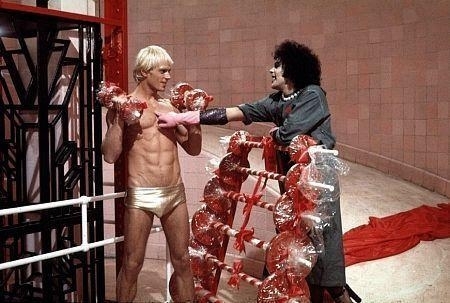
Dr. Frank N Furter pictured with his own creation, Rocky.
Perhaps my favourite aspect of The Rocky Horror Picture Show isn’t necessarily the impact, culture, or symbolism, but rather the crazy aesthetic. The Rocky Horror Picture Show is pure camp. Camp is a humorous style associated with queer culture that largely developed as a desire for community and culmination of uniqueness. It is over the top and is generally described as “failed seriousness.” This naive humour, obscene imagery, and pure fun is deeply ingrained in the film. Part of Dr. Frank N Furter’s success in gaining power over Brad and Janet isn’t the allure alone, but rather, Brad and Janet’s unrelenting blandness in comparison to the entertaining and mystical Transylvanians. However, as said by Dr. Frank N Furter,
It’s not easy having a good time. Even smiling makes my face ache.
There is no doubt that The Rocky Horror Picture Show is a cult classic, and I can say that for certain after experiencing it in person. The community, ritualism, social impact, and campy enjoyment add up to an extremely memorable experience. New waves of dedicated audiences continue to appear, adding their own twists to the traditions as pop culture changes. Just as the original story brought a unique perspective on gender and sexuality to the 1970’s, younger audiences and generations expand on the customs, culture, envelop-pushing, and over the top hilarity to keep The Rocky Horror Picture Show spirit alive and as important as ever.
Cloud9 are crashing out of the sky and burning on re-entry. They got absolutely railroaded at Blast Pro Series: Copenhagen 2019.
Cloud9 did not win a single map at Blast Pro Series: Copenhagen 2019. They were absolutely dominated by NiP, Astralis, and Liquid even though they themselves seemed out of form. They lost 6-16 against NiP on Overpass, they lost 4-16 against Liquid on Inferno, and lost 3-16 against Astralis on Nuke. These losses amounted to their last place finish at the event. Cloud9 has been on a steady decline for a while, and the trend looks like it will continue. After four months of being together as a line-up, their game-play looks worse. Even though their line-up is filled with star players, they can’t even compete with top teams. One thing is clear. Cloud9 sucks.
Cloud9’s line-up is filled with star players. Autimatic, mixwell, koosta, daps, and Subroza are all well known star players. It’s very surprising to see how poorly they have been performing for so long. It did not get better with this event. In fact, all five members of the Cloud9 line-up were at the bottom of the list of players at this even in terms of player rating. They have all been performing poorly.
Surely, something needs to change. Perhaps Cloud9 needs to follow in the footsteps of NRG and remove their in-game leader, daps, from their roster. If all five players are consistently playing poorly, this surely is a symptom of poor tactics.
As my years of public school education come to a close, here are three valuable lessons I’ve learned from my three years of high school.
1. Failure happens. What matters is the response.
Disappointing test marks have shown me the limits of my preparation methods. But dwelling on shortcomings isn’t what will make a difference. It might take several attempts to achieve the wanted result, but it takes perseverance and a desire to improve in order to reach it. I’ve learned how to change and adapt my methods in order to succeed.
2. Being flexible significantly affects your perception of a situation.
Things don’t always go the way we expect
them to. Sometimes, all that can be done is realizing that certain things can’t
be changed because they are out of one’s control. Making the best of a
situation releases the stress that builds up when looking at it from a negative
point of view. Many times, inconveniences or disappointments are but small
parts of our lives. Life goes on.
3. Stress and a lack of sleep definitely have a negative effect on your body, no matter how much you pretend and hope they don’t.
They make you more likely to catch a cold and decrease your focus. While it may sometimes seem that sleep just gets in the way of doing other, more productive things, getting a proper rest is more important in the long run.
Wishing everyone the best for what your futures hold. May you never stop learning.
A pale gleam like shimmering snow, I search for you in places I have yet to know. My mind blanks with every word you say, who’d have thought you’d infect me this way.
Like a sheet of paper, so soft and thin. you’re an elderflower growing from within, I hate the thought of a stupid cliche, but I wish I’d met you in a dingy cafe.
I’m a pair of converse that dirty quick, And you’re a puddle of mud, deep and thick. Frankly you’re quite rude and have already found your calling, but you see the thing is, I’m a feather and I’m falling.
Jazz became a mainstream staple of American culture in the early 1900’s with the rise of Be-Bop. Many rising artists from this era of jazz suffered from heroin addiction.
A Brief History of Jazz
Jazz developed from Rag and blues in the late 19th century, and was born in New Orleans. Louis Armstrong was one of the frontiers of jazz and became the father of swing. Duke Ellington made notable contributions to atonality during this time period and paved the way for musicians later in Harlem.
Harlem, heroin and Jazz
The intersection of Jazz and heroin is largely a result of geographic elements. The turn of the 18th century brought with it the introduction of heroin to New York streets. During prohibition and continuing afterwards the Sicilian mobbed trafficked a large quantity of heroin across America. New York simply became the cornerstone to their business and the center for all their trade. Harlem became a booming cultural center, one of its greatest attractions: Jazz.
This map illustrates the mischievous night life in Harlem. The witty map was published in 1932 towards the end of prohibition and pokes fun at a culture which openly endorsed drug use.
At this crossing lied a vulnerable population of economically and socially marginalized artists and a subculture that encouraged substance abuse. Jazz and blues clubs became outposts for drug dealers to sell; after all both musicians and fans were more than willing. Certain record companies went as far as to pay their musicians in heroin. The market was more than ripe. Musicians felt enormous pressure both internally and externally. The pressure to secure gigs, and record deals led to immense stresses in artists lives. Mental health issues may have also been a dominant factor in contributing to heroin use; often, musicians suffered from depression, anxiety and low self-esteem. Medically speaking heroin is very effective at relieving stress. Heroin was believed to make many musicians play better, this myth was further perpetuated by artists such as Charlie Parker. Parker was the staple of Be-bop and a heavy heroin user, he himself believed that he was able to better concentrate on the music when he used. In an effort to replicate his talent other musicians began using. Jazz artists were focused on pushing boundaries, heroin simply became a passage to expand creativity and imagination.
Charlie Parker
Charles Winick conducted a study in 1957 and concluded that a startling half of all 357Jazz musicians he had surveyed had used heroin. He had thought that a culture of fantasy had been curated around heroin, making it attractive to this population of users. In a way contagious a sort of trend led by Charlie Parker, and a desire to follow. Those that performed in this subculture took heroin in stride as another aspect to leading such a life.
Substance abuse runs rampant in populations which struggle economically and during the great depression nearly half the African American population was left unemployed.
Law enforcement was less than fair in their treatment of African American users, often being brutal in punishment towards these populations. This was largely a result of racial tensions and media portrayal which often pushed a false narrative that addiction was an epidemic which was limited to the black population. These associations proved themselves dangerous when government officials used heroin as an excuse to further marginalize black communities. Policies began to target African Americans.
In the early 1920’s one third of all prison mates were being punished for drug related charges. Overcrowding lead to reformations in the US Public Health Service. This lead to a new approach in the form of new institutions. These rehabilitation centres were placed in the country and worked to treat and study substance abuse. The first of these facilities was Lexington, Kentucky. Music was used frequently as rehabilitation in this form of treatment. Jazz Giants such as Chet Baker, Elvin Jones, Ray Charles, Jackie Mclean and Benny Green were all figures that performed in this facility. Sunny Rollins himself attended this facility.
Lee Morgan was one patient which attended this facility. After years of addiction he cleaned up due to treatment and recorded his first track in 3 years: The Sidewinder. For many lexington had a great influence upon their careers. Patients were given instruments and practice rooms. They were able to write music and play music in an environment free of stress and heroin. In this way jazz could be the contagion or the treatment of addiction.
Heroin however led to many premature deaths among musicians. Billie Holiday worked with John Hammond and toured with Count Basie, and was a heroin addict the majority of her life. She was known for her powerful, soulful vocal style. Holiday was arrested after looking for treatment for addiction in 1947. As a result she had her cabaret card revoked and was no longer permitted to perform in clubs where liquor was sold. The loss of her cabaret card led to a decline in her career. Afterwards she continued abusing alcohol and heroin until suffering liver failure. After being admitted to the hospital Holiday was arrested police but unfortunately died of heart complications and liver issues before being able to leave the hospital.
Billie Holiday
Another famous artist whose career was cut short by a life of heroin addiction was Chet Baker. Baker was the clean cut trumpet player and singer behind hits such as My Funny Valentine and It’s Always You. Baker established himself as an immensely popular name in cool jazz in America, however in the late 50’s Baker fled from America to Europe, evading persecution for his drug habits. While in Europe he was imprisoned in Italy, and kicked out of both Germany and Britain. When he returned to America in 1960 he continued to record. His career came to a temporary halt in 1966 when, in a drug related fight, he had his teeth knocked out and was unable to play his trumpet. During this time he became a pump attendant until he received dentures. Baker died in 1988 after taking heroin and cocaine and promptly falling out of a window in Amsterdam.
Chet Baker
The implications of heroin in the jazz industry are of profound depth in their connection to culture, and the positive/negative impacts on the contributions of individual musicians. The effects on social aspects such as racism and discrimination is an intriguing and controversial topic.
It has taken me some time to learn and appreciate my identity as a South Asian woman. To know that there’s a history of South Asian people breaking barriers way before it was even considered slightly possible to do so. South Asian people are on that page of history, and one of those people is Dr. Reita Faria.
Reita being crowned Miss World, 1966.
In November 1966, in London, Reita Faria was to become the first Asian to win the Miss World Beauty Pageant. At the time she was a 23-year-old medical student. When she first entered the pageant, she was told her odds of winning were 1:66. She did not have the glamorous wardrobe that her other fellow contestants had when she arrived in England for the pageant. And yet, she won.
She was the definition of beauty with a purpose, for she was not willing to let herself get caught up with the glam life that now awaited her. Overwhelmed by the press following her every move, she is quoted to have said “One day I was a student and nobody took any notice of me. The next day I was Miss World and everyone wanted to know me. It just showed how artificial and temporary all this recognition was.”
Reita Faria in Vietnam, signing a cap for a troop, 1966.
As Miss World, she did her required one year tenure, which included going to South Vietnam to support the troops. Then, despite the many movie-offers that came her way, she chose to finish off her medical degree and become a doctor.
Today Faria is still alive and well, with her husband David Powell, and with five grandchildren, still practicing as an endocrinologist. It’s pretty apparent that she has no regrets about the choices she has made. She has stated:
“The glamour world could have never given me this grounded security. I wish the girls today would realise the fleeting nature of fame and looks. Running after these flashes of publicity, trying to hold onto what changes so rapidly and always looking out for variety, be it in ambitions or relations, is bound to cause distress. It’s unusual for a celebrity to make for a happy family these days, but this is where real happiness lies — in secure relationships.”
She is truly, and forever will be, an icon to every woman in the world.
Global waste could rise to 70% by 2050 as urbanization and populations continue to rise, according to the World Bank, particularly South Asia and Sub-Saharan Africa, are set to generate the biggest increase in trash. World Bank’s urban growth specialist Silpa Kaza states, “South Asia’s waste will double, sub-Saharan Africa’s waste will triple,” so, why is this happening? The waste itself isn’t from these developing nations; but, from high-income countries who only make up 19% of the population, while still managing to produce exceedingly more than a half of the waste in the world, “over 90 percent of this waste is dumped openly in lower-income countries that frequently lack sufficient disposal and handling facilities.” Canada alone generates 23.6 tonnes of garbage a minute, 1415.5 tonnes an hour, 84931.5 tonnes a day, beating a third of the economically stable nations in the world, producing a whopping 31 million tonnes of waste a year.
According to the American Lung Association, more than 141 million people are routinely exposed to dangerously polluted air, “State of the Air 2019” report.
Nations could achieve environmental and economic benefits by better collecting, recycling and disposing of waste. Today, Germany has the best recycling rate in the world. Germany leads the development into a more environmentally friendly planet, recycling in between 52% and 56% of their municipal garbage. We can acquire similar results if we reduce our environmental footprint.
https://www.youtube.com/watch?v=jyLjUEOcLgg
Plastic is a leading factor in the environmental issues in today’s world.
3 Easy Steps To Reduce Your Carbon Footprint
Learn the 3 essentials R’s of being environmentally friendly, reduce, reuse, recycle. Moving towards zero waste is a great step towards combating climate change.
Reduce your use of single-use plastic bags, and switch to biodegradable reusable bags.
Drive less, walk more. The gas released from your car may not have a major affect on the environment, but there are around 1.2 billion people driving at the same time.
“You must be the change you want to see in the world”
After recently writing an article about the kazoo, I got one
for myself. It took me a week to realize that I was playing it from the “wrong”
end, or the end not typically played from. How embarrassing. I guess I wasn’t
paying very close attention to how the kazoo was being played. As many wind
instruments are narrower at the end they are played into and widen at the other
end, I thought this would be the same on the kazoo. However, when played this
way, the sound is softer and the tone is thinner than when it is played from
the wider end, which I believe may still be the desired sound by some musicians,
such as this one:
Here’s a couple more tunes featuring the kazoo in a somewhat serious manner.
The kazoo can be used in a variety of musical genres, such as blues.
In this next piece, the kazoo is played quite impressively. It’s placed in a glass for effects.
We’re getting to the end of the school year and I’ve noticed that everyone is obviously super stressed. Exams are coming and people are starting to study. By now, I’m sure everyone has figured out how they like to study, but just in case, here are some tips on how I personally study for exams.
Try and get revision sheets from your teachers. No matter what you think, they’re always on your side and want you to succeed. I’m sure lots of them have lists of concepts that you can review.
For lots of people (me included) the key to studying is making everything look pretty. Get coloured pens and highlighters, even nice paper. Whatever you can find to motivate yourself more.
Rewrite old notes. This is basically my whole study plan. For example, in science, my teacher gave us a sheet of concepts to and questions to help us study. So I’ve been using old notes to help me rewrite old information that I’ve kind of forgotten.
Remember to take breaks. It can be overwhelming to try and cram everything into one night. So take it slow, breath and remember that you can get through it.
I hope this helped someone maybe a little, good luck to all those taking exams!
There has been a growing trend of plant-based and vegan diets across the world. Although many are interested in the environmental sustainability, health improvements, and other benefits, there is a growing population of vegetarians and vegans who are attempting to live a cruelty-free diet. Its estimated that 9 billion animals are killed each year for meat, dairy, and eggs. That’s in the United States alone; worldwide, the estimation is 56 billion. The worst part, is that the conditions in which these animals are kept is horrific. The Rolling Stone shared insight to these conditions with an undercover factory farm worker, who they called Sarah. She works nine hour days surrounded by feces piled three feet high, watching pigs with cut snouts and broken legs crying, many of them being left to die. Sarah works with hidden cameras and microphones to take down the Big Meat industry. Their findings often trigger arrests or shutdowns of processing plants. The clients, like fast food giants, are often unaffected by investigations. She’s been doing these operations for 5 or 6 years. An activist explained,
If you haven’t been in a hen plant, you don’t know what hell is. Chicken shit piled six feet high, and your lungs burn like you took a torch to them.
A group of corporations have taken up family farms, transforming them into indoor, prison-style plants in the middle of rural nowhere. The rural location is far from the eyes of consumers. In America, the U.S. Department of Agriculture is short-staffed, leaving the responsibility of revealing the grotesque nature of modern meat farming practices. The inspectors sent by the government usually only see a small sample of animals right before they’re killed. However, leading up to that point, the animals are on their own, kept perpetually pregnant, fed growth-promoting drugs and sometimes garbage (mixed in with the grain can be an assortment of trash, including ground glass from light bulbs, used syringes and the crushed testicles of their young), while being kept sick from constantly breathing in their own feces; this all happens in a tiny and crowded crate. Undercover activists are the only lens inside of factory farms, but drafted laws by Big Meat lobbyists are trying to stop that. Known as ‘Ag Gag’ bills are making it illegal to take a farm job undercover, apply for a farm job without disclosing a background as a journalist or animal-rights activists, and hold evidence of animal abuse past 24 to 48 hours before turning it to authorities.
Chicken factory farm.
The abuse in factory farms has led to a growing population of vegans and vegetarians following following a cruelty-free diet, but these meat free diets aren’t necessarily absent of cruelty on the farm.
Across the globe, 54% of the population lives in cities, up 30% in 1950, which is a process known as rabid urbanization. This increased urbanization may benefit the economy because of a persistent ‘productivity gap’ that exists between agricultural workers and workers employed in other sectors of the economy. Economists have consistently discussed the existence of an income gap between agricultural and non-agricultural workers since the 1950’s. However, it was difficult to decipher if the difference in wages was due productivity differences or the persistent underestimating of agricultural income by researchers. Agricultural income is challenging to measure because there are many informal employees and products are often consumed on the work site. By measuring the areas of individual farms, accounting for the average yield of cross, and expected crop loss, data from the Living Standard Measurement Studies released by the World Bank and from the U.N.’s System of National Accounts was able to uncover a reasonable estimate of productivity. Through surveys and research in the The Agricultural Productivity Gap, by Douglas Gollin, David Lagakos, and Michael E. Waugh found that non-agricultural workers work about 1.1 times as many hours as agricultural workers, which wouldn’t explain the disparity in wages. It implies that quality differences between the two sectors is not a sufficient source of difference.
Capital per employed in agriculture, industry and at the GDP level in Sweden, which is similar to North American trends.
Another theory pertaining to the income gap is related to worker quality, which includes productivity and education differences. Although worker quality can’t be measured directly, authors were able to observe that non-agricultural workers have about 1.3 times more education than the average agricultural worker. However, the average agricultural income is over 2 times lower than the average non-agricultural income, which allowed the authors to suggest that the income difference isn’t fully related to educational differences. The authors didn’t find any direct reason for the wage gap. While there may be other benefits that explain why agricultural workers remain in the industry, researchers found that access to key public goods is consistently lower in rural areas than urban centres, literacy rates and the education quality was consistently lower in rural areas, and rates of malnutrition and infant morality was also higher. This could be a factor in forcing rural workers to remain in the industry. While its possible that there are unobserved differences between the two sets of workers, a 2013 study by Gharad Bryan, Shyama Chowdhury, and Ahmed Mushfiq Mobarak provided additional evidence that incentivizing people in rural Bangladesh to move into an urban area was associated with positive outcomes. As well, the fact that developing countries had a larger gaps between sectors suggests that monetary constraints among rural populations may be a driving force of the productivity gap. Providing assistance to people living in rural communities who want to move into urban areas may be an effective policy for increasing the wages of these people.
Regardless of the causes of the wage gap between agricultural and non-agricultural workers, its clear that farmers in rural communities are underpaid, likely even for no substantial reason. The type of work tends to be particularly challenging, physically and mentally, with injuries or abuse often going unreported. Particularly with migrant farmers, wages tends to be low and risk tends to be high. A family came forward after 39 year old Sheldon McKenzie didn’t receive proper care for a workplace injury through Canada’s Seasonal Agricultural Worker Program and died. They said that Canada’s program stripped the Jamaican migrant worker from his labour rights after a severe head injury and tried to cut off his access to health care. Maria Barrett, McKenzie’s cousin who lives in Winnipeg fought to keep her cousin in Canada to receive medical care. Through a practice known as medical repatriation, hundreds of workers are sent home in similar circumstance, which Barrett explained that,
It’s worse than slavery — they dispose of them.
For 12 years, McKenzie went back and forth from Canada to Jamaica, spending months doing manual labour on farms; the money he made was sent back home to his wife and daughters. In late 2014, he started working on a tomato farm in Ontario, and in January 2015, his cousin got a call saying that he had hit his head at work and was at a hospital in a coma.
His face was completely bandaged, he was swollen. We got there, he was on life-support.
Part of his brain had to be removed due to swelling and internal bleeding. Barrett recognized that there was immediate pressure to have McKenzie return to Jamaica, and due to the fact that he was no longer able to work, he lost his work visa and wasn’t qualified for health-care coverage. McKenzie’s cousin hired lawyers to try and get a humanitarian visa, and while he was granted temporary stay, McKenzie died before a decision was made on a humanitarian visa. Barrett expected support from the Jamaican liaison officer assigned to McKenzie’s case as part of the seasonal worker program, but that didn’t happen. Barrett said,
What I found out after much talking to people who will never talk on camera, when the migrants are hurt, sometimes they don’t take them to the hospital, they ship them back to Jamaica... Their only goal was to ship him back home. The only way he wasn’t shipped back in three days is because we dug our heels in and said no because the health care in Jamaica is not up to par to take care of the type of injury that he had.
When Carlton Anderson, the chief Jamaican liaison officer for Canada was asked about the allegations, Anderson said he was unaware of the incidents and that it went against obligations.
Sheldon McKenzie came to Canada as a seasonal agricultural worker.
About 30 000 farm workers come to Canada each year through the Seasonal Agricultural Worker Program, which has steadily increased over the last decade. The majority of workers come from Mexico and Jamaica. Canadian farmers hire the workers decide who is allowed to return through the program by working with Jamaican liaisons, which leaves the workers powerless. Those who complain are sent home and aren’t allowed to come back. Although the program has been running for 50 years, Canadian researchers have only recently collected data on illness and injury because the information was private. Between 2001 and 2011, 787 migrant workers in Ontario were terminated and sent to their countries of origin for medical reasons. Studies found that the workers were a vulnerable occupational group because the federal government will take away their work visa id they get sick or hurt, which allows the provinces to cut them off of health care. According to the study, only one in fifty injured or sick left willingly.
Sheldon McKenzie’s two daughters, Neishmarr (14) and Keisha (17), lost their father and the family’s only source of income.
Chris Ramsaroop, is an organizer with Justicia for Migrant Workers, and he says migrant workers are denied basic human rights and are often seen as expendable. Ramsaroop has been trying to get the government to change the programs to improve access to basic rights and healthcare. He said,
To be blunt, I consider this an apartheid system. Migrant workers live and work under a different set of legal rights and obligation than we do. We [Canadians] are not denied basic human rights, we are not denied health care. They are seen as disposable and temporary.
It’s extremely shocking as the number of foreign temporary workers that have died on Canadian soil goes untracked, both as a result of a lack of awareness and an ignorance of the status of migrant workers.
Even outside of migrant workers, farmers are paid extremely low. Large vegetable companies farm and utilize cheap labour is a system that is often extremely abusive. While the cruelties faced by animals in the meat and dairy industry is horrible, similar abuses are being felt by the vegetable and fruit farmers across the world. The cruelty for these vegetable and fruit farms is heightened with people of colour, as they are generally used by international corporations and migrant worker programs. This causes the majority of abuse and poverty to concentrate in countries populated by people of colour, but the healthy food being farmed often doesn’t reach the same ethnic minorities. The health of people with low incomes, which includes mostly people of colour, suffers due to the lack of adequate housing, child care, health care, and food. The stress caused by these living conditions can also effect health, leading to higher raters of tobacco and alcohol use, with an increased risk to health problems developing or worsening. As well, low-income individuals are less likely to use preventative care services, which results in fewer opportunities for practitioners to assess and educate low-income patients about their health risks. Even when low-income people do see health care providers, the social needs and complication of treatments is rarely addressed. Systematically, the health care institution is less accessed and less effective for low-income people. As a result, the individuals and their families that are underpaid and overworked to farm “cruelty-free” food, largely don’t receive the same healthy food that they farm, and due to the income related to their job, they also don’t have access to other factors related to overall health. Data conducted by the Centres for Disease Control and Prevention showed that even relatively healthy lower-income people, those who earn 200% or less of the federal poverty level (about $24 000 or less a year), and have fewer than three chronic conditions and no functional limitations, have higher health risks, greater social needs, and worse access to care than relatively healthy moderate income and higher income (200%-400% FPL and greater than 400% FPL respectively).
Health status of relatively healthy individuals related to income, showing that low-income individuals tend to have higher addiction rates and poorer health.Social needs of relatively healthy individuals related to income, showing that low-income individuals tend to have worse housing and limited access to food.
Unfortunately, healthy food tends to be more expensive, which means that lower-income individuals, who are more likely to be food insecure, often choose unhealthy foods. The current states of agricultural farming of cruelty-free foods is a factor that fosters low-income, particularly due to injury, abuse, and low wage, which limits the access of farmers to health care, social service, and the food they cultivate themselves. This cyclical poverty cycle is far from cruelty-free. In a system that concentrates poverty and targets people of colour, immigrants, and migrant workers, a cruelty-free diet is impossible because even if the farming practices didn’t abuse animals, the human workers are still left underpaid, overworked, and ultimately, disposed of.
Due to a long history of racism and systematic oppression, including slavery, segregation, and redlining among other factors, people of colour, particularly black people are at heightened risk of poverty and therefore, poor health. In Canada and the United States of America, communities and cities largely inhabited by people of colour and immigrants tend to be poorer. However, even economically well off people of colour tend to have lower health than their white counterparts. Part of this is due to food advertising or the fact that healthy food is seen as ‘white people food’ and is often ignored by even the black population that can afford it on a regular basis. Tanisha Gordon, a 37 year-old IT worker, was diagnosed with pre-diabetes and was forced to clean up her diet. Gordon explained in the Huffington Post,
A lot of the time, when you go to restaurants now, they have these extravagant salads with all these different ingredients in it, like little walnuts and pickled onions, like the stuff Panera sells. For me personally, that’s like a white person’s food. A lot of the mainstream stuff that’s advertised comes across as being for white people.
The growing industry of nutritionally ambitious health is unaffordable and not relatable to many, which is largely a black population. Gordon was able to shed 60 pounds with diet change, but food and exercise wasn’t the only the only obstacle. Cultural factors forced her to retrain her brain and disassociate objectively healthy food from whiteness, which as a concept is exclusive. While there is a large health gap between poor individuals and wealthy individuals, there is even disparity between wealthy white people and wealthy black people according to New Scientist, in part because of this issue. On top of cultural barriers, institutional racism in healthcare prevents care to even wealthy black people with health insurance. Income has become an important risk factor in early death, particularly in America due to lack of insurance availability, affordability, and coverage. On top of income, race is an important factor due to cultural perceptions of health, but more importantly, inadequate care due to racism in health care institutions. This is why the abuse of migrant, primarily people of colour workers is so frightening. People of colour are farming food in terrible conditions, likely not receiving it due to income or cultural influence, and as a result, has worse health, which is heightened due to institutional racism. Fundamentally, our diets require change, not necessarily what we eat, but how we get it and further, how its distributed. If that doesn’t happen, no diet can truly be cruelty free.