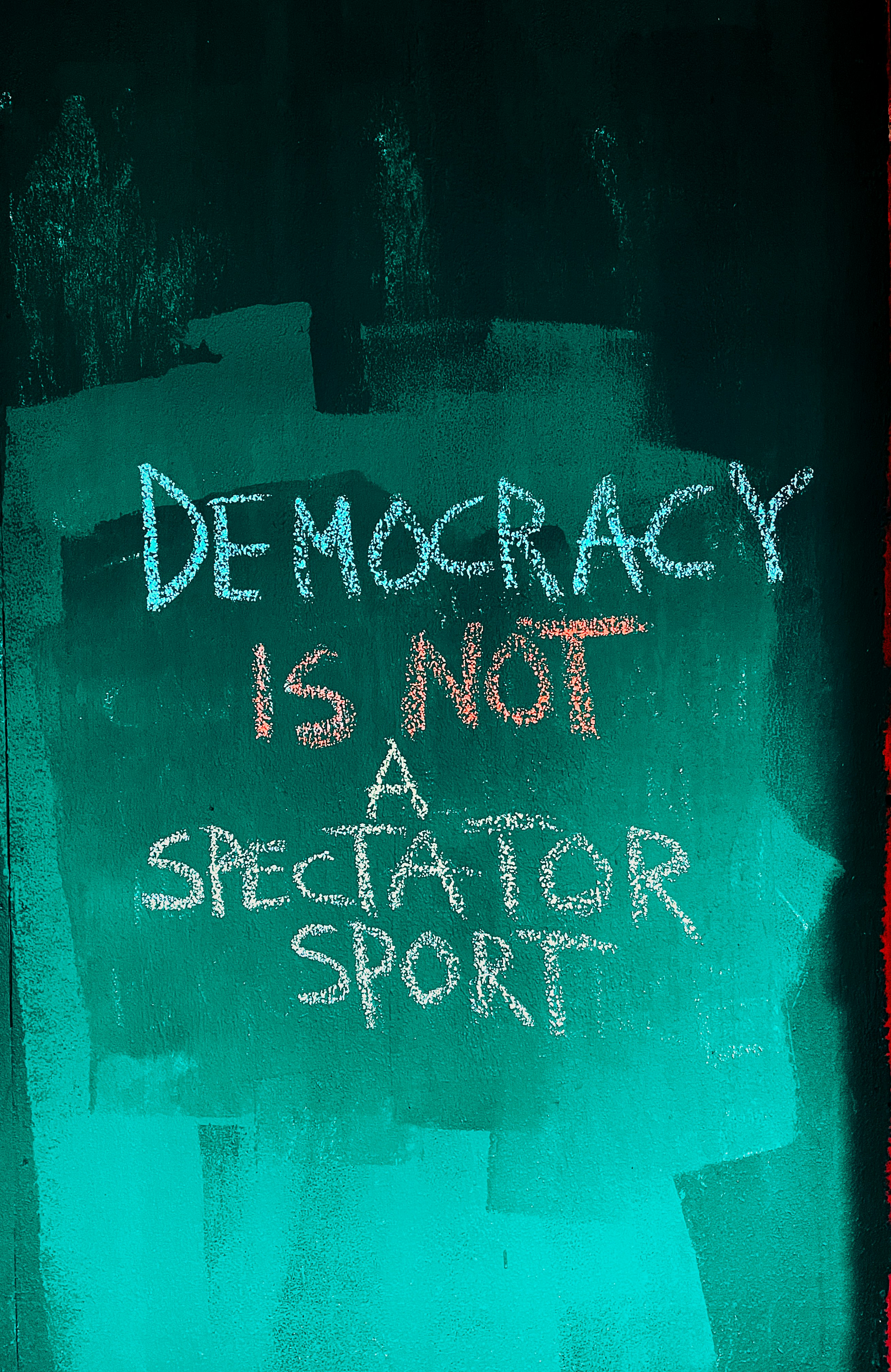

There have been cycles where democracy has thrived, such as in the mid-2000s in most of southern Europe, Latin America, and East Asia, where political regimes transitioned to democratic governments. However, as of today’s date, we are in a democratic erosion. It officially began in 2006, where many countries saw a decrease in freedoms and acquired socio-political climates which would be deemed illiberal. The erosion began from the smallest acts, such as polarization and extremism on social media or discriminatory language, and that gradually threatened the freedom of the press, integrity in judicial systems and checks and balances in the legal/political systems. It begins when the rights of the few are imperiled, and someday it becomes the rights of the majority. When democracy is endangered, and trust in democratic institutions and the state is inadequate, it becomes the personal responsibility of citizens to uphold and rebuild it.
So Can We do, Now?
>>>>> Using your critical thinking skills and accumulating perspectives from various sources is imperative, because in this day and age, where the integrity of truth is traded for user engagement, you must be wary. When media becomes engineered, nuance and reality are ripped from headlines and from discussions, and short-form content infiltrates news with misinformation and scapegoating optimized for clicks. It dissolves critical thinking, civic responsibility and intellectual freedom, all core values that uphold democracy. Investigate, because only then can a citizen truly be empowered to resist manipulation, therefore avoiding the possibility of consolidation of power. By reading (non-fiction, social commentary) books, learning from historical patterns and connecting with the experiences of marginalized people, you are equipped with the skills needed to support democracy in the spread of tyranny.
For example, Meta, a global tech giant as of early 2025, informed that there will no longer be continuation of fact-checking on their social media platforms. With many youth making social media their primary source of news, the absence of fact-checking seems to be the start of fake headlines promoting extremism for views.
To exercise democracy, citizens must share reality and know when and whom to hold accountable; ignorance is NOT bliss. In an era where falsification becomes economically or politically incentivized, and investigative journalism has become archaic and dangerous, citizens must make it their individual responsibility to investigate the truth and question, dig deep and dissent against injustice to maintain the state of democracy and resist tyranny. Passively continuing to consume extremist media and false and unbalanced information creates long-term consequences for critical thinking, endangering rights and freedoms.
What more?
Our language shapes reality; it molds perception, behaviour and thought patterns. Every word is laced with intention, implications and history, whether we are consciously aware or not, it shapes our surroundings and what sort of society we are subject to. Due to being such an entrenched part of our identities, and hence, our ideologies and the manner of our civic engagement, discriminatory and polarizing language can redefine our perception of “normal”, further the presence of prejudice, and justify the repression of minorities.
The loss of rights and, consequently, democracy, often begins small, with words that can evade accountability and serve as dog whistles. By avoiding the implications of our language and being unaware of the vocabulary that surrounds us, it is an imposition of hostile environments that can create policies/laws that restrict civil rights, limit freedom for minorities and justify, if not promote exclusion. It is imperative to deconstruct words from our history that carry negative connotation, and continue to be intentional with our choice of words. Authoritarianism aims to utilize discriminatory language to scapegoat and polarize, redirecting popular discontent, often normalizing the dehumanization of minorities. Our daily language is embedded with misogyny, colonial roots, discrimination, and hate towards minorities of all kinds. To create moral boundaries against certain phrases and terms is to avoid harmful narratives gaining traction and making discrimination socially acceptable. To avoid restriction of rights, a surge in racial violence/hate crimes, one must avoid and call out language that is hostile and discriminatory. Prevention of the concern becomes imperative in avoiding a “democratic” society that doesn’t truly protect the rights of all.
Conclusion
Democracy only thrives through collective effort; elections only work to reflect the will of the people, public policy is shaped by what the public demands and society functions through active civic engagement.
Without upholding democracy, rights and freedoms become empty symbols. Politics isn’t one day at the ballot box. It is every day, a burden to bear; however, a cause worth defending, worth fighting for.
Sources:
- https://pmc.ncbi.nlm.nih.gov/articles/PMC9910783/
- https://medium.com/datasociety-points/media-manipulation-strategic-amplification-and-responsible-journalism-95f4d611f462
- https://thesil.ca/reading-is-an-entertaining-hobby-but-it-is-also-an-act-of-politics
-
https://www.bbc.com/news/articles/cx2dpj485nn
-
https://www.bbc.com/news/articles/cx2dpj485nno
-
https://www.britannica.com/topic/democracy/The-spread-of-democracy-in-the-20th-century
-
https://kuscholarworks.ku.edu/entities/publication/17c8bc57-4e80-46d9-bc2f-e7cb7ea3e36
-
bhttps://freedomhouse.org/report/freedom-world/2018/democracy-crisis#:~:text=Political%20rights%20and%20civil%20liberties,Democracy%20is%20in%20crisis.