

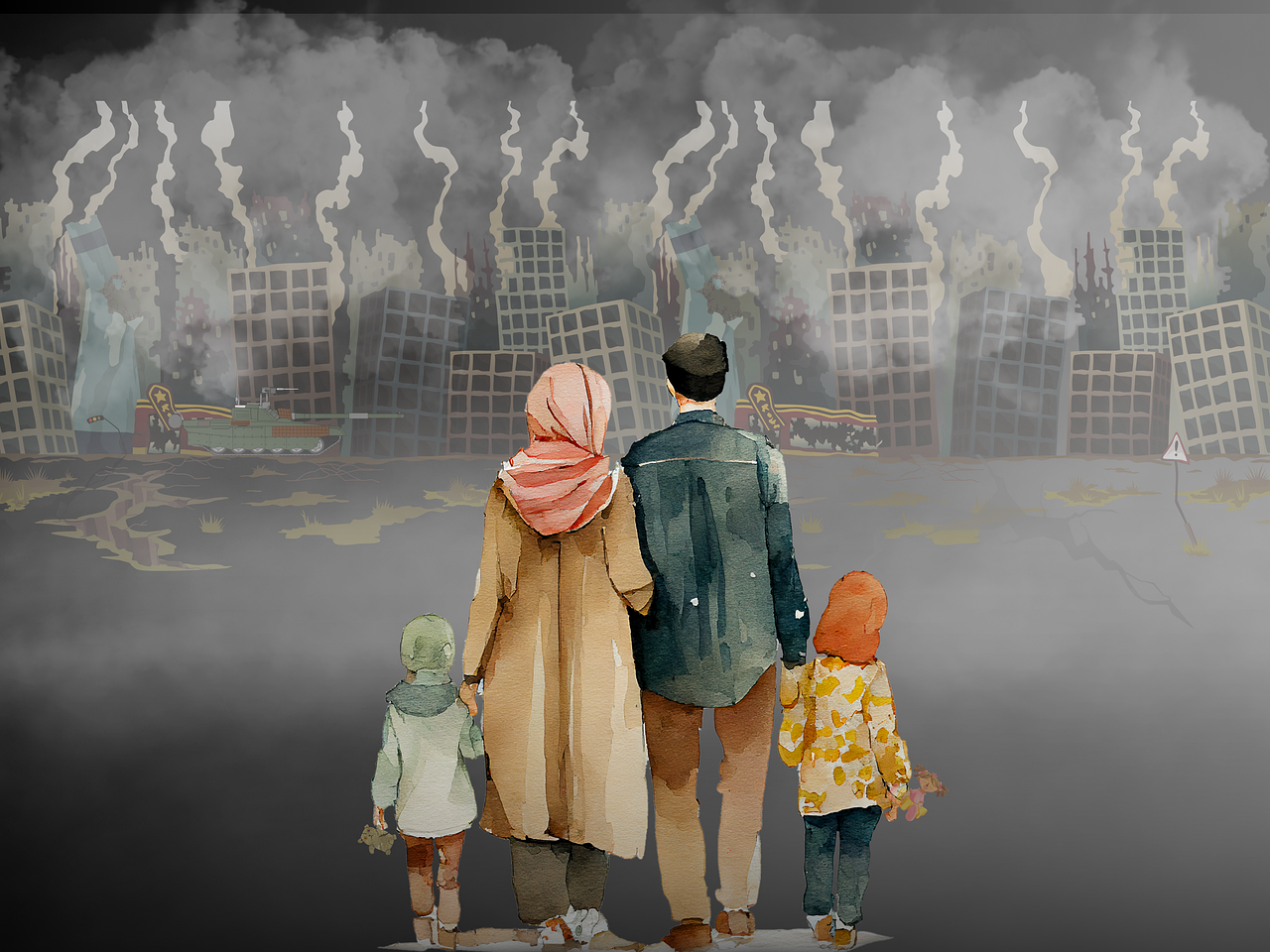
Over the past century, Syria has experienced significant political and economic instability and faced major conflicts involving their government. These recurring crises created conditions in which dynastic dictatorship and authoritarian leadership could take hold. The rule of the Assad regime represents the latest and most controversial chapter in Syria’s modern political history.
Hafez al-Assad served as the totalitarian dictator of Syria from 1971 to 2000, when he passed away due to a heart attack, his son succeeding him as the new president. During this time, Syria was run by an extremely military and centralised government, and civilians had little to no human rights or freedom of speech. Dissent and protest were suppressed with brutal force, and thousands were killed. The state was heavily guarded and surveillance based, and the majority of the population (specifically the Sunni Islamic people in the Alawite based government) were seen as opposition.
When Bashar al-Assad assumed power, he initially presented himself as a moderniser and reformer, implementing new laws that would revitalise the stagnant economy, reduce corruption and liberalise the media. As his goals went unachieved with the numerous economic barriers holding back the country, he turned to his father’s violent and authoritarian tactics. With growing distaste for the Assad regime and environmental issues pushing the population towards the capital, protests were becoming more and more common and by 2012 Syria had erupted in full civil war. Violence, torture and military power were used to stifle demonstrations and prevent the world from hearing about the condition of the conflict, and communities that had become hubs of resistance were surrounded by soldiers and tanks.
Furthermore, the religious tension between the distinct groups in Syria was augmented, as Assad and the majority of his followers were Alawite Islamic and many protesters were Sunni Muslims. Thousands of refugees were seeking asylum in neighbouring countries, which were, along with global powers, dividing into pro and anti Assad. The US (at the time led by President Obama) , the EU, Qatar, Turkey and Saudi Arabia supported the rebels and offered asylum to refugees, while Iran and Russia became some of Assad’s strongest allies. After the government’s use of chemical weapons (mustard gas and sarin in aerial bombs, missiles and artillery rockets) became known and identified as a clear violation of the OCPW’s international regulations, powerful organisations worldwide called for Assad to step down and release political prisoners. A partial and short-lived ceasefire took place in April 2012, but violence resumed quickly and soon reached even higher levels.
It wasn’t long after Syria began receiving equipment and artillery from other countries, the rebels from the ones nearby and Assad from Hezbollah and forces in Iran, escalating the situation and causing new political tensions. Russia began deploying air troops to Syria, and Western forces started to attack chemical facilities.
The civil war began to decline in intensity about a year before Assad’s downfall, as involved countries backed out, dealing with their own regional conflicts. Russia withdrew as they invaded Ukraine, and Iran retreated with the Israel-Hamas war. Many refugees were forced back to Syria as other parts in the Middle East also became unsafe.
However, as governmental support waned, the HTS (or the Hayat Tahrir al-Sham, a Sunni militant and/or terrorist group) forced Assad (who fled to Russia) to release his hold on the country and began the reform of a fractured society. Ahmed al Sharaa, the interim president, stated he intended the careful construction of a constitution to take place over the next few years and called for all armed factions (including the HTS) to dissolve to prevent further violence.
Today, despite a reduction of violence in Syria, the new government and country as a whole are facing immense challenges. Severe economic collapse, needed political reform and widespread humanitarian needs. The situation is undoubtedly lighter, but Syrians are confronting new hardships, and contributions to charities like UNICEF can help provide the support they urgently need.
Sources: