

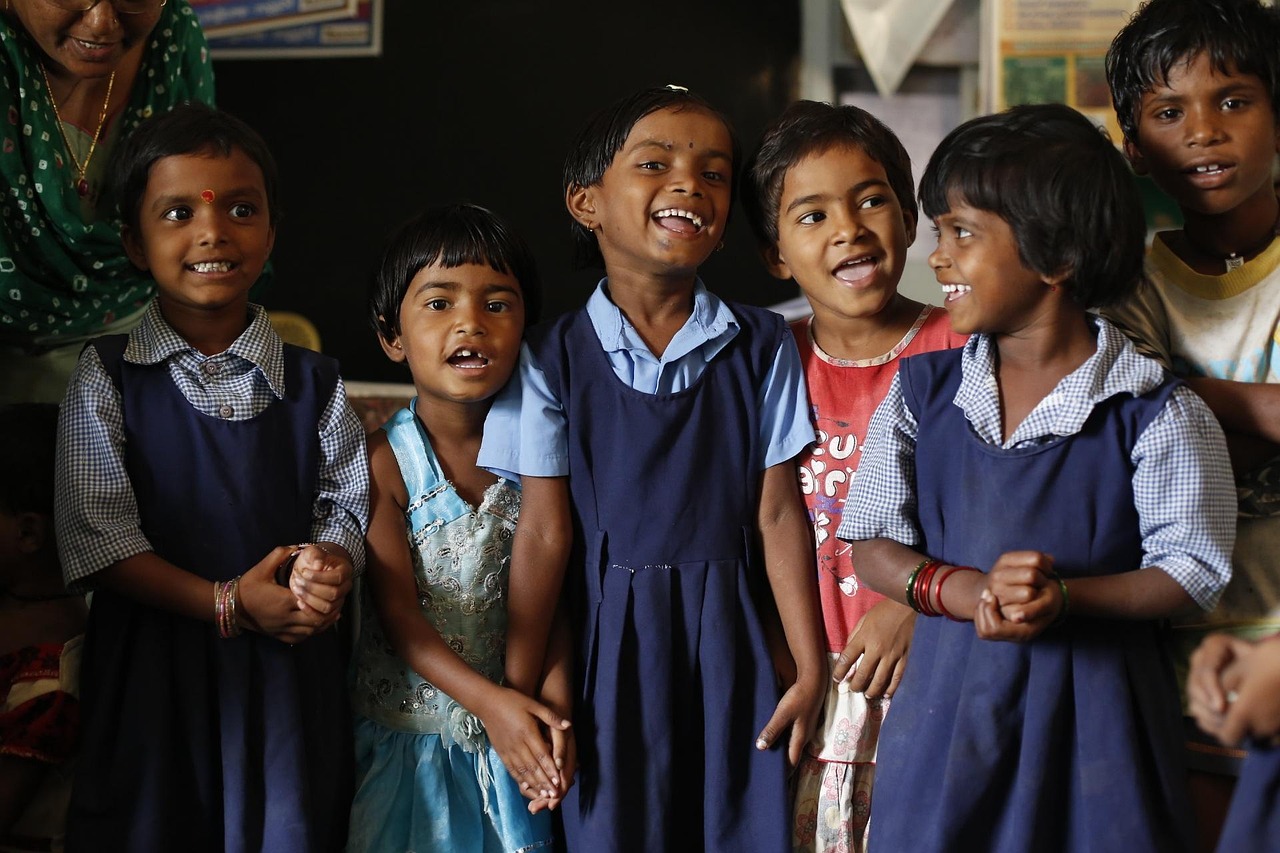
Quality education for children and youth—regardless of sex, gender identity, race, religion, ethnicity, or ability—is a basic human right and is central to achieving a sustainable and prosperous quality of life. Education provides children with the knowledge and skills they need to face daily challenges, while also fostering economic growth and social development. However, there are many barriers to providing quality education in less developed countries, including overcrowded, unsafe, or distant schools, limited investment in curriculum, materials, and teachers, and pressure for children to support their families through work. Children living in conflict areas, children with disabilities, girls, and those whose religion, race, or ethnicity differs from the majority or ruling group often face even greater challenges. Above all, the physical and emotional safety of students is a necessity for basic education to take place.
Once these fundamental barriers are addressed, the challenge of education shifts from access to engagement—how students experience learning within the classroom itself. Teaching methods such as student-centred learning, open-ended instruction, and addressing fears surrounding learning have been used for years, while others continue to emerge alongside social and technological change. These approaches can be highly effective in helping students participate, engage, and understand material. Still, the question of how to get students to pay attention, understand concepts, and complete assignments remains prominent within the education sphere. The importance of classroom environment is often overlooked, with blame frequently placed solely on teaching practices. While classroom atmosphere is not the only factor influencing students’ readiness to learn, it can be highly impactful.
To explore this further, I interviewed 40 students from my school and community to learn what type of learners they identify as and what strategies help them learn best in a classroom environment. While I would have liked to speak with more students, this group represented a wide range of experiences, including cultural backgrounds and learning styles.
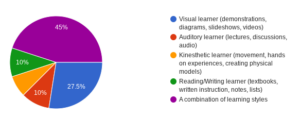
I asked two questions. The first—“Which learning style best describes you?”—produced fairly predictable results. Forty-five percent of students described themselves as having a combination of learning styles, which is reasonable given that most people rely on multiple sensory cues to process information. This was followed by visual learners at 27.5%, auditory learners and reading/writing learners tied at 10% each, and kinesthetic learners at 7.5%.
The second question—“What strategies or environmental factors help you focus best, both in and outside of school?”—generated a wide variety of responses. These included preferences for lighting (dim, bright, or natural), sensory tools (fidgets, music, white noise, noise-cancelling headphones, and movement breaks), routine styles (flexible, structured, or Pomodoro-style), and even preferred seating or learning positions within the classroom, such as the floor or standing desks. Some responses were more unexpected, including drawing—and even “Windex” (??). While I am unsure what was meant by this, the purpose of the survey was to represent student perspectives, so I can hardly leave it out.
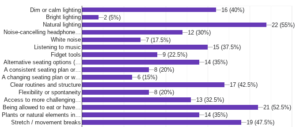
I will not go into exhaustive detail here, but the data clearly shows that student preferences vary widely, although there is some consensus on factors such as natural lighting. In general, just as students’ brains process information differently, their learning needs also differ. This leads to my proposal of grouping classrooms by learning styles to reduce conflicting needs within shared spaces. However, this approach presents new challenges, such as potential social regression due to limited interaction with peers who think differently, which could negatively impact teamwork skills and empathy.
In conclusion, while it is understandable that classroom environment has not always been a top priority, creating inclusive and adaptable learning spaces could significantly improve students’ mental health, focus, and overall success in their educational journeys.
Sources
https://www.international.gc.ca/world-monde/issues_development-