

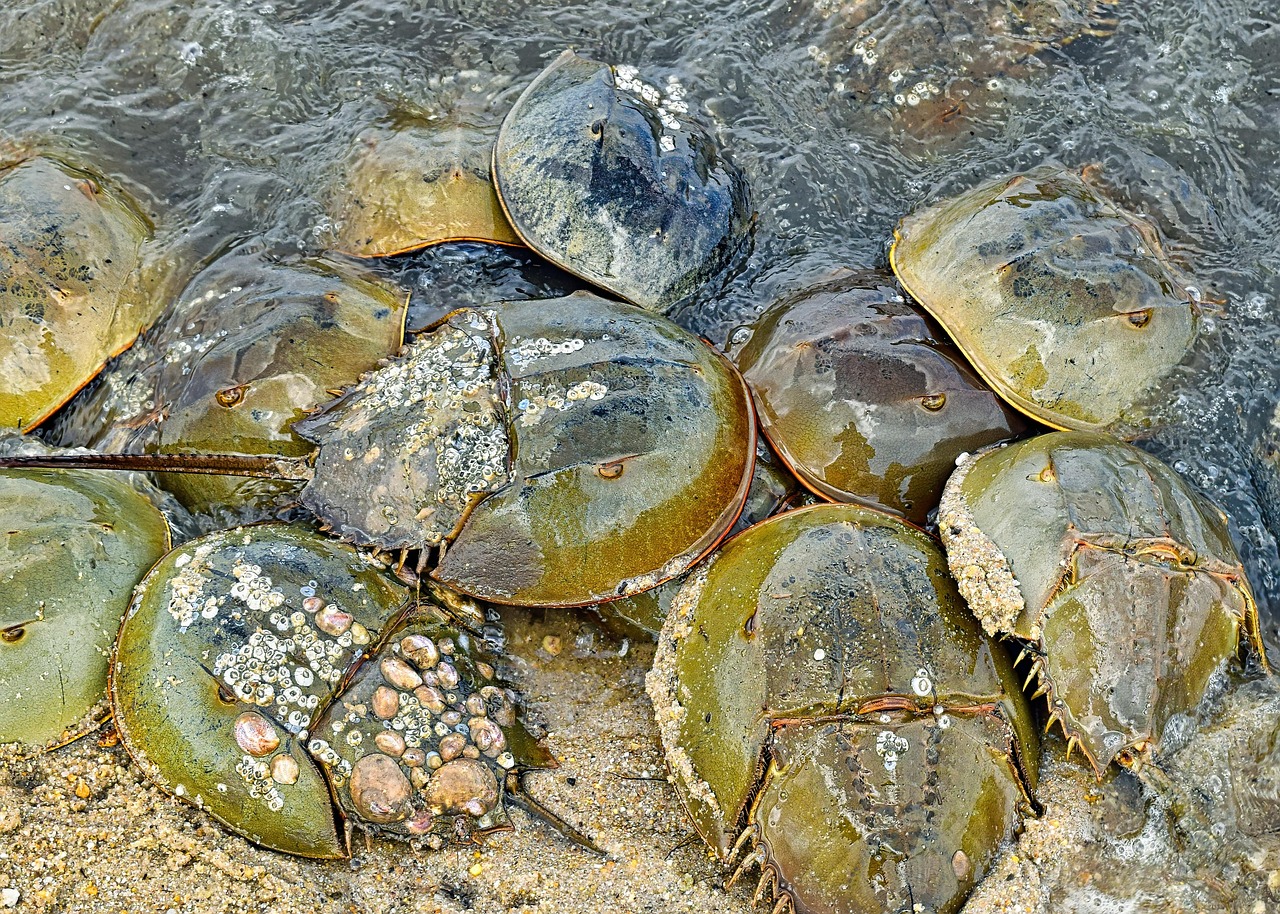
Vaccines are one of the most essential medical supplies in the world. They help humans prevent certain diseases, even the fatal ones. In fact, they have decreased roughly 40% of the child and infant mortality rates for over 50 years! [1]
But, have we ever wondered what we use to test vaccines in the labs? The creatures in the picture is the answer: horseshoe crabs!
What are horseshoe crabs?
Horseshoe crabs are arthropods of family Limulidae, and they are the only surviving members of Xiphosura. Horseshoe crabs aren’t crabs or crustaceans; they are chelicerates, related to arachnids (spiders, ticks, scorpions). Their body has three main parts: cephalothorax (house eyes, limbs, and organs); abdomen; and telson (tail spine) to balance, not to sting . The largest part is the cephalothorax, which looks like a horseshoe, giving them their name. [2]
Experts call them “living fossils” because they’ve been around and remained unchanged since the Triassic period (at least 445 million years), making them older than the dinosaurs! [2]
They live in brackish water, and are often found along the coasts of the western Atlantic Ocean in North America, and the Central Indo-Pacific in South and Southeast Asia. [2]
From “living fossils” to mankind’s heroes:
Horseshoe crabs has a special copper-based blood, called “blue blood“. It’s true to its name because their blood is indeed blue in colour. It is intriguing as we immediately think of red, which is not the case for horseshoe crabs. The “blue blood” contains a substance called LAL (Limulus Amebocyte Lysate). This specific substance is used to test vaccines, any other injectable drugs, and medical devices to make sure these medical supplies don’t have any dangerous bacterial toxins called “endotoxins“, which are hazardous to human body by causing reactions such as high fever, chills, low blood pressure, organ failure, an septic shock, etc [3] . Their blood are used for further biomedical researches beyond LAL like cancer research, diagnosing leukemia, and other medical diagnostics [4]. However, it is estimated that around 15% of horseshoe crabs die after the blood being drawn, even though most of them survive [5].
What’s more, the biomaterials from the shell is useful, too. Their shell is made of chitin, a biopolymer. It can be used to manufacture contact lenses, sutures, and wound dressings, especially for burn patients which improve the healing time by 35% to 50% [5].
Conclusion:
Horseshoe crab’s contribution to our mankind is undoubtedly significant. Remember that in every dose of vaccines and injections we’ve had, there is blood and unseen sacrifices of this sea creature. Therefore, we should take action to protect horseshoe crabs and their habitats to ensure that this spectacular marine animals to continue exist on this beautiful Earth.