

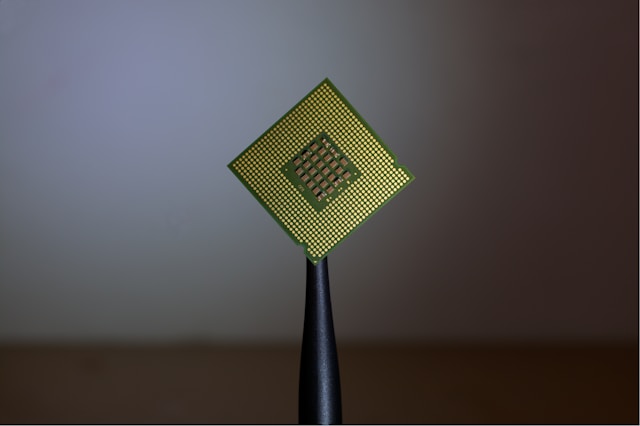
A microchip shape our modern world!
Intro
Every time you unlock your phone or stream a video, a computer chip (as known as Microchip) — smaller than your fingernail — sends millions of signals per second back and forth. Without it, our digital lives simply wouldn’t exist. Why? As all electrical device are more likely to have them. Something big like your vehicle or base stations which is something handle your data. To something detail like genomics, ai, and your phone! Smart consumer tech, data- and telecommunication, home automation, automotive, healthcare, robotics, and more and more! Microchip exist everywhere!
What is microchips
To begin with, what is it actually? There is no way computer chip is just a flat little square metal! So when we talk about a computer chip, we are actually referring to a tiny electronic computer built on a small piece of silicon. Right, the semi-metal we’ve learned in school. And in other word, silicon is a semiconductor, which this property allows it to control the flow of electricity- to switch the circuits on and off.
Of course, a chip isn’t just one simple piece. If you’ve ever read technology news, you’ve probably heard about the development of “2-nanometer” or “3-nanometer” chips, and one nanometer is one billionth of a meter, which is tens of times smaller than a human red blood cell.
At this nanoscale, engineers use advanced techniques to add patterns* on the silicon surface. These tiny structures form the pathways through which electric currents travel, giving the chip its unique abilities. So that means the more patterns or transistors on a chip can fit, the more powerful and capable it becomes!
That’s why companies and researchers are racing to create chips with smaller and smaller nanometer sizes, so that they could have more functions on it and turn our technology becomes faster and more efficient.
————————————————————————————
*: During the production process, manufacturers coat silicon wafer with a radiation-sensitive material, forming a very fine coating called “resist.” When a beam of radiation hits the resist, it triggers a chemical reaction that carves out details such as patterns and circuits on the wafer.
Sources:
https://www.asml.com/en/technology/all-about-microchips/microchip-basics
https://scitechdaily.com/johns-hopkins-unlocks-new-chemistry-for-faster-smaller-microchips/