

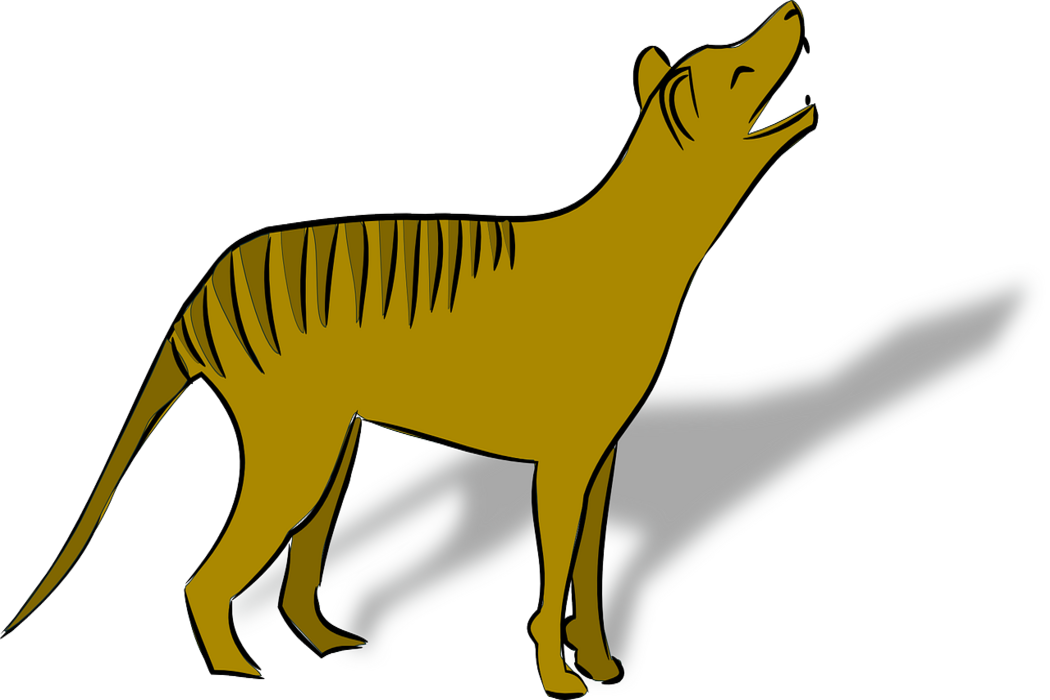
Discovering the Tasmanian tiger
It’s the 18th century. After a long journey, you and your fellow European settlers finally disembark onto a brand-new, elusive, yet exciting island. After exploring the land and taking in everything this new alien land has to offer, you hear a rustling in the bushes behind you. Slowly, you turn around, and a shadowy, swift figure emerges. It’s a tiger-no, a wolf? This yellow-brown dog, decorated with dark black tiger-like stripes, roars at you. You freeze in awe, and name it the Tasmanian Tiger.
Ground breaking tantalizing discoveries in genetic work have led to optimism in de-extinction efforts. Recently, scientists are working to bring extinctic animals such as the woolly mammoth, quagga, and Tasmanian tiger back to life. And no, this idea isn’t some kind of Jurassic Park-style fiction about bringing extinct animals back from the dead. There is actual scientific evidence supporting the possibility of reviving these historic creatures. In this blog I will be exploring everything about the Tasmanian tiger and whether or not scientists can truly bring this animal back from the dead.
What’s a Tasmanian Tiger?
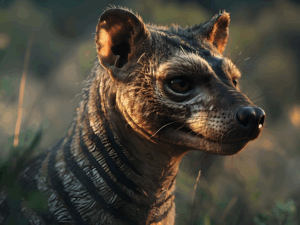
The Tasmanian tiger, or thylacine, was an extinct carnivorous marsupial native to Tasmania, Australia, and New Guinea. It was typically found in biomes such as forests, grasslands, and woodlands. Due to its hunting nature, it was particularly drawn to areas with dense vegetation and open plains. Its appearance resembles that of a large dog with tiger stripes, possessing both dog-like and cat-like features. It is the only animal known to showcase a combination of cat and dog traits, leading to a “cat-dog hybrid” comparison.
Videos of thylacine actually exists!
The Tasmanian tiger was one of very few animals that went extinct before 1940 to have been captured on video. This is an extremely impressive accomplishment, as the thylacine was already on the brink of extinction, and video capturing technology was still relatively new. It is thanks to videos like the one above that we were able to confirm the Tasmanian tiger actually existed and gain a much deeper understanding of its anatomy and behavior. This video is an amazing record of a species lost to time and a reminder of just how important species preservation is before it’s too late. Due to footage like this, people are even more optimistic that scientist could, maybe one day, bring this amazing creature back to life.
The Extinction of Thylacine
Extinction of the Tasmanian tiger was primarily due to the rise of humans, combined with the harshness of Mother Nature. Everything just went horribly for these creatures. Overhunting, habitat loss, competition, and disease all contributed to their fall. Once European settlers found their way to Tasmania, they started overhunting them. In some cases, there were even bounties placed on the thylacine’s head. Humanity blamed the thylacine for killing sheep, and the Tasmanian government would place bounties on them. With a bounty, there was very high motivation to hunt them. The rise of farming and industrialization led to lots of habitat destruction. The introduction of humans also led to the introduction of domestic dogs and invasive species directly competing with the thylacine for resources. To add insult to injury, there was evidence that a lot of thylacines were being infected with disease that rapidly spread across the population. All those factors caused a rapid population decline. The last wild thylacine was killed in 1930, and the last captive thylacine died in 1936, with it officially being labeled extinct in 1982. Unfortunately, at the time, there was no global outrage over their extinction. Conservation wasn’t really mainstream, as humanity was very different back then. The last captive thylacine’s death went practically unnoticed. It died due to circumstances that could’ve been prevented, as they were entirely due to human error. Zoos back then had much lower standards regarding the animals’ enrichment or welfare. Nowadays, something like that would never happen, and zoos take conservation and animal welfare seriously. While yes, it went extinct, it’s important we learn from this, as the global and environmental impacts could have been serious, and issues like these still remain in today’s world.
Potential Impacts on The Ecosystem
Since the thylacine went extinct so long ago, us, as humans, weren’t able to properly or fully document the impacts on the ecosystem that the Tasmanian tiger left behind after its extinction. However, based on basic ecology principals, we’re able to theorize many of the lasting impacts that the extinction of the Tasmanian tiger could’ve caused. The thylacine was a tertiary consumer found on the fourth topic level of the ecological pyramid. This classification identifies the thylacine as an apex predator, further evident by its diet, which included small mammals and birds such as black ducks, swamphens, or Tasmanian native hens. Seeing how the thylacine was one of the few predators of these animals, there’s an incredible likelihood that its extinction meant that these species no longer faced natural predation. The extinction of an apex predator in almost all cases directly results into triggering a trophic cascade. With no top predators dictating all the smaller animals, an imbalance of populations amongst the food chain is created. This eventually leads to an effect known as mesopredator release. Essentially, since there is no apex predators, medium sized predators receive a monumental spike in population, which in turn causes a decrease in even smaller animal populations due to the greater food demands of those medium sized predators. Overall an apex predator going extinct such as the thylacine is never a good thing for the ecosystem.
How will scientists bring back the thylacine?
Colossal Biosciences and the University of Melbourne’s Thylacine Integrated Genomic Restoration Lab currently have plans to bring the thylacine back from the dead. A few things to preface before I explain the details: the thylacine they’re creating will not be 100% accurate to the one that went extinct, as this animal has been dead for years, so there is a lot of guesswork. There is also potential for behavioral differences from the original thylacine, as one’s genes don’t necessarily determine their behavior. Besides that, their goals are to pretty much make their own version of a thylacine. The main method is de-extinction, where modern tools will be used to recreate the thylacine’s genome by looking at its closest relatives. Scientists have currently sequenced all of the thylacine’s genome from preserved thylacine specimens, and the closest relative has been identified as the numbat. The plans are to use the numbat as a genetic template, and potentially a surrogate. Using a process known as CRISPR, the goal will be to edit the genome of the numbat to match the DNA of a thylacine. Piece by piece, they will try to reconstruct a functional thylacine genome. Once the genes have been edited and an embryo is created, it will be planted into a surrogate such as the numbat that will carry and give birth to the thylacine. This will be a bit tricky, as marsupials are typically born extremely early, making the artificial womb process more complex. They’re shockingly far along with this process, as they’ve almost completely rebuilt the thylacine genome, with over 300 gene edits made. They expect to finish within 8–10 years, with a high likelihood of it being actually feasible, with most technology barriers passed. Other de-extinction efforts are more far along, such as the dire wolf, woolly mammoth, and northern white rhino, all showing great progress. With all of these de-extinction efforts, a huge morality debate has come along with it.
Should humans bring thylacines back?
The resurrection of any extinct animal raises many morality questions. Should humanity just let them rest peacefully, or should we try to redeem our ecology failures as a humanity? There is a wide range of both pros and cons when discussing if a dead animal should be brought back. On one hand, this is an amazing opportunity for scientific advancement, biodiversity restoration, conservation awareness, and a form of redemption. On the other hand, there’s ecological uncertainty, ethical concerns, fewer resources for other endangered animals, and behavioral inaccuracies. Learning how to bring back an extinct animal will push the limits on what we know about genetics and reproductive technologies, potentially allowing breakthroughs in medicine and further protection against extinction. The previously damaged ecosystem could potentially be repaired with the reintroduction of certain animals. Getting to witness de-extinction efforts will generate a huge public interest in all things conservation. However, we don’t necessarily know how these new animals will interact with the environment. Many things must be questioned, such as where to even put the animal, how the ecosystem will react, and whether or not this could cause any disruptions. It’s also speculated whether it’s even moral to create something in a lab, highlighting the trauma we may be giving to the creation, as well as any other animals involved in the process. Putting all this effort into something niche will take resources away from current ecology issues. Finally, the animal created may not even have the same behavior, essentially introducing an animal that otherwise wouldn’t exist. This entire topic could have huge consequences, where most experts agree it should be used to complement conservation and not try to act as a substitute.
TL;DR
The Tasmanian Tiger was once a marsupial native to Tasmania that ended up going extinct due to the rise of humanity. Videos of it still exist, giving us great insight on it. Scientists are currently trying to bring it back using CRISPR, and they have currently made quite some progress. This topic in general raises some serious questions about ethics, but with great hope for science.